
Add ₹999 more to unlock FREE SHIPPING!
Your sacred cart is currently empty.
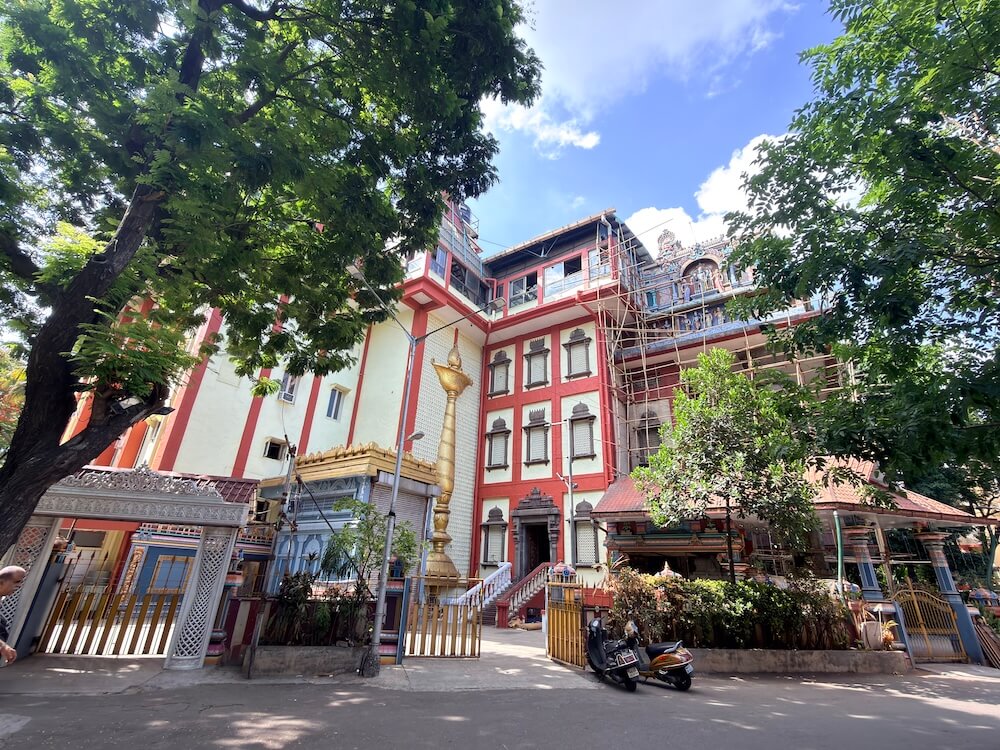
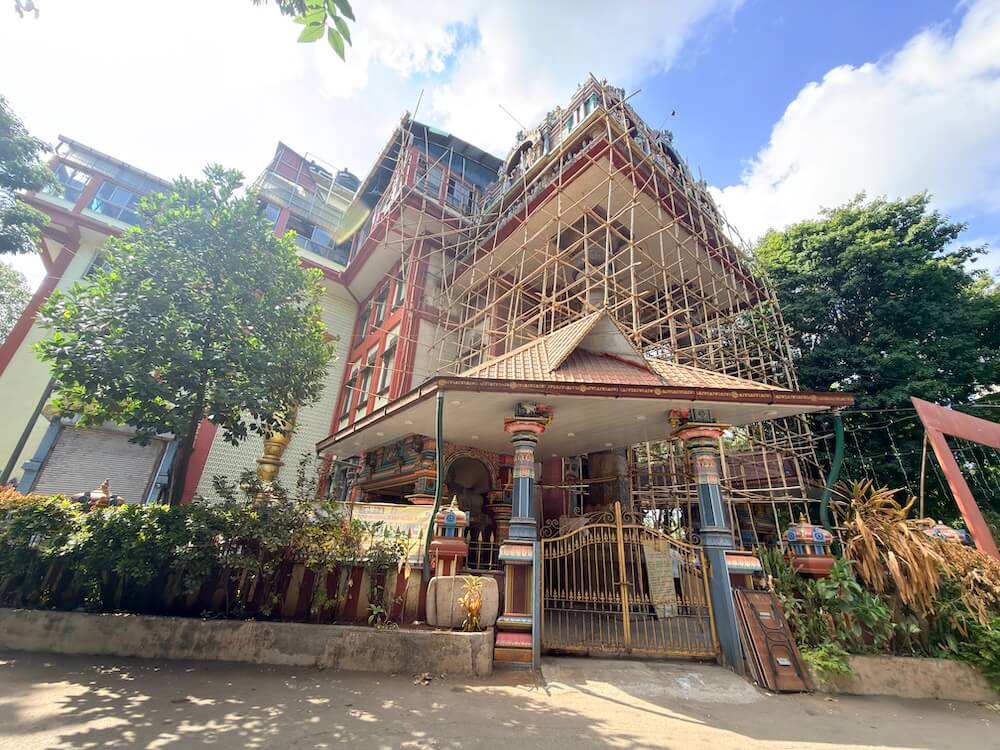
Shop Photo FramesIn the Tamil language, ‘Thiru’ means sacred or auspicious. Thiruchembur therefore means sacred Chembur. Situated on the Salsette islands, the Chembur area was once picturesque and covered with hills. Considering this area sacred, the organization ‘Sri Subramanya Samaj’ built a temple here in the eighties for their presiding deity, Murugan (Kartikeya). Built in the Dravidian architectural style, this temple is a major place of worship for Tamil and other South Indian devotees in Mumbai. A unique feature of this temple structure is that the main sanctum sanctorum is located at the top of this multi-storied building. Every year, there is a massive crowd here for the Thai Poosam festival.
This deity, worshipped primarily as Murugan in South India, is also known by the names Skanda, Kumara, Shadanana, Shanmukha, Angara, Senani, Devasenapati, Agnibhu, Dwadashakara, Guha, Ganga-putra, Mahasena, Shaktidhara, Siddhasena, and Vishakha. His mythological identity is that of the son of Shiva and Parvati, the commander of the divine army, and the valiant god who destroyed Tarakasura. There is no explicit mention of Kartikeya in early Vedic literature. However, mentions of Kumara or Skanda are found in texts from the later Vedic period, between 800 and 300 BCE, such as the ‘Atharvaveda’, ‘Shatapatha Brahmana’, and ‘Chandogya Upanishad’. During this period, he was considered a deity associated with war. In South India, however, he was regarded as the god of knowledge. Various mythological stories of Kartikeya are told in the ‘Mahabharata’ as well as the ‘Ramayana’. Stories of him becoming the commander of the gods and slaying the demons Tarakasura and Surapadman are found in the ‘Padma Purana’, ‘Matsya Purana’, and other Puranas, as well as in the ‘Mahabharata’. Some stories describe him as a celibate, while others mention his wives Devasena and Valli, and his sons Shakha, Vishakha, and Naigameya.
Since Kartikeya is a deity associated with war, many royal dynasties seem to have considered him their family deity. In the second and first centuries BCE, the Yaudheya republic existed in the region between the Sutlej and Yamuna rivers (present-day Ludhiana, Ambala, Karnal, Rohtak, and Hisar). Kartikeya was their tutelary deity. The six-faced Kartikeya was depicted on their coins. Between the first and third centuries CE, he was also depicted on the coins of the Kushan Empire under the name ‘Skando-Kumaro’. In particular, Emperor Kumaragupta I (c. 415–455 CE) highlighted his connection with this deity through his very name. Images of Kartikeya with a peacock are found on his coins. There is evidence that independent temples of Kartikeya were built during the Gupta period. After the Gupta period, the independent worship of Kartikeya in North India declined, and the construction of his independent temples became rare. During this same period, however, the worship of Kartikeya began in earnest in South India. Based on the Sangam-era literature of the Tamil tradition, the deity Murugan appears to have been extremely popular during the period from approximately 300 BCE to 300 CE. A detailed description of Murugan is found in the Sangam-era poem ‘Thirumurugaatruppadai’. According to many modern historians of religion, Murugan was originally a local deity of the Tamil region. Later, he was integrated with the Vedic-Puranic Skanda and developed into the composite form of the present-day Kartikeya or Subramanya. Between 850 and 1279 CE, the Chola kings gave great royal patronage to the worship of Murugan. Subsequently, the Pandya and Vijayanagara regimes further enriched this tradition. The six major temples of Murugan in Tamil Nadu, known as ‘Arupadaiveedu’, remain places of worship for millions of devotees today. These temples are the Palani Murugan Temple (Dindigul District), Thiruchendur Subramanya Swamy Temple (Thoothukudi), Thiruparankundram Murugan Temple (Madurai), Swamimalai Swaminatha Swamy Temple (Kumbakonam), Thiruttani Murugan Temple (Thiruvallur), and Pazhamudhircholai Murugan Temple (Madurai). In South India, Murugan is worshipped not merely as the son of Shiva, but as an independent deity, protector, and bestower of knowledge.
The history of the Thiruchembur Murugan Temple in Chembur and the Subramanya Samaj that manages this shrine begins in the mid-twentieth century. In the 1940s, many Tamil-speaking citizens who had come to Mumbai for employment settled in the Matunga area. At that time, Matunga was known as the ‘Mini Madras’ of Mumbai. These migrant citizens decided to come together to preserve their religious and cultural roots. Initially, Tamil devotees would gather at the residence of T. V. Lakshmanan, who was popular by the name ‘Vimco Lakshman’ in Matunga, to perform various religious programs. This led to the founding of the Subramanya Samaj. The organization was officially registered in April 1945. At that time, the organization did not have its own premises. Therefore, the spaces of ‘Sri Shankar Matham’ and ‘South Indian Bhajan Samaj’ in Matunga were used to celebrate festivals and events such as ‘Skanda Sashti’, ‘Thai Poosam’, and ‘Panguni Uthiram’.
Later, the organization identified three contiguous plots in Chedda Nagar, Chembur, for the construction of the temple. At that time, a special piece of information emerged through ‘Ashtamangala Prashnam’ (a special technical ritual for seeking divine guidance). In ancient times, this area of Chedda Nagar was a dense forest. Many sages had performed penance here. Therefore, this place was considered sacred for the Murugan temple. The epithet ‘Thiruchembur’ for the temple originated from this.
In September 1972, the foundation stone laying ceremony for this temple was performed under the guidance of the 68th Acharya of the Kanchi Kamakoti Peetham, Jagadguru Shankaracharya Sri Chandrasekarendra Saraswathi Swamigal. The ‘Pancha Shilanyasam’ (five-fold foundation stone laying ceremony) of the temple was performed by distinguished dignitaries, including the then Chairman of the Maharashtra Legislative Council, V. S. Page; former Sheriff of Mumbai, Prof. T. V. Ramanujam; Tamil scholar Ki. Va. Jagannathan; profound scholar of the ‘Shrimad Bhagavata’, Anjam Madhavan Nambudiri; and the Director of ‘Bharatiya Vidya Bhavan’, S. Ramakrishnan. In accordance with the rules of the Agama Shastras, a ‘Balalayam’ (a temporary small temple) was erected here before the main temple. The idols of Lord Murugan, Lord Vinayaka, and Ayyappa were consecrated in this Balalayam on 5 February 1973. The construction of this temple offers a unique vision of national integration. Architect C. S. K. Raj planned the temple’s architecture. While the Christian architect C. S. K. Raj designed the temple, the Bohra Muslim architect Abbas Jusdanwalla performed the technical work of integrating this design with the ancient temple art of Tamil Nadu. A distinctive feature of this temple structure is that it is multi-storied. One enters the sanctum sanctorum of the temple by climbing a flight of 108 steps. This sanctum sanctorum is located on the terrace of the temple. The Agama Shastras strictly mandate that a temple’s sanctum sanctorum must be directly connected to the ground. To adhere to this, massive concrete pillars in the shape of wells were erected from the ground up to the top of the building, and the foundation of the sanctum sanctorum was laid upon them. The first Maha Kumbhabhishekam ceremony of this newly constructed temple took place on 24 January 1980. Subsequently, the second was held on 12 December 1991, and the third on 27 March 2000. The most recent and fourth Maha Kumbhabhishekam was performed on 6 April 2022, under the leadership of the Temple Festival Committee chaired by the then Chairman of Tata Sons, N. Chandrasekaran.
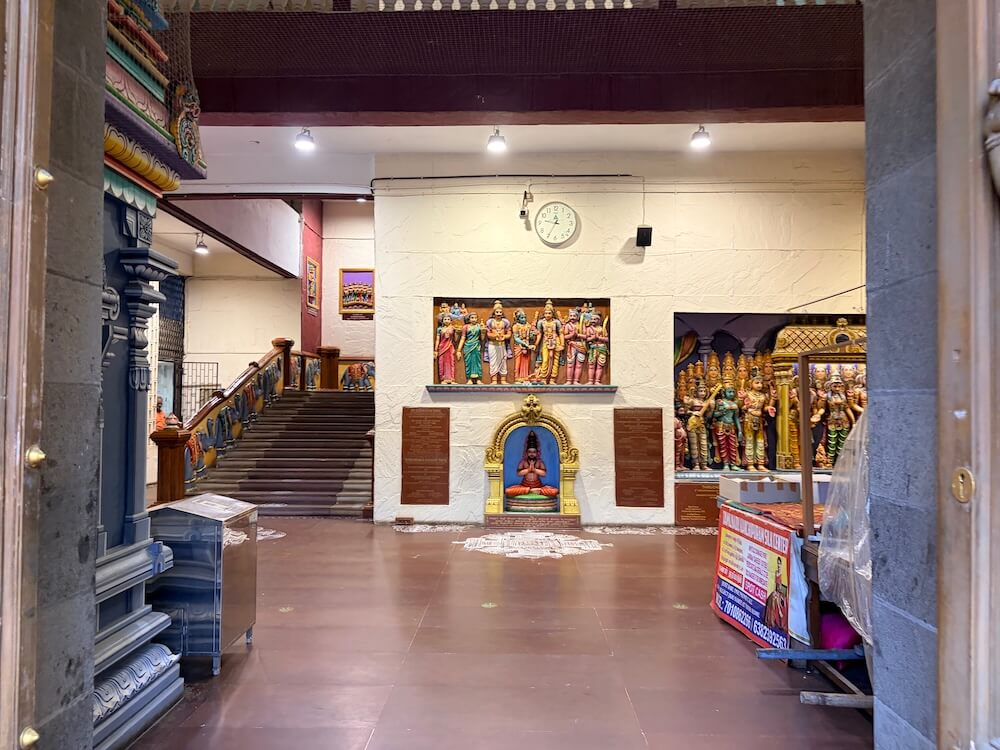
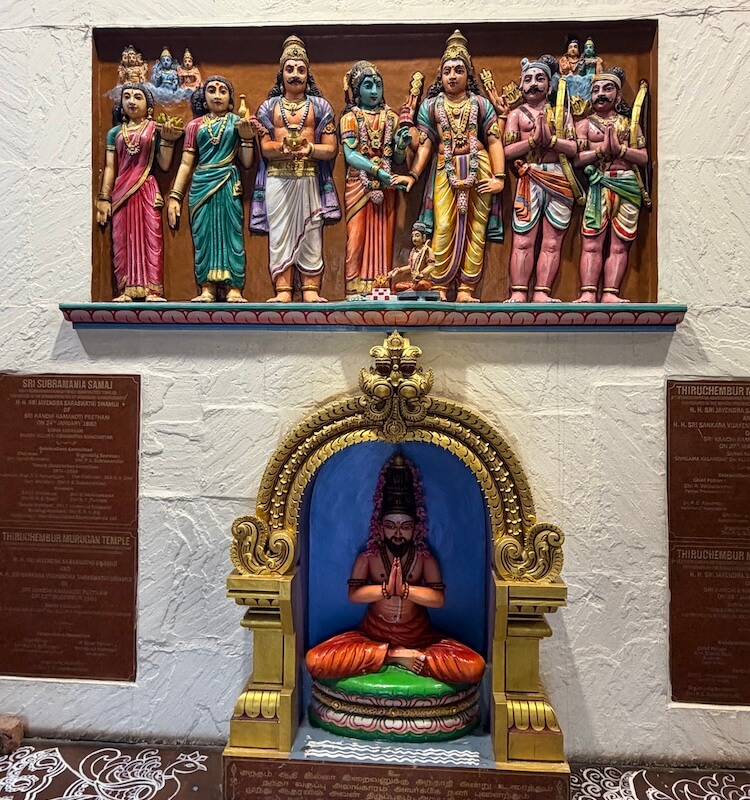
This temple is four stories high and magnificent in nature. Dravidian architectural style has been extensively used in its construction. The temple features a tall Rajagopuram. On it, colorful sculptures of deities, sages, Yakshas, Gandharvas, and mythological episodes are depicted in various tiers. The temple courtyard has a high entrance gate. One enters the ground floor of the temple through a high porch with a sloping roof. It has a tall stone entrance gate. On the front wall of this ground floor, in a carved niche at the lower level, is the idol of the Shaiva saint of Tamil Nadu, Arunagirinathar. He lived during the 14th century. His poetic work, ‘Thiruppugazh’, which praises Lord Murugan, is famous.
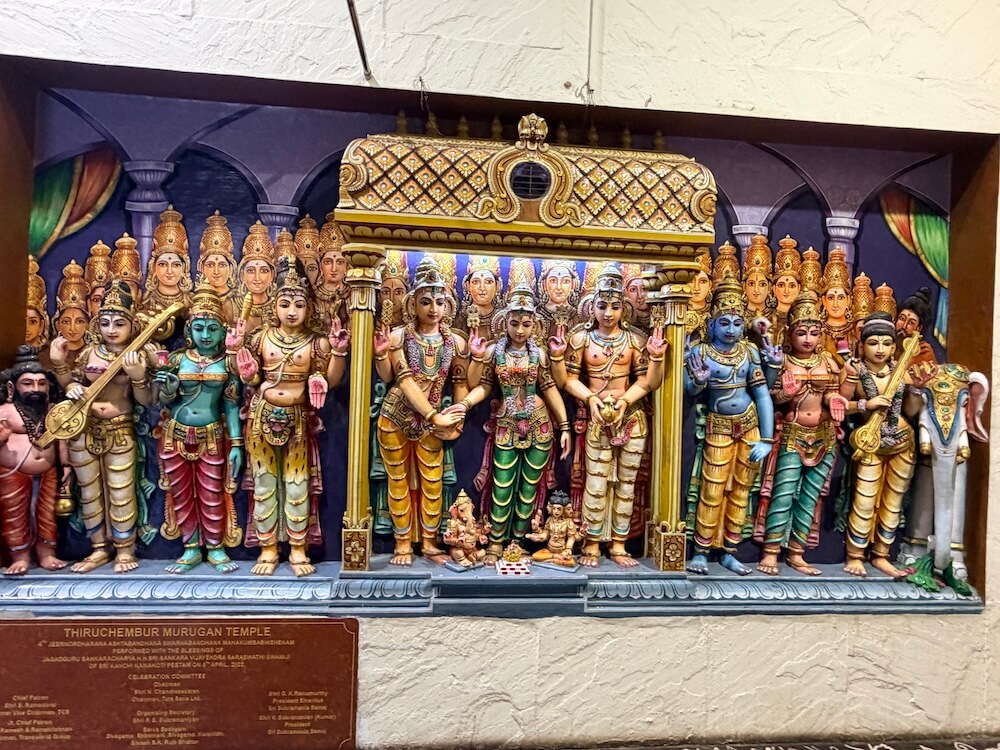
Above this is a large sculptural panel. It depicts the wedding ceremony (Panigrahanam) of Lord Murugan and Mother Valli. According to mythology, Valli was the daughter of Nambirajan, a king of a wild tribe in South India. In this panel, Murugan stands on the left as the bridegroom, and Valli stands as the bride. Following the tradition of Southern sculpture, Valli’s idol is depicted here in a green hue. Additionally, this panel features sculptures of King Nambirajan, Valli’s brothers, her companions, and the priest performing the wedding fire ritual. Higher up, there are also sculptures of Shiva-Parvati, Brahma, Vishnu, and Lakshmi. Next to this is another grand sculptural panel. It depicts the wedding ceremony of Murugan and Mother Devasena (‘Devasena Kalyanam’). In the center, within the wedding pavilion, Murugan is accepting the hand of Devasena. To her right, her father, Devraj Indra, is performing the ‘Kanyadan’ ritual while holding a golden vessel. On one side of the pavilion are Murugan’s parents, Shiva and Parvati. Beside them are Saraswati and Narada in the guise of a sage. On the other side, Vishnu and Lakshmi are standing. In the far right corner is Airavata, the elephant vehicle of Indra. At the base of the pavilion, Brahma, who is officiating the wedding, and Murugan’s elder brother, Ganesha, are seated. According to the mythology in the Skanda Purana, the extremely powerful demons Tarakasura and Surapadman attacked the celestial realm and drove the gods away. Murugan then accepted the command of the gods’ army and completely annihilated the demons. He restored Indra’s throne to him. In gratitude, Devraj Indra gave his daughter ‘Devasena’ in marriage to Murugan. Legend has it that this divine wedding ceremony took place in the Vedic tradition in the hilly region of Thiruparankundram in Tamil Nadu.
In this hall, grand images and brass idols of Murugan, Devasena, and Valli are enshrined. From this ground-floor hall, there is a staircase leading to the main temple. The marble steps of this staircase are decorated with various types of Rangoli. The railings of the staircase feature a ‘Gajarang’ (elephant motif). Additionally, colorful embossed sculptures of various forms of Lord Murugan, the ‘Shat Karthikakanya’, Shiva-Parvati, ‘Navaveera’, and ‘Gajamukhasura’ are placed on the walls in various places. After climbing these 108 steps, one enters the main courtyard of the temple at the top of the building.
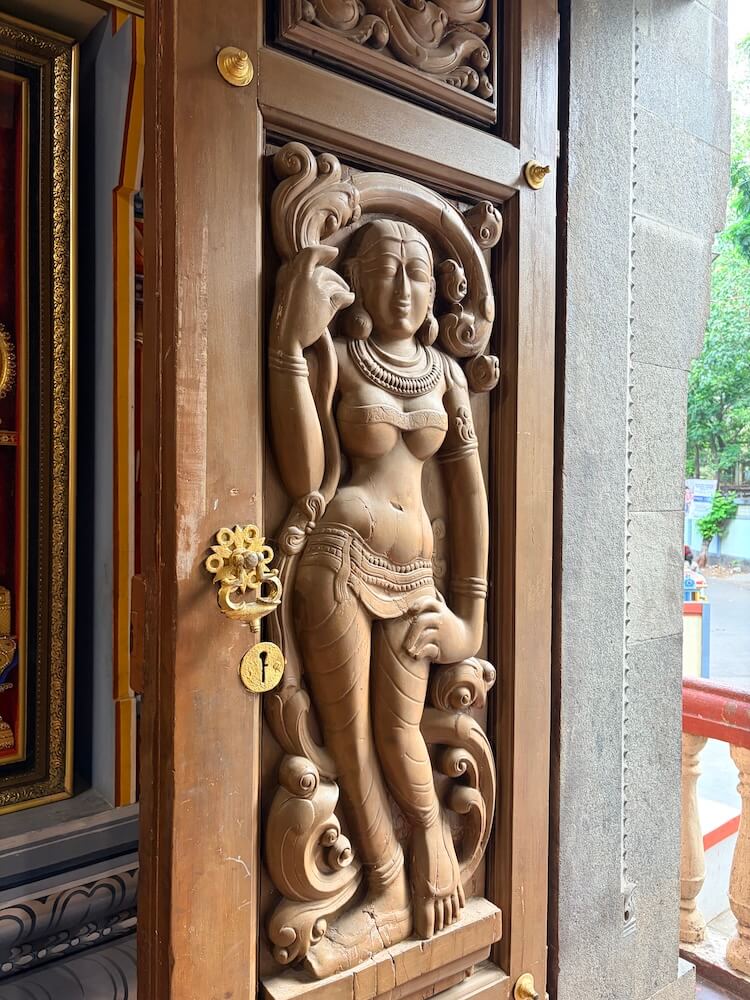
This courtyard has a grand stone entrance. On the stone platform next to the carved pillars, there are idols of Dwarapalas (gatekeepers) in Nataraja posture. An image of Gajalakshmi is carved on the lintel of the entrance frame. The entrance has a sturdy, traditional rosewood door. There is a Gopuram above the entrance. As soon as one enters, there is a tall, shining brass flagstaff (Dhvajastambha) in front. In the spacious assembly hall (Sabha Mandapa) directly ahead, the main sanctum sanctorum of the temple is situated. In front of it are metal sculptures of the peacock and the rooster, the vehicles of the deity. This sanctum sanctorum and the other shrines here are built of granite stone. The stone for this was specially brought from Mahabalipuram. This standing idol is two-armed. In the right hand, the idol holds the gold-plated ‘Vel’ (spear) given by Parvati, while the left hand rests on the waist. The idol is adorned with a golden crown, precious necklaces, and silk garments in the Southern style. Behind the idol is an ornate silver arch (Makhar). Above it is a magnificent silver halo (Prabhavali). On this halo, peacock feathers and sun rays are carved. Along with the main shrine, separate shrines for Ganapati, Durga, Guruvayurappan, Dharmashasta (Ayyappa), Dakshinamurti, Anjaneya (Hanuman), Shiva, Nataraja, and the Navagrahas have been erected in this courtyard. The idols of Ashtalakshmi are in the niches of the assembly hall walls.
The daily schedule of this temple is conducted according to the rules of the Agamas of Tamil Nadu. Devotees can avail the benefit of Darshan in the temple from 5:30 in the morning to 12:00 in the afternoon and from 4:30 in the evening to 9:00 at night. The Ushakala Puja and Aarti take place here at 6:00 in the morning. Following this, the Kalashanti Puja is performed at 8:30 in the morning. The main afternoon Aarti, known as the Uchikala Puja, takes place at 11:30 in the morning. The evening Maha Aarti, known as the Sayaraksha Puja, is performed at 6:30 in the evening. At this time, a large crowd of devotees gathers in the temple for Darshan. The final ritual of the night, the Arthajama Puja, is performed at 8:30 at night.
Throughout the year, various festivals are celebrated in the temple in a traditional manner according to the Tithi. The largest annual festival here is ‘Thaipusam’. This festival falls on the day of the Pushya Nakshatra in the Tamil month of ‘Thai’, which corresponds to January-February. On this day, Goddess Parvati gave the Vel (spear) to Lord Murugan to defeat the demon. On the day of this festival, thousands of devotees from Mumbai and various parts of Maharashtra come here for Darshan after observing strict fasts, piercing their bodies with needles, and carrying the Kavadi on their shoulders. The second important festival here is ‘Skanda Shashti’. This festival continues for six consecutive days from the Pratipada to the Shashti of the Shukla Paksha in the month of Kartika. On the day of Shashti, the event of ‘Soorasamharam’ (the slaying of the demon Surapadman by Murugan) is presented in a theatrical form on the road outside the temple. On the Tithi of ‘Panguni Uthiram’ falling in the month of Chaitra, the wedding ceremony of Lord Murugan and Goddess Valli, known as ‘Kalyana Utsavam’, is celebrated with great grandeur. On the day of the ‘Karthigai Deepam’ festival in the month of Margashirsha, thousands of earthen lamps are lit on the entire temple and the Gopuram. Additionally, on the day of the Krittika Nakshatra that occurs every month, a special Annabhishekam (a ritual of applying cooked rice to the idol) and a Palkhi procession are organized in the temple. During the nine days of Navaratri, Chandi Homa is performed here.
This sacred temple stands as a testament to deep spiritual devotion, ancient architectural grandeur, and rich local cultural traditions.
The sanctum sanctorum houses the divine idol consecrated according to ancient Vedic traditions, surrounded by serene courtyards and traditional temple architecture.
Navratri, Maha Shivratri, Annual Temple Jatra & Deepotsav
Compare and book flights, secure top-rated local hotels near the temple, hire reliable guides, and rent cars instantly.
Extend your pilgrimage by visiting other highly sacred temples located nearby.


Add ₹999 more to unlock FREE SHIPPING!
Your sacred cart is currently empty.
Shop Photo FramesFill in your delivery details below to place your order.
Add comment