
Add ₹999 more to unlock FREE SHIPPING!
Your sacred cart is currently empty.
Shop Photo FramesSion, or ‘Sion’ as it is known, is the village that served as the gateway to the islands of Mumbai and Salsette. In this modern suburb of Mumbai stands a temple of Lord Shri Krishna, popularly known as ‘Gokul’. With its exquisite wood carvings, beautiful ancient-style sculpted idols, and a sanctum sanctorum (Garbhagriha) designed in the South Indian Sreekovil style, this temple has become a major attraction for countless devotees. The temple was established six decades ago by ‘The Bombay South Kanara Brahmins Association’. Today, it serves as an important cultural and social hub for the South Kanara Brahmin community in Mumbai.
Sion and the adjacent Matunga area have a large population of South Indians. Due to the industrial and economic development of Mumbai during the British colonial era, large waves of migrants from across the country arrived here, particularly at the beginning of the twentieth century. People of various castes, religions, and sects from many parts of the country settled here. Among them were English-educated individuals from the southern parts of Karnataka, specifically from Udupi and South Kanara. To fulfill their religious, cultural, and social needs, the Brahmin community established their organization here about 90 years ago. Dr. U. B. Narayan Rao was the founding president of this organization. The 1961-62 management committee of this organization included distinguished citizens such as Kudpi Bhujang Rao, Dr. Lalita Rao, and A. Venkat Rao.
The Bombay South Kanara Brahmins Association, popularly known as ‘Gokul’, resolved to build a grand temple for their presiding deity, Gopalakrishna. Donations were collected from K. Sitaram Rao of Chennai, the generous industrialist Seth Brijlal Rungta, Zhimidevi Shriram Jhunjhunwala, as well as the Ashta Mathas of Udupi (Adamaru, Pejawara, Kaniyuru, Sode, Puttige, Shiruru, Palimaru), the Dwarka Peeth, the Swami of Kashi Math, and other donors. Through these efforts, a grand temple of Gopalakrishna was finally built during the tenure of the 1961-62 management committee. The cost of the temple at that time exceeded two and a half lakh rupees. The stone idol of Gopalakrishna, donated by Narmada Mahavir Prasad Rungta, was consecrated here, and the temple was inaugurated on 12 March 1962 by the then Governor of Maharashtra, Shri Sri Prakasa. Over time, due to the growing religious, cultural, and social needs of the community, the need to expand the temple premises arose. Consequently, under the leadership of the organization’s president, Dr. Suresh Rao, the ‘Redevelopment Project, 2016-2022’ was planned. Under this project, the Bhumi Pujan was performed on 2 July 2017 by Shri Vidyadheesha Teertha Swamiji of Palimaru Math, Udupi, and Vidyaprasanna Teertha Swamiji of Kukke Subramanya Math. On 30 June 2019, the foundation stone of the temple was laid by Vishwesha Teertha Swamiji of Pejawara Math, Udupi.
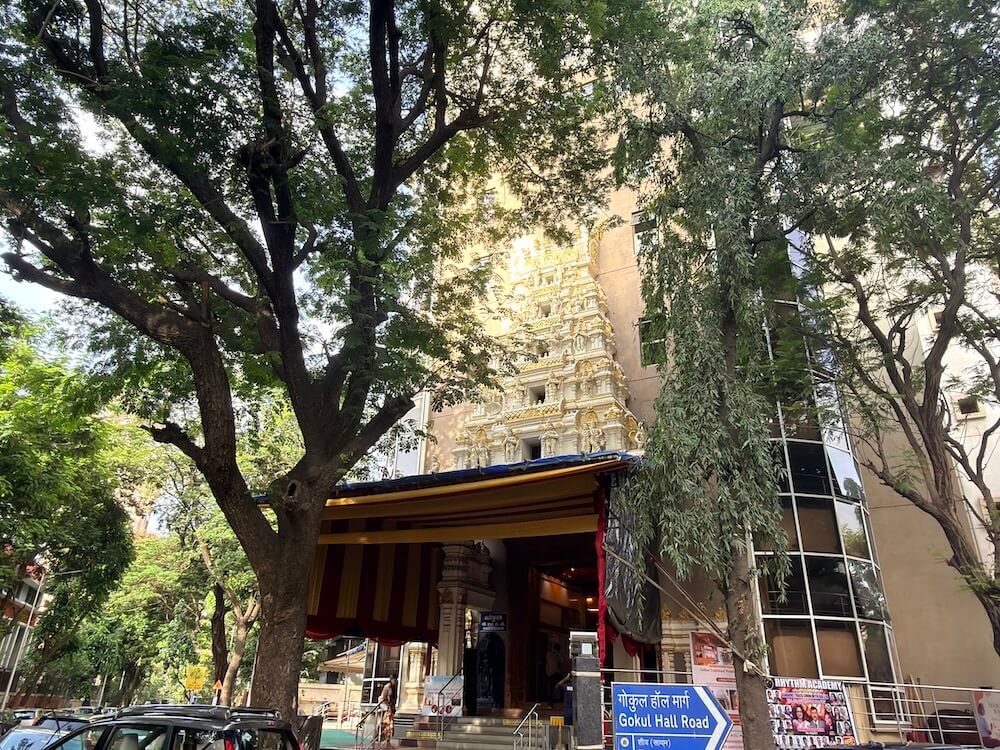
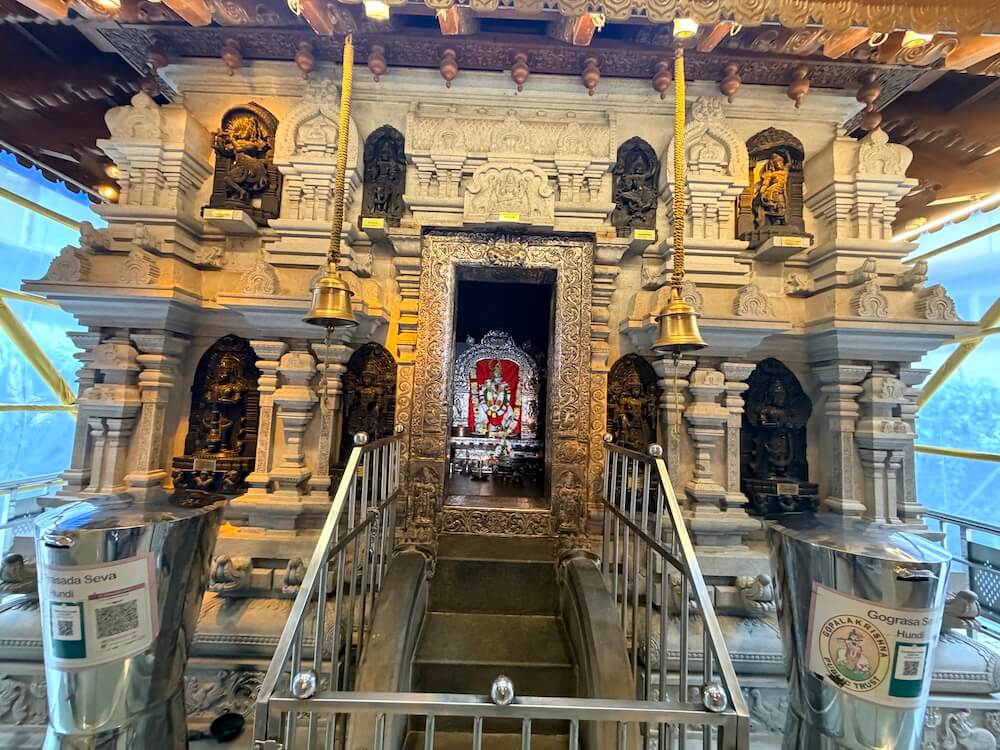
This grand multi-storied temple stands in a quiet area on the road known as Gokul Hall Road in Sion. The temple’s architecture reflects a confluence of Dravidian and coastal Karnataka styles. At the entrance of the temple, there is a small yet attractive seven-tiered South Indian style Gopuram. Each level features small ‘Kuta’ and ‘Shala’ type niches. The Gopuram is adorned with sculptures of various deities, including Radha-Krishna, Shiva, Garuda, and Hanuman. The temple structure consists of a Mukhamandapa (front hall), Sabhamandapa (main assembly hall), and the Garbhagriha (sanctum sanctorum). A unique feature of the Mukhamandapa is the two large idols of the Vaishnava gatekeepers, Jaya and Vijaya. Carved in black stone and representing an excellent example of South Indian sculpture, these idols are positioned on both sides of the entrance to the Sabhamandapa.
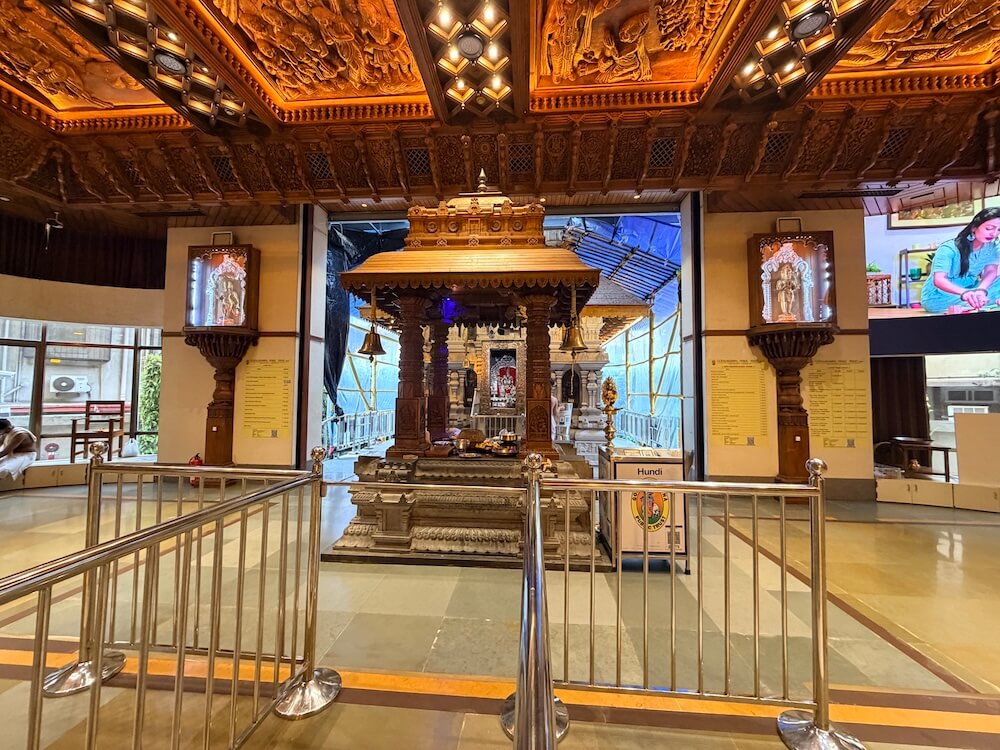
A remarkable feature of this temple is its wood carvings and intricate work, which bear a strong resemblance to the wood carving styles of the Hoysala and Vijayanagara empires. Temples in the Udupi and Mangaluru regions are famous for their wooden carvings, and that same heritage has been preserved in this temple. Wood has been extensively used in the door frames of the Sabhamandapa, its doors, the entrance passage, and the ceiling of the inner area. It is adorned with carvings and various types of sculptures. The carving on the domed ceiling and the borders of the Sabhamandapa is particularly noteworthy. It features the ‘Ashtadashadala’ (eighteen-petaled lotus), the Shri Chakra, diverse geometric patterns, as well as various leelas from the life of Shri Krishna and a series of the Dashavatara. The Sabhamandapa has grand pillars carved with creepers, lotus petals, Yaksha-Kinnaras, Gaja-Simhas (elephant-lions), and various Vaishnava symbols. Some pillars are topped with arch-like structures.
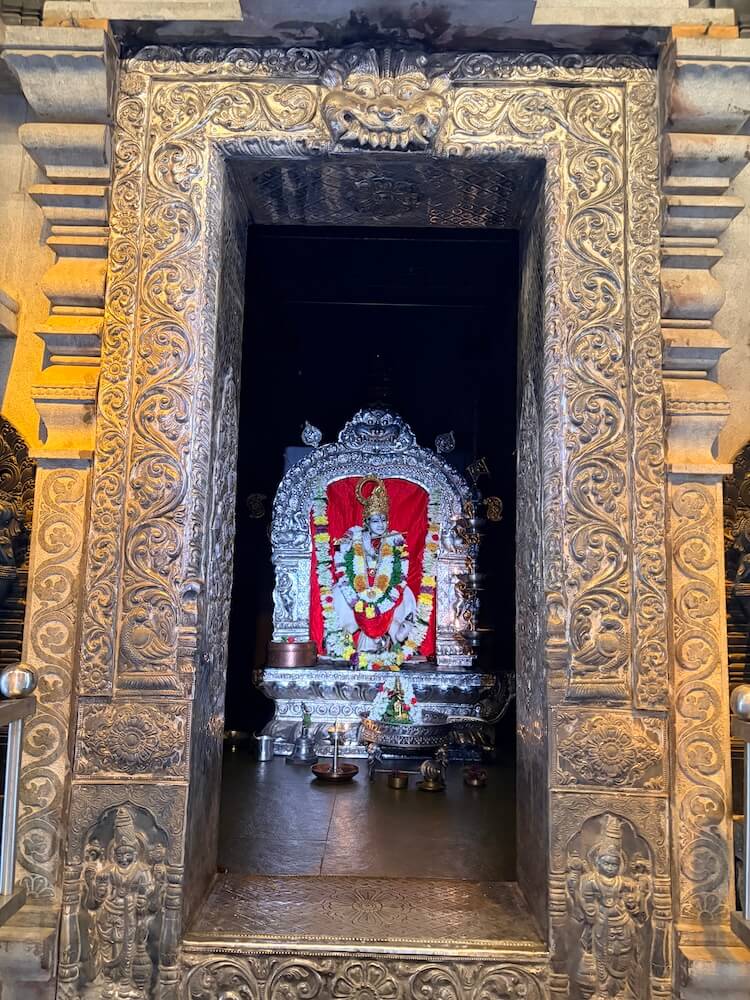
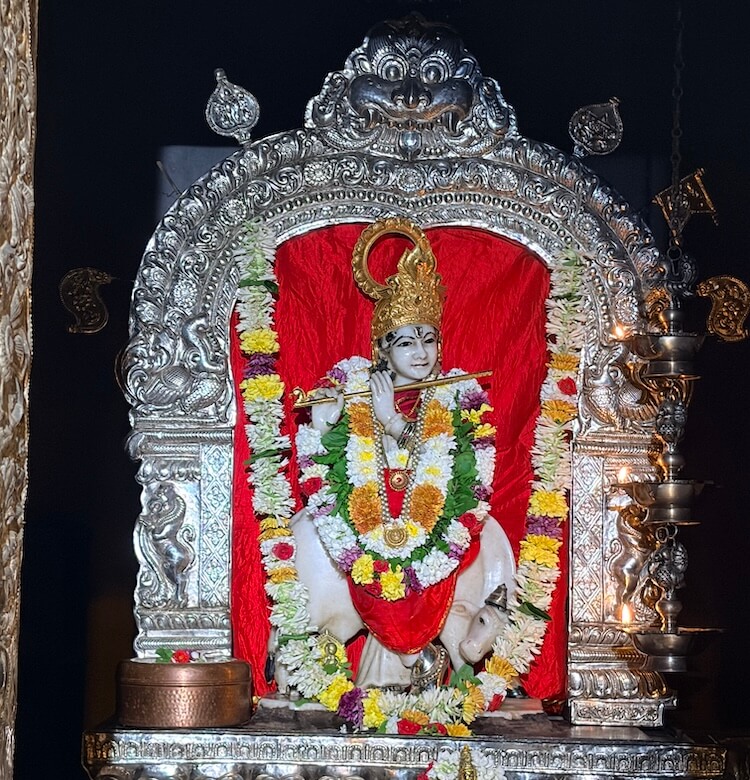
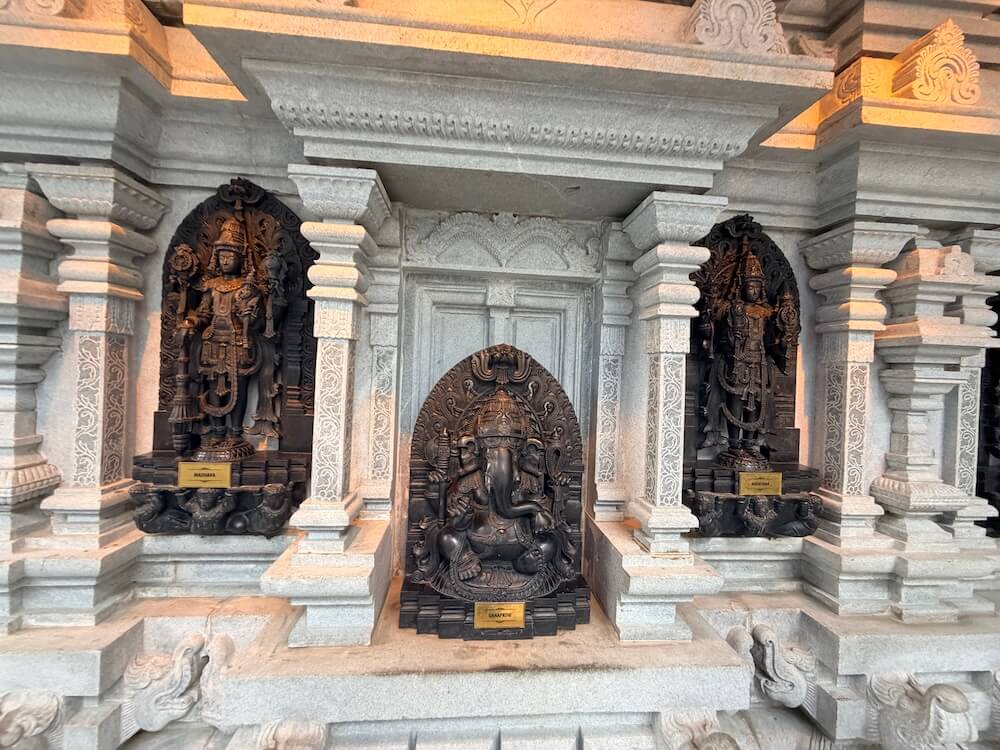
In the Sabhamandapa, in front of the Garbhagriha, there is a large umbrella-like structure. In the South Indian tradition, this is known as the Kanaka Mandapa or Brahmaratha Mandapa. A few steps away lies the temple’s Garbhagriha. This sanctum is built of a special type of marble. It features a sloping roof on all four sides and a Kalasha. The design of this Garbhagriha is similar to the South Indian Sreekovil. Its entrance is covered with ornate silver plating. On the lintel of the door frame, there is a Kirtimukha, while the lower part of the frame features carvings of gatekeepers. Above the door frame, there is a marble sculpture of Gajalakshmi. Inside, on a high pedestal, is a silver Makhar (shrine). This Makhar has a Makara-torana (arch). In the upper middle part of the arch is a Kirtimukha, while Vyala figures are carved on the pillars below the Makara-torana. The idol of Gopalakrishna is seated within this Makhar. Carved in marble, the idol is in the Tribhanga posture. The idol wears a golden crown on its head and holds a golden flute in its hands. A cow (Gomata) stands behind the Krishna idol. On the outer walls of the Garbhagriha, idols of various names of Lord Vishnu are placed in different niches. Similarly, one can also have the darshan of an idol of Lord Ganesha here.
Devotees can visit the temple for darshan daily from 7:00 AM to 1:00 PM and from 5:00 PM to 9:00 PM. Aarti is performed in the temple every day at 7:30 AM, 11:45 AM, and 7:30 PM. Following the Mangala Aarti, the rituals conclude with prayers, Uttara Puja, Rajopachara, Arghya, Padya, Shankha Tirtha Prokshana, Krishna Arpana, and the distribution of Prasada. Based on the prior registration of devotees, services such as Deeparadhana, Ashtottara Archana, Sahasranama Archana, Alankara Puja, Mahapuja, Udayasta Puja, and Ranga Puja are also performed here. Gokulashtami is a significant festival at this temple. The birth anniversary of Lord Sri Krishna is celebrated here with great enthusiasm in a traditional manner. It is said that for this occasion, the temple and the idol are decorated with flowers specially flown in from Bengaluru. The ‘Mosaru Kudike’ festival, celebrated on the day after Janmashtami, is a major center of attraction for devotees. This festival is similar to the ‘Govinda’ celebrations in Mumbai. It is celebrated here with various popular folk dances, in the same manner as it is observed in Udupi. There is a Tulsi Vrindavana in the temple courtyard. Tulsi Puja is performed here daily, and the ‘Tulsi Vivaha’ ceremony is celebrated with great grandeur during the month of Kartika. Additionally, festivals such as the temple’s foundation day, Mahashivaratri, Narasimha Jayanti, Madhva Navami, Shankara Jayanti, Purandara Dasa Aradhana, Raghavendra Swami Punyathithi, and Ram Navami are also celebrated with deep devotion. Similarly, popular public religious programs such as collective Satyanarayana Puja on Makar Sankranti, Saura Upakarma (collective Yajnopavita/sacred thread changing ceremony), Navaratri, and Deeparadhana are also organized.
This sacred temple stands as a testament to deep spiritual devotion, ancient architectural grandeur, and rich local cultural traditions.
The sanctum sanctorum houses the divine idol consecrated according to ancient Vedic traditions, surrounded by serene courtyards and traditional temple architecture.
Navratri, Maha Shivratri, Annual Temple Jatra & Deepotsav
Compare and book flights, secure top-rated local hotels near the temple, hire reliable guides, and rent cars instantly.
Extend your pilgrimage by visiting other highly sacred temples located nearby.


Add ₹999 more to unlock FREE SHIPPING!
Your sacred cart is currently empty.
Shop Photo FramesFill in your delivery details below to place your order.
Add comment