
Add ₹999 more to unlock FREE SHIPPING!
Your sacred cart is currently empty.
Shop Photo FramesAlong with the original inhabitants, many communities have made significant contributions to the development of Mumbai. The Telugu-speaking Arya Vysya (Komati) community is one of them. The temple of Kanyakaparameshwari Devi, the presiding deity (Kuladevata) of this community, which is at the forefront of trade and business, is located in Matunga. Also known as Vasavi Kanyakaparameshwari, this Goddess is the maiden and virgin form of Mother Parvati. She is a proponent of non-violence and an anti-war deity. A large number of devotees gather here on the occasion of the temple’s foundation day, which is a sacred place of worship for the Arya Vysya community, as well as on Vasavi Jayanti.
Due to the large population of South Indians, as well as the indelible mark of various temples built in the distinct South Indian architectural style and the culinary culture, the Matunga area was referred to as ‘Mini Madras’. The history and etymology of Matunga are said to be that King Bimbadeva, also known as Bhimadeva Yadav, the fourth son of Ramdevrao Yadav of Devgiri, established his capital at Mahim, i.e., Mahikavati, in 1295 AD. This king had a large elephant stable in the Matunga area. In Sanskrit, an elephant is also called ‘Matanga’. From this, the area came to be known as ‘Matangalaya’, and it is believed that the name ‘Matunga’ was derived from the corruption of the words ‘Matanga’ and ‘Matunga’. According to some, there was a settlement of the Matanga community for the maintenance of elephants during the time of King Bimba, which is why this area may have been named Matunga. According to mythological legend, Sage Matanga resided in this area, and the name Matunga originated from him.
The development of Mumbai began after the seven islands of Mumbai were transferred from the Portuguese to the British. The creeks here were reclaimed, and new colonies were established in the space created. The development of Mumbai gained momentum after the railway started here in 1853 and after the great plague epidemic of 1897. Along with the original inhabitants like the Koli and Bhandari communities, the Parsis, Gujaratis, Marwaris, Tamils, and the Telugu-speaking Komati community from Andhra Pradesh also played a part in this. Not only that, but along with the freedom movement, the Telugu speakers also had a significant contribution to Mahatma Phule’s Satyashodhak movement. At the behest of Mahatma Phule, Swami Ramayya Venkayya Ayyawaru established a branch of the Satyashodhak Samaj in Kamathipura, Mumbai. According to ‘Castes and Tribes of Southern India, Volume 3’, the Komati people are originally from the banks of the Godavari River. Godavari also has a name in Sanskrit, ‘Gomati’. From this, these people came to be called ‘Gomati’, and in Telugu, it was corrupted to ‘Komati’. Some believe that the word Komati came from the word ‘Gomati’ and is related to cows. Later, during the census conducted during the Madras Presidency period, people of this community registered themselves as Arya Vysya. Vasavi Kanyakaparameshwari is considered the Kuladevi of this community. The original temple of this Goddess is at Penugonda in the West Godavari district of Andhra Pradesh. Adorned with a seven-story Gopuram and South Indian architecture, this temple is considered the Kashi of the Vysyas. An idol of this same Goddess is installed in the temple at Matunga.
The legend of this Goddess is told in the ‘Vasavi Purana’. It is said that in the 10th-11th century, the Komati King Kusuma Shresthi was ruling from Penugonda, i.e., Jyeshthashailam. He was a vassal of King Vishnuvardhana Maharaj of the Vengi kingdom. Kusumamba was the name of his wife. This couple were devotees of Shiva. Many years passed after their marriage, but the couple did not have children, so they performed the ‘Putrakameshti Yajna’. As a result, Kusumamba gave birth to twins on a Friday, the tenth day (Dashami) of the month of Vaishakha. The boy was named Virupaksha and the girl was named Vasavi. Later, under the guidance of the family guru Bhaskaracharya, Virupaksha learned the Vedas, swordsmanship, horsemanship, martial arts, archery, and the things necessary for governance. Vasavi mastered all the fine arts and gained proficiency in philosophy, becoming known as an intelligent woman.
Once, when Emperor Vishnuvardhana came to Penugonda, he saw Vasavi. Smitten by her beauty, he determined to marry her. This was a huge shock for the Komati King Kusuma Shresthi. He was worried due to the age gap, the difference in caste, and the fact that the Emperor was already married. He discussed the proposal of Vishnuvardhana with his ministers. Finally, they unanimously decided to give importance to Vasavi’s opinion. To this, Vasavi said that she wanted to remain a maiden for the rest of her life. After this, Kusuma Shresthi conveyed the refusal to Emperor Vishnuvardhana. Consequently, the Emperor was extremely enraged and sent his army to capture Vasavi. In this difficult situation, Kusuma Shresthi called a large council of the heads of 18 cities and people of 714 Gotras. In the council, the heads of 102 Gotras decided that no matter how powerful the enemy is, we will fight for a good cause. However, the people of 612 Gotras expressed the opinion that marital relations would be safer and more beneficial. But ignoring the opinion of this majority, finally, Guru Bhaskaracharya and Kusuma Shresthi decided to fight for their honor.
At that time, Vasavi Devi said, “Why should there be bloodshed for one girl? It is not right to sacrifice the lives of soldiers for our own selfishness. It is better to give up the thought of war. Instead, let us rebel in a new way. We can stop the war through non-violence and self-sacrifice. Only people with strong willpower and moral strength can participate in such self-sacrifice.” According to Vasavi Devi’s suggestion, on the banks of the Godavari, at the sacred place of Brahmakund, the royal servants prepared 103 fire pits (Agni Kundas). Then Vasavi asked the couples of 102 Gotras, “Will you jump into this sacred fire with me?” Believing that Vasavi was an incarnation of God, everyone agreed. At that moment, Vasavi revealed her divine radiance and said, “I am an incarnation of the Adi Parashakti. I have come into this Kali Yuga to uphold the dignity of women and protect Dharma, to bring about the destruction of Vishnuvardhana, and to demonstrate the greatness of the Vaishya community to the world. Just as Goddess Sati entered the sacred fire unable to bear the insult, I too am entering the sacred fire to depart to the celestial realm. In his previous birth, Kusuma Sreshti was a great saint named ‘Samadhi’; according to his wish, he and the people of 102 Gotras will attain Moksha. That is why I have asked you all to perform ‘Atma-balidan’ (self-sacrifice).” As these words left her lips, the Goddess vanished. Thereafter, the others entered the sacred fire. Upon learning of this, Vishnuvardhana could not bear the shock. His heart shattered, and he collapsed, vomiting blood, and died. Following this, Vasavi’s brother, Virupaksha, visited Kashi, Gaya, and many other pilgrimage sites. In memory of this pilgrimage, he installed 101 Lingas for each Gotra at Penugonda. Subsequently, Vishnuvardhana’s son, King Rajanarendra, installed an idol of Vasavi there as a mark of respect. Since that day, the entire Vaishya community has been worshipping her.
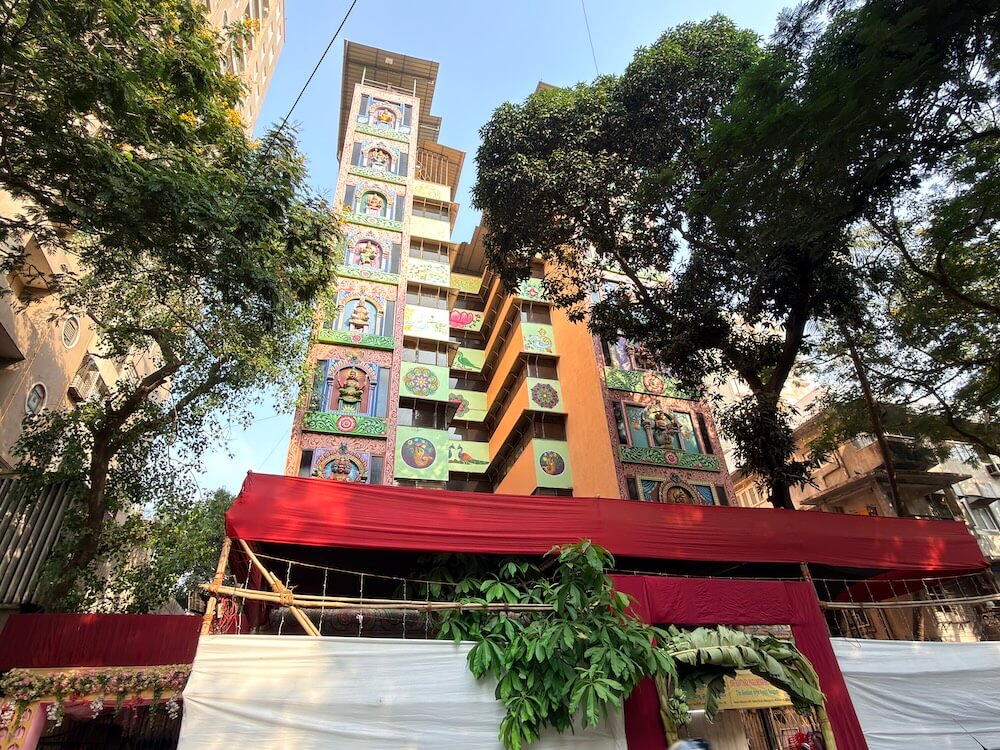
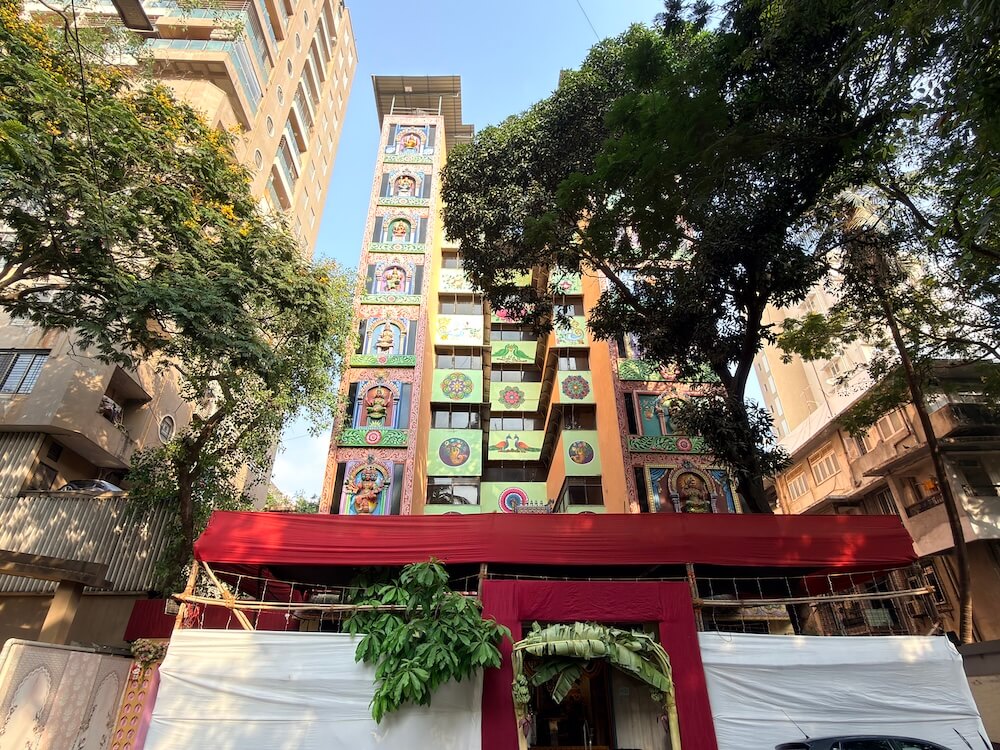
In 1964, the leaders of the Vaishya community residing in the Matunga area first established a small temple for their Kuladevi (family deity) here. At that time, the temple only housed a photograph of Vasavi Kanyaka Parameshwari Devi, which was worshipped. Later, in the year 2000, under the initiative of the organization ‘The Bombay Arya Vysya Sangam’, a large temple of Kanyaka Parameshwari Devi was constructed, and the idol of the Goddess was consecrated. The eight-story structure of the Kanyaka Parameshwari Devi temple is located a short distance in front of the Shankar Math in Matunga. On the outer walls of the upper floors, various forms of the Goddess and an image of Kartikaswami are sculpted on both sides. The temple of the Goddess is located on the ground floor.
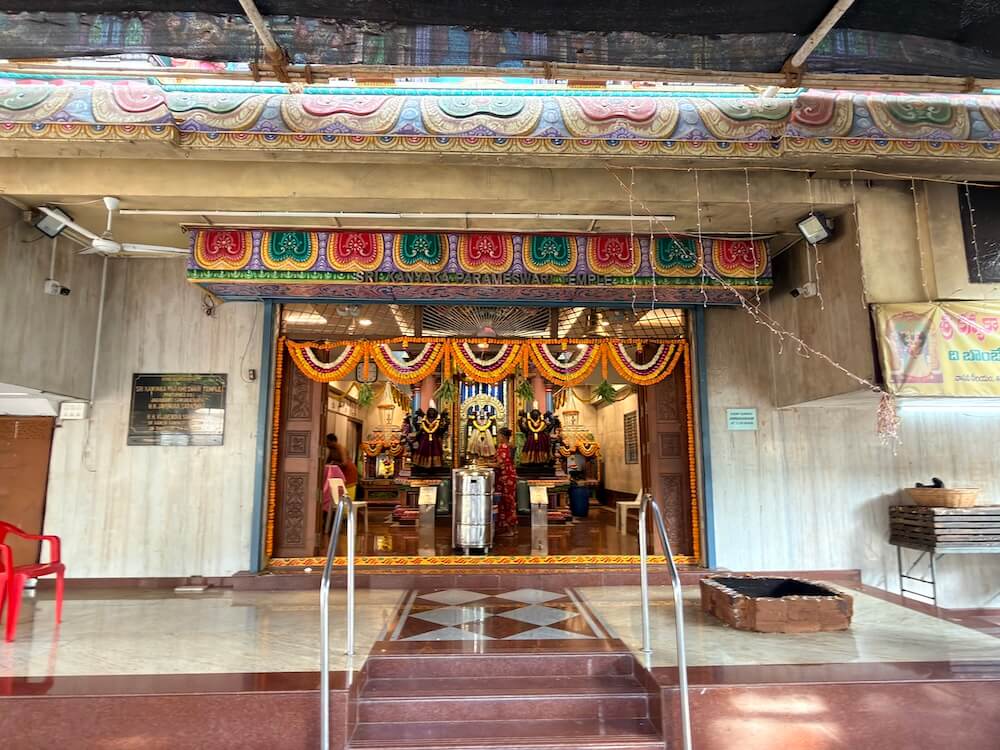
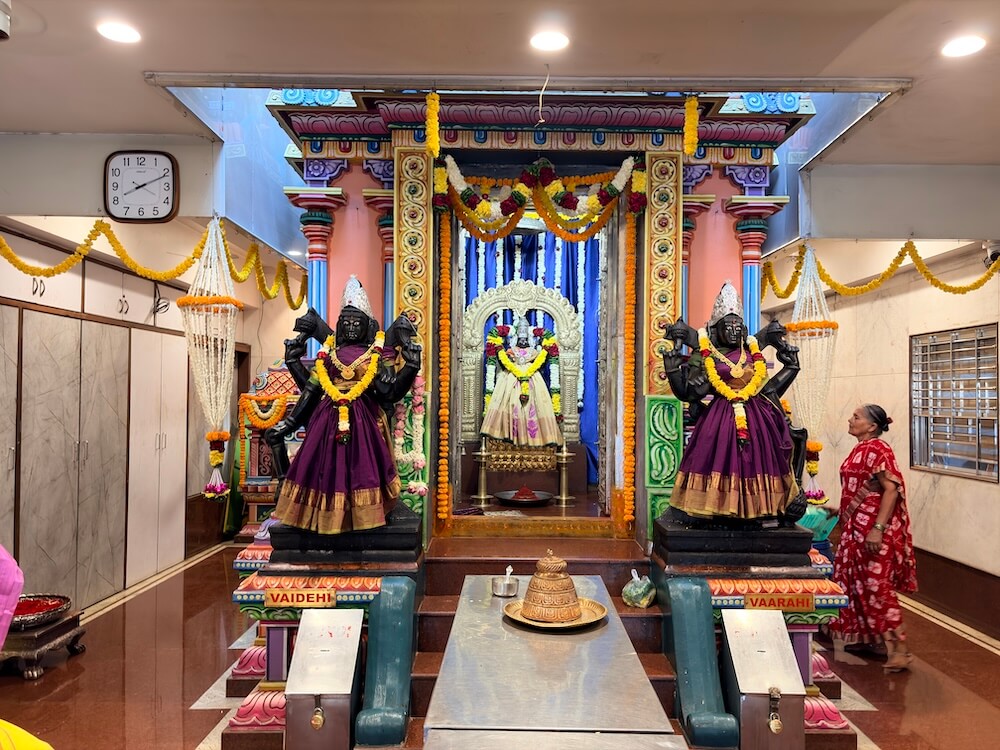
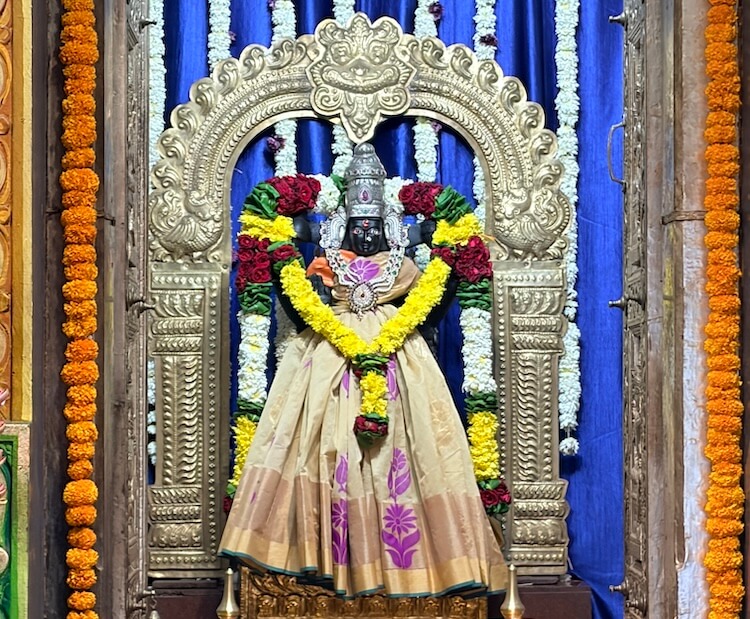
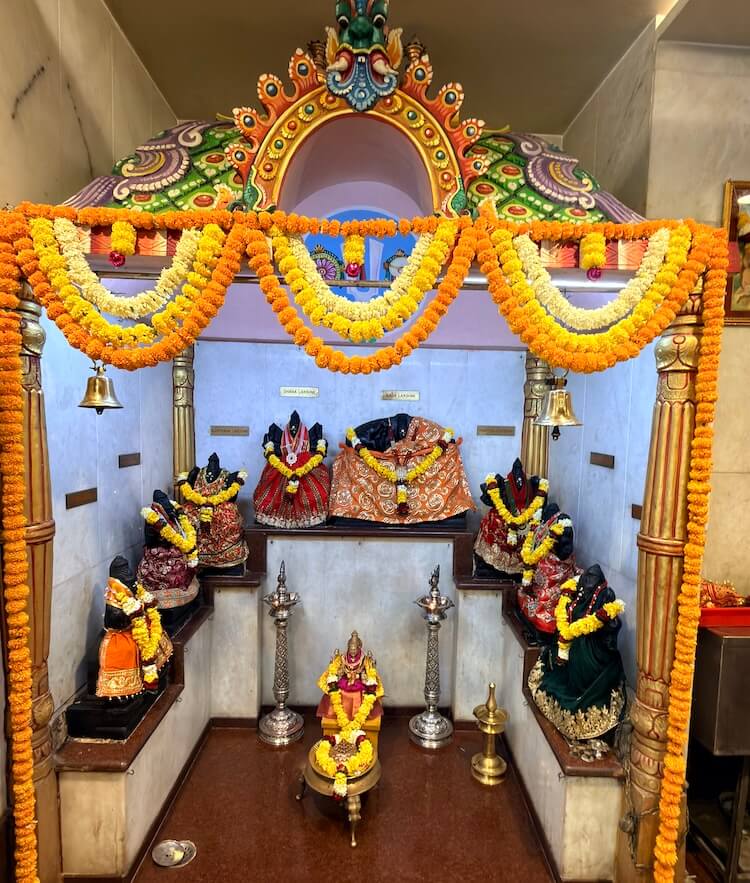
There is an open courtyard in front of the temple. From here, one ascends four steps to enter the temple sanctum. On this marble platform, to the right, is an eternal Havan-kund. The temple is structured with a Sabha-mandapa (assembly hall) and a Garbhagriha (sanctum sanctorum). The Sabha-mandapa has a wide horizontal entrance. There are four shrines in the four corners of the Sabha-mandapa, with the Garbhagriha in the center. In these four shrines, built in the Southern style, idols of Ashtalakshmi and Durga, Vinayaka, Nageshwar (the Shiva Linga of Mahadeva), and Anjaneya (Hanuman) are consecrated. The Ashtalakshmi idols include Gajalakshmi, Dhanalakshmi, Dhanyalakshmi, Mahalakshmi, Santanalakshmi, Veeralakshmi (Vijayalakshmi), and Aishwaryalakshmi. The Garbhagriha is in the Southern style and is accessed by four steps. To the left of the entrance of the Garbhagriha stands the idol of Vaidehi in black stone, and to the right is the idol of Varahi Devi. Inside, on a marble altar, the black stone idol of Vasavi Kanyaka Parameshwari Devi is consecrated. Behind the Goddess, who is adorned with garments, ornaments, and flower garlands, is a silver arch (Makhar). It features a Makara-torana, with a Kirtimukha carved at the top center. A brass idol of the Goddess is also seated here on the left. Kanyaka Parameshwari Devi is Chaturbhuja (four-armed). In her upper hands, she holds a lotus flower with a parrot, as well as a noose. Her lower right hand is in Abhaya Mudra, and her left hand is in Varada Mudra. On the outer wall behind the Garbhagriha is an idol of Goddess Vaishnavi. The Garbhagriha is topped by a Shikhara.
In this temple, devotees can have Darshan of the Goddess daily from 6:00 AM to 11:00 AM and from 5:00 PM to 9:00 PM. The Navratri festival is celebrated with great enthusiasm and on a grand scale. During the nine days of Navratri, the Goddess is decorated in different forms. Devotees make it a point to visit during this time to witness the festival and the beautiful form of the Goddess. Additionally, ‘Vasavi Jayanti’, the birth anniversary of Vasavi Kanyaka Parameshwari Devi, is celebrated in this temple with deep devotion. During these major festivals, special Mahaprasad is organized for the devotees.
This sacred temple stands as a testament to deep spiritual devotion, ancient architectural grandeur, and rich local cultural traditions.
The sanctum sanctorum houses the divine idol consecrated according to ancient Vedic traditions, surrounded by serene courtyards and traditional temple architecture.
Navratri, Maha Shivratri, Annual Temple Jatra & Deepotsav
Compare and book flights, secure top-rated local hotels near the temple, hire reliable guides, and rent cars instantly.
Extend your pilgrimage by visiting other highly sacred temples located nearby.


Add ₹999 more to unlock FREE SHIPPING!
Your sacred cart is currently empty.
Shop Photo FramesFill in your delivery details below to place your order.
Add comment