
Add ₹999 more to unlock FREE SHIPPING!
Your sacred cart is currently empty.
Shop Photo FramesThe Jogeshwari Caves are significantly recognized as the ‘first Hindu caves’ in Maharashtra. Created in the first half of the sixth century—approximately fifteen hundred years ago—these caves share a resemblance with the main caves at Gharapuri (Elephanta). As part of Mumbai’s ancient architectural heritage, these caves were located within the boundaries of the village of Amboli in ancient times. Consequently, in old historical documents, these caves are also referred to as the ‘Amboli Caves’. Currently, this temple is protected as a ‘National Monument’ under the Archaeological Survey of India.
In the latter half of the nineteenth century, specifically in 1880, James Fergusson and James Burgess published the book ‘The Cave Temples of India’. In this volume, they recorded meticulous measurements and details of the Jogeshwari Caves’ layout, pillars, and sculptures. Art historian Prof. Walter Spink also provided an in-depth analysis of the architecture of the Jogeshwari Caves in his book ‘Ajanta to Ellora’. According to Walter Spink, these caves were created in the sixth century AD, roughly between 520 and 550 AD. From an architectural perspective, this period is considered a vital link connecting the caves of Ajanta-Ellora and Gharapuri, or Elephanta.
An early reference to these caves dates back to 1784. The renowned archaeologist William Hunter referred to them as the ‘Amboli Caves’. In his article in the seventh volume of ‘Archaeologia’, he noted that most of the sculptures there were already defaced and that worship was being conducted in the main sanctum sanctorum inside the cave. George Valentia visited these caves in 1802 and provided information about them in his book ‘Voyages and Travels to India and Ceylon’. He stated that there was a Shiva Linga in the central sanctum inside the main hall, which makes it clear that this cave was dedicated to Mahadeva. In the book ‘Cultural Heritage of Mumbai’, Dr. Madhukar Keshav Dhavalikar also remarked, ‘There must have been a Shiva Linga in the sanctum in ancient times, but it was later named Jogeshwari due to the installation of a Goddess there.’
Like Gharapuri, the Jogeshwari Caves are primarily Shaivite, specifically belonging to the Pashupata sect. The presence of the Lakulisha sculpture in the caves confirms that they were pilgrimage sites for the Pashupatas. During that period, Maharashtra was under the rule of the Kalachuris. The branch of the Kalachuri dynasty that ruled here originated from Maheshwar, also known as Mahishmati. Krishnaraja (550–570 AD) was the founder of this branch. His silver coins were known as ‘Krishnaraja-Rupaka’. Some of these coins were found in the Kalbadevi-Thakurdwara area of Mumbai, confirming his authority over these islands. These Kalachuris were worshippers of the Pashupata sect.
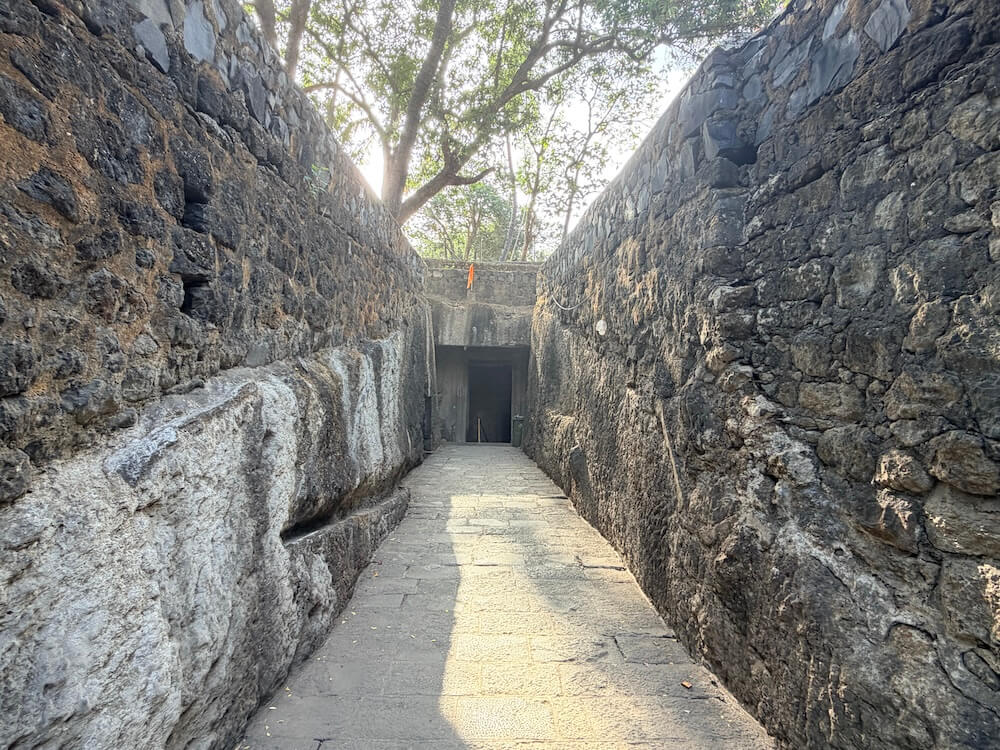
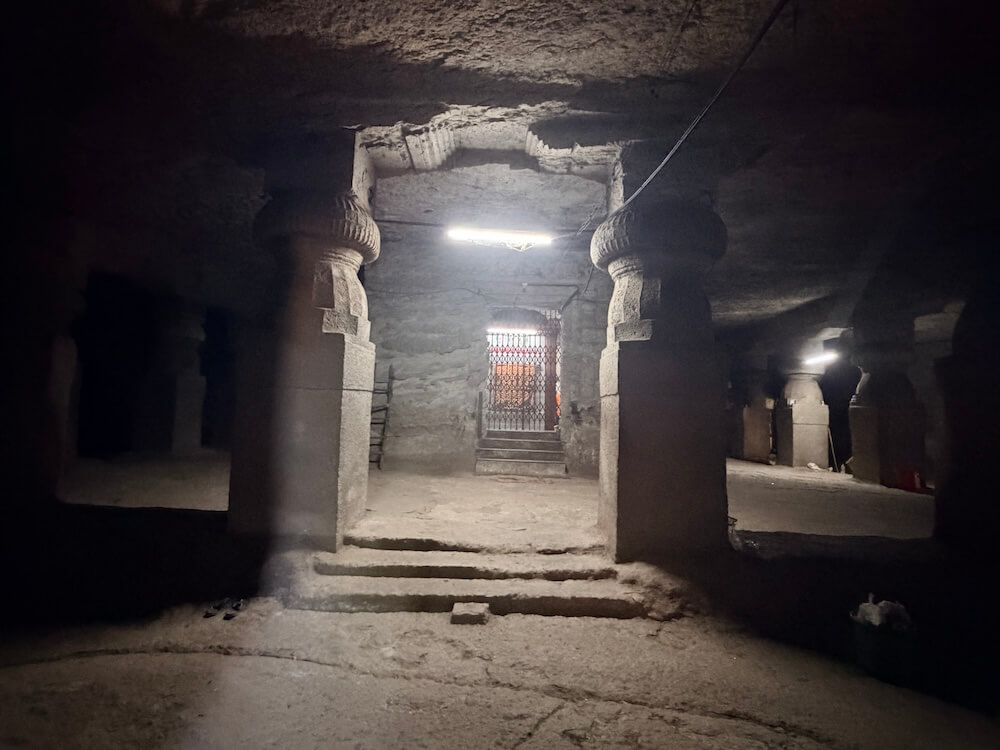
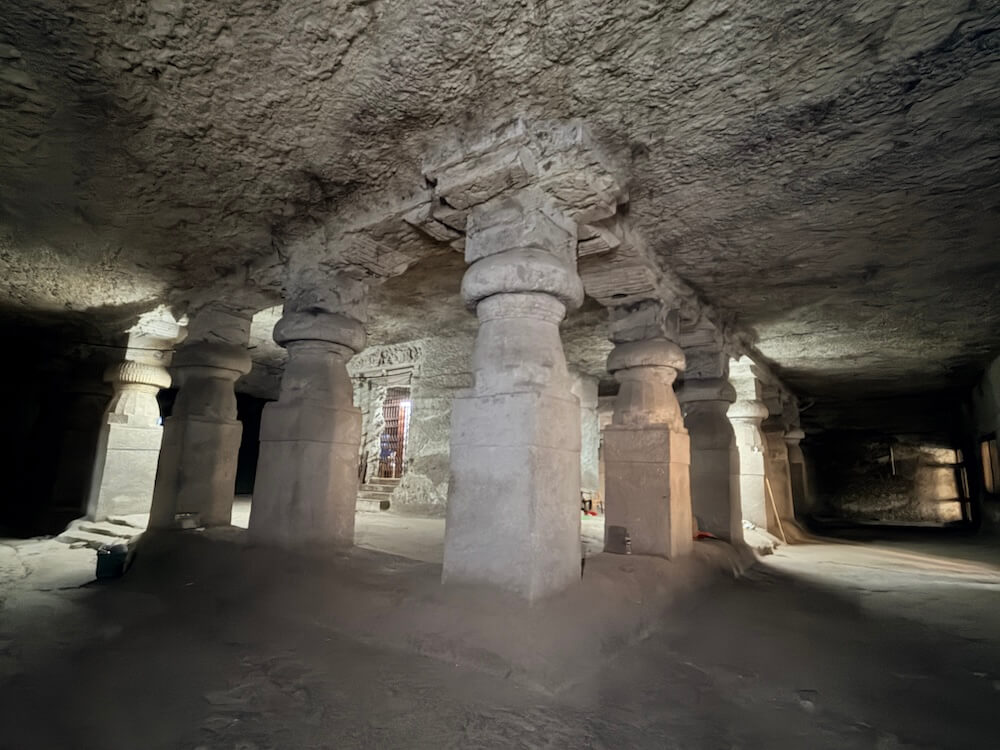
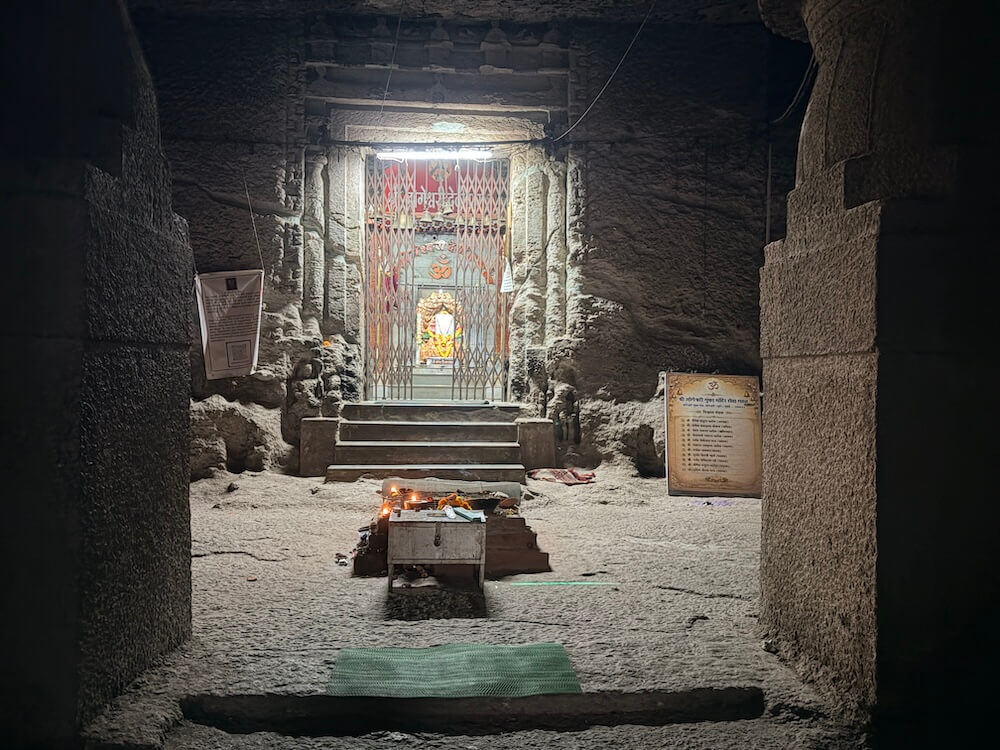
These caves are carved into a large rock formation, specifically black basalt. The total length and width of these caves are much larger compared to other contemporary caves. The layout of the Jogeshwari Caves is distinct from many others; they are excavated deep into a large rock below ground level. There is a large, long passage to enter the caves, which was created by cutting the rock at right angles. In the center of the caves is a vast assembly hall, known as the Mahamandapa. There are rows of grand pillars on all four sides of the Mahamandapa. These pillars are highly characteristic from an architectural standpoint; their upper sections feature fully bloomed, amalaka-shaped carvings. In architectural terminology, this design is called a ‘cushion capital’, a hallmark of Gupta and Vakataka-era art. These pillars are perfectly proportioned and bear the immense weight of the entire ceiling. More advanced and refined versions of these pillars are later seen in the caves at Gharapuri, which is why the Jogeshwari Caves are considered the precursor, or the ‘nandi’ (prologue), to the Gharapuri caves.
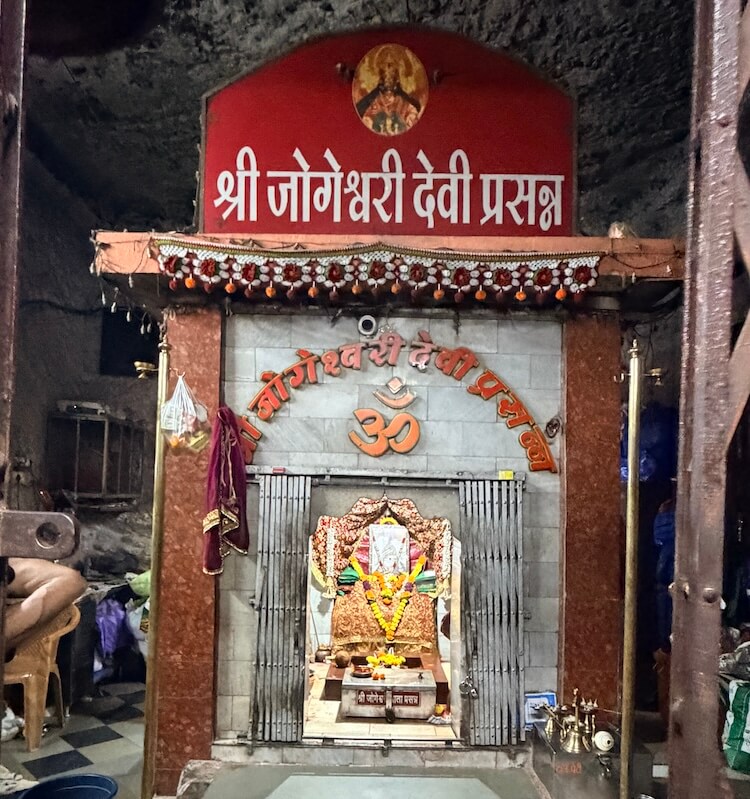
In the very center of the Mahamandapa lies the main sanctum sanctorum. This sanctum is of the ‘Sarvatobhadra’ style, meaning it has entrances on all four sides. Currently, the Goddess Jogeshwari resides in this sanctum. This Goddess is considered the Kuladevata (family deity) of many local families in the western suburbs of Mumbai, particularly the Pathare Prabhu community. The sculptures carved on the entrance of the sanctum and the main eastern entrance are of great significance. The sculpture of Lakulisha Shiva, the main proponent of the Pashupata sect, is carved here.
It is believed that the Pashupata sect, which considers Pashupati or Shiva as the supreme deity, spread from the lands of Gujarat and Rajasthan. Lakulisha is considered the founder of this sect. Acharya Lakulisha was born in the late first century BC or the second century AD in the village of Kayavarohan (Taluka Dabhoi, District Vadodara), which was known as ‘Ichhapuri’ in the Satyayuga, ‘Mayapuri’ in the Tretayuga, and ‘Meghavati’ in the Dwaparyuga. He is considered the final, 28th avatar of Lord Shiva. Lakulisha systematically organized the Shaiva tradition, which had ancient roots dating back to the Vedic era. This is also known as the ‘Agamanta Sampradaya’. In this sect, the Shiva-avatar Lakulisha is worshipped in idol form. The iconographic form of Lakulisha is depicted sitting in Padmasana (lotus position), with an erect phallus, holding a citron in his right hand and a staff (lakuta) in his left, while Pashupatinath is worshipped in the form of a Shiva Linga. In the sculpture here, Lord Shiva is shown sitting in Padmasana on a lotus seat, holding a lakuta (staff) in his hand, with his disciples seen sitting around him with folded hands. This sculpture proves the connection between the Jogeshwari Caves and the Pashupata sect.
Another important sculpture carved in the Jogeshwari Caves is the ‘Andhakasuravadha’ (the slaying of the demon Andhaka). In this sculpture, Lord Shiva is depicted in a fierce form, slaying the demon Andhaka. In one of Shiva’s hands is a trident, which he has thrust into the chest of Andhakasura. According to mythology, every drop of Andhakasura’s blood that fell to the ground would give rise to a new demon. Therefore, Chamunda Devi is depicted beside Shiva, collecting the blood in a vessel. On Shiva’s back, the skin of Gajasura, the elephant demon, is carved. The expressions on his face and the posture of his body appear remarkably lifelike. Although the sculpture has suffered significant erosion over time due to water seepage, its intricate details remain clearly visible today. This sculpture is an excellent example of the destructive form of Shiva in Shaivite philosophy.
Furthermore, the sculpture of the Shiva-Parvati wedding, known as the ‘Kalyanasundaramurti’, is a major feature of these caves. This sculpture depicts the wedding ceremony of Lord Shiva and Mother Parvati. Lord Brahma, who is performing the wedding rites, and other gods and Digpalas standing as witnesses can be seen here. The moment where Shiva’s right hand holds Parvati’s hand has been skillfully brought to life in stone. The expressions on the faces of the figures in this sculpture, along with their ornaments and attire, are of a high standard of craftsmanship. Additionally, the ‘Ravananugraha’ sculpture is carved on the upper part of the eastern entrance of the caves. In this sculpture, Ravana is shown attempting to lift Mount Kailash, while Shiva presses the mountain down with his big toe, humbling Ravana’s pride. Beside this sculpture is the Nataraja Shiva, or the dancing Shiva. Various mudras and dance gestures of Shiva are carved here.
The book ‘Stories in Stone: Historic Caves of Mumbai’ by historians and archaeologists Dr. Suraj Pandit and Arun Narayan, who have conducted a systematic study of these caves in modern times, is considered reliable. This book sheds light on the sculpture in the Jogeshwari caves, their precise period, and their connection to the ancient trade routes of Mumbai. According to them, the creation of the Jogeshwari caves was not solely for religious or spiritual purposes; it had a significant economic and geographical context. In ancient times, Sopara and Kalyan were very important international trading ports in the Konkan region. Trade routes leading to Paithan, Junnar, and Nashik were used to transport goods arriving at these ports to the hinterland, or the Ghats. A chain of caves including Kanheri, Magathane, Jogeshwari, and Mahakali was formed along this very route. These caves were used by traders and travelers for lodging, rest, and security. The Jogeshwari caves were a major hub on this trade route. Consequently, traders and the rulers of that time provided significant financial support for the construction of these caves. The grandeur and vastness of these caves bear witness to the rich economic resources of that era.
It is observed that the rooms and verandas located beside the main hall of these caves resemble the Vihara style of Buddhist caves. However, they have been skillfully converted into the structure of a Hindu temple. Specific types of openings and gaps have been left in the ceiling and sides to allow light into the caves. This allows sunlight to fall directly onto specific parts of the sanctum sanctorum or the main hall. Apart from the main temple, some small sub-caves and water cisterns are also carved here. Due to the weak quality of the basalt rock, the humid climate, and water seepage caused by intense urbanization in the vicinity, many sculptures here have eroded. Some parts are on the verge of destruction. The problem of water logging in the caves during the monsoon has caused significant damage to the stone.
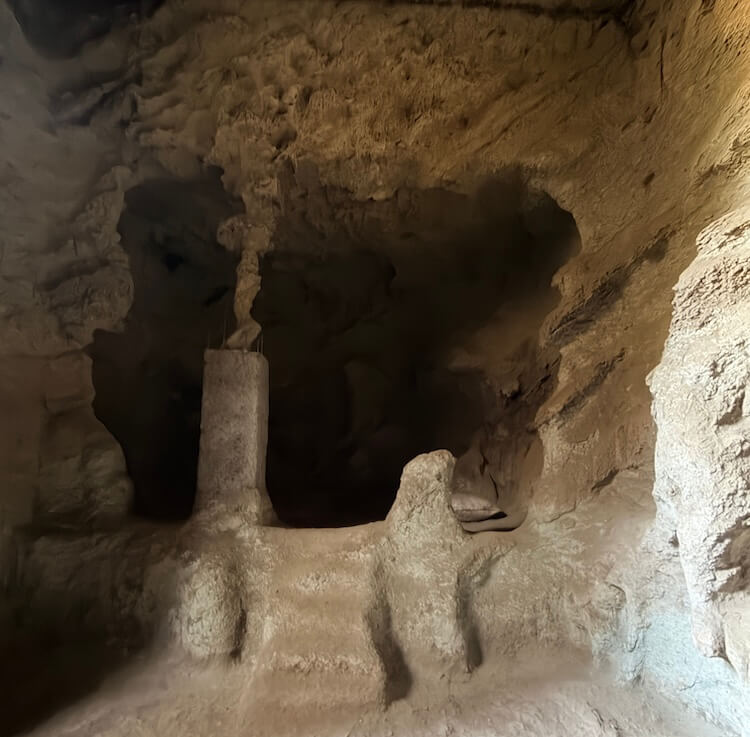
These caves are situated in the bustling area of Jogeshwari. Near the entrance of the caves, there are lamp pillars (Deepastambhas) on both sides. Below the pillar on the right, there is an idol of Ganpati in a niche. Near the pillar on the left, inscriptions containing information about the caves are carved. From here, the path leading to the caves, a distance of about 50 meters, is carved at right angles into the rock on both sides. Descending about 13 steps from the entrance, one enters the main assembly hall of the cave. This hall has large pillars on all sides, and in the center is the ‘Sarvatobhadra’ style sanctum sanctorum of Jogeshwari Devi. In front of the main entrance of the sanctum, there is a sacrificial altar (Havankund) in the assembly hall. One enters the elevated sanctum by climbing four steps. Various sculptures are carved on the door frames of the sanctum. Inside the sanctum, there is an idol of Jogeshwari Devi and her footprints (Padukas) on a Vajrapitha. Apart from the main shrine of the Goddess, there are separate sanctums for Mahadev, Ganpati, and Hanuman in these caves.
In this historic Jogeshwari Cave Temple, festivals such as Mahashivratri, Navratri, and the month of Shravan are celebrated on a large scale throughout the year. Since this cave temple is primarily dedicated to Lord Shiva and Jogeshwari Devi, festivals of both Shaivite and Shakta traditions are celebrated here. On the day of Mahashivratri, special prayers are organized in the temple. On this day, a large number of devotees come here to perform Jalabhishek and Dugdhabhishek on the Shiva Linga. In these caves, which are examples of Kalachuri-era architecture, many sculptures of the Shaivite sect such as the Shiva-Parvati wedding, Nataraja, and the slaying of Andhakasura are carved. Therefore, this historic structure gains special significance on Mahashivratri. Similarly, the Navratri festival in the month of Ashwin is the second major festival here. During the nine days of Navratri, special worship of the Goddess, Maha-Aarti, and Bhajan sessions are organized. Furthermore, there is a special crowd in this cave every Monday during the month of Shravan. Bhajan programs are held in the cave throughout the month. Devotees and tourists are allowed entry into this cave seven days a week from 6:00 AM to 1:00 PM and from 4:30 PM to 9:00 PM.
This sacred temple stands as a testament to deep spiritual devotion, ancient architectural grandeur, and rich local cultural traditions.
The sanctum sanctorum houses the divine idol consecrated according to ancient Vedic traditions, surrounded by serene courtyards and traditional temple architecture.
Navratri, Maha Shivratri, Annual Temple Jatra & Deepotsav
Compare and book flights, secure top-rated local hotels near the temple, hire reliable guides, and rent cars instantly.
Extend your pilgrimage by visiting other highly sacred temples located nearby.


Add ₹999 more to unlock FREE SHIPPING!
Your sacred cart is currently empty.
Shop Photo FramesFill in your delivery details below to place your order.
Add comment