
Add ₹999 more to unlock FREE SHIPPING!
Your sacred cart is currently empty.
Shop Photo FramesAn ancient temple of Lord Nrisimha is situated in the village of Varud in Jintur Taluka of Parbhani District. He is considered the fourth avatar among the ten avatars of Lord Shri Vishnu. Countless devotees from Varud village and the surrounding five-village radius hold deep faith in the Nrisimha of this ancient temple, which is built in the Hemadpanti architectural style. There is a legend that the original idol from the temple at Charthana was brought here. As this place is renowned as a ‘Jagrut Devasthan’ (an awakened place of divinity), it is always crowded with devotees seeking darshan. The Nrisimha Jayanti festival is celebrated here in the month of Vaishakh. An annual five-day festival is organized from Kartik Purnima to Chaturthi. A large number of devotees visit for darshan during this festival.
A legend is famous regarding the establishment of this temple and the arrival of the idol. It is believed that this idol was brought here from Charthana along with Santoba, an ancestor of the Marathi litterateur Laxmikant Tamboli. Santoba, a resident of Jintur, was a supreme devotee of Lakshmi-Nrisimha. He used to walk daily from Jintur to the temple in Charthana. He would not consume food without having darshan of the Lord. Pleased with Santoba’s devotion, Lord Nrisimha appeared before him in person. He asked Santoba to seek a boon. Upon this, Santoba requested Lord Nrisimha to accompany him home. Nrisimha accepted this request. He said, “I am ready to come with you. You walk ahead, and I will follow you. However, do not look back while walking on the way. If you look back, I will stop at that very place forever.” To this, Santoba asked, “How will I know that you are following me?” Nrisimha suggested a solution, “Prepare a cart made of sorghum stalks (dhanda). I will sit in that cart. Tie a bell around the neck of the bullocks pulling the cart. Consider that I am sitting in the cart as long as you hear the sound of that bell.” Following Nrisimha’s instructions, Santoba set off towards Jintur with the cart. While traveling, when they reached near the river at Varud, the sound of the bullocks’ bells suddenly stopped. Due to the silence, Santoba looked back. Because Santoba looked back, the condition set by Nrisimha was broken. He stopped right there at that very moment. Santoba made many pleas to Lord Nrisimha to continue walking, but it was of no use. There was a Shiva temple nearby. Lord Nrisimha liked that Shiva temple. He decided to reside there. He told Santoba to meet the villagers and convey the message to clear the temple site.
In those days, this place of Mahadeva was in a desolate area outside the village. Wild animals used to roam there. Due to the dense thickets in the area, the villagers did not dare to go there for darshan. The villagers used to stack bundles of sorghum stalks (kadba) from their farms in the temple premises. Santoba conveyed Nrisimha’s message to the villagers of Varud. However, the villagers did not believe him. The villagers asked Santoba in return, “Does God ever speak in person?” They further stated, “This is our rightful place for stacking sorghum. Therefore, we cannot give this place to God.” They clearly refused to vacate the land. Santoba went to Lord Nrisimha and expressed his helplessness by conveying the villagers’ refusal. After that, all the bundles of sorghum stacked in the temple premises suddenly caught fire. Upon receiving this information, all the villagers ran to the spot. They were astonished to see this incident. Realizing their mistake, they bowed their heads before Santoba and at the feet of Lord Nrisimha, seeking forgiveness. After this incident, the villagers cleaned the entire temple premises. They brought sand from the banks of the river flowing in front and fashioned an idol behind the Shiva Linga in the temple. Lord Nrisimha entered that sand idol. That idol manifested in a ‘Swayambhu’ (self-manifested) form. This incident occurred on the full moon day (Purnima) of the month of Kartik. Since Lord Nrisimha manifested at Varud on Kartik Purnima, the tradition of celebrating an annual festival here every year began from that time.
An inscription is available in the original Nrisimha temple at Charthana. According to the records in this inscription, there is a clear mention that in Shaka 1184, that is, in the year 1266, a Brahmin named Rama built the assembly hall (sabhamandap) and the guest house (dharmashala) of the temple at Charthana. In ancient times, many temples in the Hemadpanti architectural style existed in the Charthana area. In later times, Muslim invaders attacked this region and destroyed many of the temples here. During that period, the Nrisimha temple at Charthana was famous. To protect the idols of Nrisimha and other temples from the attacks, local villagers hid these idols in safe places or relocated them elsewhere. A school of thought among historians is that Santoba must have brought this ancient idol of Nrisimha from Charthana to Varud for safety during this period.
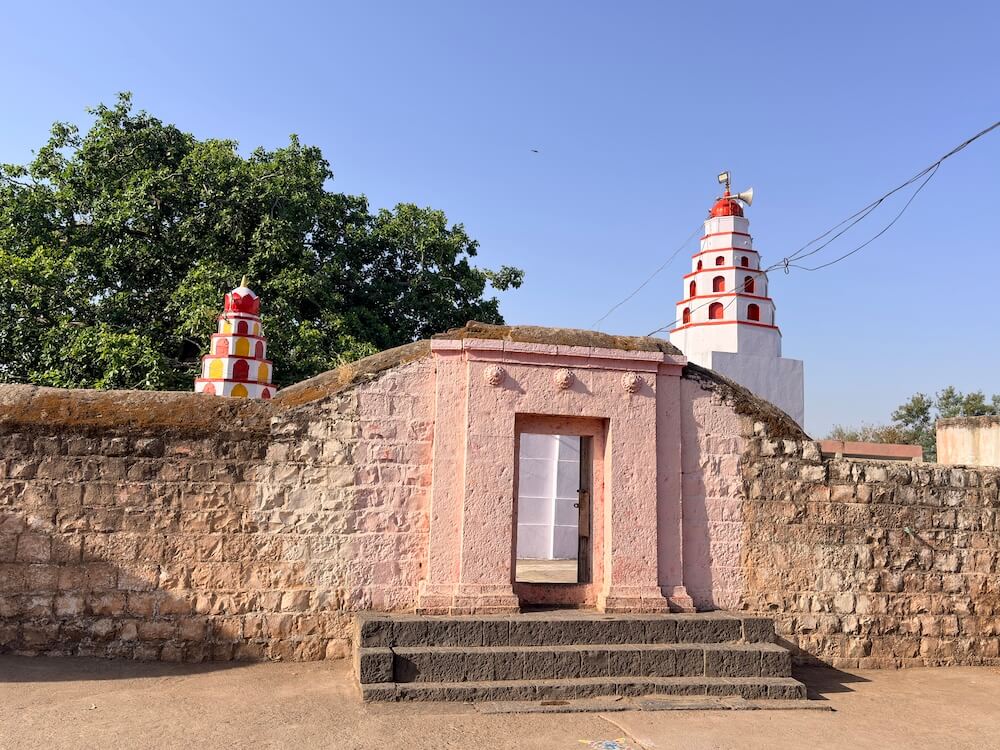
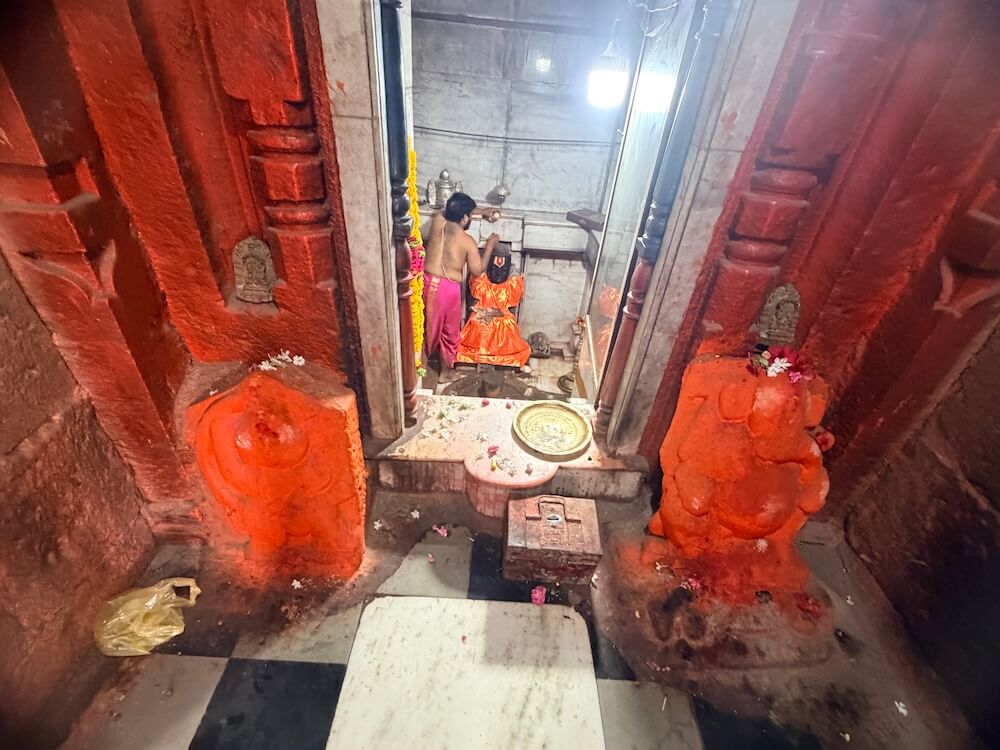
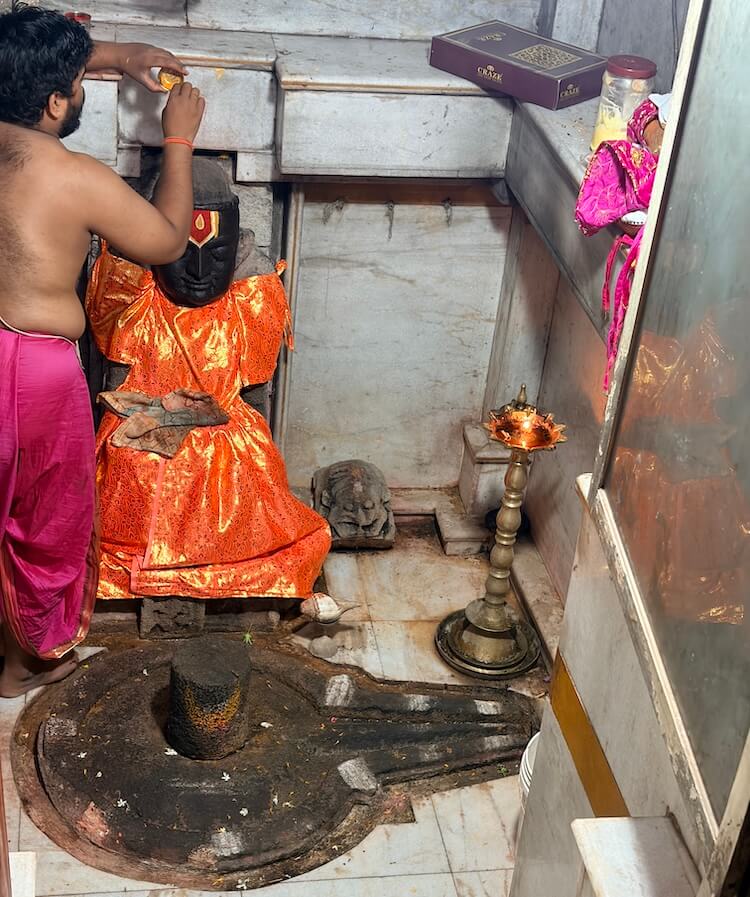
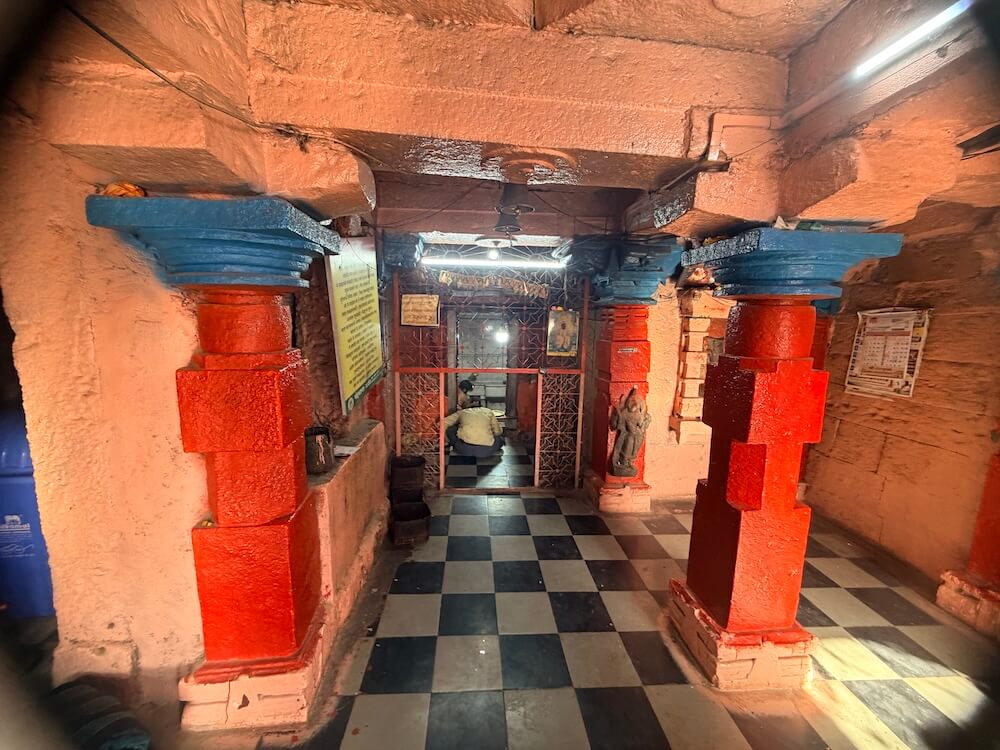
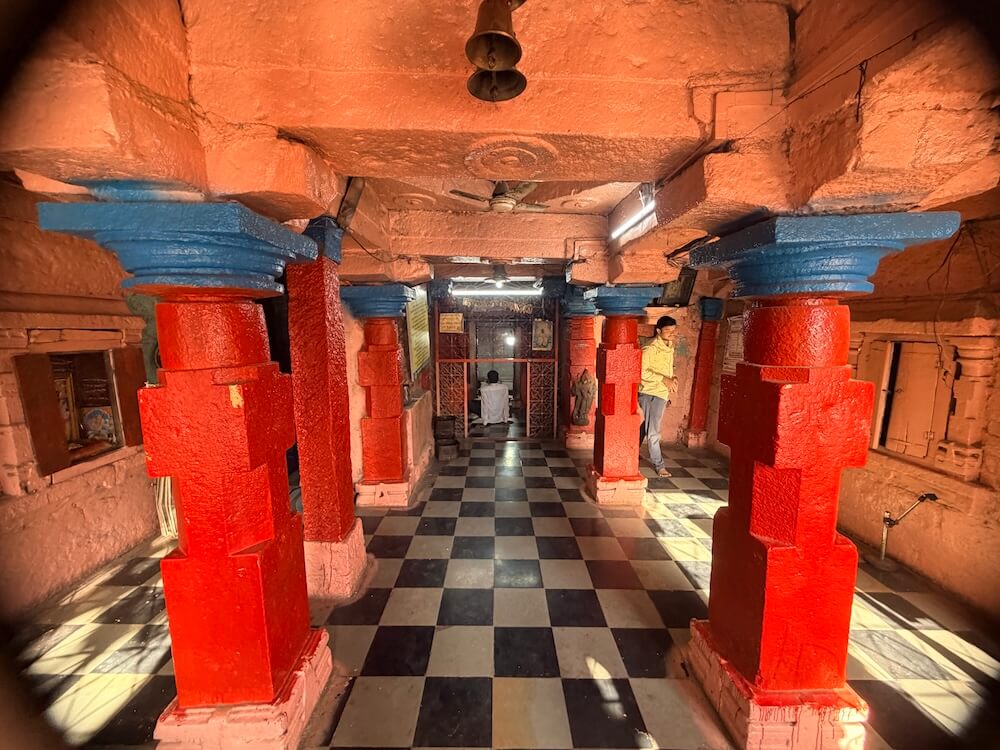
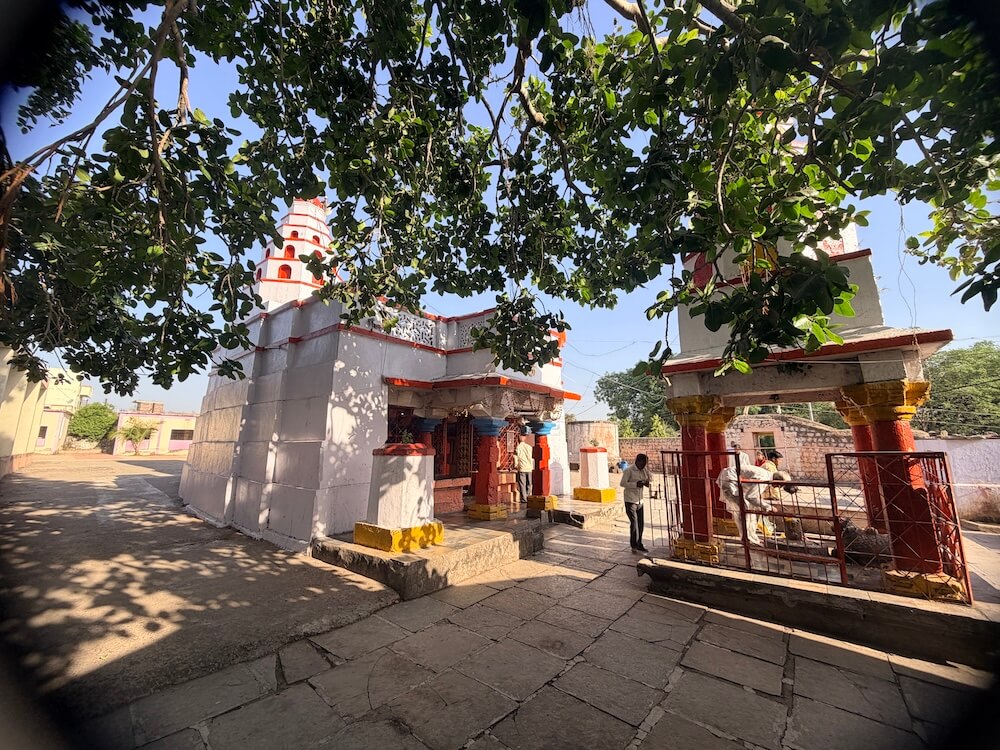
This Nrisimha temple is spread over an area of about two acres. There is a strong stone fortification wall on all four sides of the temple. One enters the large courtyard through a small entrance in the fortification. In this courtyard, there is a stone lamp tower (deepmal). There is a small independent Shiva temple in front of the main temple. The structure of the main Nrisimha temple consists of an assembly hall, an antarala (vestibule), and a sanctum sanctorum (garbhagriha). The stone pillars in the assembly hall stand on strong bases. Various shapes are carved on these pillars. In front of the assembly hall is the temple’s sanctum, which is six feet deep. In the center of this sanctum, an ancient oval-shaped Shiva Linga is installed in a large pedestal (shalunka). Behind this Shiva Linga is an idol of Lord Nrisimha about five feet tall. This idol is crafted in a form sitting peacefully with folded hands on his lap. There is no separate idol of Goddess Lakshmi here along with Lord Nrisimha. Devotees believe that Goddess Lakshmi is secretly seated on Nrisimha’s lap here. The form of the Nrisimha idol here is gentle and calm. Beside the lamp tower in the temple courtyard, there is an ancient ‘barav’ (a stepwell). Stone steps have been arranged to descend into this stepwell. A pavilion has been erected in the temple premises for the convenience of devotees. A stone chamber (ovari) has been built near the stepwell. The samadhi of the temple’s founder, Santoba, is in this very area.
Above the sanctum sanctorum lies a stone spire. On this spire, seven distinct tiers are visible, gradually decreasing in size from bottom to top. These tiers are adorned with carved niches for deities. At the very pinnacle of these seven tiers sits a spherical Amalaka, topped with a golden Kalash. According to the history of this spire, five traditional domes originally stood atop the main temple instead of the current structure. Later, around the year 1961, the current spire was constructed in place of those five old domes.
Various religious festivals are celebrated in this temple throughout the year. The Narasimha Janmotsav is organized here on the day of Vaishakh Shuddha Chaturdashi. On this day, the reading of the Lakshmi-Narasimha scripture takes place at 2 o’clock in the afternoon. Following the scripture reading, the Narasimha Janmotsav, Pashan Abhishek, Vasant Puja, and Brahmana Puja are performed. On the second day of the festival, traditional family rituals are observed in the temple. At night, a Bhajan program is held throughout the temple. During the month of Shravan, every Saturday, the Palkhi Dindi of Santoba arrives at the temple in Varud from Jintur. Upon the arrival of this Dindi at the temple, Bhajan, deity worship, Maha Aarti, and the distribution of Mahaprasad to the devotees take place. After this, the Dindi departs back towards Jintur. Devotees from the surrounding areas visit the temple every Saturday of the Shravan month to seek blessings from this Dindi. The Kakada Utsav begins in the temple from Kojagiri Purnima. During the Kakada Utsav, the deity’s Abhishek, collective Bhajan, and Aarti are performed every day at dawn. On Kartik Shukla Purnima, after the completion of family rituals in the afternoon, the Bhajan group carries the Palkhi to the Santoba Dev temple in Jintur. There, after the completion of the Panchpadari religious ritual, the mask of Santoba is placed in the Palkhi. This Palkhi returns to the main temple in Varud at night. Upon the arrival of the Palkhi at the temple, Bhajan and Maha Aarti are performed again. After the Maha Aarti, this Palkhi circumambulates the main temple seven times. Thereafter, devotees perform Bhajan in the assembly hall throughout the night. On the day of Chaturthi in the Kartik Krishna Paksha, the Bhajan and Lalit, which is the fair program, are conducted. On the day of Panchami, family rituals and Laghurudrabhishek are performed in the morning. This mask of Santoba remains in the Narasimha temple at Varud for a total of five days. On the sixth day, this mask is transported back to the temple in Jintur. Devotees can have Darshan here every day from 6 o’clock in the morning until 9:30 at night.
This sacred temple stands as a testament to deep spiritual devotion, ancient architectural grandeur, and rich local cultural traditions.
The sanctum sanctorum houses the divine idol consecrated according to ancient Vedic traditions, surrounded by serene courtyards and traditional temple architecture.
Navratri, Maha Shivratri, Annual Temple Jatra & Deepotsav
Compare and book flights, secure top-rated local hotels near the temple, hire reliable guides, and rent cars instantly.
Extend your pilgrimage by visiting other highly sacred temples located nearby.


Add ₹999 more to unlock FREE SHIPPING!
Your sacred cart is currently empty.
Shop Photo FramesFill in your delivery details below to place your order.
Add comment