
Add ₹999 more to unlock FREE SHIPPING!
Your sacred cart is currently empty.
Shop Photo FramesThe famous temple of the Sat Asaras, who represent the water element among the five elements (Panchatattva), is situated on Manmala Tank Road in the western part of Matunga. This temple is dedicated to the Goddess Manmala, one of the seven Asaras. It is said that this temple is two to two and a half centuries old. The Manmala Devi here is considered to be the Gramadevata (village deity) of Matunga. Devotees believe that Manmala is a deity who fulfills the desires of the heart. For this reason, many devotees make vows to this Goddess. Numerous people from the surrounding area participate in the Ashwin Navaratri festival celebrated here.
There is a popular belief that the Sat Asaras in this temple are spiritually awakened (Jagrut). According to the ‘Bharatiya Sanskriti Kosh’, the word Asara is a corruption of the word Apsara. Apsaras are women of the Gandharva class and are also called Gandharvi. Sayancharya has derived the etymology of this word as ‘Ap + Saras’, meaning ‘those Apsaras who play in the water’. For this reason, they have been considered water deities. Since they are always together in a group of seven, they are called Sat or Sati Asara. In the research book ‘The Folklore of Bombay’ by R. E. Enthoven, published in ۱۹۲۳, it is mentioned that in some parts, Asaras are also called Mavalaya. It is believed that these Asaras trouble children and young women.
The renowned scholar Durga Bhagwat, in her article ‘Dharma and Lokasahitya – Abhichar or Jadutona’ (‘Navabharat’, November ۱۹۵۹), has stated that two types of disease deities are considered in Indian folk tradition. One type is the earth deity and the other is the water deity. These water deities reside in places like rivers, lakes, and wells. According to folk beliefs in Konkan, the seven Asaras reside near all water bodies. Some believe that they live only in ponds with lotuses. Because of the disease-causing, fierce (Tamsi) power of the seven Asaras, they are worshipped so that their grace remains upon us. According to folk tradition, Gavalidev is their brother. He is also worshipped along with the seven Asaras. Matsyi, Kurmi, Karkati, Darduri, Jatupi, Sompa, and Makari are the names of the seven Asaras in the scriptures. However, in folk tradition, they have various names. In this temple in Matunga, Kanhopatra, Champavati, Kevdavati, Manmala, Jarimari, Shitaladevi, and Khokladevi are called the seven Asaras. Among these, Jarimari, Shitaladevi, and Khokladevi are essentially folk deities and are associated with diseases. Their temples are found elsewhere in Mumbai as well.
Until the latter half of the nineteenth century, the Matunga area was a desolate forest. King Bimbadev alias Bhimdev Yadav, the fourth son of Ramdevrao Yadav of Devgiri, was ruling here in the thirteenth century. In the year ۱۲۹۵, he established his capital at Mahim (Bimbasthan). It is said that this king had a large elephant stable (Gajashala) in the Matunga area. In Sanskrit, an elephant is also called Matanga. From this, this area began to be called Matangalaya. The name Matunga might have been derived from the corruption of Matanga or Matunga. According to some, there was a settlement of the Matang community here during the time of King Bimb for the maintenance of the elephants. Therefore, this area might have been named Matunga. According to mythological legends, the residence of Sage Matanga was in this area. The name Matunga came from that.
Between the years ۱۷۲۰ and ۱۷۲۸, the British built the Worli embankment. After filling the Mahim creek, grain cultivation began in Matunga along with places like Mahalaxmi, Parel, Worli, and Mahim. There were also salt pans in this area. This area later emerged as a British artillery station at the beginning of the nineteenth century. A large military camp was set up here. However, in the year ۱۸۳۵, due to an epidemic, especially the outbreak of the water-borne Guinea worm disease, the camp here was shifted to Pune and this area became completely desolate. Only a few hamlets of the laborers from these camps remained in this area. In a sense, an epidemic was responsible for the change in the fortune of this area. After the plague epidemic of ۱۸۹۶, the British government developed Matunga as one of the first planned suburbs of Mumbai in the first decade of ۱۹۰۰ to reduce the congestion of Mumbai.
The story of this Sat Asara Manmala Devi temple is that there used to be a pond in the current temple premises. About two hundred to two hundred and fifty years ago, some people found these seven idols in that pond. The name of this pond was Manmala Lake and it was later filled up. One of the goddesses was named Manmala after this lake. It is said that this incident of finding the idols happened about two hundred and fifty years ago. That was the time when the Worli embankment was completed, farming began, and the population increased. At that time, the villagers built a small temple for the idols of the goddesses. While Matunga was being developed as a planned suburb, the British government granted the land to the temple in ۱۹۲۵. According to the book ‘Mumbai’s Aadya Jagrut Shaktipeethe’ by Prof. Dr. Bhalchandra Akalekar, on ۱۶ March ۱۹۸۵, the then Deputy Commissioner of the Mumbai Municipal Corporation, Govind Khairnar, had demolished the Manmala Devi and Hanuman temple here. However, the villagers rebuilt it. On ۹ May ۱۹۸۷, a golden pinnacle (Kalash) was installed on the temple of the Goddess by the then Police Commissioner S. Ramamurthi.
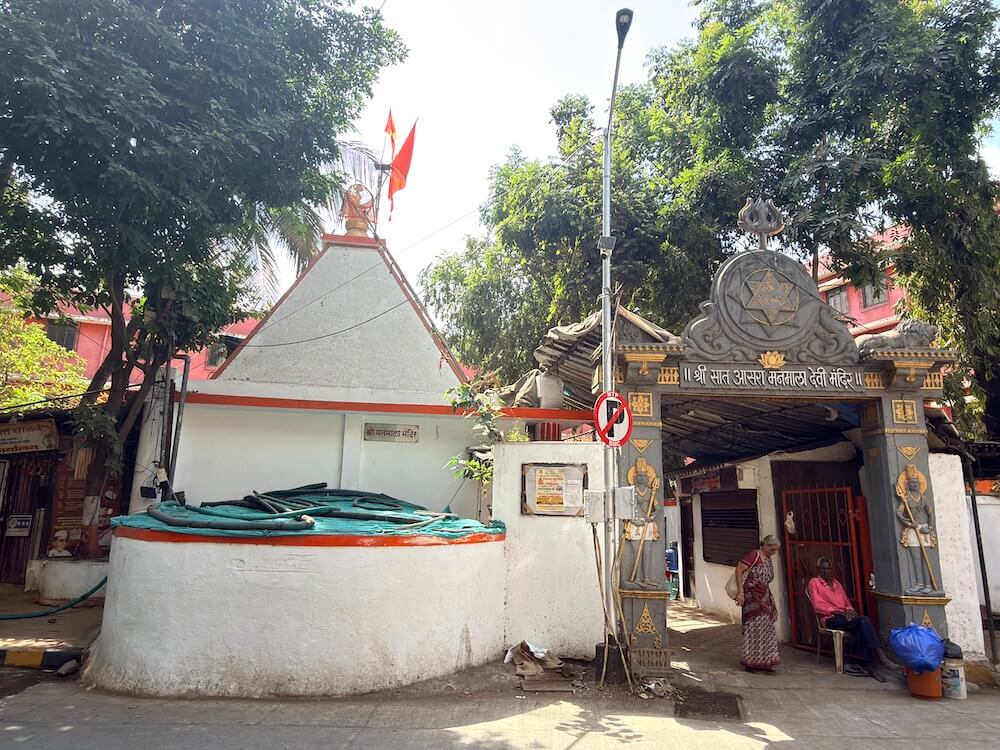
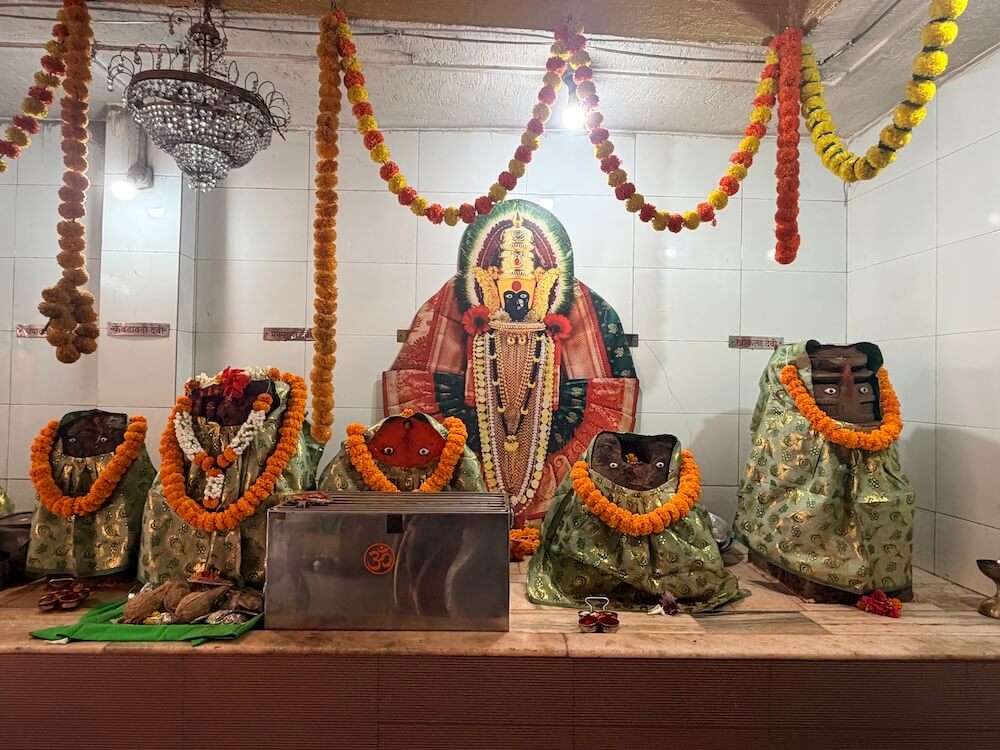
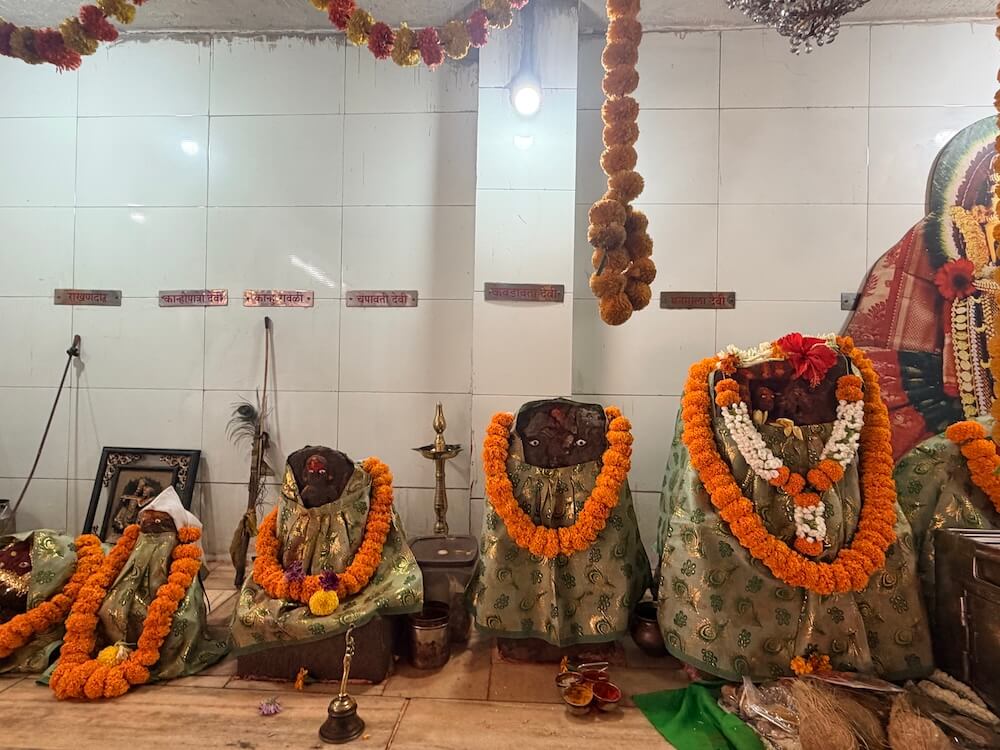
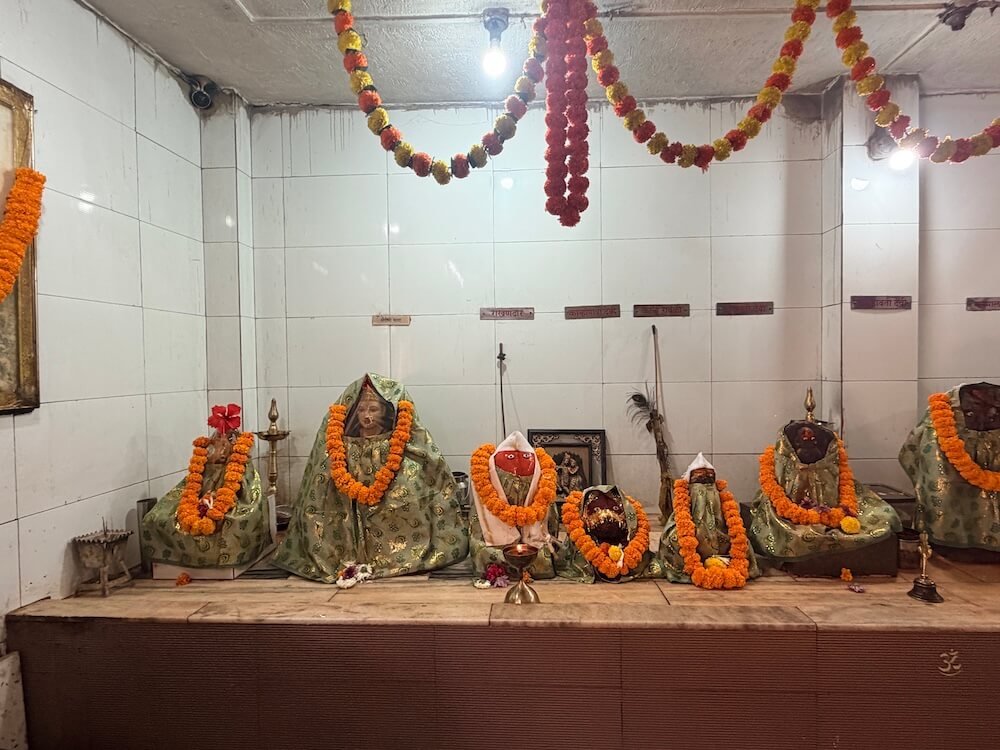
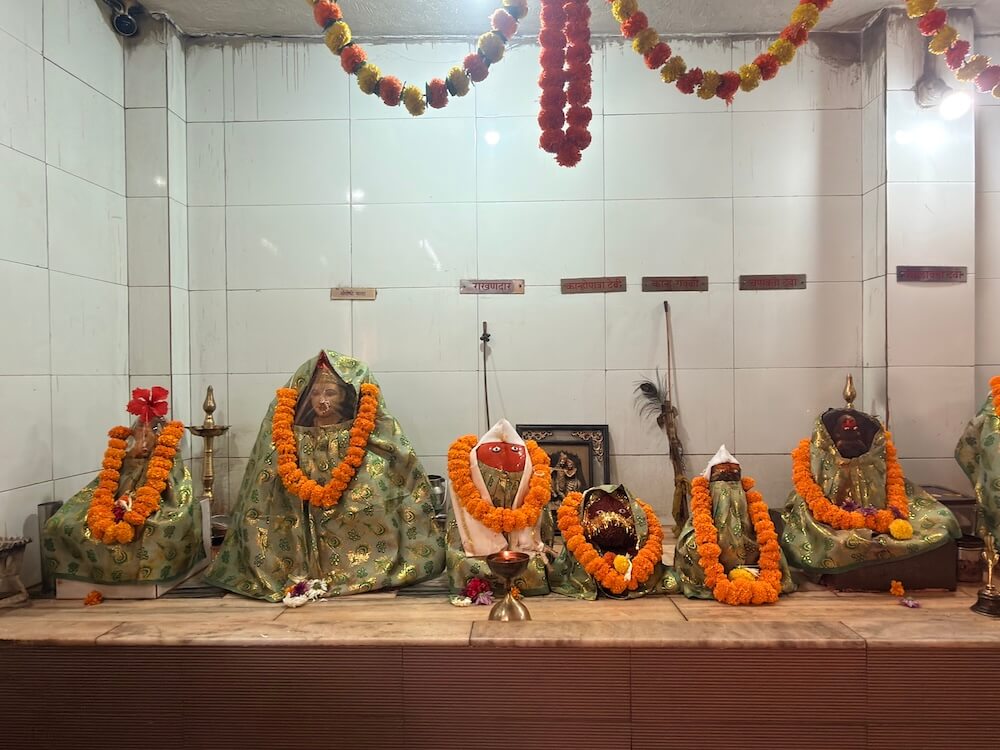
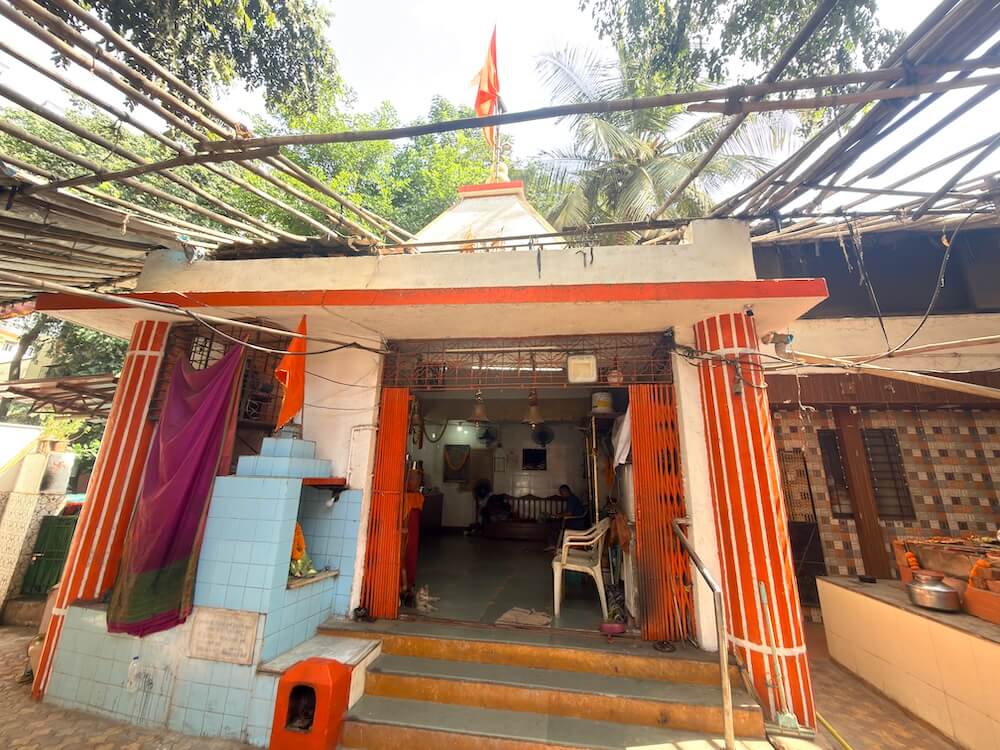
This temple is situated in the peaceful surroundings of Matunga. The temple premises feature a grand entrance gate of modern construction. Two unique sculptures of gatekeepers (Dwarapalas) are carved onto its pillars. These gatekeepers belong to the Shaiva tradition, and these sculptures are influenced by the traditions of the Koli community. Apart from wearing a Koli-style loincloth and a tall, cap-like crown on their heads, they are bare-chested. They hold large tridents in their hands and wear a serpent-shaped sacred thread (Yajnopavita). Such gatekeeper sculptures are rare. Above this entrance, a circular Shri Yantra is carved, topped with a trident sculpture. There are two lion figures at both corners of this roof. A short distance inside, to the left, is the shrine of Gavdevi. Here, a stone idol of Gavdevi is enshrined on a high platform. Adjacent to it is the temple of Manmala Devi. The temple construction is modern, standing on a plinth three steps high. To the left of these steps, an idol of Sai Baba is enshrined in a small marble niche. Upon entering the assembly hall (Sabhamandap), one finds the idols of the seven Asaras—Manmala Devi, Kanhopatra, Champavati, Kevadavati, Jarimari, Shitaladevi, and Khokladevi—enshrined on a high, horizontal platform to the left. Along with them, idols of Kanhu Gawali, the guardian (Rakhandar), as well as Santoshi Mata and Ganesha are also enshrined on this pedestal. The idols of the seven Asaras, the guardian, and Kanhu Gawali are made of various types of unhewn stone. Cowrie-like eyes have been affixed to these stones. The idol of Khokladevi among these is highly distinctive; it is a fragment of a stone-carved pillar from an ancient temple, upon which two eyes have also been placed. All these idols are draped in rich, ornate garments. The stones representing Kanhu Gawali and the guardian (Bhairava) feature Gandhi-cap-style crowns. A large image of Tulja Bhavani Mata is placed on the wall behind this high platform. The temple has a generally triangular spire (Shikhara) topped with a golden finial (Kalash). There is an ancient well in the temple courtyard, and there is a popular belief that its water is curative for ailments.
Devotees can have Darshan in this temple from 6 in the morning until 8 at night. A large number of devotees visit for Darshan every Tuesday and Friday. Navaratri Utsav is the biggest festival celebrated at this temple. The Chaitra Navaratri festival is celebrated in a relatively simple manner, whereas the Ashwin Navaratri festival is celebrated with great grandeur and various religious activities.
This sacred temple stands as a testament to deep spiritual devotion, ancient architectural grandeur, and rich local cultural traditions.
The sanctum sanctorum houses the divine idol consecrated according to ancient Vedic traditions, surrounded by serene courtyards and traditional temple architecture.
Navratri, Maha Shivratri, Annual Temple Jatra & Deepotsav
Compare and book flights, secure top-rated local hotels near the temple, hire reliable guides, and rent cars instantly.
Extend your pilgrimage by visiting other highly sacred temples located nearby.


Add ₹999 more to unlock FREE SHIPPING!
Your sacred cart is currently empty.
Shop Photo FramesFill in your delivery details below to place your order.
Add comment