
Add ₹999 more to unlock FREE SHIPPING!
Your sacred cart is currently empty.
Shop Photo FramesNagdevi Street in South Mumbai is an area characterized by narrow roads, densely packed new and old buildings, chawls, and heavy vehicular traffic. Nestled within an old building here is a small temple dedicated to Nagdevi, the presiding deity of this locality. Although the temple is small, its fame is immense. Located near Nagpada, an area that preserves the memory of the Naga lineage in Mumbai, a large fair is held at this temple on the day of Nag Panchami. Devotees believe that the Nagdevi here is ‘Jagrut’ (awakened) and that she grants the wishes of those who worship her with sincere devotion.
The Shaiva tradition has held influence over the Mumbai islands since ancient times. The Shaiva sect embraced serpent worship, giving the Naga a place around Lord Shiva’s neck. Mumbai is a part of the Konkan region, which historically had a large settlement of the Naga people. In his miscellaneous essay ‘Konkan and Naglok’ (‘Rajwade Lekhsangraha’, Part 2, pages 229-235), the historian Vishwanath Kashinath Rajwade stated that the region of Mahital, or parts of it, later came to be known as ‘Aparantaka’. The Nagas had various clans, including Vasuki, Takshaka, Karkotaka, Kaliya, and Kukun. These Sanskrit clan names eventually evolved into Marathi surnames; for instance, Vasuki led to Vase and Bhase, Takshaka to Takhe and Tikhe, Karkotaka to Kokate and Gokate, Kaliya to Kalye and Kale, and Kukun to Konkane. The name ‘Konkan’ itself is derived from a valiant individual of the Kukun Naga clan.
The original homeland of the Naga clans was Naglok, also known as Mahital, Aparant, or Konkan, from where they spread far and wide. For a time, the Nagas had significant conflicts with other people; however, the Mahabharata records the marriage of Arjuna to the Naga princess Ulupi, suggesting that the Naga people maintained good relations with others. Govardhan Brahmins are still found in regions like Nagaon, Pal, Nagothane, and Tale in the Raigad district. Historian Rajwade suggested that they might be descendants of the Brahmarshi named Govrata, who lived in the netherworld (Patala) of the Nagas. Naganika (2nd century BCE), the queen of the powerful Satavahana ruler Satakarni I, was of Naga lineage. Generally, between 185 BCE and 220 CE, excluding the quarter-century reign of King Nahapana of the Kshaharata dynasty, the Satavahanas held power over the Konkan and, by extension, the Mumbai islands.
From the 9th century CE onwards, for four centuries, the Shilahara dynasty of North Konkan held power over Thane and the various islands of present-day Mumbai. The kings Chhitta and Mummuni, who built the famous Shiva temple at Ambernath in 1050 CE, belonged to this Shilahara dynasty. The Walkeshwar Temple in Walkeshwar was also established during the Shilahara period. In the scholarly editorial preface to the book ‘Mumbai cha Vruttant’ by Balkrishna Bapu Acharya and Moro Vinayak Shingne, Bapurao Naik stated that it was these Shilahara kings who introduced Naga worship and the village-denoting word ‘Pada’ to the Mumbai islands. According to S. M. Edwards, editor of the Mumbai Gazetteer, the ancient practice of Naga worship and the Dravidian linguistic style brought by the Shilahara kings and their followers are likely the reasons behind the name ‘Nagpada’, as mentioned in the book ‘The Rise of Bombay: A Retrospect’ (1902, page 20). This temple of Nagdevi is situated near Nagpada, which was formerly a grazing ground for cattle.
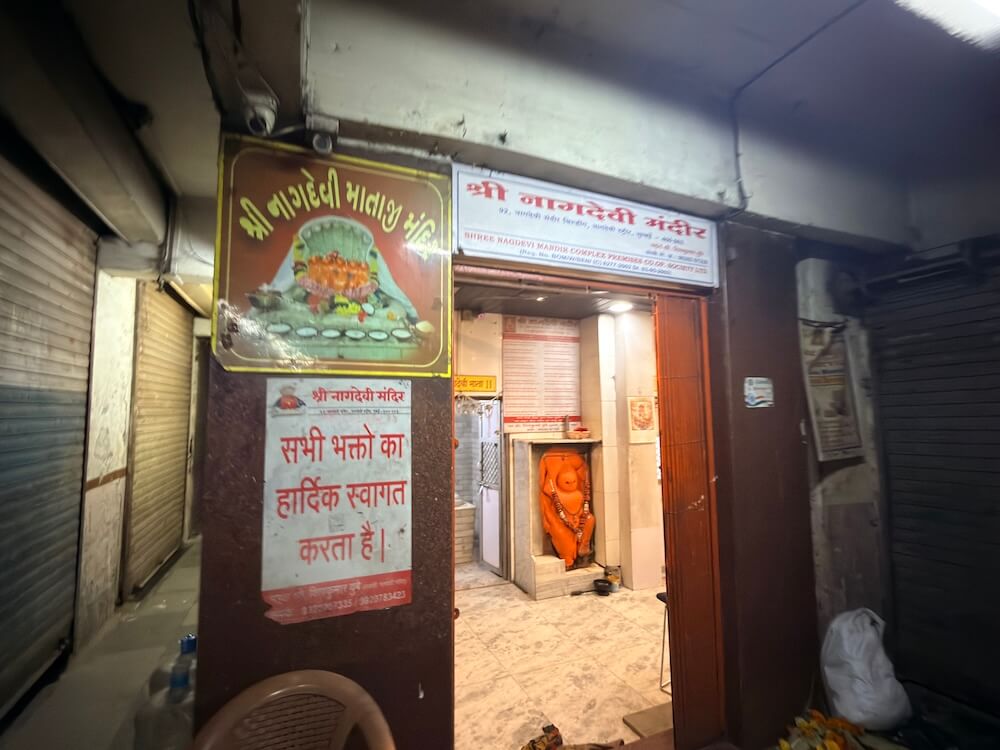
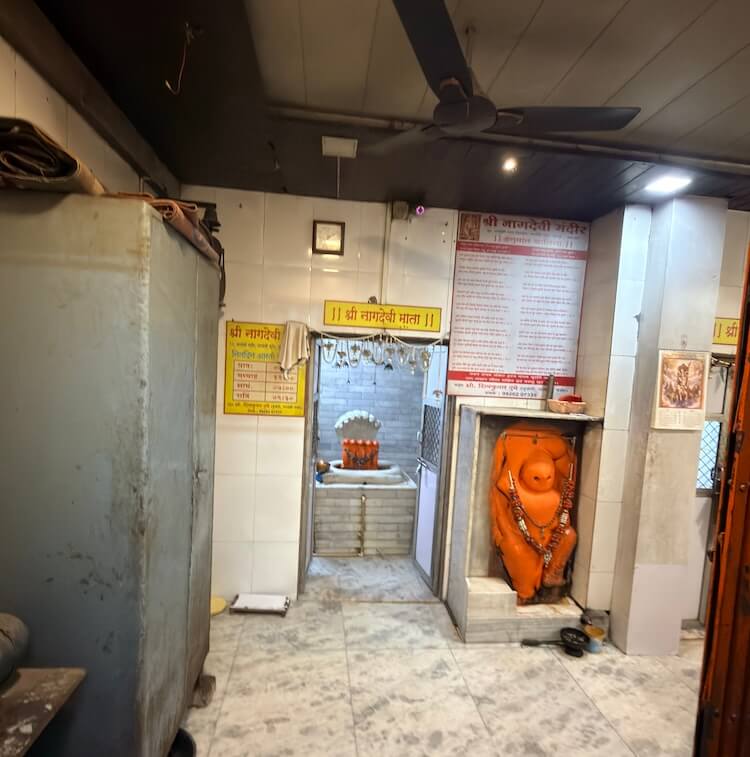
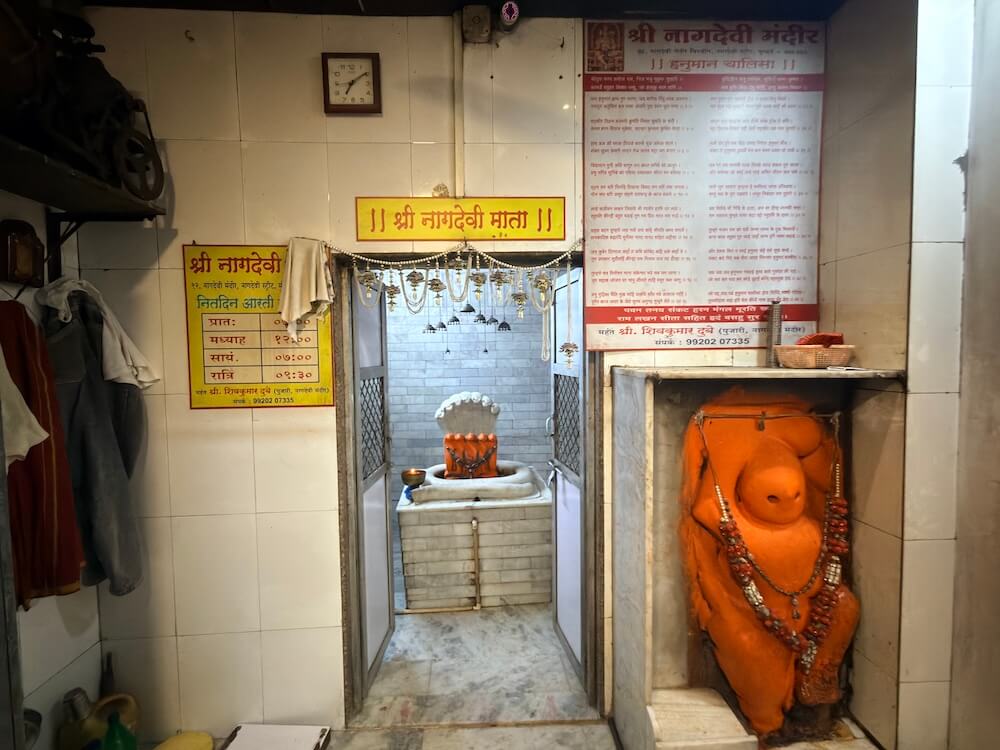
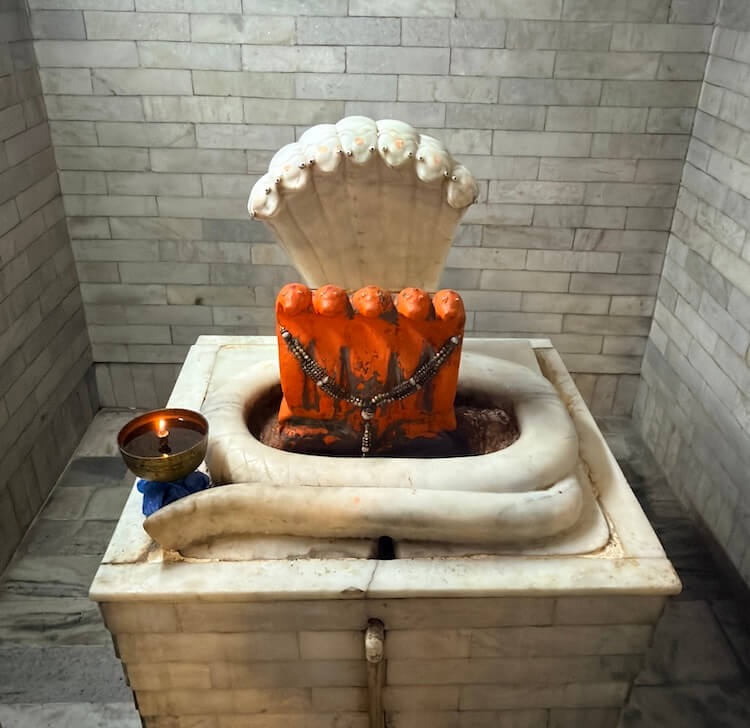
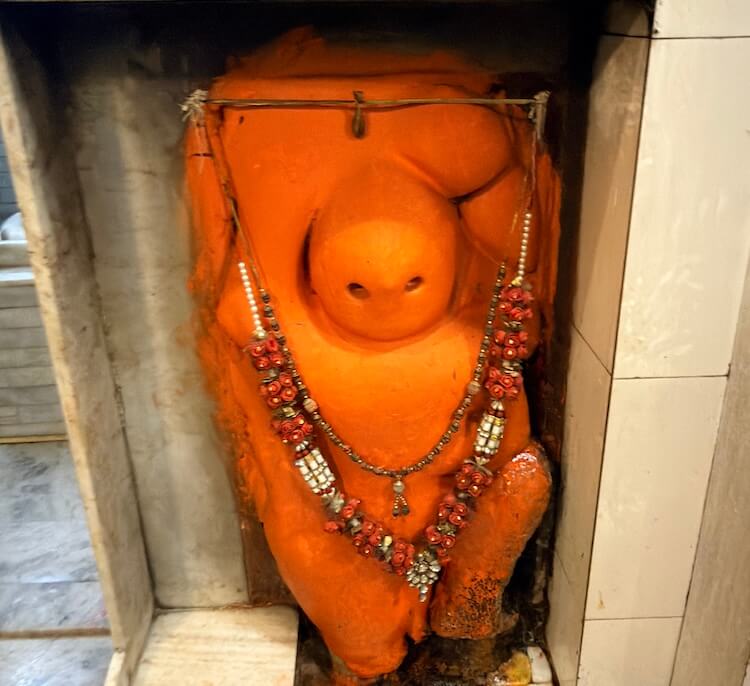
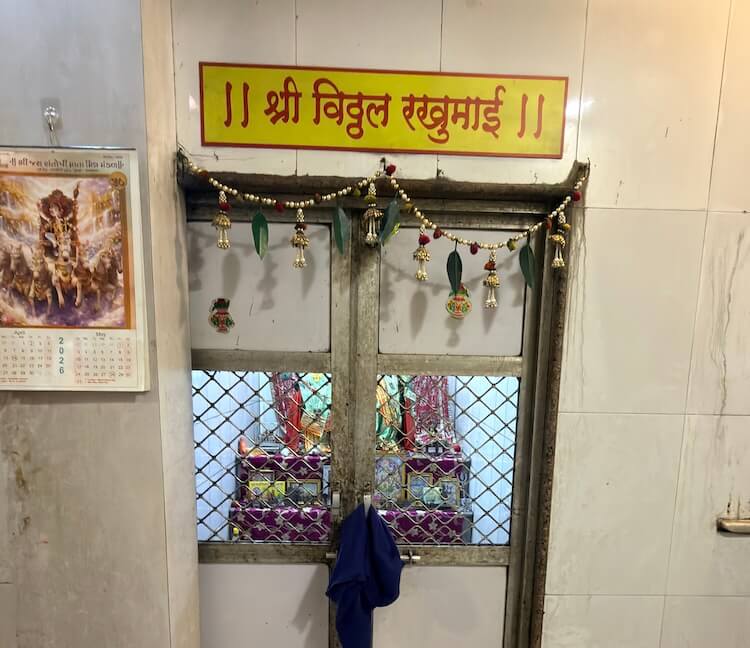
It is said that the presence of Nagdevi here dates back at least four to five centuries. The exact history of the temple’s establishment is unknown. According to local experts, the temple was founded by the Koli community. The temple is located within the building ’92, Nagdevi Temple Building’ on Nagdevi Street. A signboard with the temple’s name is displayed on the facade of the building. The path to the temple leads through a small alley there. Inside, amidst commercial units, lies this small temple. A few years ago, the temple underwent renovations; it was beautified with marble tiles on the walls and flooring. The temple consists of a small mandapa and three sanctums. Upon entering, the sanctum of Nagdevi is directly in front. Inside, an ancient stone idol of Nagdevi is seated on a marble pedestal. The idol depicts a five-hooded serpent carved onto a square stone. The memory of sacrifices once offered to folk deities is preserved in the form of blood-red vermilion (shendur), which is also applied to this idol. The idol is entwined by a large marble Naga king, who holds his hood over the deity like an umbrella. To the right of the main sanctum, in a separate shrine, is an old stone idol of Hanuman smeared with vermilion. In the sanctum to the right of Nagdevi’s main sanctum, the idols of Vitthal-Rukmini are installed. A Ganesha idol is placed in a niche on the outer wall of this sanctum. In the sanctum to the right of this, a Shiva Linga with a brass base (shalunka) is installed on the floor. Above this Shiva Linga, a Naga king holds his hood. Nearby is a mask of Lord Shiva. In the left corner of the sanctum, there is a stone idol of Bhairavnath with a brass mask, and in the right corner, an unhewn stone idol of Sheetala Mata. A marble idol of Parvati is placed in a niche on the back wall of the sanctum. A Nandi idol stands before the entrance of this sanctum.
Devotees can visit the temple between 5:00 AM to 12:30 PM and 4:00 PM to 10:00 PM. Aartis are performed daily at 7:00 AM, 12:00 PM, 7:00 PM, and 9:30 PM. Nag Panchami is the most important festival celebrated here. On this day, special worship of Nagdevi is performed, and many women visit to offer prayers. Devotees from various parts of Mumbai come here to offer milk to Nagdevi. Additionally, festivals like Ashadhi and Kartiki Ekadashi, and Shivratri are also celebrated here.
This sacred temple stands as a testament to deep spiritual devotion, ancient architectural grandeur, and rich local cultural traditions.
The sanctum sanctorum houses the divine idol consecrated according to ancient Vedic traditions, surrounded by serene courtyards and traditional temple architecture.
Navratri, Maha Shivratri, Annual Temple Jatra & Deepotsav
Compare and book flights, secure top-rated local hotels near the temple, hire reliable guides, and rent cars instantly.
Extend your pilgrimage by visiting other highly sacred temples located nearby.


Add ₹999 more to unlock FREE SHIPPING!
Your sacred cart is currently empty.
Shop Photo FramesFill in your delivery details below to place your order.
Add comment