
Add ₹999 more to unlock FREE SHIPPING!
Your sacred cart is currently empty.
Shop Photo FramesMumbadevi is the ‘Gramadevata’ (tutelary deity) of Mumbai. It is said that this great metropolis derives its name from this protecting Goddess. Mumbadevi is the folk deity of the Agri-Koli community, the original inhabitants of Mumbai. The temple of Mumbadevi, who has resided on the island of Mumbai for at least 700 years, was built in Bhuleshwar in the eighteenth century. In this temple, the Goddess is worshipped in the form of Parvati. The temple also houses shrines for Jagadamba and Annapurna Mata. Devotees from not only Mumbai but also from outside the city stand in queues daily to seek the blessings of these Goddesses of power and prosperity.
It is now widely accepted that the name of the city, Mumbai, comes from the name of Mumbadevi. The history of this name is quite fascinating. Until the last decade of the fifteenth century, neither was this city here, nor was it called Mumbai. There were seven islands here: Great Colaba, Little Colaba, Mazgaon, Parel, Worli, Matunga, and Mahim. The Greek mathematician and geographer Claudius Ptolemy recorded these islands as ‘Heptanesia’ in Aparanta in 150 AD. The Portuguese first set foot on the island of Mahim on 21 January 1509. Later, in 1534 AD, Sultan Bahadur of Gujarat ceded these islands to the Portuguese. The Portuguese referred to these islands by names such as ‘Bom Vida’, ‘Buam Bahia’, and ‘Bombaim’. It is said that the name Mumbai originated from the corruption of these names into Bombay and subsequently into Mumbai.
However, the scholarly work ‘The Rise of Bombay – A Retrospect’ (1902) by S. M. Edwards, as well as Volume 1 of the ‘Greater Bombay Gazetteer’, have refuted this. Edwards clearly stated that the original name of this city was indeed Mumbai. The Portuguese turned it into Bombaim, and the British into Bombay. This name, of course, comes from Mumbadevi. Historian J. Gerson da Cunha also confirmed this in his book ‘The Origin of Bombay’ (1900).
Many legends are told about the name Mumbadevi. In the Gujarati book ‘Shaktitattva ane Shivatattva’, published by the Shri Mumbadevi Temple Trust in 1985, J. H. Dave provided a legend that the Goddess worshipped as the family deity by Maricha, the maternal uncle of Ravana, is known as Mamai in Saurashtra. Gujarati merchants who came to Mumbai from Saurashtra four to five hundred years ago established this Goddess here. She was named Mumbadevi after Mamai. However, the thesis ‘Mumbadevi and the Other Mother Goddesses in Mumbai’ (March 2009) by Marika Vicziany and Jayant Bapat, published by Cambridge University Press, has expressed doubts about this legend. The authors state that there is no other evidence or explanatory story regarding this legend.
A popular legend regarding Mumbadevi is associated with the Koli community. According to the book ‘Mumbai-che Varnan’ (1863) by Govind Narayan Madgaonkar, Mumbadevi is the family deity of the Kolis, and she was established by a Koli woman named Munga, who ‘according to the scriptures of the Hindu people, named her Mungadevi. It is possible that this evolved into Mumbadevi. Or perhaps some Brahmin replaced the letter ‘ga’ with ‘ba’.’ A legend regarding the name of this Goddess appears in a 52-verse Sanskrit Mahatmya. It states that ‘formerly, a great demon named Mumbarak lived on this island. He performed penance to please Lord Brahma and asked for a boon that he should not die at the hands of anyone and should always be victorious. Brahma granted his wish. Consequently, he began to torment people and gods on earth. Then all the gods sought refuge in Vishnu and prayed that this demon be destroyed. At that time, gods like Vishnu and Shiva drew out their own radiance to create a Goddess to kill the demon. The Goddess mortally wounded Mumbarak and threw him to the ground. The demon then sought refuge in the Goddess. He praised the Goddess. Upon this, the Goddess asked him to seek a boon. He then said that my name should accompany yours and it should be famous in the world forever.’ The Goddess adopted the name Mumbadevi after this demon Mumbarak. This legend is also mentioned on the official website of the Mumbadevi Trust. Govind Narayan Madgaonkar has stated that ‘this demon might have been the first Mubarak.’ J. H. Dave, as well as Krishnarao Raghunathji Navalkar alias K. Raghunathji, who published the book ‘The Hindu Temples of Bombay’ in 1895, also expressed the same opinion.
According to ‘The Gazetteer of Bombay City and Island’ (Volume 1), Mubarak Shah I was a Sultan of Gujarat in the fourteenth century. In 1318 AD, he captured the regions of Mahim and Salsette. At this time, the Muslim army had destroyed the temples of Mahalakshmi and Mumbadevi here. The exact history of the establishment of the original temple of the Goddess is unknown. However, when Balakrishnarao Somvanshi, a commander of Mumbai’s first king Pratap Bimb, brought the area up to Walkeshwar under his control in 1142 AD, there was a temple of Mumbadevi here, just like Walkeshwar. Where the Chhatrapati Shivaji Maharaj Terminus (CSMT, formerly Victoria Terminus) stands in Mumbai today, there was once a ‘Phansi Talao’ (Gallows Tank). The original temple of Mumbadevi was near this tank. The temple was moved from there to build new fortifications around the Mumbai fort. According to the ‘Greater Bombay District’ (Volume 1) gazetteer, this event took place in 1766 AD. According to Govind Narayan Madgaonkar, since there was no true heir to the original temple standing at Phansi Talao, the East India Company government determined the value of the temple and demolished it. The responsibility of building this temple at its current location was entrusted to Pandusheth Sonar. He was a prominent merchant of that time and a respected gentleman with significant influence in the government circles. He built this temple at its current location in Bhuleshwar. The new Mumbadevi temple is mentioned in the book ‘Journal of a Short Residence in India’ by the British travel writer Maria Graham (Lady Calcott). Maria Graham personally visited this temple on the day of 15 August 1809. She writes, ‘The largest pagoda (temple) in Bombay is in Black Town, about one and a half miles from the fort. It is dedicated to Mumba Devi. Judging by her idol and attributes, she appears to be Parvati, the wife of Shiva. Inside a large courtyard surrounded by high walls, there is a beautiful pond. It is built of stone and has steps to facilitate bathers according to the water level. Around the pond are the houses of Brahmins, a dharmashala for the accommodation of travelers, and temples of various deities. In one of these temples, there is a beautifully carved Trimurti. It is like a huge bust with three faces. The middle face is of Brahma the Creator, the one on the right is of Shiva the Destroyer, and the one on the left is of Vishnu the Preserver. Rice, fruits, milk, and flowers are offered to these deities daily, and they are continuously anointed with water.’ (Journal of a Short Residence in India, Second Edition, 1813, p. 14). The Mumbadevi pond mentioned by Graham was built by Sheth Nagardas Navlakha.
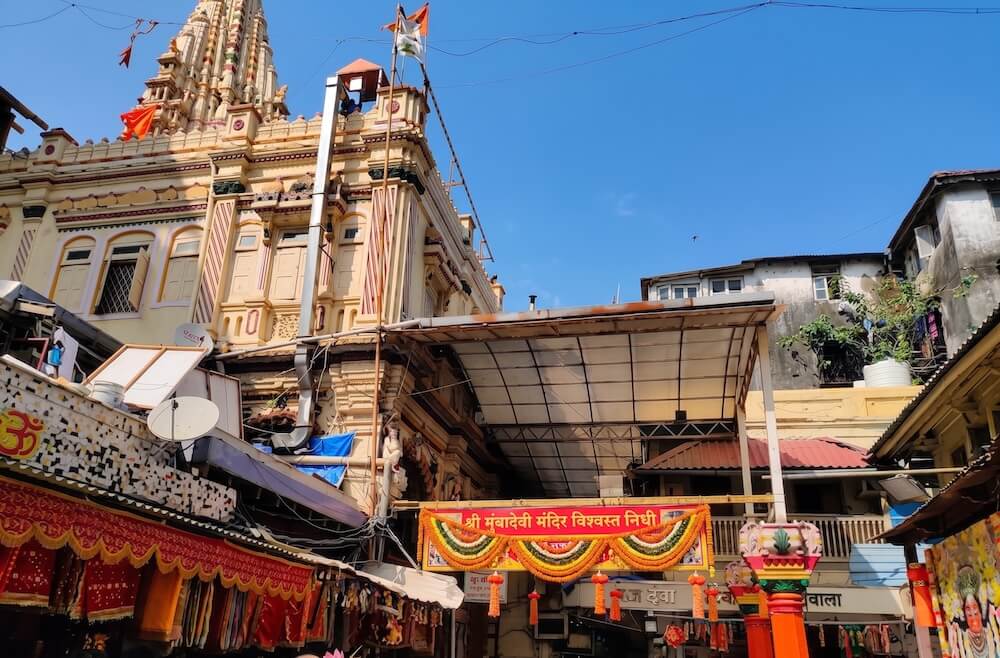
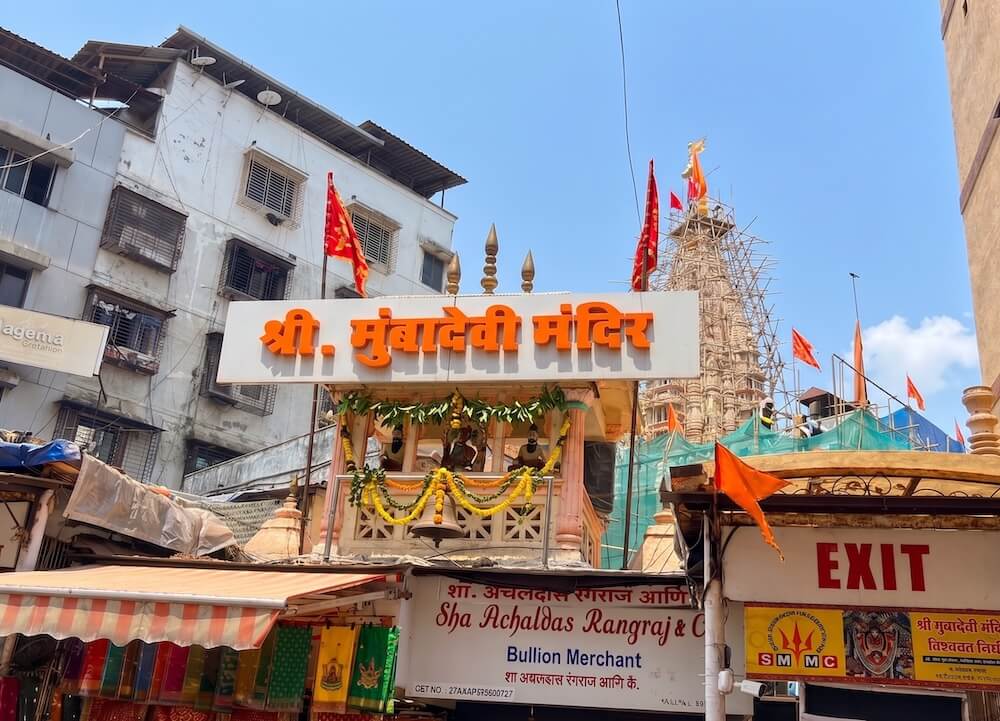
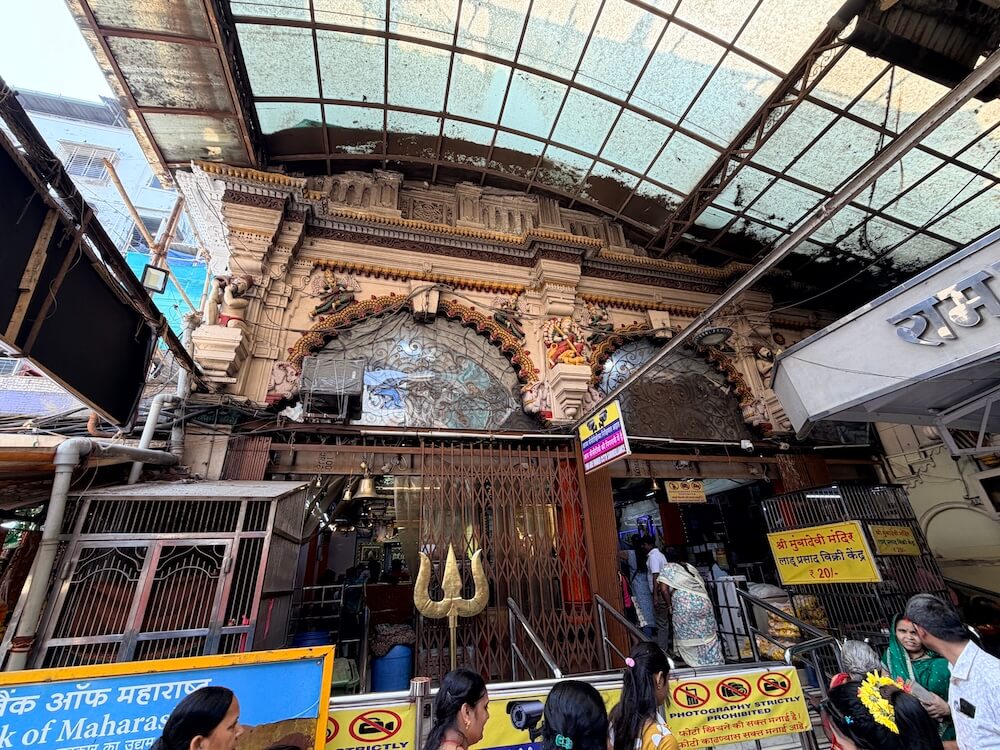
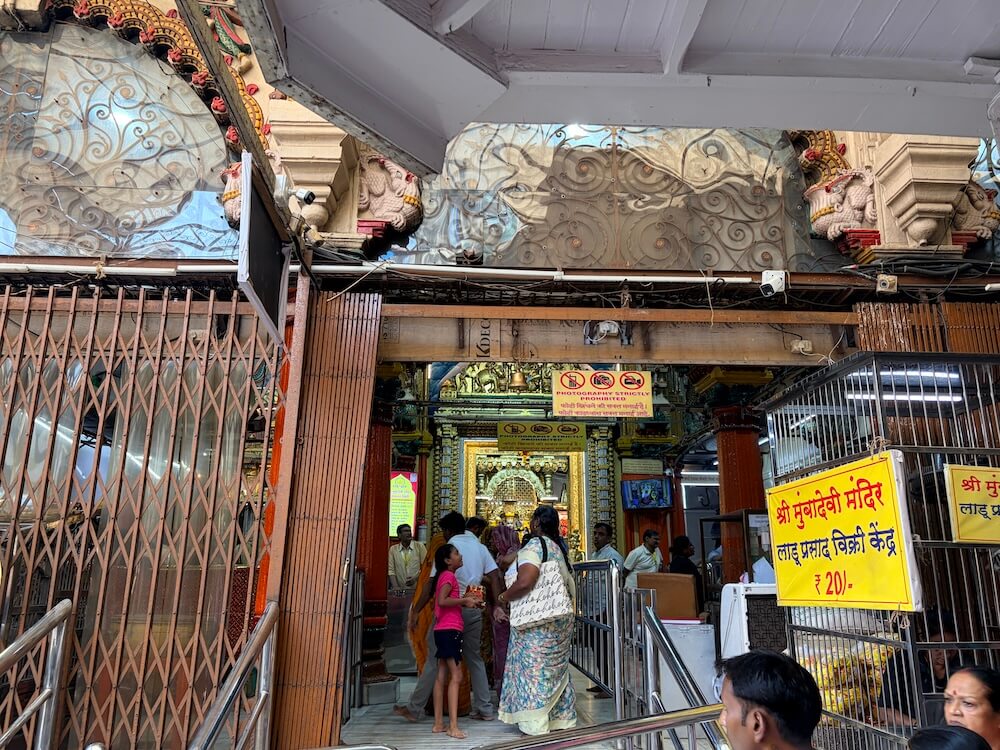
The entrance to the Mumbadevi temple complex is located amidst the crowd of many shops on the main road of Bhuleshwar. It is easily recognizable by the queue of devotees and the bustling crowd. In the pavilion above this entrance, which resembles a nagarkhana (drum house), the idol of the eighteen-armed Durga Devi is enshrined in the center. Here, the Goddess is in her demon-slaying form. Beside this idol are the idols of two sages. There are three spires in the upper part. After walking some distance from here through the crowd of shops selling worship materials and other items, one reaches this temple of the Goddess, which is over two hundred and fifty years old. There is a small courtyard in front of the temple. It has an elephant-back (gajaprishthakara) shaped roof for the convenience of devotees. In this courtyard, there is a large pillar. Right next to it, a large replica of a conch shell has been erected. There is also a large havan-kund (sacrificial fire pit) nearby. In front of the temple steps, there is a large golden trident. This temple of the Goddess is tall and magnificent, built in marble stone. The structure of the temple consists of a sabhamandapa (assembly hall) and a garbhagriha (sanctum sanctorum). The spire of the temple is in the Urushringa style of Nagara architecture. It is topped with an amalaka and a kalasha. A religious flag (dharmadhwaja) flutters on the spire. The assembly hall of the temple is approximately two stories high. The assembly hall has three entrances. Two of these entrances are wide, while the third is relatively smaller. The arches of these entrances feature makara-toranas (crocodile-shaped arches). There are sculptures of surasundaris (celestial beauties) as well as ascetics playing the conch and veena. In the upper part between the two arches, the idol of the eighteen-armed demon-slaying Durga Mata is enshrined.
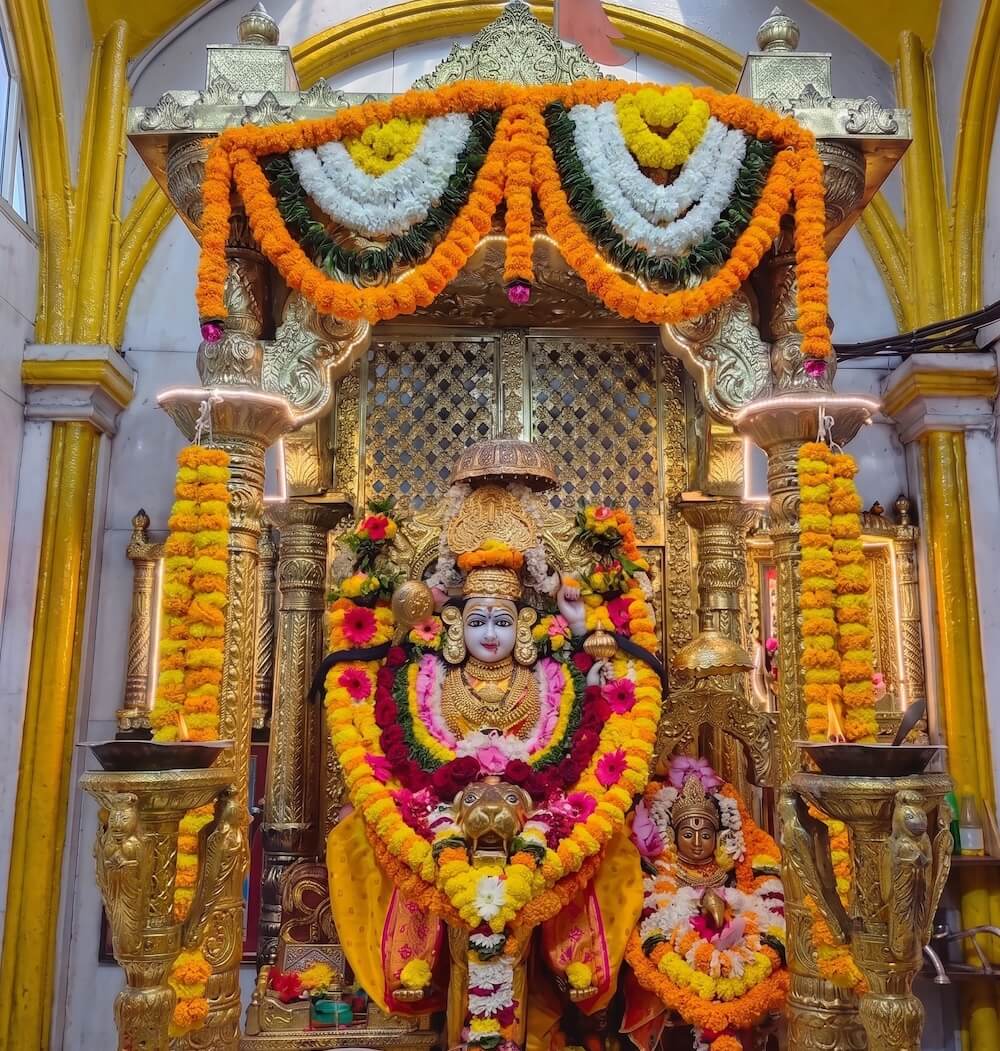
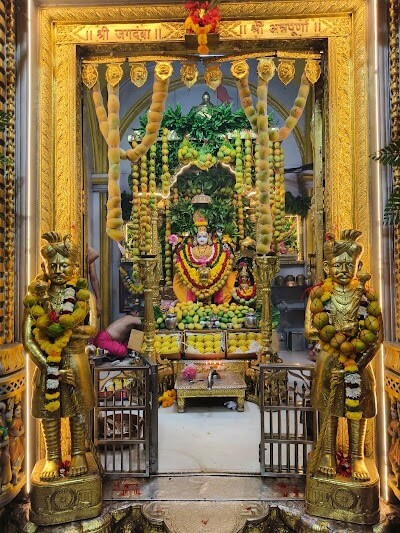
One enters the assembly hall through the darshan queue. Directly ahead is the sanctum sanctorum of the temple. The facade of this sanctum is adorned with intricate carvings. The entrances to the sanctum are covered with gilded sheets featuring embossed designs. On the lintel of the doorway to Mumbadevi’s sanctum, there is an idol of Ganesha. Inside, on a high marble altar, Mumbadevi, the presiding deity of Mumbai, is seated. The original idol of the Goddess is made of black stone and is in a standing posture. She is adorned with garments, ornaments, and garlands of flowers. The Goddess has large eyes. She wears a nath (nose ring), a traditional Marathi ornament. On special festivals and occasions, a golden mask is placed on the face of the Goddess. The Goddess wears a golden crown. In front of her, the face of a gold-plated lion is visible. A sword is kept on a brass stand in front of the Goddess. This idol of the Goddess is from ancient times. In the highly decorated sanctum adjacent to Mumbadevi’s, the idols of Jagadamba Mata and Annapurna Devi are enshrined. The idol of Jagadamba is made of marble stone. Here, the Goddess is seated on a lion. Next to this idol is a small brass idol of the Goddess. The idol of Annapurna Devi is made of original stone and is smeared with vermilion. A silver sheet has been placed over the original stone of the idol. In 1895, when Krishnarao Raghunathji Navalkar, alias K. Raghunathji, wrote a description of Mumbadevi, only the idols of Mumbadevi and Annapurna Devi were present here. Except during the Navratri festival, the vahanas (vehicles) of Mumbadevi and Jagadamba Mata are changed. The garments of the Goddesses also change according to the day of the week. According to the information provided by the temple priests, the Goddess is adorned with white garments on Monday, red on Tuesday, green on Wednesday, yellow on Thursday, light green on Friday, blue on Saturday, and red again on Sunday.
A special feature of this temple is the Shri Yantra here. This golden Shri Yantra is kept in the sanctum of Mumbadevi. This Shri Yantra has been consecrated by Shankaracharya Jayendra Saraswati of the Kanchi Kamakoti Peetham. A special worship called Rajopachara is performed here during Navratri. This worship concludes with a homa (fire ritual) in front of the temple on the ninth day (Navami).
Devotees start gathering for darshan in this temple from early morning. Devotees can have darshan of the Goddess in the temple from 6:30 AM to 9:00 PM. During the Navratri period, the darshan timings are from 5:30 AM to 10:30 PM. The temple has an aarti every morning at 5:30 AM. After that, there is the main aarti at 9:30 AM, an offering of milk and fruits followed by an aarti at 11:30 AM, a dhup-aarti in the evening at 6:30 PM, the main aarti at 8:00 PM, and the shayan-aarti (night prayer) at 10:15 PM. There is a huge crowd of devotees in the temple for the main aartis of the Goddess. Four Navratri festivals are celebrated in this temple throughout the year: Sharadiya, Chaitra, Ashadha, and Magh. During those times, this temple complex in Bhuleshwar takes on the appearance of a grand fair. Apart from this, festivals like Ram Navami, Hanuman Janmotsav, Mahavir Jayanti, and Krishna Jayanti are also celebrated in the temple. Every year on Kartik Pratipada, the Mumbadevi Annakut festival is held here, and a Navchandi Yajna is performed on every full moon day. Magh Ekadashi is celebrated as the temple’s foundation day (Patotsav). There is a huge crowd of devotees for all the festivals in this temple, which is the center of faith and devotion for the people of Mumbai. Next to this temple is the Indrayani Ambaji Temple. In it, the idol of Amba Mata in the form of rice (tandula) is enshrined.
This sacred temple stands as a testament to deep spiritual devotion, ancient architectural grandeur, and rich local cultural traditions.
The sanctum sanctorum houses the divine idol consecrated according to ancient Vedic traditions, surrounded by serene courtyards and traditional temple architecture.
Navratri, Maha Shivratri, Annual Temple Jatra & Deepotsav
Compare and book flights, secure top-rated local hotels near the temple, hire reliable guides, and rent cars instantly.
Extend your pilgrimage by visiting other highly sacred temples located nearby.


Add ₹999 more to unlock FREE SHIPPING!
Your sacred cart is currently empty.
Shop Photo FramesFill in your delivery details below to place your order.
Add comment