
Add ₹999 more to unlock FREE SHIPPING!
Your sacred cart is currently empty.
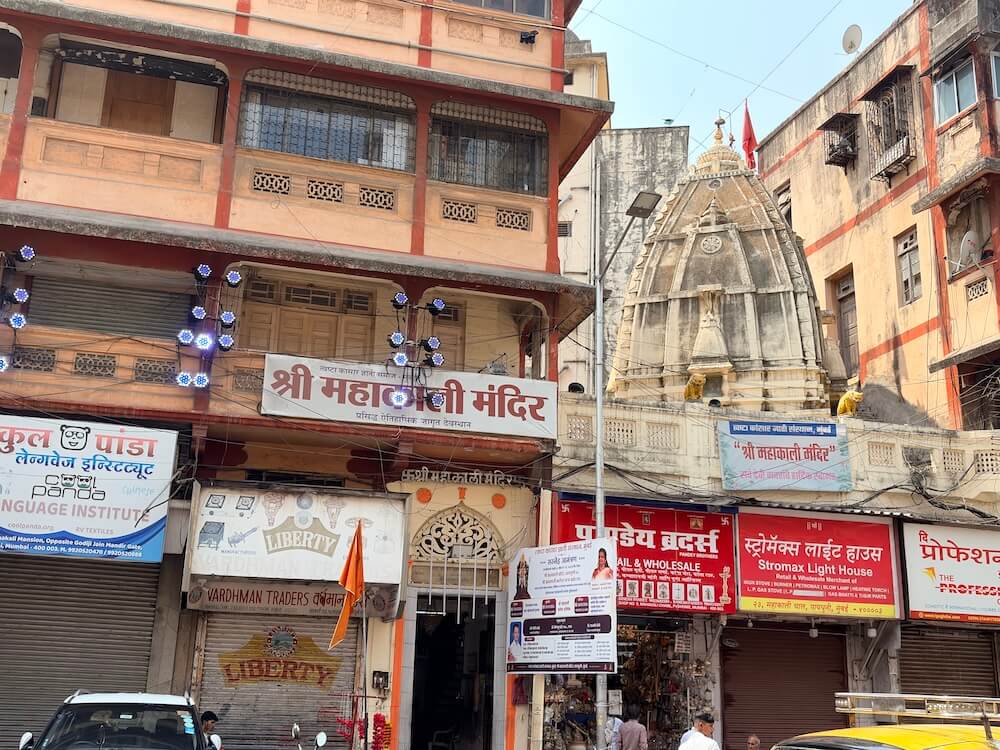
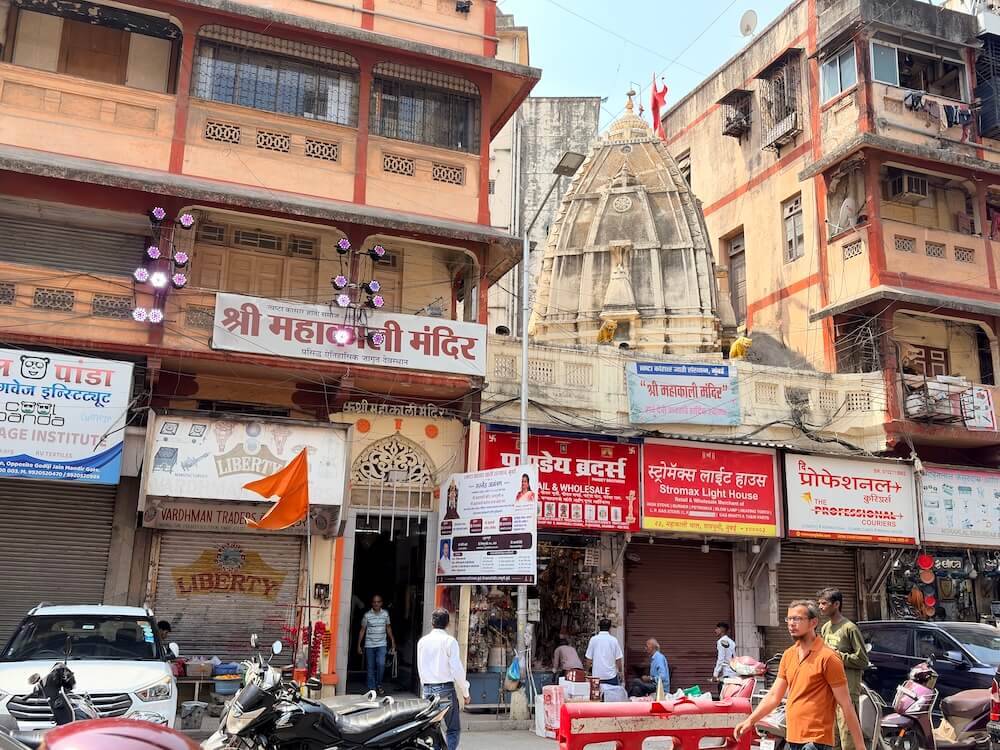
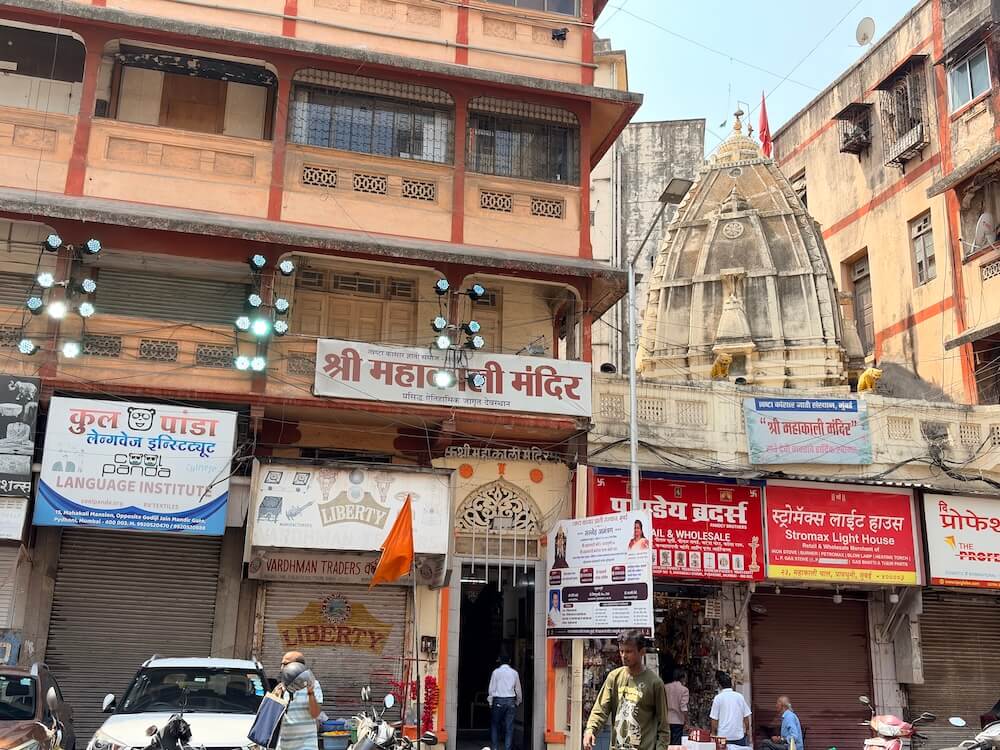
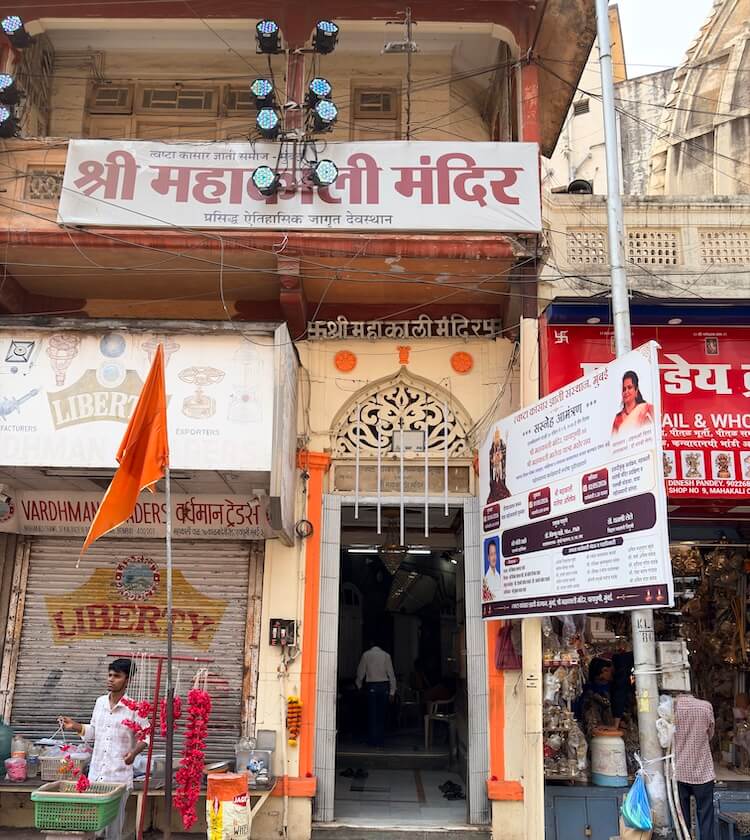
Shop Photo FramesKalbadevi is a form of Mahakali, also known as Goddess Kalika. Situated on the very street named after the Goddess in Pydhonie is the Mahakali Temple, which is more than two hundred and fifty years old. Mahakali is considered the family deity (Kuladevata) of the Twashta Kasar community. This Goddess, who slays the wicked, is worshipped as a protective deity in the Twashta Kasar community. Eminent citizens of this community came together to establish this temple here. This temple is a revered spiritual sanctuary for countless families of this community in Mumbai. The annual festival (Yatra) of the Goddess takes place on Vaishakh Purnima. Thousands of citizens participate in this celebration.
According to the legend in the ‘Devi Mahatmyam’, the primal nature, Adimaya Bhagavati Mahalaxmi, created two forms, Mahakali and Mahasaraswati, from Tamo guna and Sattva guna, and instructed them to produce one pair of male and female each, suitable for their respective qualities. From that, the universe and creation subsequently came into being. Thus, it is believed that just as Mahakali is the destroyer, she is also the Mother of the Universe and the nourisher. The most famous legend associated with this Goddess is related to the demon named Raktabija. According to the eighth chapter of the ‘Durga Saptashati’, Raktabija was a powerful demon. He had received a boon from Lord Shiva that if a drop of his blood fell on the ground, another demon exactly like him would be created from it. Because of this, he had become invincible. To rescue the gathering of deities from his misdeeds, Goddess Durga assumed the form of Mahakali. While fighting Raktabija, so that not a single drop of his blood would fall on the ground, Kali assumed a colossal form and that is Mahakali. She consumed Raktabija’s blood even before it could touch the ground. In this manner, she annihilated this fearsome Asura.
The Twashta Kasar community considers itself to be the descendants of Twashta Rishi. Twashta is also the name of a deity in the Vedic group of deities. According to an entry in the Marathi Vishwakosh (Marathi World Encyclopaedia), ‘He was the artisan of the gods. He fashioned Indra’s Vajra, an iron axe for Brihaspati, and vessels called “Chamas” for drinking Soma. It was he who built Indraprastha for Dhritarashtra (Mahabharata, Adiparva, 2२७·५९), Dwarka for Krishna (Bhagavata 10·50), and Lanka for Indra (Ramayana, Uttarakanda, 5). Nala, who built the bridge (Rama Setu), is his very son. He has also been given names such as Prajapati and Vishwakarma. For whatever had to be done through craftsmanship, he alone had the authority, thus it is mentioned in the Brahmanda Purana (3·1·86).’ In the Brahma Vaivarta Purana, a legend of Vishwakarma is recounted wherein Vishwakarma had a liaison with an Apsara named Dhritachi. Consequently, Lord Brahma cursed that Apsara. As a result, she was born in the house of a cowherd, while Vishwakarma attained birth as a Brahmin. In this birth, these two met at the holy pilgrimage site of Prayag, and from them originated people such as gardeners (Mali), coppersmiths/brassworkers (Kasar), shell-workers, goldsmiths, stone-cutters, etc. It is said that in ancient times, whenever artisans of the Twashta Kasar community performed metalwork, they worshipped Mahakali to protect themselves from the heat and to achieve success. Mahakali is not merely a symbol of destruction; she is also the deity who bestows ‘Moksha’ (liberation). She destroys ego, ignorance, and evil thoughts from the minds of her devotees. It is believed that worshipping her brings victory over enemies and freedom from fear.
Formerly, Pydhonie was an ordinary hamlet in Mumbai. Regarding this, Govind Narayan Madgaonkar wrote in his book ‘Mumbai-che Varnan’, published in z1863z: ‘Matarpakhadi, Umarkhadi, Mazgaon, and Mahim were separate islands with small saltwater creeks in between. The place which we call Pydhonie was a continuous saltwater creek, and when the tide came in, water would flood from Bhendi Bazaar up to Chinchbunder. The reason this place came to be called Pydhonie is said to be that people formerly came from Mahim, Worli, and Matunga, washed their feet in this creek, and then entered Mumbai, which is why it came to be named Pydhonie.’ According to the book ‘Mumbai-cha Vrittanta’ (z1889z) by Balkrishna Bapu Acharya and Moro Vinayak Shingane, the tidal water reached up to Pydhonie until roughly the z1790zs. In that era, in the year z1762z, this temple was established here. Within about a decade of the temple’s establishment, the development of Pydhonie began. Krishnarao Raghunathji Navalkar alias K. Raghunathji published the book ‘The Hindu Temples of Bombay’ in z1895z, which contains notes on temples in central and southern Mumbai. This temple is also recorded in this book.
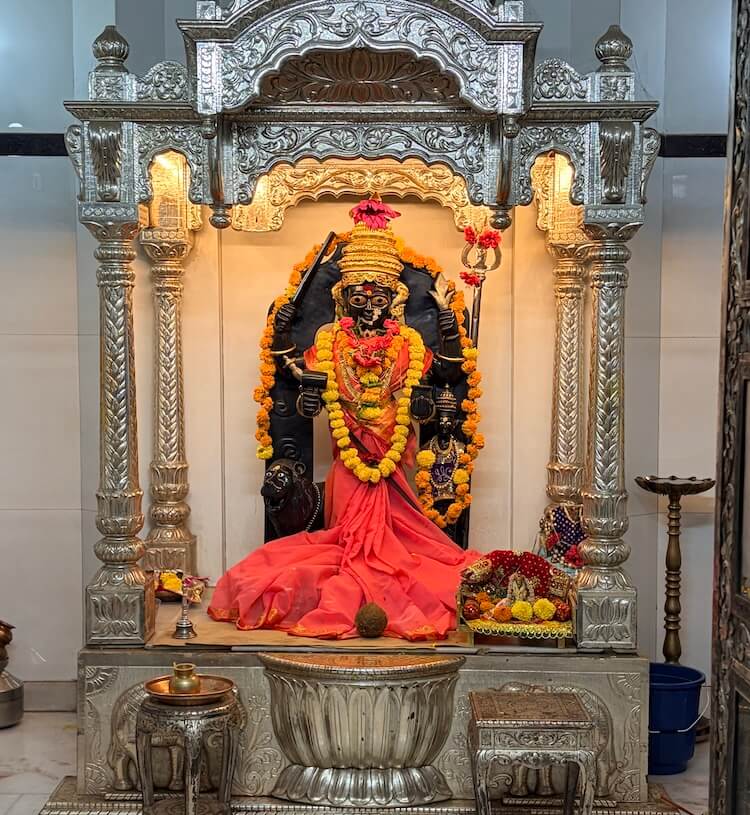
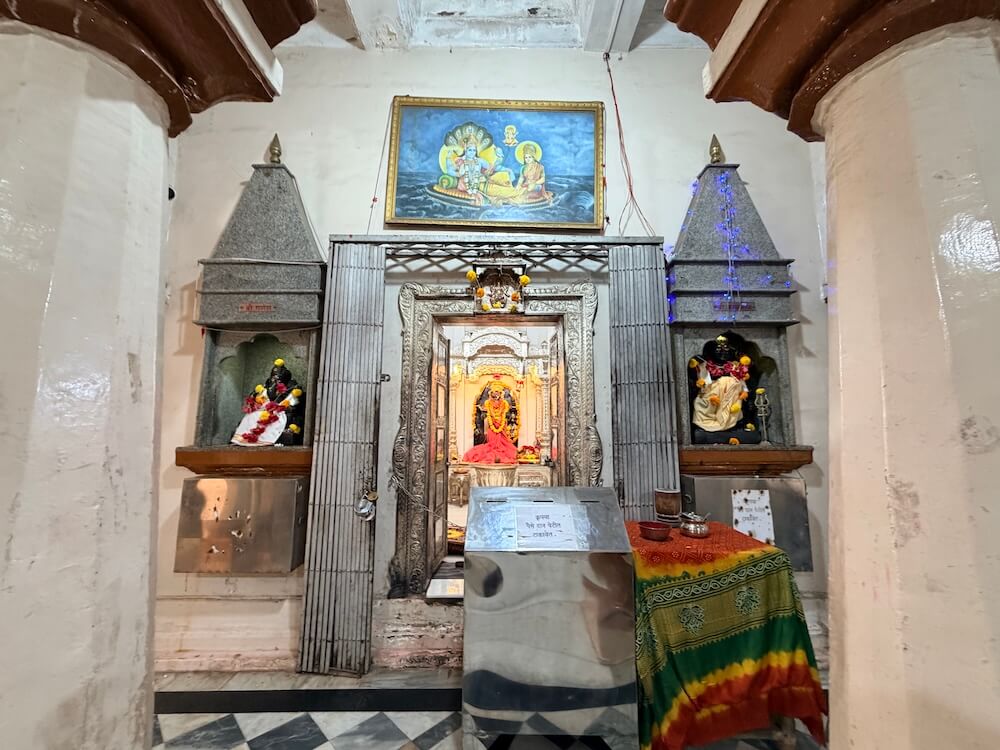
Amidst the hustle and bustle of the busy street and the crowd of shops lies the small entrance of this temple. The architecture of this temple consists of a assembly hall (Sabhamandapa) and a sanctum sanctorum (Garbhagriha). The assembly hall here was built in z1911z. In the assembly hall, on both sides of the entrance to the sanctum sanctorum, there are two large niches. In the left niche is seated the idol of Ganesha, while in the right niche is seated the idol of Kala Bhairava. The door frame here is covered with embossed silver plating. At the lintel centre (Lalatbimba) of the door frame, a carved idol of Ganesha is seated, while in the upper lintel part (Uttaranga) is a large image of Sheshashayi Lakshmi-Narayana. In the sanctum sanctorum, an idol of Mahakali carved in black stone is seated within a magnificent silver shrine. This idol has four arms (Chaturbhuja). In the upper right hand of the Goddess is a Trishula and in the left hand a sword. In the lower left hand is a Damaru, and in the right hand is a vessel (Patra). Adorned with garments, ornaments, and flower garlands, the head of this idol wears a golden crown featuring Makara earrings. Near the feet of the Goddess here is the idol of a tiger (Vyaghramurti). The re-consecration of all three idols—Mahakali, Ganesha, and Kala Bhairava—took place on z9z June z2011z. These idols were crafted by Rajiv H. Talim, a sculptor from the Twashta Kasar community. Over the sanctum sanctorum of the temple rises an Urushringa-type spire, tapering upwards on all four sides. It features niches on all four sides. Atop are the Amalaka and a golden Kalasha. The sacred flag (Dharmadhwaja) is fluttering on the spire. The installation of the Kalasha on this temple took place during the period when the Revolt of z1857z was underway, while a hundred years after that, in the year z1957z, this Kalasha was gilded with gold.
In this temple, devotees can have the divine darshan of the Goddess daily from morning 7 to afternoon 12 and from afternoon 3 to night 9. There is a heavy rush of devotees at this temple on the two days of Tuesday and Friday. Here, festivals and celebrations such as Gudi Padwa, Rama Navami, Hanuman Jayanti, Ashadh Krishna 14 and Falgun Amavasya for Mahapooja (Dandi Pujan), Kojagiri Purnima, Tripurari Purnima, Vasant Panchami, Holi, and Vijayadashami are celebrated with great enthusiasm. The Navaratri festival is also celebrated in the temple with great pomp and in a devotional atmosphere. During this period, on Ashwin Shukla Shashthi, the Gondhal of the Mother Goddess is performed, and on Navami, Homa-Havan is conducted. Vaishakh Purnima is the foundation day of the Mahakali Mata Temple. On this day, a grand fair (yatra) of the Goddess is held here. This three-day long festival commences with the lighting of lamps on the evening of Vaishakh Shukla 14. On Vaishakh Purnima morning, the holy abhishekam is offered to the Mother Goddess. On Vaishakh Krishna Pratipada evening, there is the temple circumambulation (pradakshina) of the Mother Goddess and the Palkhi procession. People from all communities participate in large numbers in this procession.
This sacred temple stands as a testament to deep spiritual devotion, ancient architectural grandeur, and rich local cultural traditions.
The sanctum sanctorum houses the divine idol consecrated according to ancient Vedic traditions, surrounded by serene courtyards and traditional temple architecture.
Navratri, Maha Shivratri, Annual Temple Jatra & Deepotsav
Compare and book flights, secure top-rated local hotels near the temple, hire reliable guides, and rent cars instantly.
Extend your pilgrimage by visiting other highly sacred temples located nearby.


Add ₹999 more to unlock FREE SHIPPING!
Your sacred cart is currently empty.
Shop Photo FramesFill in your delivery details below to place your order.
Add comment