
Add ₹999 more to unlock FREE SHIPPING!
Your sacred cart is currently empty.
Shop Photo FramesThe historic Bhavani Shankar Mandir, one of Mumbai’s renowned Shaivite temples, is situated near Gowalia Tank in the Grant Road area. This temple is two hundred and twenty years old. It is one of the oldest temples of the Daivadnya Brahmin community in Mumbai. A wealthy merchant of nineteenth-century Mumbai, Shankarsheth Murkute, established this temple. He was the father of Nana Shankarsheth, the architect of modern Mumbai, a devotee of Lord Shiva, who laid the foundation for Mumbai’s public life, political movements, and various welfare facilities. Built in the Deccan-Maratha architectural style, this temple is a revered place of worship for countless devotees of Lord Shiva in the area. Annually, a Bhavani Shankar Yatra is held here on Margashirsha Pournima.
Vinayakrao Madhavrao Pitale, former editor of the periodical ‘Daivadnyamitra,’ published the book ‘Charitra of Shrimant Namdar Jagannath Shankarsheth alias Nana Shankarsheth’ in the year one thousand nine hundred and sixteen. According to the information therein, Nana Shankarsheth originally belonged to a Daivadnya Brahmin merchant family from Murbad in Thane district. Among the ancestors of this family, Narayansheth traded pearls in Porbandar, Gujarat. Maniksheth, the son of Narayansheth, held the potdari (a hereditary office) of Murbad. Babulseth, the son of Maniksheth, was Nana’s grandfather. Due to harassment from the Portuguese, he migrated to Ghodbunder, a convenient port for trade near Thane at that time, and began trading from there.
Babulseth was a devotee of Lord Shiva. He had built the Amriteshwar temple in Murbad. He had also established a Shiva temple near his bungalow in Ghodbunder. Shankarsheth was his son. This father and son later migrated to Mumbai for business expansion. Here, they established a firm and started a money-lending business. In seventeen ninety-nine, they earned immense wealth during the Tipu-English war in Mysore. At that time, their treasury contained sixteen lakh rupees in cash and one lakh rupees worth of jewels, as recorded by Vinayakrao Pitale. Jagannath, alias Nana, was born to this Shankarsheth and his second wife, Bhavanibai alias Taibai, on the tenth of February, eighteen hundred and three, in the late night of Mahashivaratri. Bhavanibai passed away a few years after Nana’s birth. Thereafter, in eighteen hundred and six, Shankarsheth built this temple in memory of his beloved wife. The Shiva Lingam, the family deity of the Murkute household, and an idol of Devi Bhavani were installed therein. In the same year, the temple’s consecration ceremony (Pran Pratishtha) was performed on the auspicious occasion of Datta Jayanti. The names of Nana’s father and mother are interwoven in the name of this temple. According to the information in the biography written by Vinayakrao Pitale, Shankarsheth had also built a dharmashala (rest house for pilgrims) next to this temple.
After Shankarsheth’s demise in eighteen twenty-two, Nana, who was then nineteen years old, bore the great responsibility of the family and the trade business. Nana fulfilled it excellently. In his subsequent forty-three-year career, Nana Shankarsheth undertook various welfare activities in Mumbai. To spread education among the local people, he established the ‘Bombay Native Education Society’ here. In his own mansion, he started the ‘Students Literary and Scientific Society’ as well as the ‘Jagannath Shankarsheth Girls’ School.’ He laid the foundation for the Law College in Mumbai. His contributions were significant in the establishment of ‘Grant Medical College,’ ‘J. J. School of Arts,’ ‘Prince Albert Museum’ (Bhau Daji Lad Museum), and Rani Bagh (Jijamata Udyan). He prioritized women’s education, opposed Sati and child marriages, and made substantial contributions in many areas such as Mumbai’s healthcare system, water supply, and patient care. The first railway ran in Mumbai on the sixteenth of April, eighteen fifty-three. For this railway, Nana had established the ‘Great Eastern Company’ here in eighteen forty-three. Due to his tireless efforts, the railway came here, which is why he is known as the ‘Father of Indian Railways.’ In the central courtyard of the Chhatrapati Shivaji Maharaj Terminus (Victoria Railway Terminus) building at Bori Bunder, a stone medallion on the facade features the sculpted masks of Sir Jamshedji Jijibhoy, Lord Elphinstone, Lord Ray, Mountstuart Elphinstone, Sir Bartle Frere, along with Nana Shankarsheth.
Nana was a man of reformist ideas and a religious disposition. When he went to Nashik to perform the Shraddha ceremony for his father, the local priests created a disturbance, stating that as he was not a Brahmin, he did not have the right to perform the Shraddha ceremony according to scriptural rites and rituals. They pelted stones at Nana’s palanquin. At that time, the Collector of Nashik sent a police squad and cavalry to protect him. Even after such an incident, Nana’s devotion did not waver. He was an ardent devotee of Lord Shiva. He had built a large Shiva temple in the compound of his bungalow in Pune. He had also erected Shiva temples in Matheran and Shahapur. He built dharmashalas for devotees in Bhuleshwar, Walkeshwar, Ghodbunder, Vajreshwari, and Shahapur. After his father’s death, he renovated the Bhavani Shankar Mandir premises and created a garden called ‘Anjirbag’ in the area. This garden was formerly very extensive. f5 It is said that it stretched from today’s Grant Road railway station to Bhatia Hospital. Poor citizens in the surrounding areas of Walkeshwar, Mahalaxmi, and Girgaon had to travel to Byculla for medical treatment. Taking this into consideration, he started a dispensary within the temple complex. Due to Nana Shankarsheth’s renovation of this temple, a popular belief arose that he himself had built it. In Govind Narayan Madgaonkar’s book ‘Mumbai che Varnan,’ published in eighteen sixty-three, it is also mentioned that this temple was built by “the renowned Shrimant Jagannathji Shankarsheth.”
In the course of time, the temple built by Shankar Sheth had lost its former glory. It was not even included in the list of Mumbai’s heritage structures. As a result, there was a danger that this temple, like other historical structures in Mumbai, would be destroyed. Taking this into consideration, Dr. Sadashiv Gorakshkar, the then director of the Chhatrapati Shivaji Maharaj Vastu Sangrahalaya, took the initiative. He began efforts to repair the temple and restore the structure to its original form. His efforts were successful, and in the year एक हजार नऊशे सत्त्याण्णव-अठ्ठ्याण्णव, the conservation work of this temple commenced. The Saptakoteshwar Temple built by Chhatrapati Shivraya in Goa, the Shantadurga Temple, Nana Phadnavis’s Wada in Menavali, the temples in the Banganga Tank area of Mumbai, and the HSBC Bank building on Nariman Road in Mumbai were all conserved and renovated by the company ‘Vastuvidhan’. This same company also undertook the conservation work of the Bhavani Shankar Temple. The Shankar Sheth family provided the funding for this project. After this conservation and renovation, which took place in the year दोन हजार दोन, the temple has attained its present form.
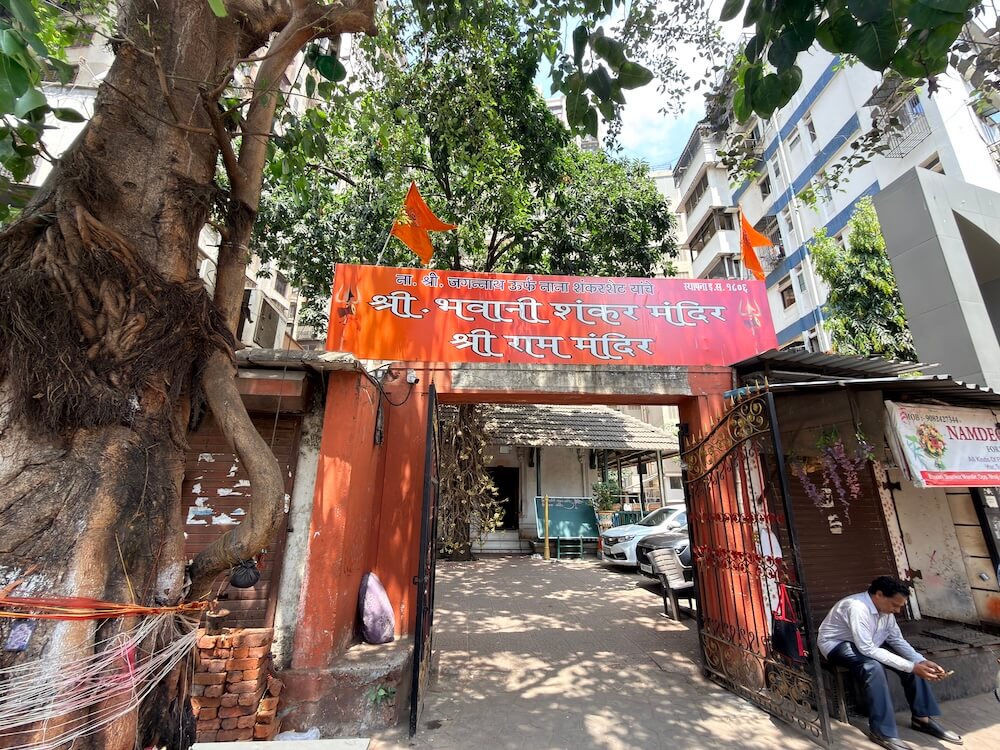
This temple is situated in a spacious compound in Nana Chowk, Grant Road. The compound wall here has a large iron-grilled gate. In front is a paved courtyard. Near the entrance and in the courtyard are tall ‘Kailaspati’ trees. The scientific name of this tree is ‘Couroupita guianensis’. This tree, originally from Central and South America, arrived in Asia about तीनशे years ago. This tree bears fruits resembling cannonballs. Hence, it is also called the ‘Cannonball Tree’ or ‘Tofgolyache Zad’. The flowers of this tree are very distinctive. The inner structure of these large flowers somewhat resembles a Shivlinga, and their petals look like a cobra’s hood. Therefore, this tree is called ‘Nagalingam’ or ‘Kailaspati’ tree. These trees are specifically planted in the courtyards of Shiva temples.
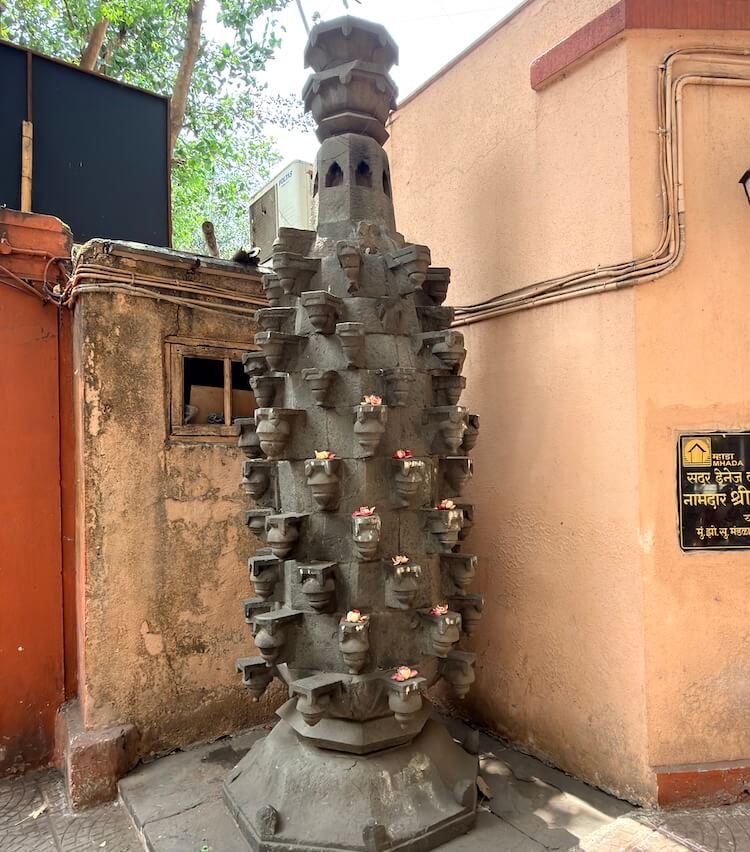
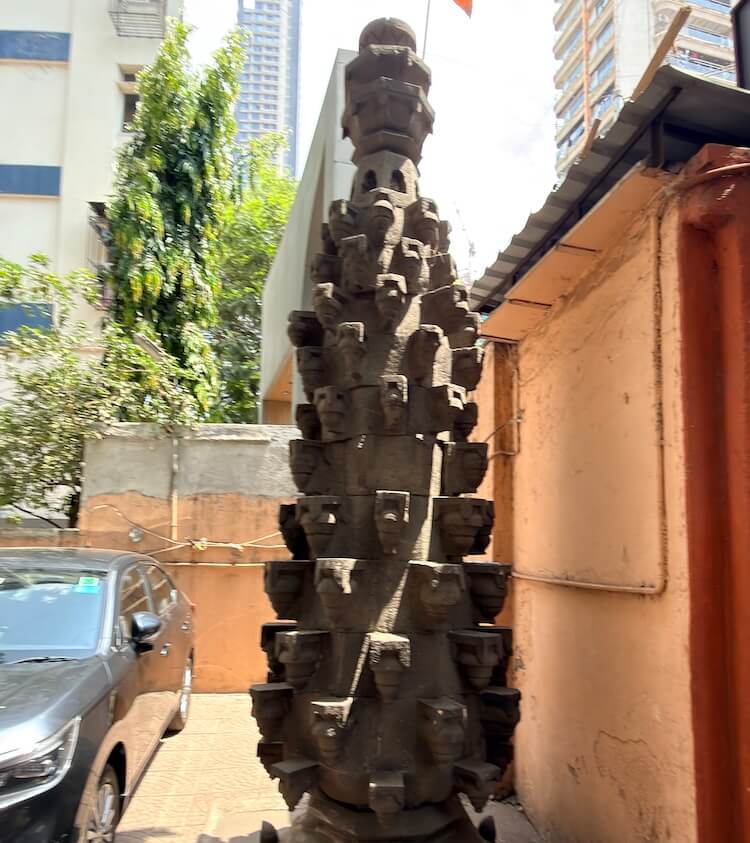
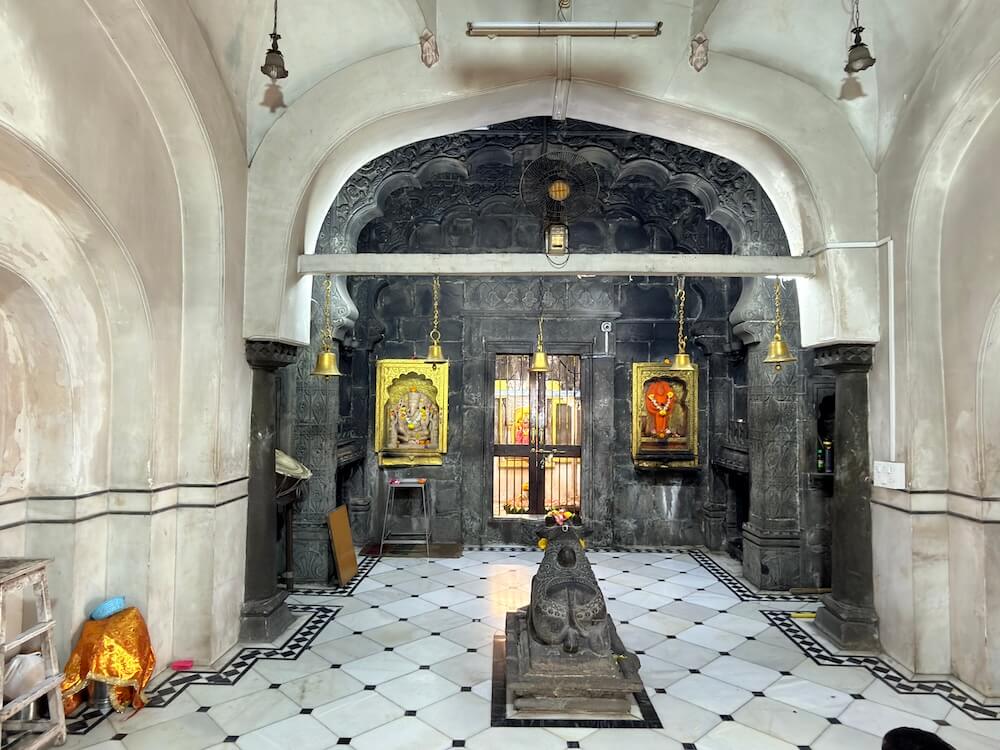
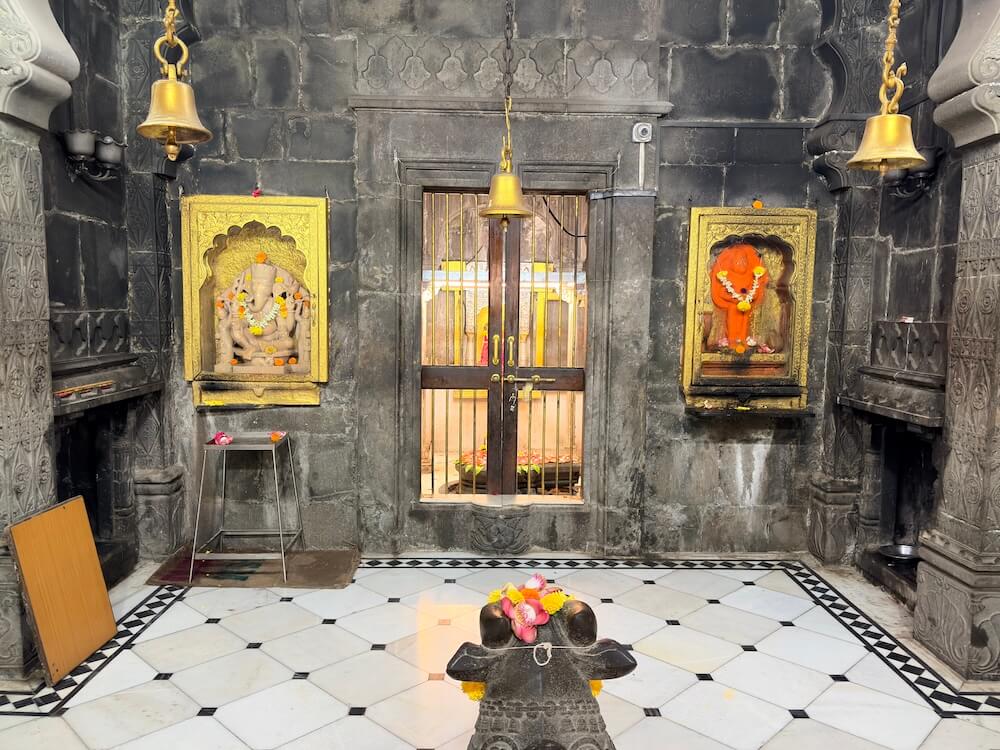
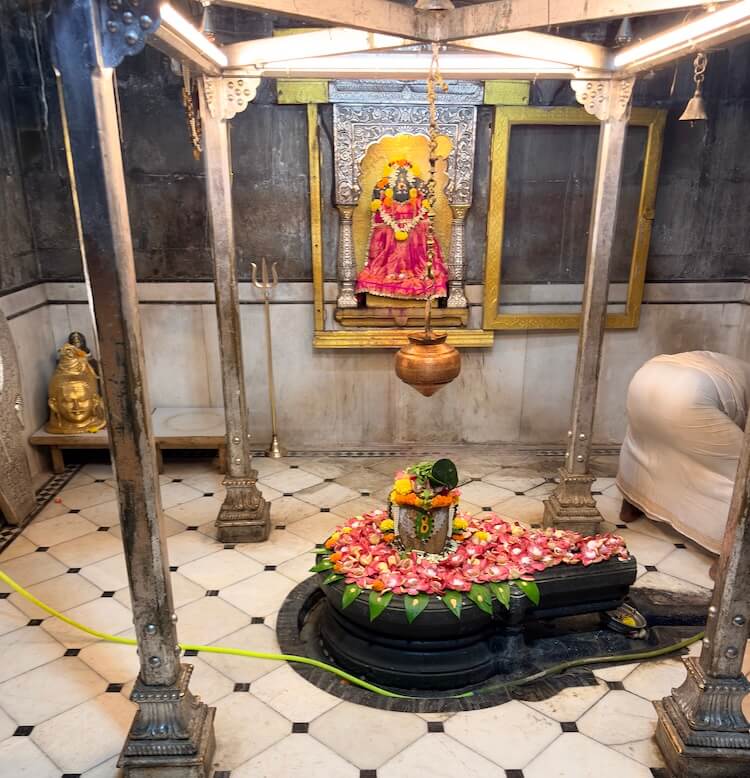
In the temple courtyard, there are two very artistic stone Deepmalas (lamp towers). In front stands the temple in the Deccan-Maratha architectural style. The design of this temple also incorporates a blend of various cultural architectural styles, such as Konkani-style tiled roofs, Maharashtrian-style stone paving, and Islamic architectural jalis (screens). The structure of this temple comprises a Sabhamandap (assembly hall), Antarala (vestibule), and Garbhagriha (sanctum sanctorum). The Sabhamandap of the temple is spacious and has a domed shikhara (spire). A murti of Ganesha is enshrined on the parapet of the roof. The Sabhamandap has three entrances. The inner walls are shaped into arches. An old-fashioned glass chandelier hangs from the domed ceiling of the Sabhamandap. In the front part of the Sabhamandap, a stone murti of Nandi, carved from stone, is enshrined on a stone platform. The Antarala has a large arched stone archway. On the front wall of the Garbhagriha, a murti of Ganesha is enshrined in a golden niche on the left, while on the right niche is a vermilion-smeared murti of Hanuman. The Garbhagriha has a flat stone doorframe. The ceiling of the Garbhagriha is domed. On the ground level, the Shivlinga of Shivshankar is enshrined, and in the shrine on the wall is a murti of Bhavani Mata. Above this Garbhagriha, built entirely of stone, is a shikhara adorned with intricate carvings in the Maratha architectural style.
Behind this temple is a Shri Rama temple. According to the book ‘The Hindu Temples of Bombay’ published in the year एक हजार आठशे पंच्याण्णव by Krishnarao Raghunathji Navalkar alias K. Raghunathji, Nana Shankarsheth belonged to the Daivadnya Brahmin (goldsmith) community. He amicably resolved a specific dispute within this community. In commemoration of that, he had built this temple. After the recent renovation, this temple has attained its current modern form. The structure of this temple comprises a Sabhamandap and a Garbhagriha. The Garbhagriha has a somewhat octagonal shikhara, topped with a three-tiered kalasha (finial). Inside the Garbhagriha, on a high altar, are enshrined marble murtis of Shri Rama, Lakshmana, and Sita, adorned with clothes and ornaments. To the left of this temple, in a large mandap, is a bust of Nana Shankarsheth.
Devotees can have Darshan in this temple from सकाळी ६ to रात्री ८.३०. Many renowned personalities such as ‘Bharat Ratna’ Lata Mangeshkar and ‘Balgandharva’ have visited this temple. According to information provided by Nana’s descendant, Surendra Shankarsheth, during the early period of Lata Mangeshkar’s singing career, her family resided in a dwelling next to the temple. At that time, Lata Didi used to visit this temple daily before going to the music studio.
The main festival here is Mahashivratri. On this day, as well as on Mondays in Shravan, a large number of devotees come for Darshan at this temple. In addition, festivals like Ram Navami, Gokulashtami, and Dattajayanti are also celebrated here with great enthusiasm. Margashirsha Pournima is the day of the deity’s Yatra (procession). In earlier times, this Yatra was celebrated with great pomp. Vinayakrao Madhavrao Pitale’s biography of Nana provides the following information: “During Nana’s time, this fair held great significance. The entire temple, its premises, the grand building of the Dharmashala adjacent to the temple, and Nana’s own palatial bungalow were exquisitely illuminated with lights. Flags and banners were hung everywhere. The place was beautifully adorned. So much so that it dazzled the eyes of onlookers. Among the invited guests on the occasion of the above fair were the Honourable Governor, members of the Council, High Court Judges, Bottlewalas, and other prominent citizens. Once the invited guests gathered at the seating area, a dance program was held for their entertainment. Similarly, after offering roses, garlands, and bouquets, the guests would proceed to the spacious and adorned terrace of the same bungalow. The arrangements there were also exquisite. There were couches and chairs upholstered in velvet and high-quality satin for the guests to sit on. Once the guests were seated, there was a large, extensive garden in front of the bungalow, belonging to Nana himself, called Anjeerbag. In that garden, various types of ornamental fireworks would begin. They were magnificent. It is said that these fireworks were very famous. Afterwards, the ceremony would conclude.”
This sacred temple stands as a testament to deep spiritual devotion, ancient architectural grandeur, and rich local cultural traditions.
The sanctum sanctorum houses the divine idol consecrated according to ancient Vedic traditions, surrounded by serene courtyards and traditional temple architecture.
Navratri, Maha Shivratri, Annual Temple Jatra & Deepotsav
Compare and book flights, secure top-rated local hotels near the temple, hire reliable guides, and rent cars instantly.
Extend your pilgrimage by visiting other highly sacred temples located nearby.


Add ₹999 more to unlock FREE SHIPPING!
Your sacred cart is currently empty.
Shop Photo FramesFill in your delivery details below to place your order.
Add comment