
Add ₹999 more to unlock FREE SHIPPING!
Your sacred cart is currently empty.
Shop Photo FramesChaitanya Mahaprabhu, the extraordinary Vaishnava saint from Bengal, established the importance of the Holy Name by teaching that the path of devotion (Bhakti Yoga) is superior to the path of intellectual knowledge (Jnana Yoga) and that the Supreme Lord can be attained through this path, which is simple and accessible to all. Following the Gaudiya Vaishnava philosophy taught by him, the ‘International Society for Krishna Consciousness’ (ISKCON), which propagates and spreads Krishna consciousness worldwide, has built many beautiful and grand Krishna temples across the globe. The Radha Gopinath Temple, situated in the Girgaon Chowpatty area of Mumbai, is one of them. Known as ‘ISKCON Girgaon Chowpatty’, this temple is considered an important spiritual center for devotees of Lord Krishna. In August 2018, the ‘Indian Green Building Council’ awarded this temple the ‘Reverent’ green rating certification.
A. C. Bhaktivedanta Swami Prabhupada is the founder of ISKCON. He is also known as Srila Prabhupada. The Swami was born on September 1, 1896, in Kolkata. His original name was Abhay Charan De. His father, Gour Mohan De, and mother, Rajani, were religiously inclined. From childhood, they instilled the values of Krishna devotion in him. He received his education at the Scottish Church College in Kolkata, where he mastered English, Sanskrit, and various other subjects. In 1922, Prabhupada met Bhaktisiddhanta Saraswati Thakura, a great saint in the Sri Gaudiya Vaishnava tradition. In 1933, Prabhupada received formal initiation from Bhaktisiddhanta Saraswati and became a preacher of the Vaishnava tradition. For some time, he worked in the pharmaceutical business to support his family, but after 1950, he retired from worldly life and dedicated himself full-time to Krishna devotion and spiritual preaching. In 1959, he accepted Sannyasa, the renounced order of life. In this ashram, he adopted the name A. C. Bhaktivedanta Swami.
It was the desire of his guru, Bhaktisiddhanta Saraswati, that Swami Prabhupada should take the teachings of Lord Krishna to the Western world through the English language. Accordingly, Swami Prabhupada wrote the commentary ‘Bhagavad-gita As It Is’. He also translated the Srimad-Bhagavatam and other Vaishnava scriptures. In 1965, at the age of 69, overcoming many difficulties and two heart attacks during his journey, Swami Prabhupada went to America. Under his vision, ISKCON was founded in New York in 1966. Prabhupada established this organization with the primary objective of spreading the Bhagavad-gita and Vaishnava philosophy throughout the world. He taught people the ‘Hare Krishna Mahamantra’ and started a Bhakti movement based upon it. Swami Prabhupada wrote over 70 books, including commentaries on the Bhagavad-gita and Srimad-Bhagavatam, and the major work, Chaitanya Charitamrita. He departed from this world on November 14, 1977, at the Krishna Balaram Temple in Vrindavan. Today, more than six hundred grand ISKCON temples, over sixty agricultural communities, and fifty gurukulas are active in more than 100 countries around the world. Among these, the grand temples in Vrindavan, Bengaluru, Delhi, and Juhu in Mumbai are famous for their architecture and spiritual activities. Only Lord Krishna is worshipped in these temples. There is a significant reason for this. In the ninth chapter of the ‘Srimad-Bhagavad-gita’, titled ‘Rajavidya Rajaguhyayoga’, Lord Krishna states that the worship of other demigods is born of ignorance. This verse is: ‘ye ’py anya-devatā-bhaktā yajante śraddhayānvitāḥ | te ’pi mām eva kaunteya yajanty avidhi-pūrvakam ||23||’ This means, ‘O son of Kunti, even those who worship other gods with faith and devotion are actually worshipping Me alone; but they do so in an improper way, out of ignorance.’
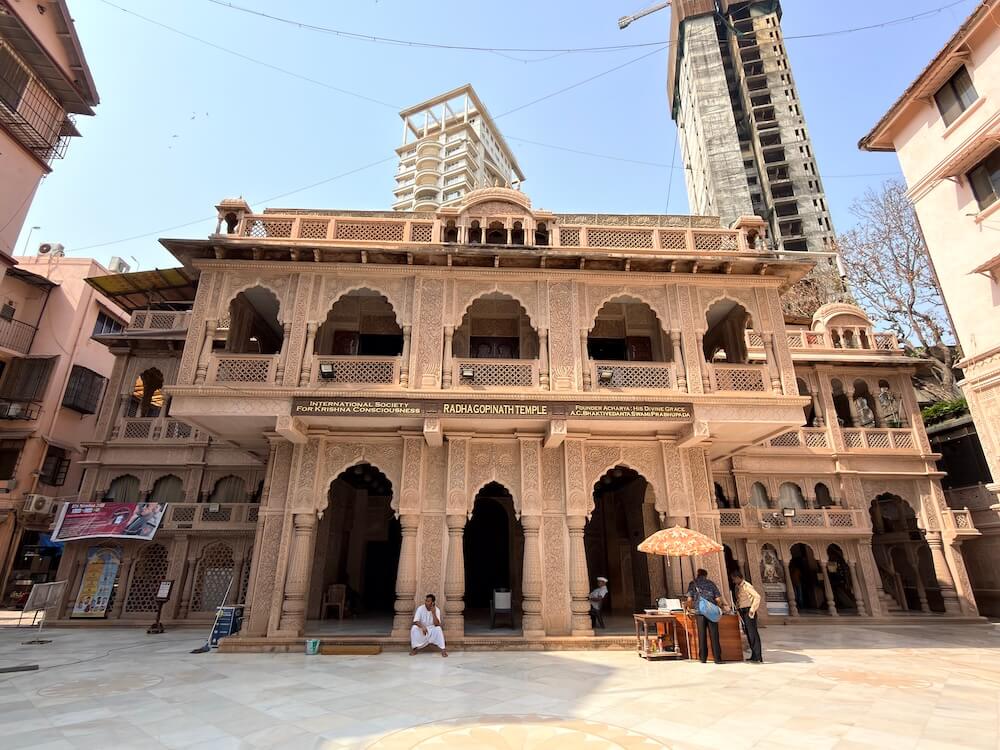
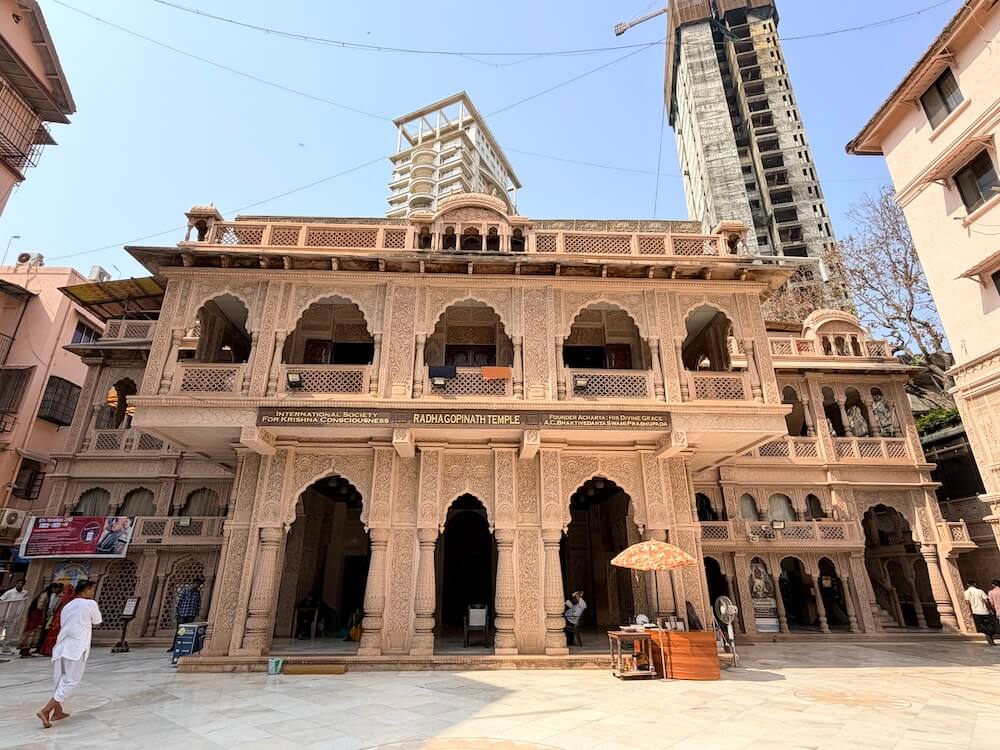
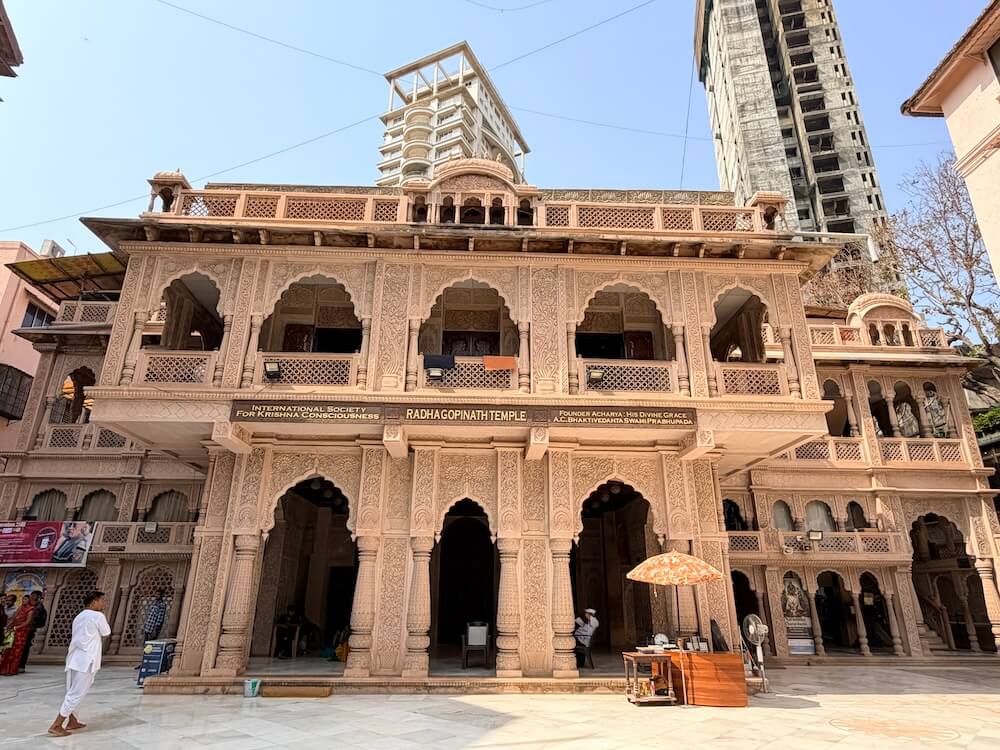
The history of the construction of this temple is told as follows: the temple began in a very simple form. Arvind Mafatlal, the then-president of the Lady Northcote Hindu Orphanage, and the managing trustee, Dr. N. D. Desai (Sri Nathji Das), invited ISKCON devotees to help run the orphanage according to the traditional gurukul system. Initially, the trustees gave ISKCON only a small room behind the orphanage. A few devotees began to live in that small space with their minimal belongings. In 1971, Swami Prabhupada came to the nearby ‘Bharatiya Vidya Bhavan’ for a program. After the program, while descending the steps of Bharatiya Vidya Bhavan, he suddenly pointed his cane toward the site where the temple currently stands. His secretary, Shyamasundar Das, was with him. Swami Prabhupada told him that we should have a temple here. Swami Prabhupada’s devotees and followers accepted this instruction, and under the guidance of Sri Radhanath Swami Maharaj, that small room was transformed into today’s magnificent temple. On July 17, 1988, in a grand ceremony, the deities of Radha Gopinath were installed. The temple was built by artisans from Odisha, following the style of the Rajasthani palaces and grand havelis found in the Krishna-lila land of Vrindavan in Uttar Pradesh. Sandstone from Bharatpur, Rajasthan, was used for the temple. The intricate carvings on this stone were done by sculptors from Patan, Gujarat. The temple is situated in the quiet area of Girgaon. The spacious and clean courtyard of the temple is paved with marble throughout. On the second floor of this two-story haveli-style temple lies the grand assembly hall and the sanctum sanctorum. The floor of this assembly hall is made of Italian marble. ‘Burmese’ teak wood has been extensively used for the niches on the walls of the assembly hall, which feature intricate carvings. The ceiling of the assembly hall is adorned with four beautiful chandeliers. Chairs have been placed along the walls at various spots for the convenience of devotees. In accordance with ISKCON temple standards, a statue of Swami Prabhupada has also been installed in this pavilion. This statue is seated within a grand and beautiful wooden altar (makhar). In the glass display case on the wall behind the altar, copies of the Bhagavad Gita As It Is, authored by Swami Prabhupada and translated into various languages from around the world, are kept. Along one wall of the assembly hall, a sacred seat (gadi) is placed. On the pedestal atop this teak platform, a copy of the Srimad Bhagavad Gita, wrapped in red cloth, is kept.
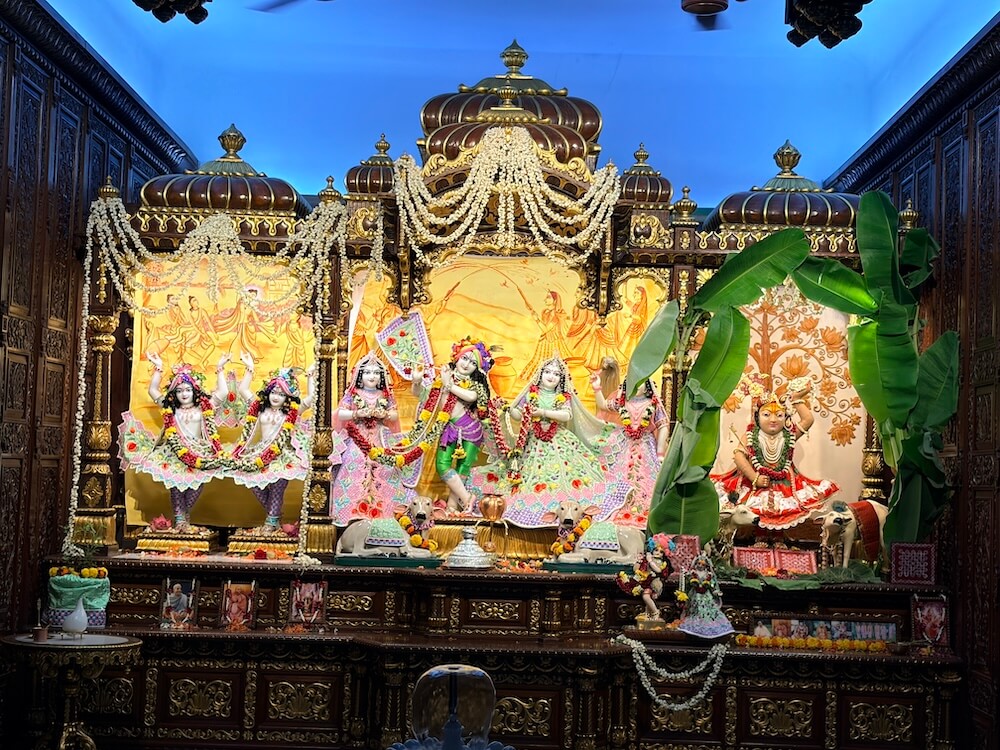
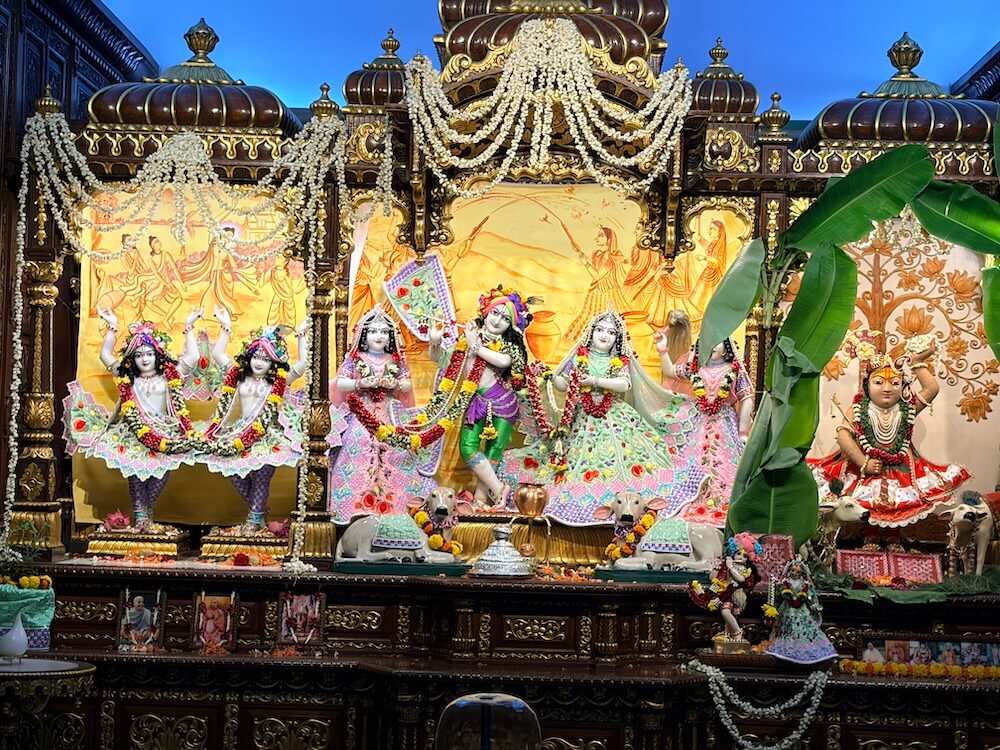
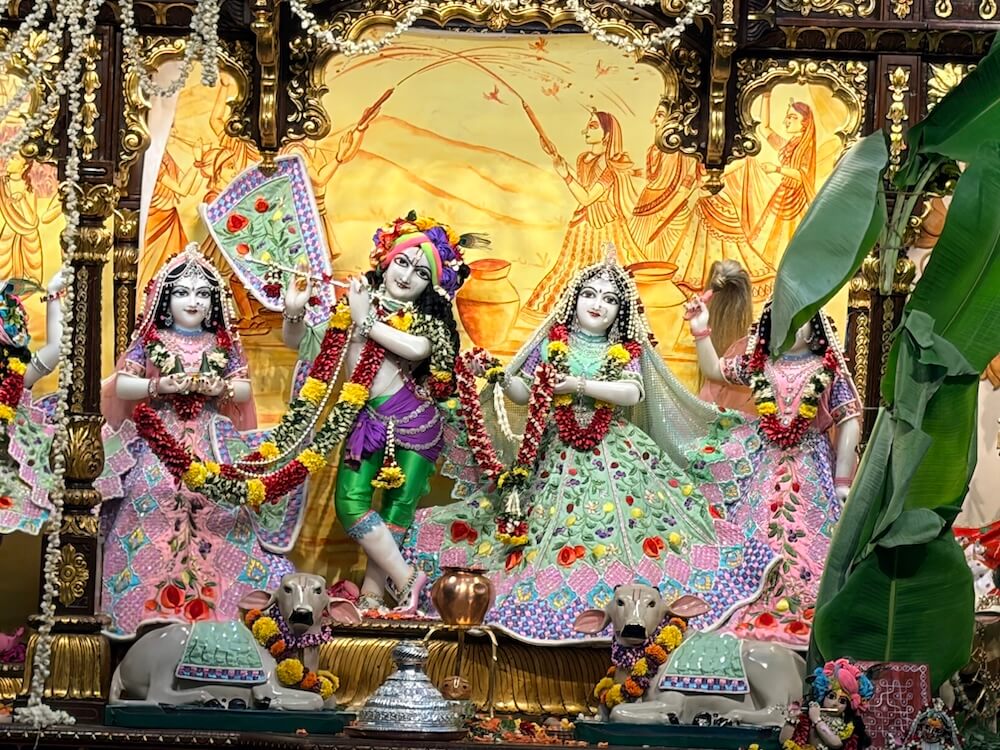
The sanctum sanctorum (garbhagriha) of the temple and its throne are considered an exquisite masterpiece of carved art. The facade of this sanctum is reminiscent of Rajasthani havelis. The front walls of the sanctum are adorned with enchanting floral carvings. Inside, on a high altar, marble idols of Radha and Gopinath are seated in the center within a six-spired triple-arched altar. Accompanying them are idols of Gopis dressed in vibrant and pleasing attire. Here, Krishna is depicted holding a flute, while Radha is shown holding flower garlands in both hands. The wall behind the altar depicts scenes from the life of Krishna. Located on the ground floor of the temple haveli is the Bhaktivedanta Hall. This hall features flooring made of white Makrana marble, and the walls are paneled with high-quality teak veneer. The temple is fully air-conditioned.
The daily religious activities at the temple continue from dawn until night. The temple’s daily routine begins at 4:30 AM with the Mangala Arati. During this arati, the doors of the sanctum are opened, and offerings of naivedya and incense are made to the deities. At 5:00 AM, Tulsi Arati takes place, during which devotees perform circumambulation (pradakshina) of the Tulsi plant and offer prayers. From 5:15 AM to 7:15 AM, devotees sit together to chant the Mahamantra. At 7:15 AM, the Darshan Arati is performed. At this time, the deities are adorned in new clothes, and the decorated sanctum is opened for darshan. Following this, at 7:30 AM, Guru Puja is conducted, during which an arati is performed for the statue of Swami Prabhupada. At 8:00 AM, a discourse based on the Srimad Bhagavatam is held. In this discourse, verses from the Srimad Bhagavatam are recited, and their meanings and Vedic philosophy are explained. The temple closes for darshan at 1:00 PM and reopens at 4:30 PM after a midday rest. The Sandhya Arati begins at 7:00 PM. During this arati, sankirtan is performed to the rhythm of cymbals (taal) and mridanga. After the Sandhya Arati, an evening discourse based on the Bhagavad Gita is held at 7:30 PM. At 8:30 PM, the Shayan Arati takes place, which is the final prayer before the deities retire for the night. The temple doors close for darshan at 9:00 PM.
In addition to these daily programs, various religious festivals are organized at the temple. Festivals such as Sri Krishna Janmashtami, Radhashtami, Gaura Purnima, Rama Navami, and Govardhan Puja are celebrated here with great enthusiasm and large crowds of devotees. During these festivals, the temple is specially decorated with flowers, and continuous kirtan and distribution of Mahaprasad take place. Additionally, special spiritual classes are conducted on Sundays, providing guidance based on Vedic literature.
This sacred temple stands as a testament to deep spiritual devotion, ancient architectural grandeur, and rich local cultural traditions.
The sanctum sanctorum houses the divine idol consecrated according to ancient Vedic traditions, surrounded by serene courtyards and traditional temple architecture.
Navratri, Maha Shivratri, Annual Temple Jatra & Deepotsav
Compare and book flights, secure top-rated local hotels near the temple, hire reliable guides, and rent cars instantly.
Extend your pilgrimage by visiting other highly sacred temples located nearby.


Add ₹999 more to unlock FREE SHIPPING!
Your sacred cart is currently empty.
Shop Photo FramesFill in your delivery details below to place your order.
Add comment