
Add ₹999 more to unlock FREE SHIPPING!
Your sacred cart is currently empty.
Shop Photo FramesIn the structure of Indian society, the village (gram) holds special significance. Hindu folk religion recognizes deities that protect these villages, known as Gramdaivatas. Unlike Vedic deities, these deities possess a distinct nature and form, appearing as either male or female. Some folk deities of the original pre-Aryan inhabitants of India were later elevated and endowed with mythological narratives. The Gramdevi, known as Gaondevi, is enshrined here in her original form—a *Taandala* (an uncarved, naturally shaped stone). However, she has been given the title ‘Leelavati’. Along with her, the folk deity Shitaladevi is also enshrined in this temple.
According to folk belief, Gramdaivatas protect villages from natural calamities such as epidemics and droughts. It is believed that through their grace, both the ‘Pandhari’ (village settlement) and the ‘Kali’ (agricultural land) remain prosperous. Most Gramdaivatas are female and are referred to as Gaondevi. Historian Usha Vijayalakshmi has researched the origins of Gaondevi temples. According to her, these temples were places of worship, but they also served the purpose of demarcating village boundaries. In ancient times, village borders were marked by stones. Often, people would move these stones, leading to disputes between two villages. These disputes gave rise to the word ‘Sangram’ in Sanskrit. This word means a battle or conflict between two villages. To resolve this issue, a Gaondevi temple was often erected on the border as a permanent marker.
Beyond this practical purpose, Gaondevi temples were also built as sacred places of worship and as the *Kuldevata* (family deity) for the local families. In the confluence of Aryan and non-Aryan cultures, they were imbued with a new sense of sanctity. The Gramdevi in this temple is considered a form of Durgadevi. Since the *Adishakti* (Primal Energy) performs various divine plays (*leelas*), she is called Leelavati, a title bestowed upon the Gramdevi here. According to the legend surrounding this temple, the goddess is one of the original ‘Saat Asara’ (Seven Sisters). The eminent scholar Durga Bhagwat, in her article ‘Dharma ani Lokasahitya – Abhichar kinva Jadutona’ (Navbharat, Prajnyapathshala Mandal, Wai, Nov. 1959, p. 26), expressed her views on the symbols of Mother Earth. She states, “The symbols of Mother Earth are the infinite folk village deities. Among all these deities, the status of the Seven Sisters is the highest. The prestige of these Seven Sisters is celebrated throughout India in one form or another. They are known as deities who cause diseases.” These Seven Sisters are worshipped as Saptamatrikas or Saat Asara. According to the ‘Bharatiya Sanskritikosh’, ‘Asara’ is a corrupted form of the word ‘Apsara’. Apsaras are women of the Gandharva class, also known as Gandharvis. Sayanacharya derived this word as ‘Ap + Saras’, meaning ‘those Apsaras who play in the water’. Thus, they are considered water deities. Because they are always together in a group of seven, they are called ‘Saat’ or ‘Saati Asara’. Their names are Matsyi, Kurmi, Karkati, Darduri, Jatupi, Sompa, and Makari.
Krishnarao Raghunathji Navalkar, alias K. Raghunathji, published the book ‘The Hindu Temples of Bombay’ in 1895. This book contains the legend of the Gramdevi temple. According to it, once a man had a dream of the goddess. She appeared to him wearing a green saree, with a vermilion mark on her forehead, green bangles on her wrists, and her hair flowing loose. After appearing, the goddess said, “I am one of the seven Asaras who rule over the seven worlds. My name is Gaondevi. Build a temple for me here.” The next day, he told his neighbor about the dream. Soon, the news spread by word of mouth. People went to the spot mentioned by the goddess in the dream and searched. There, they found the *Taandala* of the goddess, an uncarved stone. Following this, everyone together built a temple and consecrated the *Taandala*. According to the book ‘Mumbai-til Aadya Jagrut Shaktipithe’ by Prof. Dr. Bhalchandra Aklekar, the person who had the dream was named Babaji Mhatre, and this event occurred around the year 1750.
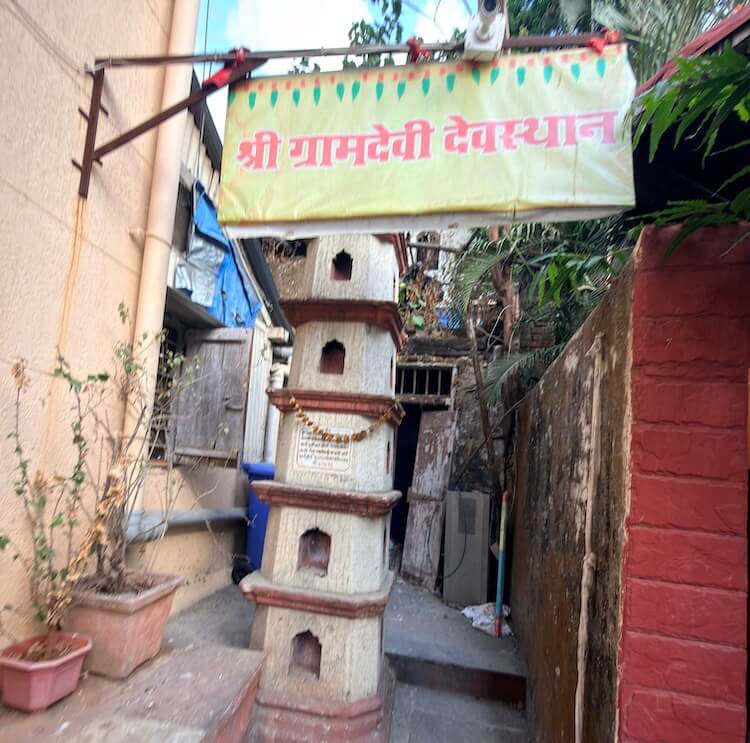
Krishnarao Raghunathji Navalkar visited this temple around 1895. At that time, the temple’s structure resembled a house, with the assembly hall (*sabhamandap*) and the sanctum (*gabhara*) combined. On one side of the ground floor, there were two small shrines. Between the roof and the ground floor, a gallery was built for women to sit during *kirtans*. The rear part of the building had a dome and a spire. The dome was built of cement, while the spire was made of wood. The temple had three doors—one in the front and two on the sides. Gas pipes were installed around the front door, and on days of major festivals and fairs, small domes were attached to them for illumination. There were also three lamp towers (*deepmalas*) in front of the temple. After renovations over time, the temple attained its current form.
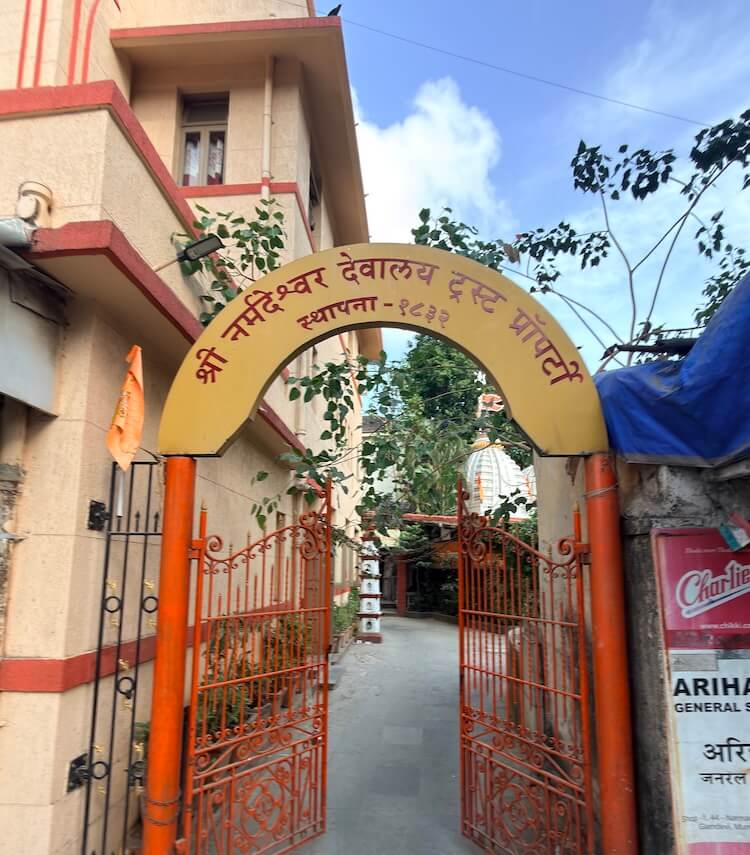
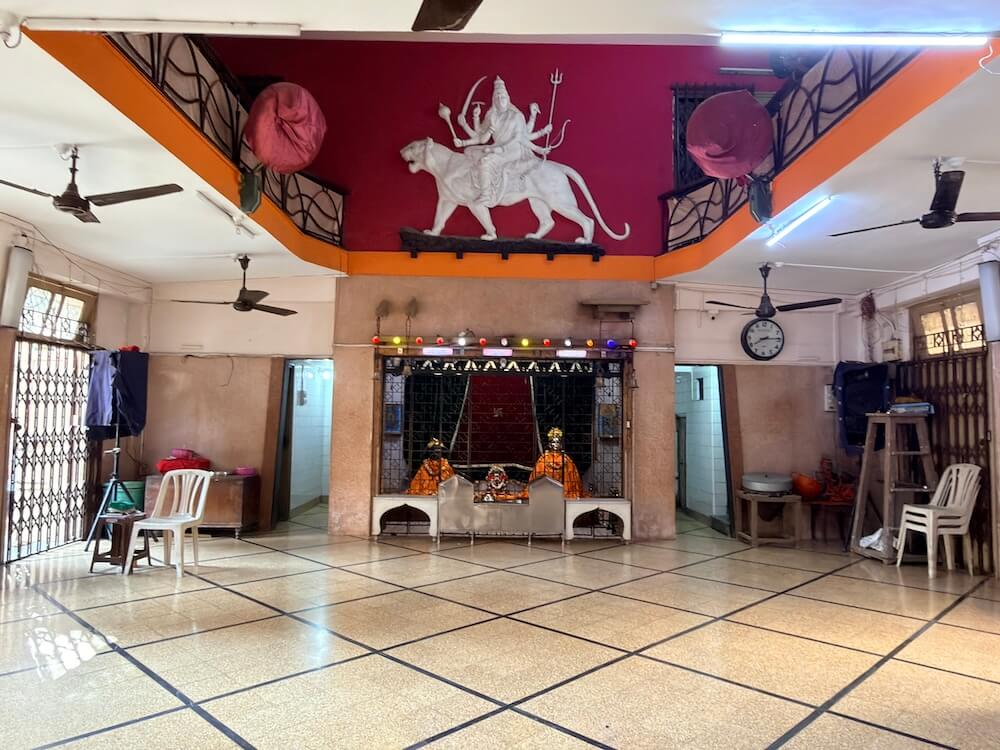
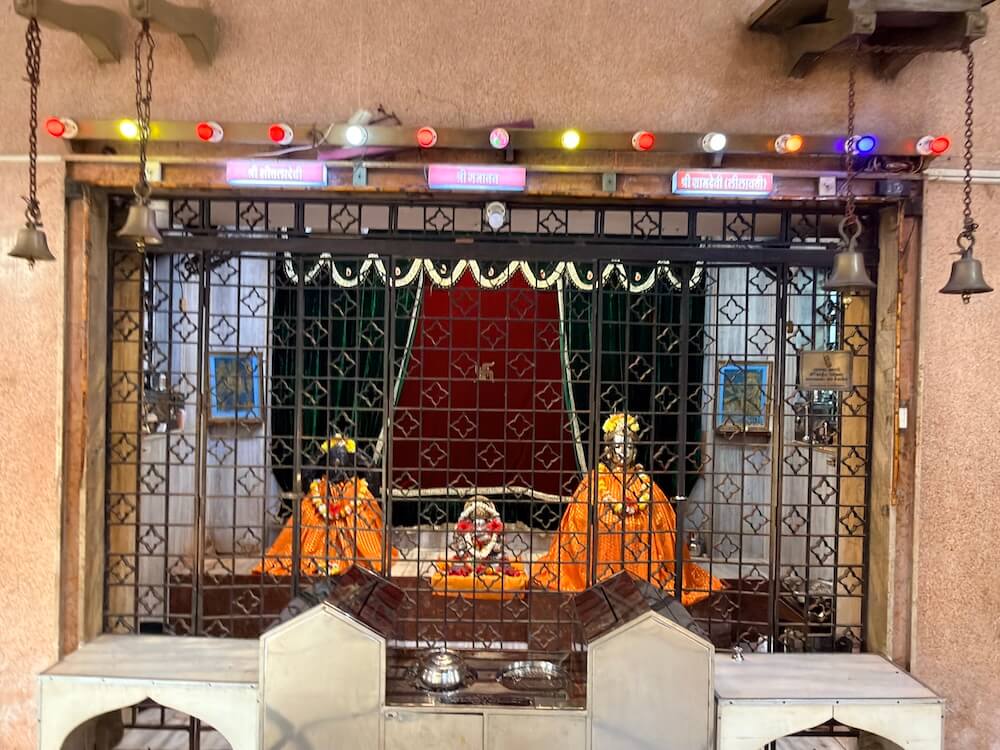
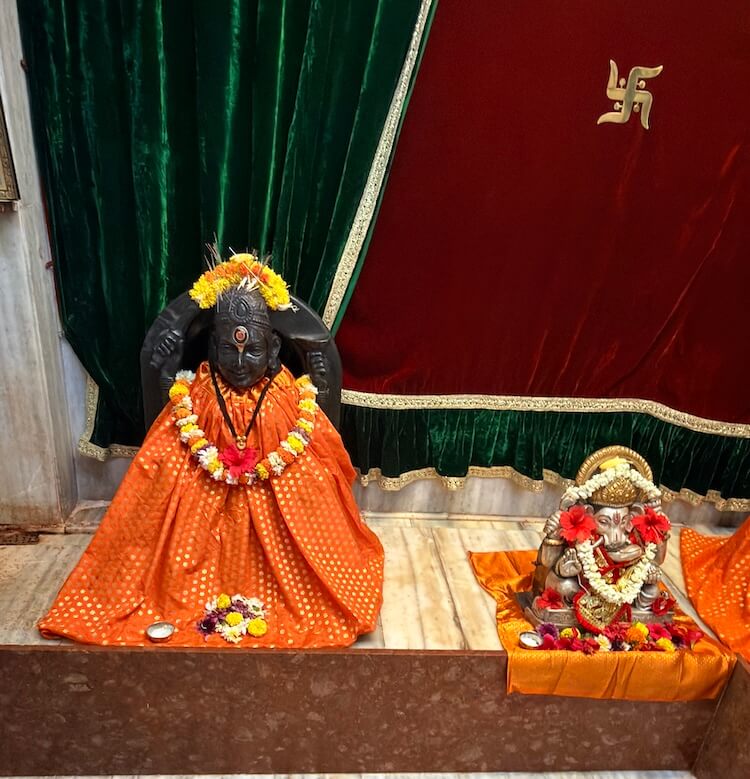
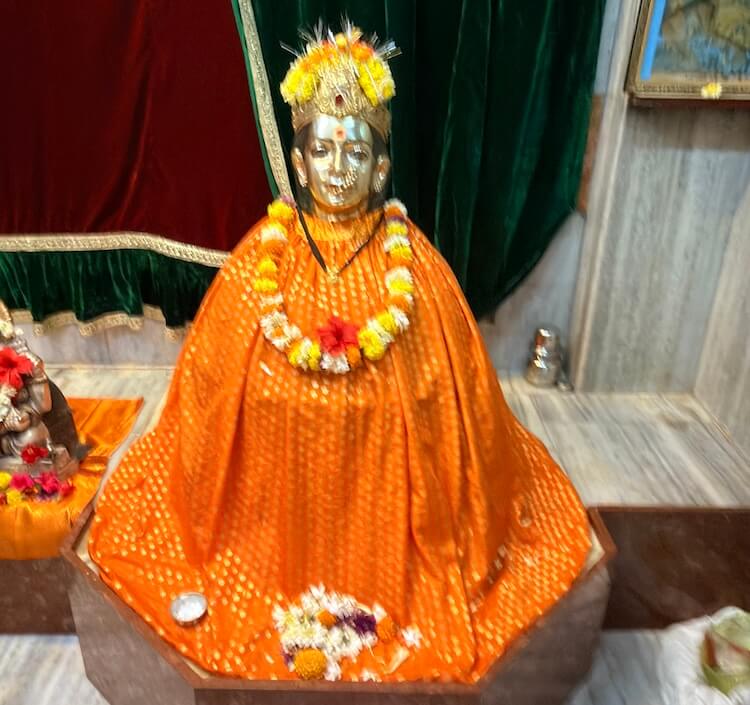
Upon arriving in the Gaondevi area, one first sees the back of the temple from the junction. This tall, two-story structure features two spires of equal height built in a modern style with an influence of the *Urushringa* architectural pattern. One enters the temple courtyard through an iron arch located on the side of the building. The courtyard is paved throughout, containing a total of five new and old lamp towers, as well as a Tulsi Vrindavan and a fountain. On the front side, there is a temple of Narmadeshwar and Dattatreya, built by the Narmadeshwar Devalaya Trust. On the left is the Gramdevi temple structure, consisting of an assembly hall and a sanctum. One enters the assembly hall through a wide wooden door. Upon entering, the spacious and lofty nature of the hall is striking. The hall features large square windows, three entrances, and a gallery above. In front is a simple sanctum built of cement concrete. On the wall above it is a magnificent relief sculpture of Goddess Durga. Here, the Devi is in her Ashtabhuja (eight-armed) form, mounted on a tiger. She holds a mace, sword, discus, conch, trident, bow, and a flower. One of her hands is in the Abhaya Mudra (gesture of fearlessness). In the sanctum sanctorum, on a high altar to the right, the idol of the Gramadevi (village deity), Lilavati, is consecrated. Here, the Devi is in the form of an uncarved stone (Taandala) adorned with garments, featuring a silver mask. To the left on the altar, the idol of Goddess Shitala is enshrined. This idol, carved from black stone, is decorated with garments, ornaments, and flower garlands. Between these two idols, a silver idol of the remover of obstacles, Gajanan (Ganesha), is seated.
In this temple, owned by the ‘Gavdevi and Girgaon Gramasth Somvanshi Kshatriya Pathare Jnati’, devotees can have darshan from 5:30 AM to 12:00 PM and from 4:00 PM to 10:00 PM. Devotees can offer garlands, hair braids, or ‘Oti’ (offerings) to the Devi through the priests between 9:00 AM to 11:00 AM and 5:00 PM to 8:00 PM. Various religious festivals and celebrations are observed in the temple according to tradition. Navratri is the biggest festival celebrated here. During this period, the temple premises are decorated with lights. On the seventh day of Navratri, a Havan ritual is performed before the Devi. Grand celebrations also take place in the temple during Deepavali and Vijayadashami. Near this temple is the temple of Narmadeshwar. Adjacent to it is the temple of Dattatreya. The annual fair of both the Gavdevi and Narmadeshwar temples is held on Margashirsha Purnima. Many devotees participate in the fair.
This sacred temple stands as a testament to deep spiritual devotion, ancient architectural grandeur, and rich local cultural traditions.
The sanctum sanctorum houses the divine idol consecrated according to ancient Vedic traditions, surrounded by serene courtyards and traditional temple architecture.
Navratri, Maha Shivratri, Annual Temple Jatra & Deepotsav
Compare and book flights, secure top-rated local hotels near the temple, hire reliable guides, and rent cars instantly.
Extend your pilgrimage by visiting other highly sacred temples located nearby.


Add ₹999 more to unlock FREE SHIPPING!
Your sacred cart is currently empty.
Shop Photo FramesFill in your delivery details below to place your order.
Add comment