
Add ₹999 more to unlock FREE SHIPPING!
Your sacred cart is currently empty.
Shop Photo FramesAkkalakot’s Swami Samarth, revered by countless devotees with the unwavering faith that “Swami can make the impossible possible,” is considered the third incarnation of Dattatreya. Devotees believe that Swami Samarth, who lived in the nineteenth century, continues to stand by His devotees even today. Today, there are Swami Samarth Maths in villages and towns across Maharashtra. Among them, the Math in Dadar has a history spanning one hundred and twenty-five years. This Math was established by Sadguru Balkrishna Maharaj Suratkar, an ardent devotee of Swami Samarth. In this Math, a revered place of worship for countless Swami Samarth devotees in Mumbai and its surrounding areas, the holy Padukas (footprints) of Swami Samarth are enshrined.
Shri Swami Samarth is an incarnated being belonging to the Dattasampradaya. The worship of Dattatreya, who is considered the upholder of Varnashramadharma as described in the Puranas and Upanishads, an ideal embodiment of Gurutatva (the principle of Guru), and a preceptor of Yoga, has been prevalent across the country since ancient times. In the fifteenth century, due to the divine personality of Nrusimha Saraswati, the Dattasampradaya acquired the form of a distinct spiritual tradition. Shripad Shri Vallabh is considered the first incarnation of Dattatreya. Nrusimha Saraswati is the second incarnation, while Akkalakot’s Swami Samarth is considered the third incarnation of Datta. The early life of Swami Samarth is unknown. In ‘Shri Swami Charitra Saramruta,’ there is a legend that Nrusimha Saraswati, the first incarnation of Datta, at the time of the conclusion of His incarnation, went to Shrishail Kardaliban in Andhra Pradesh in 1458 AD. There, He performed penance for 350 years. During that time, an anthill formed around Him. One day, a woodcutter’s axe accidentally fell upon this anthill. From that anthill, Swami Samarth manifested.
From Shrishail Kardaliban, He traveled via Calcutta, Jagannathpuri, and Kashi to the banks of the Godavari, and in 1838 AD, He manifested in Mangalvedha. The scripture ‘Swami Leelamrut’ states, “In Shaka seventeen hundred and sixty (1760), Swami, for the salvation of the world, manifested in Mangalvedha, as the direct incarnation of Datta.” Thereafter, on Ashwin Shuddha Panchami in Shaka 1779 (1857 AD), He appeared in Akkalakot. Information regarding Swami Samarth’s early life is unavailable. However, He once stated, “We are Yajurvedi Brahmins, Our name is Nrusimhabhan, Our Gotra is Kashyap, Our Rashi is Meen (Pisces)…” Throughout His life, He bestowed grace upon many. Through His assurance, “Fear not, I am with you,” He gave courage to many. His promise was, “I Myself bear the welfare of those who worship Me with exclusive devotion.” Swami Samarth, discarding the ostentation of rituals, purity-impurity observances, and such, taught the common people the glory of chanting the Divine Name (Namasmaran). He resided in Akkalakot for about 20 years. Many stories of His miracles and divine experiences are recounted. In 1878 AD, on Chaitra Vadya Trayodashi, He attained Samadhi in Akkalakot.
The history of Dadar’s Swami Samarth Math is as follows: Sadguru Balkrishna Maharaj was born on October 28, 1866, in Surat, into a Gujarati family, and He established this Math on May 29, 1910. Later, He came to Mumbai for His education, staying with His uncle Shivshankar. At that time, a strong movement for religious reform was sweeping across the country. From this, various sects like Prarthana Samaj, Arya Samaj, and Swami Narayan Sampradaya emerged. After coming to Mumbai, Balkrishna Maharaj gravitated towards the Arya Samaj. The establishment of this sect was originally in Mumbai. Swami Dayanand (original name Moolshankar Ambashankar, born – 1824, Tankara, Kathiawar) established this modern religious sect on April 10, 1875. According to the entry about this sect in the Marathi Vishwakosh (Marathi Encyclopedia), “The Arya Samaj declared its supreme duties to be leading India back to the Vedic path and teaching the Vedic Dharma to the entire world, and vigorously commenced the work of reviving and propagating the Vedas. The original Vedas do not advocate idol worship, avatarvad (doctrine of incarnations), pilgrimages, vows, Pauranik rituals, etc. Therefore, the proponents of Arya Samaj deemed all these practices to be discarded. They stopped Shraddhas (ancestral rites) and dismissed priests. They began explaining to people that Rama and Krishna were not divine incarnations but great human beings.” While this tradition accepted the Chaturvarnya (four-fold social order), it rejected caste discrimination and untouchability, and also granted everyone the right to study the Vedas.
Balkrishna Maharaj’s uncle, Shivshankar, was a Shaiva devotee. He was not pleased that Maharaj had turned towards a sect like the Arya Samaj. Living next to them was Ramchandra Venkatesh Baradkar, also known as Tat Maharaj, a devotee of Swami Samarth. Shivshankar took Balkrishna Maharaj to Tat Maharaj. Tat Maharaj took Balkrishna Maharaj to the Ashtabhuja Devi Temple in Bhuleshwar and arranged for him to have Darshan of the Goddess there. After this, Balkrishna Maharaj accepted Tat Maharaj as his Guru and became a devotee of Swami Samarth. In the initial period, He worked as a Sanskrit teacher at the Gokuldas Sanskrit Pathshala in Mumbai. He also conducted tuition classes for English and Sanskrit. At that time, He resided in Jambhulwadi. There is a legend that He removed the affliction of a ghost (Bhutbadha) from a person in a neighboring family. Due to this incident, His reputation as a holy man (Satsurush) possessing divine power spread.
From Jambhulwadi, He moved to Malad to reside with His friend Dwarkadas. After this, for some time, He resided in a house in Mamledar Wadi, Malad. During this period, many people came to Him from far and wide with their problems. Bhajan programs were held there every Thursday and Saturday. After late-night programs, it became inconvenient for these devotees to return home from Malad. From this, the idea arose to arrange for Bhajan programs at a central location. Among His devotees was a gentleman named Bhausaheb Deshmukh, who was the Chief Clerk in the British Government’s Collector’s Office. He selected a bungalow in Dadar. That bungalow belonged to a Muslim individual, and it was said to be haunted. However, Balkrishna Maharaj, stating, “We shall establish Samarth there and grant liberation to all the spirits,” instructed them to take possession of the bungalow. Today, the Math stands on the very site of that bungalow. Two years later, this bungalow was renovated. During that period, the Math was temporarily moved to another location in Matunga. However, after the renovation, the Swami Samarth Math has stood on this site from August 30, 1913, to this day. Similar to this Math, Maharaj also established a Math in the Begumpura area of Surat in 1911. On Vaishakh Vadya Ekadashi, Shaka 1840, Wednesday, June 5, 1918, at sunrise, Maharaj attained Mahasamadhi (passed away) in Surat. His Samadhi is located near the Swami Math in Surat.
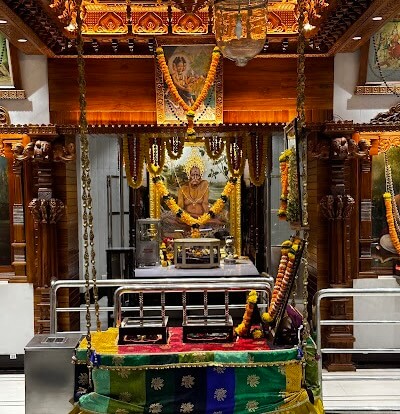
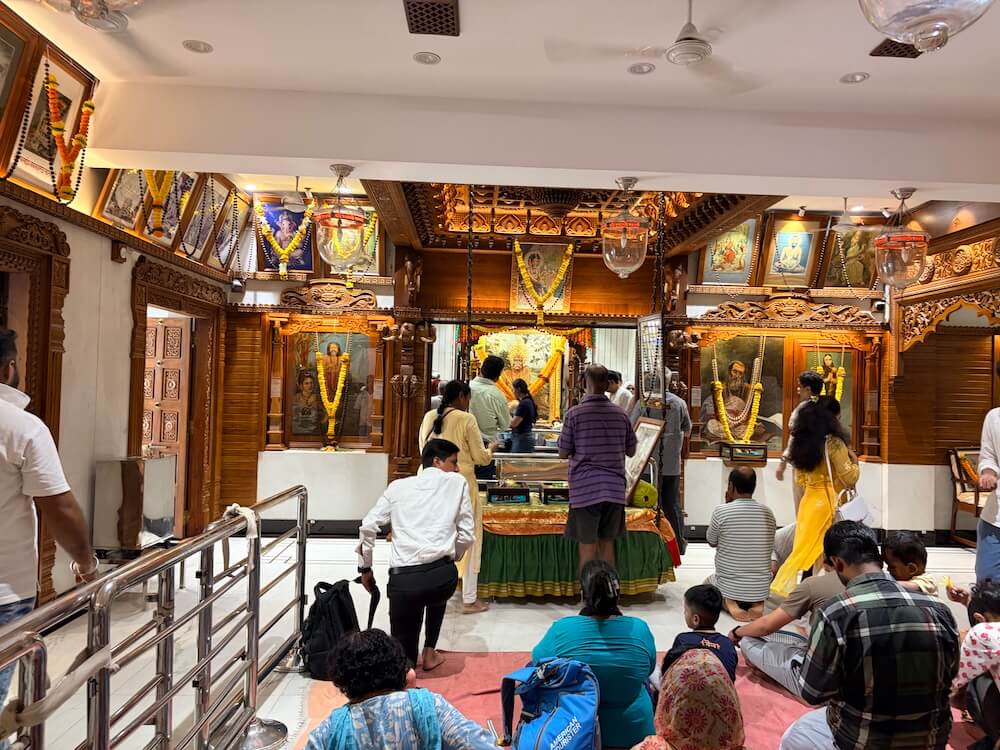
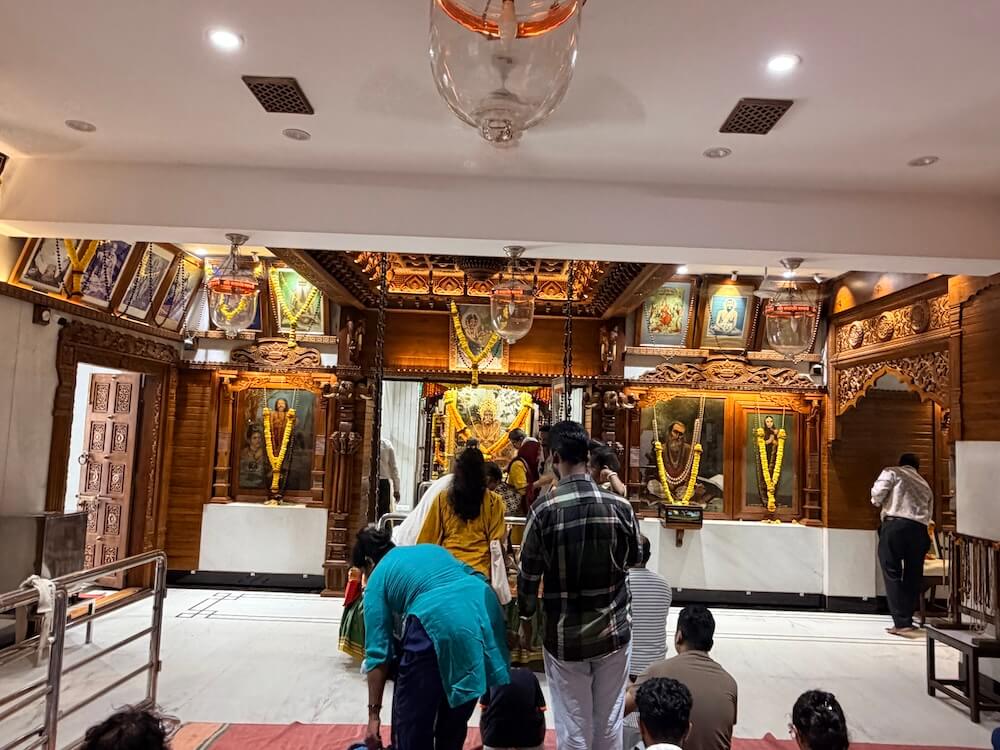
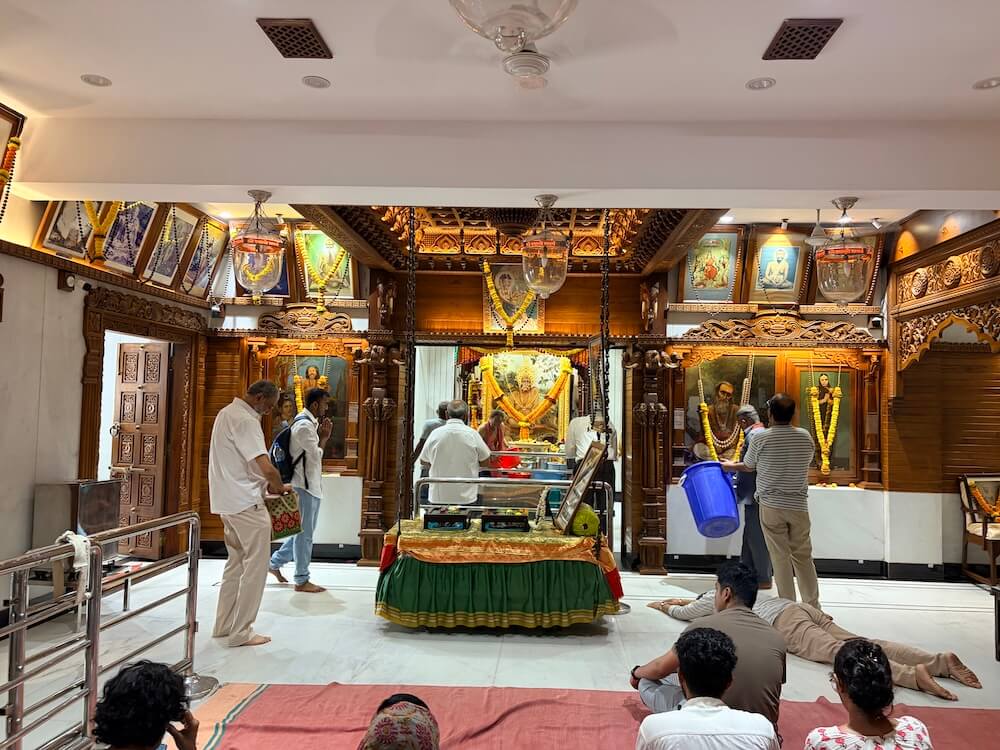
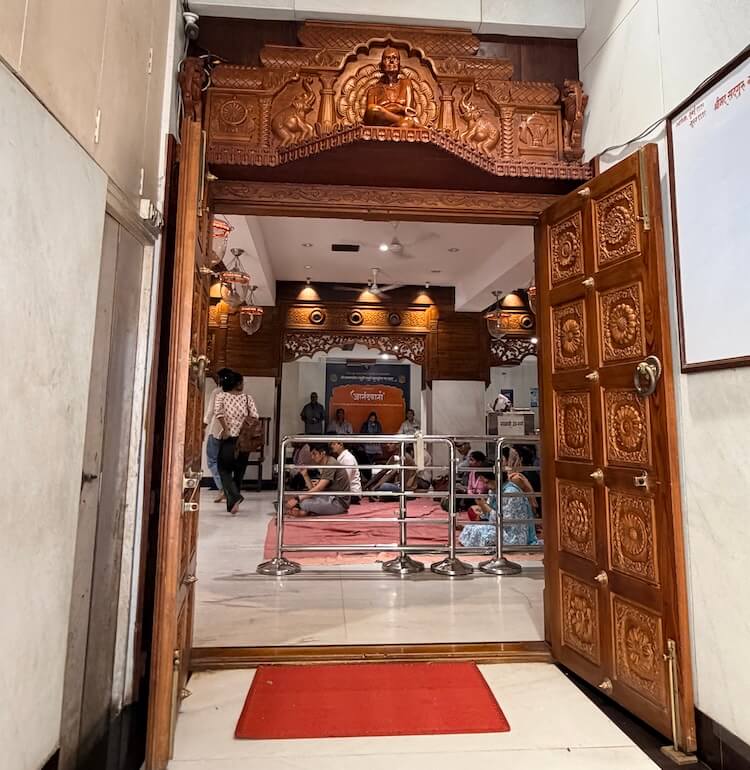
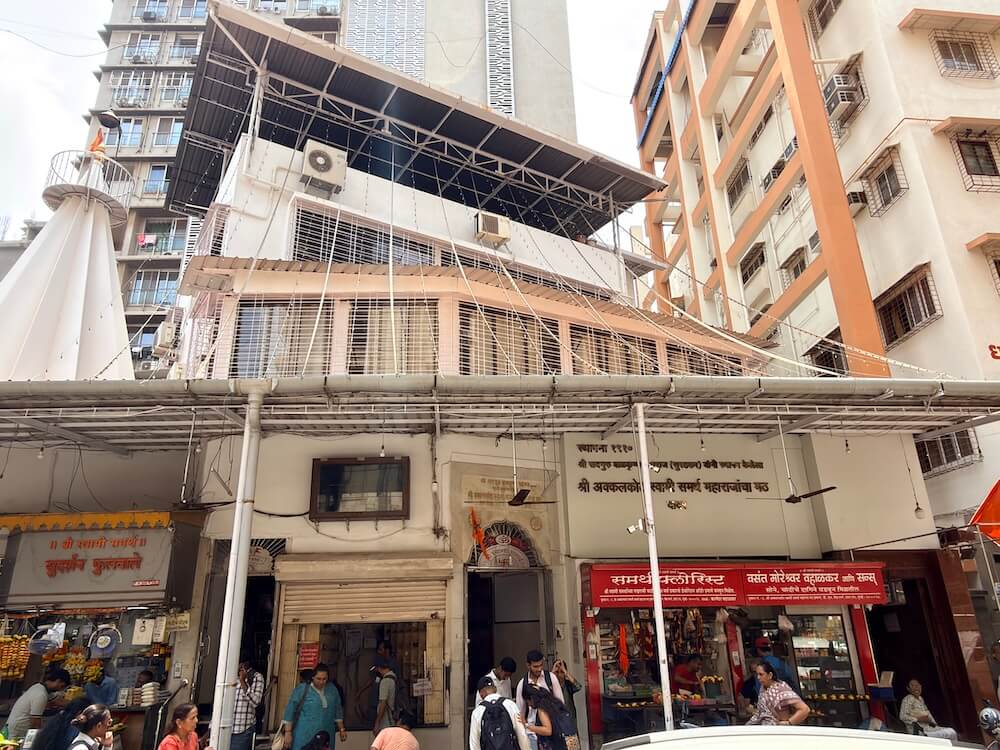
This Math is situated in a large lane in the vicinity of ‘Shiv Sena Bhavan’ in Dadar. Outside the Math, there are shops selling puja items, as well as pictures and idols of Swami Samarth. One enters this Math through a tall arched gateway. The Math comprises a grand assembly hall (Sabhamandap) and a sanctum sanctorum (Garbhagriha). This Sabhamandap, with its marble flooring, features broad square pillars. Carved wood has been extensively used in the temple. The Sabhamandap is adorned with a canopy embellished with intricate woodwork and glass chandeliers. On the walls of the Sabhamandap, within beautiful wooden frames, are large images of Swami Samarth, Balakrishna Maharaj, Kamalāmātā, and others. Images of great personalities like Ramakrishna Paramahamsa, Samarth Ramdas Swami, Gondavalekar Maharaj, Shankar Maharaj, deities such as Ganesha, Dattatreya, Saraswati, and revered saints of the Swami Samarth tradition are also present on these walls. In the Sabhamandap, in front of the Garbhagriha, a swing is suspended. Upon it are enshrined images and Pādukās (holy sandals) of Swami. In the Garbhagriha, adorned with wooden panels, a magnificent image of Swami Samarth is installed. Balakrishna Maharaj had consecrated the image of Samarth by placing relics of Swami Samarth within the base of the throne here, and then covering it with a marble slab. A special significance of this Math for devotees is the presence of Swami Samarth’s Pādukās here. According to a divine vision granted by Swami Samarth, Balakrishna Maharaj himself went to Akkalkot and brought these Pādukās. These Pādukās are kept in the shrine (Devaghar) within a room inside the Math. Meanwhile, silver Pādukās are kept for darshan in the main Garbhagriha. The Garbhagriha is crowned with a tall spire (Shikhar).
In this Math, renowned as Dadar Math, Aarti is performed daily at 7:30 PM on Sundays, Mondays, Tuesdays, Wednesdays, and Fridays, and at 7:00 PM on Thursdays and Saturdays. Many festivals are celebrated here throughout the year. These include festivals such as Swami Samarth Prakat Din (Appearance Day), Punyatithi (Death Anniversary), Gurupratipada, Kojagiri Pournima, Shripad Vallabh Punyatithi, Datta Jayanti, Nrusimha Saraswati Jayanti, and Mahashivaratri. During the Swami Samarth Prakat Din festival, thousands of devotees come here for darshan. Thousands of devotees also visit every Thursday. During these festivals, Laghurudra is performed here from 6:30 AM to 11:30 AM. Thereafter, Aarti is performed. The principal day for this Math is Saturday. On this day, a grand Bhajan ceremony takes place here. Traditionally, for devotees coming from afar, Aarti used to be performed on Thursdays and Saturdays from 10:00 PM to 11:30 PM. Following this, for about half an hour to an hour, devotees would offer garlands to Balakrishna Maharaj. After that, Maharaj would deliver discourses on Eknathi Bhagavata until 2:00 AM. A unique feature was that even though Maharaj’s mother tongue was Gujarati, these discourses were conducted in Marathi. His instruction was that no one should enter the Garbhagriha wearing a cap, turban, or handkerchief. As per Maharaj’s command, no discrimination based on caste (touchable-untouchable) or religion (Hindu-non-Hindu) is observed in this Math.
Previously, after Abhisheka, coconuts were offered to devotees in this temple. Now, instead of whole coconuts, Naralpak (coconut sweet) is distributed as Prasad. Balakrishna Maharaj was fond of tea. Therefore, even today, tea is offered to devotees during the intermission of the Bhajan on Saturdays. Furthermore, during the Parayan (recitation of holy texts) held at the Math, 300 to 400 liters of milk are distributed as Prasad. Videography and photography are prohibited inside this Math.
This sacred temple stands as a testament to deep spiritual devotion, ancient architectural grandeur, and rich local cultural traditions.
The sanctum sanctorum houses the divine idol consecrated according to ancient Vedic traditions, surrounded by serene courtyards and traditional temple architecture.
Navratri, Maha Shivratri, Annual Temple Jatra & Deepotsav
Compare and book flights, secure top-rated local hotels near the temple, hire reliable guides, and rent cars instantly.
Extend your pilgrimage by visiting other highly sacred temples located nearby.


Add ₹999 more to unlock FREE SHIPPING!
Your sacred cart is currently empty.
Shop Photo FramesFill in your delivery details below to place your order.
Add comment