
Add ₹999 more to unlock FREE SHIPPING!
Your sacred cart is currently empty.
Shop Photo FramesThe Babu Amichand Panalal Adishwarji Jain Temple, nestled in the Malabar Hill area of Mumbai, is a significant place of devotion and one of the foremost shrines for the Shwetambar Murtipujak sect of Jainism. The principal deity revered in this temple is Prabhu Adishwar, the first Tirthankar of Jainism. He is also known by the names ‘Adinath’ or ‘Rishabhdev’. The temple complex, situated on the Malabar Hill, is serene and tranquil. The marble carvings adorning this temple are particularly renowned. This temple is considered an excellent symbol of the Jain community’s contribution to temple architecture in the early twentieth century. For over a hundred years, the spiritual traditions and rituals of Jainism have been continuously observed here. This temple is counted among the most beautiful and clean temples in Mumbai.
Until the eighteenth century, this part of Malabar Hill was covered in dense forest. Around the year one thousand eight hundred and thirty, British officials began to use this area for their residences. In the one thousand eight hundred and eighties, the official residence of the Governor of Mumbai was moved from Parel to Malabar Hill. This decision further enhanced the importance of the area, leading to the establishment of an elite residential neighbourhood here. The location of the Babu Amichand Panalal Jain Temple proved to be strategic, set against this very historical and geographical backdrop. Records in the history of this area show that the Shilahara kings built the Walkeshwar Temple and the Banganga Tank in the year one thousand one hundred and twenty-seven. In sixteen hundred and seventy, Dr. John Fryer first referred to it as ‘Malabar Point’. In seventeen hundred and fifteen, Rama Kamat rebuilt the Walkeshwar Temple. In eighteen hundred and eighty-one, the Hanging Gardens were created on Malabar Hill, and thereafter, in nineteen hundred and four, the construction of the Babu Amichand Panalal Adishwarji Jain Temple was completed.
Around Vikram Samvat १९५८ (circa १९०१ CE), Shrimati Kunwarbai, wife of the renowned Mumbai Nagarshreshthi Babu Amichand Panalal Sheth, expressed a heartfelt desire to construct a Jinālaya upon this elevated and magnificent parcel of land in Walkeshwar and Malabar Hill. In accordance with her wish, Shethji himself commenced the construction of the Jinālaya on this very land, which was his own property, utilising his personal funds. During the period of construction, one night, following a divine indication, Shethji was blessed with the darshan of a wondrous Jinapratimā, and he felt an inner inspiration to consecrate that sacred image of the Lord right here. Following that divine indication, they journeyed with their family to Khambhat. With the assistance of the city’s eminent shreshthis, they began to visit each Jain temple, seeking that wondrous idol. In the course of this quest, they discovered the idol in the basement of the Jain temple at Jiravala Pada. With the consent of all, the idol was brought to Mumbai amidst a grand celebration. On the auspicious day of Margashirsha Shuddha Panchami, Wednesday, the twenty-fifth of November, nineteen hundred and three, in Vikram Samvat nineteen hundred and sixty (nineteen hundred and three C.E.), under the divine guidance of the Shasanprabhavak Muniraj Shri Mohanlalji Maharaj, Seth and Sethaniji consecrated the Moolnayak Shri Adishwar Prabhu.
Babu Amichand Panalal was also known as ‘Mota Babu’, and hence this temple is locally referred to as ‘Mota Derasar’. His worthy sons, Babu Dolatchandji and Babu Sitabchandji, consecrated an idol of Shri Shamala Parshvanatha on the first floor of the Jinalaya. Subsequently, Shethji constructed a magnificent Upashraya within the Jinalaya premises. After Kunwarbai’s passing on Shravan Vadya ९, Friday, Vikram Samvat १९६७ (१९१० CE), Shethji himself detached from worldly affairs and dedicated himself to spiritual practice within the Upashraya. On a most blessed Sunday, the thirteenth day of the bright fortnight of Phālguna in Vikram Saṁvat nineteen hundred and eighty-four (which corresponds to the Christian year nineteen hundred and twenty-eight), that is, on the fourth of March, nineteen hundred and twenty-eight, he most peacefully cast off his mortal coil, attaining mahāsamādhi.
The golden era of the Jinalaya’s development commenced in Vikram Samvat २०१७ (१९६० C.E.). At that blessed time, the venerable leader of the Sangha, the worshipful Yugadivakar Acharya Bhagawant Shri Vijaydharmasurishwarji Maharaj, graced Walkeshwar for the conclusion of His Varshitap. During this golden period, from Vikram Samvat २०१७ to २०३२ (१९६० to १९७५ C.E.), the revered Gurudeva Himself, along with His Guru, the worshipful Siddhantnidhi Acharya Shri Pratapsurishwarji Maharaj, and His disciples and grand-disciples, Sahityalankar Acharya Shri Yashodev Surishwarji Maharaj and Shatavadhani Acharya Shri Jayanand Surishwarji Maharaj, observed a total of ten Chaturmasas, thereby bringing about a spiritual transformation of the Walkeshwar Jinalaya. Inspired by Yugadivakarji, the consecration of Shri Shankheshwar Parshwanath and Munisuvrat Swami took place on Vaishakh Vadya ७, Vikram Samvat २०१८ (१९६१ C.E.). Furthermore, on Vaishakh Shukla १०, Vikram Samvat २०१९ (१९६२ C.E.), the consecration ceremonies for Shri Simandhar Prabhu, Pundarikswami, Gautamaswami, Padmavatidevi, Saraswatidevi, and Lakshmidevi were performed. Thereafter, on the fifth day of the dark fortnight of Māgha in Vikram Saṃvat two thousand twenty-nine (nineteen seventy-three CE), the sacred images of Śrī Vighnahar Pārśvaprabhu, Śrī Mahāvīrasvāmī, the eternal Śrī Ṛṣabha, Chandrānan, Vāriṣeṇ, Vardhamānaprabhu, and Śrī Ghaṇṭākarṇavīradev were consecrated.
During this very period, the permanent Vardhaman Tap Ayambil Khata and the Pathshala were established in Vikram Samvat two thousand nineteen (one thousand nine hundred sixty-two C.E.). The Upashray was expanded, and numerous lasting religious activities and great observances were completed, including Upadhan Tap with Anjanshalaka Mahotsavs and one hundred and eight Chhath Udyapans. It was also during this time, inspired by him, that eighty Jinalayas were constructed in Mumbai, such as Chembur Tirth and Bhayandar Bavan Jinalaya Tirth. The five-story grand Jain Dharmashala in Bhuleshwar and Lalbaug, and various magnificent Upashrays, were also initiated through his inspiration. For these sacred endeavors, on Maha Shuddh Tritiya in Vikram Samvat two thousand twenty (one thousand nine hundred sixty-four C.E.), he was bestowed with the title ‘Yugdivakar’ at Walkeshwar by the entire Jain community of Mumbai. Subsequently, the Padukas were installed under the divine guidance of Acharya Shri Ramsurishwarji Maharaj. Under the divine guidance of Āchārya Śrī Chandrodaysurīśvarajī Mahārāja, Śrī Nāgeśvar Pārśvaprabhu was consecrated. Furthermore, under the sacred guidance of Āchārya Śrī Padmasāgarsurīśvarajī Mahārāja, the idols of six Prabhus, including Śrī Padmaprabhasvāmī, were consecrated.
Under the divine guidance of Acharya Shri Suryodayasurishwarji and Acharya Shri Ratnasurishwarji, who were graced by Yugadivakarji, the inheritors of Babu Daulat Chandji Amichandji Javeri consecrated the grand Kayotsarga idol of Shri Adishwar Prabhu, along with Shri Pundarik Swami and the sacred Charan Padukas of Shri Adishwar. On this auspicious occasion, a silver Navkar Mantra-Patt, a marble Rayan tree, and the Shri Dharmadham – Nageshwar Parshwatirtha were established in memory of the revered Yugadivakar Gurudeva. The construction of a Jinashala with अठ्ठावीस magnificent stone idols was also completed. To commemorate the centenary of the Jinalaya, a historic festival, renowned throughout Bharatvarsha, was celebrated in the presence of approximately चारशे Sadhus and Sadhvis. During this time, significant donations were offered for the sanctum sanctorums of Jinalayas undergoing renovation across Bharatvarsha and for various Upashrayas.
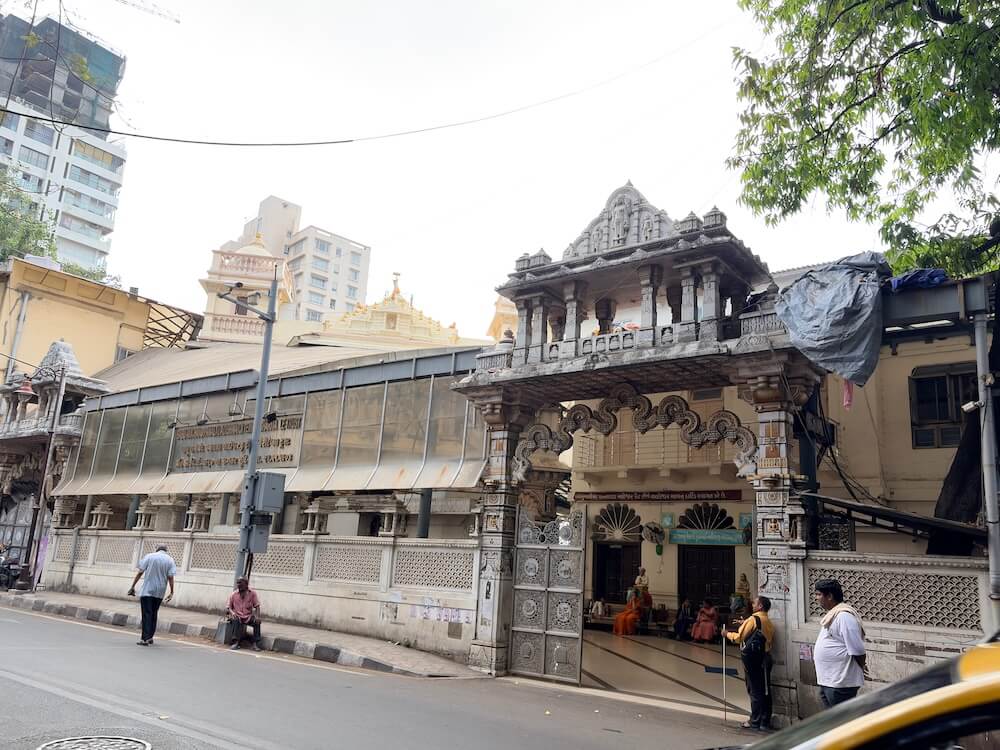
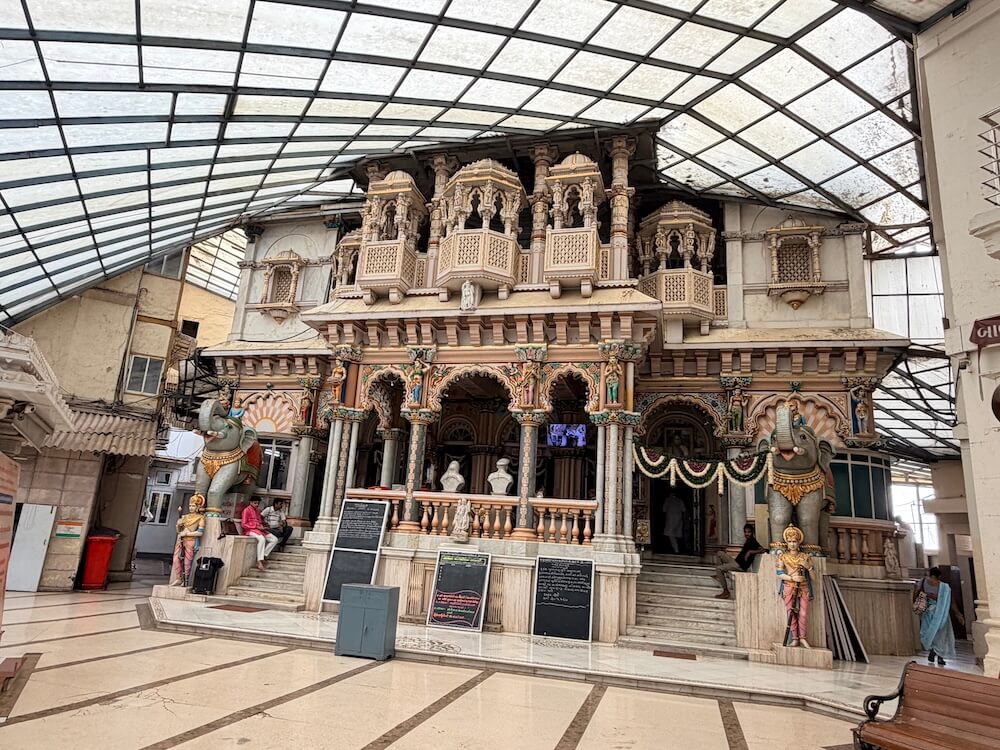
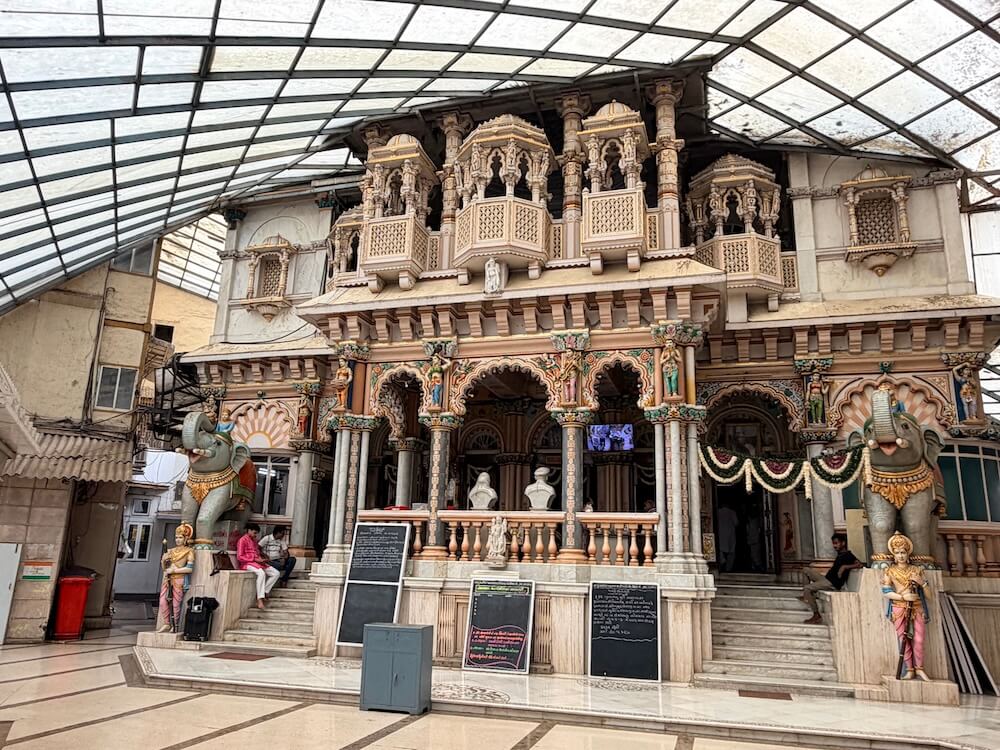
The Babu Amichand Panalal Adishwarji Temple, nestled in the affluent Malabar Hill area of Mumbai, stands as an exceptionally important and historic treasure of Jain temple architecture. The temple’s main entrance, situated along the primary road, predominantly showcases the influence of the ‘Maru-Gurjara’ architectural style. This style is widely prevalent in Western Bharatvarsha, particularly in Rajasthan and and Gujarat. This entrance is exquisitely carved from white stone. Directly above the entrance is a small, shikhara-like mandapika. At its heart, a meditating Tirthankara is carved. Iconographically, this is an image of Adishwarji, who is Bhagwan Rishabhdev. The pillars supporting the entrance are intricately carved, adorned with Ghat-Pallava and Kirtimukha at their upper sections. Above these pillars is an arched Torana. This Torana is considered a prime characteristic of the ‘Pratoli’ or the aesthetic beauty of an entrance in Jain architecture. Through this entrance, one steps into the temple courtyard. The temple courtyard is covered with a glass roof. Within the courtyard, there is a separate temple dedicated to Ghantakarna Mahavir. His idol is fierce in form, holding a bow and arrow. This temple also houses an idol of Bhagwan Ganesha, which is considered a symbol of the historical ties between Hindu and Jain Dharma.
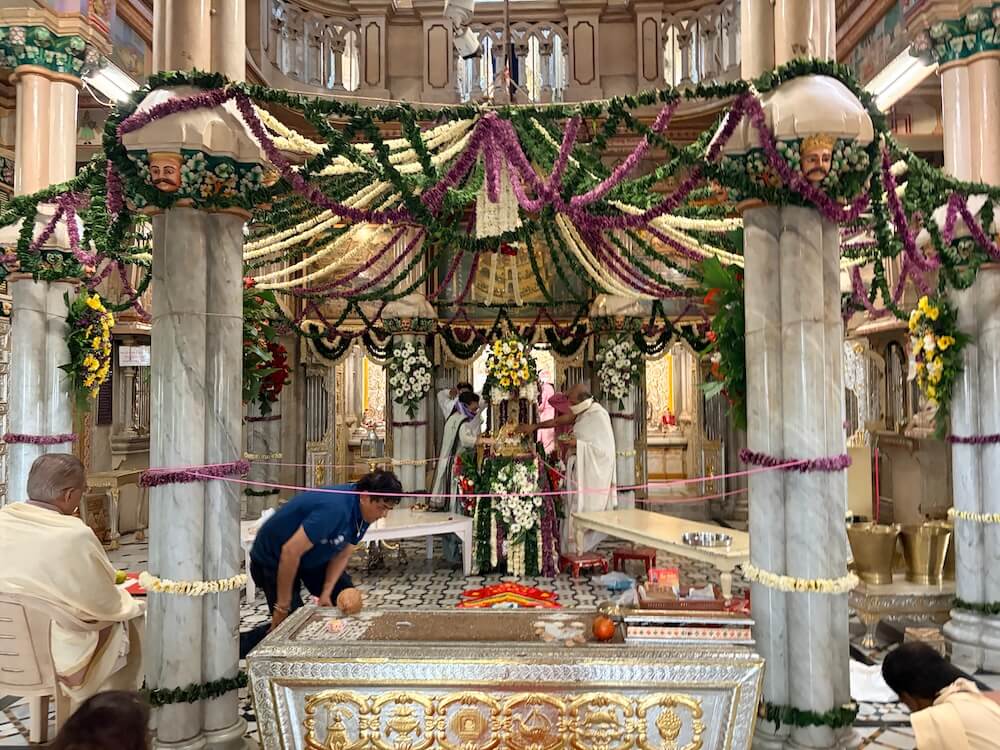
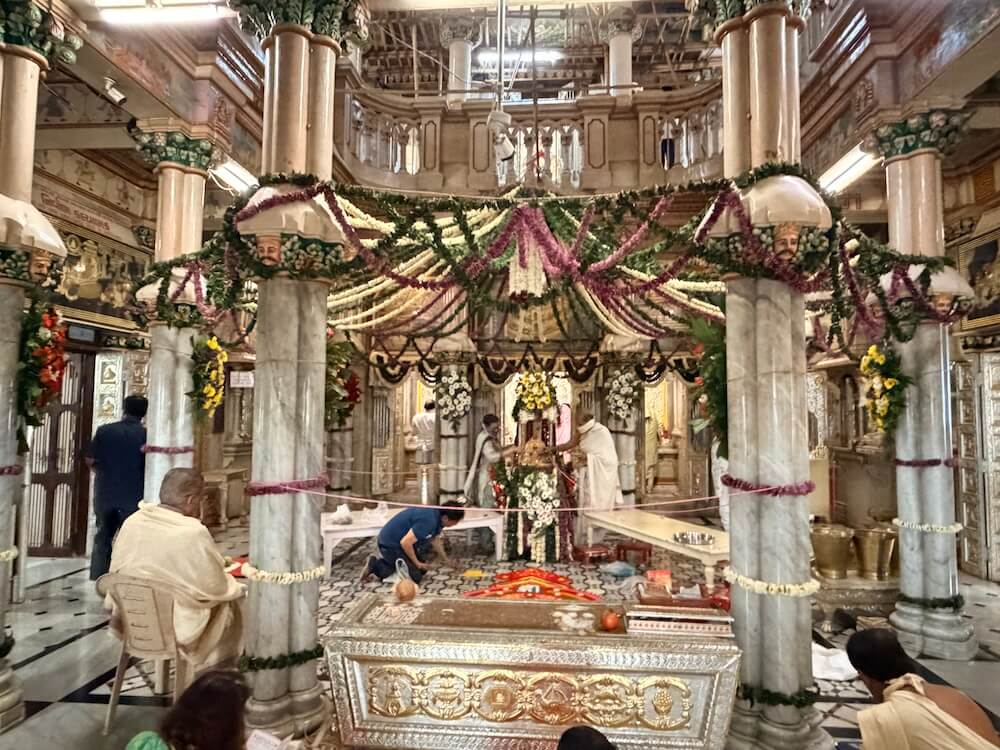
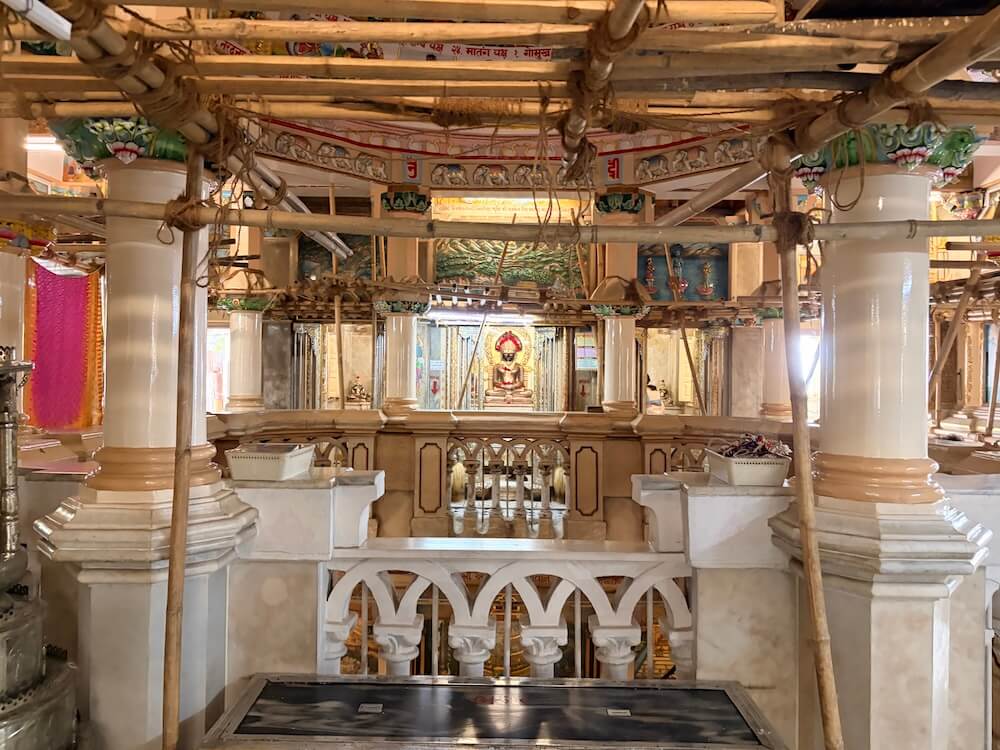
On both sides of the temple entrance stand magnificent elephant idols, with riders mounted upon these majestic Gajrajas. The temple’s Adhishthana is built upon a high plinth. The various layers of the Adhishthana are adorned with carvings of elephants, horses, and human figures. The outer walls of the temple are embellished with various images of Tirthankaras. Additionally, a series of images depicting Yakshas, Yakshinis, dancers, and musicians are carved here. The carvings on these walls resemble intricate fabric weaving, also known as ‘lace-work’. Ascending a few steps, one enters the temple’s Sabha Mandapa. The marble pillars in this spacious Sabha Mandapa are adorned with delicate floral and geometric patterns. The upper sections of these pillars feature Kirtimukha and depictions of idols in various mudras. The paintings on the temple’s ceiling and walls are another significant feature of this edifice. These paintings depict various episodes from Jain Puranas, the life stories of Tirthankaras, and Jain astronomical concepts. Notably, this traditional artwork has endured to this day. The entrance to the Garbhagriha is covered with silver foil. The Garbhagriha itself is constructed entirely of white marble. Within this sanctum, a grand idol of Bhagwan Adinath is seated in the Padmasana posture. According to Jain iconography, a Shrivatsa symbol adorns His chest, and locks of hair are depicted on His shoulders, which are considered a unique characteristic of Prabhu Adinath. Near the feet of the idol, His Lanchan, the bull (Vrishabha), is carved. Among the Upadevatas, the idol of Devi Padmavati, the Yakshini of Bhagwan Parshwanath, is adorned with ornaments. From the first floor of this temple, one can behold a panoramic view of the city and the sea.
Many annual festivals are celebrated in this temple. Paryushan Parva is the most important eight-day festival in Jain Dharma, during which the Kalpasutra is recited. On the last day, Samvatsari is celebrated, and everyone seeks forgiveness from each other by saying “Michhami Dukkadam.” On Mahavir Jayanti, a palanquin procession of Prabhu is taken out. As Akshaya Tritiya is associated with Bhagwan Rishabhdev, the Parana (breaking of fast) for devotees observing Varshitap is organized on this day. Diwali is celebrated as a symbol of Bhagwan Mahavir’s Nirvana, and Laddus are offered on this day. Devotees can have Darshan in this temple daily from सकाळी सहा to रात्री नऊ.
This sacred temple stands as a testament to deep spiritual devotion, ancient architectural grandeur, and rich local cultural traditions.
The sanctum sanctorum houses the divine idol consecrated according to ancient Vedic traditions, surrounded by serene courtyards and traditional temple architecture.
Navratri, Maha Shivratri, Annual Temple Jatra & Deepotsav
Compare and book flights, secure top-rated local hotels near the temple, hire reliable guides, and rent cars instantly.
Extend your pilgrimage by visiting other highly sacred temples located nearby.


Add ₹999 more to unlock FREE SHIPPING!
Your sacred cart is currently empty.
Shop Photo FramesFill in your delivery details below to place your order.
Add comment