
Add ₹999 more to unlock FREE SHIPPING!
Your sacred cart is currently empty.
Shop Photo FramesMalabar Hill is an elite area of Mumbai. Occupied by the Governor’s residence, ministers’ bungalows, and the homes of the wealthy and merchant classes, this area still retains the chawls of its original inhabitants. While this locality showcases the manifestations of modernity on one hand, it also preserves ancient temples, monasteries of saints, and sacred pilgrimage sites that bear witness to antiquity. The Banganga Tank, created by Lord Shri Rama, and the Shiva Linga, installed by His own hands, continue to attract countless devotees to this area even in the present day.
The last hill located at the southwestern tip of Mumbai is the Walukeshwar Hill. It was once a small mountain. One part of it was named ‘Khambala’, another ‘Gavlyachya Talyavaril Dongar’, and a third ‘Tankervill’. The tip of the hill extending into the sea, known as the ‘Dandi’ area, was called ‘Shirgundi’. The luxurious residence of the Governor is now located there. Since the beginning of British rule, this area has been referred to as Malabar Point. Pirates used to hide in this region. These pirates hailed from areas like Dharmapattanam and Kotta on the Malabar Coast. The name Malabar Hill was derived from them. Previously separated from the island of Mumbai, this hilly region was desolate. Some grassy parts were reserved for cattle grazing. In the year 1728, people leased some land from the government here to grow vegetables like cucumbers, okra, eggplants, and cluster beans.
It is said that the original Walukeshwar temple was located in the Dandi area, where the Governor’s residence currently stands. There is evidence that Shiva worship has been practiced on the islands of Mumbai since the 6th century CE. About 1,500 years ago, the islands of Mumbai were under the rule of the Traikutaka kings, who were feudatories of the Kalachuris. The caves in Mumbai such as Jogeshwari, Elephanta (Gharapuri), and Mandapeshwar, which show the influence of the Shaiva sect, date back to the time of these Traikutakas and Kalachuris. The Kalachuris were Pashupata Shaivas. It is said that they created the ‘Shivasrushti’ at Gharapuri. A Shiva idol, which bears a resemblance to the sculptures found in front of the main cave at Gharapuri, stands today in the Baradev Temple at Parmanand Wadi in Parel village. According to historians, this idol was created between the years 525 and 530 CE. This clarifies that the Shaiva sect has had a presence on these islands since that time. From the 9th century CE, for the next four centuries, the Silahara dynasty of North Konkan held power here. The kings Chhitta and Mummuni, who built the famous Shivalaya at Ambernath in 1050 CE, belonged to the Silahara dynasty. The third volume of ‘The Gazetteer of Bombay City and Island’ states that the original Walukeshwar temple was built during the time of these Shiva-devotee Silaharas.
This site of Walukeshwar and the Banganga Tirtha are also mentioned in the ‘Mahikavatichi Bakhar’. In 1142 CE, the first king of Mumbai, Pratap Bimb, sent his Chief Minister Balkrishnarao Somvanshi to conquer the islands of Mumbai. He conquered the region up to Walukeshwar. According to the mention in the Bakhar, “From Yesave to Juhu, up to Vahinle, the King saw much and went to Walukeshwar. He saw the Banganga and noticed the Hanuman idol. He stayed there for some days.” According to this chronicle, the Banganga Tirtha and the Walukeshwar temple existed here in the 12th century. Govind Narayan Madgaonkar recorded information he had heard about this temple in his book ‘Mumbai-che Varnan’. “It is said that this temple was very ancient. It was built about 600 years ago by a Marathi chieftain named Kebaji Rana. However, no evidence for this can be found.” Madgaonkar suggested that this chieftain might have been from the reign of Bhimraja (Bimbdev Yadav).
According to the Gazetteer, the great significance of this temple was due to its proximity to ‘Shirigundi’. This Shirigundi was Sanskritized to the name ‘Shrigundi’. Currently, a small temple for it exists within the Raj Bhavan premises. Originally, there was a large rock there. It had a small slit, like the eye of a needle (used for threading). Information about this Shirigundi is provided in the book ‘Shri Sarva Deva Sabha: The Hindu Pantheon’ by the theologian Edward Moor, published in 1810. He noted in the book, “At the very end of a promontory called Malabar Point on the island of Bombay, there is a rock with a fissure. The shape of this rock appears like a ‘Yoni’. Many pilgrims and people come to this place with the belief that passing through this sacred symbol, or fissure, purifies a person. Since this ‘Yoni’ is high up between the rocks, it is not easy to reach. On stormy days, the vast waves of the sea constantly crash against this rock.” The rock is no longer there, but there is a temple of the Goddess. An annual fair is held there on the Tuesday following Guru Purnima. At that time, devotees are allowed entry into the Raj Bhavan.
Edward Moor also recorded the presence of temple ruins near this Shirigundi. According to his notes, “Near this rock are the remains of a temple. Based on its appearance from about 225 years ago, it can be said with certainty that this temple must have been very beautiful and grand in the past. There may be truth in the belief that when Mumbai was under Portuguese rule, the iconoclastic Portuguese blew up this temple out of religious zeal. Fragments of finely carved dressed stones are now seen scattered at and around the site of this temple, and various types of idols are carved on their surfaces. Many stones that would have been very useful for construction there were carried away by the Hindus. They used those stones in the nearby beautiful Brahmin village for the construction of the lovely Banganga Tank and the temple there.”
The legend of this temple is linked to the period of Lord Shri Rama’s exile. The legend of this temple was published around the years 1860-61 in the newspaper ‘Dnyanodaya’, which began in Ahmedabad in the year 1843. According to the legend published in the newspaper, when Shri Rama set out for Lanka, he arrived at the seashore on the sandbar of Walkeshwar. It was Shri Rama’s daily vow to worship a new Shiva Linga brought by Lakshmana from Kashi. On that day, Lakshmana was delayed in bringing the Linga from Kashi. Therefore, Shri Rama fashioned a Shiva Linga out of sand, worshipped it, and consecrated it right there. Just then, Lakshmana arrived with the Linga. Shri Rama then consecrated the Linga brought by Lakshmana at Walkeshwar. As mentioned in ‘Dnyanodaya’, “The temple currently known as Walkeshwar is, in reality, Lakshmaneshwar. The original site of Walkeshwar was on the sandbar of Walkeshwar. The Linga installed there by Shri Rama is not found at present. Ever since the original temple was destroyed, people began calling Lakshmaneshwar itself as Walkeshwar. When Rama felt thirsty there, he struck the earth with an arrow to produce water, and after drinking it, he was satisfied. Because this water was produced by an arrow, it is called Bantirth or Banganga. Since the Patalganga from the netherworld emerged upwards due to the arrow, it is also called Patalganga.” According to another mythological legend regarding the Banganga tank, Parashurama shot fourteen arrows into the sea from the peaks of the Sahyadri mountains. One of those arrows fell here, creating this holy pilgrimage site.
The current temple standing on the banks of the Banganga tank was built in the year 1715 by Ramji Kamat. Ramji Kamat, referred to as ‘Ramji Kamathi’ in the English correspondence of that time, belonged to the Gaud Saraswat (Shenvi) community. According to the Madgaonkars, it is said that he was the chief commander of the local army at that time and had received the land of Walkeshwar as a grant from the government. Jayraj Salgaonkar, in the book ‘Mumbai City Gazetteer’, noted that Ramji Kamat was in the clerical service of the British. Based on a letter he sent to Sarkhel Kanhoji Angre, officials of the East India Company declared Ramji Kamat a traitor. Subsequently, he was put on trial. As the charges against him were proven, he was sentenced to imprisonment, and his property was put up for auction. He died in the year 1728 while still in prison. After his death, it was revealed that the letter was forged. Ramji Kamat had established this temple five years before this trial, which had caused a great sensation at that time.
However, a different history is provided in the text about the Walkeshwar temple on the ‘GSBKonkani.net’ website, which is dedicated to the Gaud Saraswat Brahmin community. According to it, a Gaud Saraswat Brahmin named Lakshman Prabhu, who was in the court of the Shilahar King of Thane, established the Walkeshwar temple in the year 1127. Later, Ramji Kamathi renovated it. Subsequently, the temple was renovated once again on Monday, 18 August 1989, which was Shravan Shuddha 14. At that time, a Sanskrit inscription narrating this history was prepared and placed on the front wall of the temple’s sanctum sanctorum. It is as follows –
‘Atra Shilaharanvaya samaye dvadashamite shate kraiste. Shivamandiram puranam reje yallakshmaneshvarakhyamabhut ॥1॥
Rachitam Lakshmananamna Gomantadvijamahapradhanena. Aitihye varteyam loke Saumitrina tu sambaddha ॥2॥
Kale Mumbadvipe kruraphirangitarangabhangahate. Vidhvansitam tadaitat kevalamasit shilasamaharah ॥3॥
Mumbadvipe pashchat ankavaniksamghashasanam prapte. Asinmudadhyakshah senadhyakshastatha mahashreshthi ॥4॥
Sumatirjanabhiramah punyatma Ramakamatirnama. Sarasvatam kulam yo Gargya gotram cha bhushayamasa ॥5॥
Samsthapyadau ‘Kote’ Samaliyalal-Venkateshau sah. Nandashararshidharitri- mite tadurdhvam sa vikrame varshe ॥6॥
Jirnodharam krtva punarapi Shivamandiram sa nirmitavan. Yadvalukeshvara iti khyatim lokeshu pavanimapa ॥7॥
Kshudro valukakana iva vishvam krtsna yadagratobhati. Tam Valukeshvaramaham vande’nantam krpanidhim shantam ॥8॥’
The Marathi translation of this inscription is as follows: “Here, in the twelfth century of the Christian era, during the time of the Shilahar kings, an ancient Shiva temple adorned this place, and its name was Lakshmaneshwar. This temple was built by Lakshman, a Gaud Saraswat Brahmin Mahapradhan from Gomantak, that is, Goa. However, according to the legend and tradition in the public mind, this story is linked to the son of Sumitra, that is, Lakshmana. Later, in the course of time, when the wave of attacks by the cruel Portuguese, or ‘Phirangis’, hit the island of Mumbai, they destroyed this temple. Consequently, this temple was completely ruined, and only a heap of stones remained there. Thereafter, when the British East India Company’s rule was established on the island of Mumbai, there was a great merchant named Ram Kamat, who was highly beloved by the people, intelligent, and a virtuous soul. He had brought glory to his Gargya Gotra and Saraswat lineage. That Ram Kamat first installed Samaliyalal and Venkatesh in the Fort area. Then, in Vikram Samvat 1779, he renovated that dilapidated Shiva temple and built a grand Shiva temple there once again. This temple is famous today by the highly holy name of Walkeshwar. Before this infinite Shiva, the entire universe appears like a small grain of sand. I bow with all my heart to that infinite, merciful, and supremely peaceful Lord Shri Walkeshwar.”
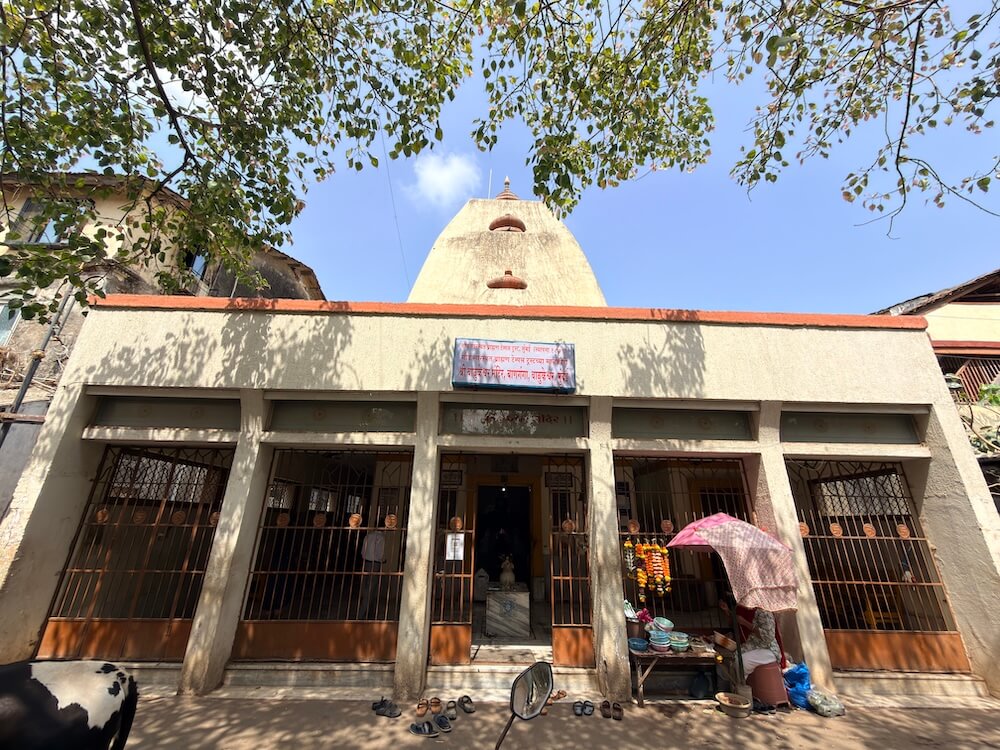
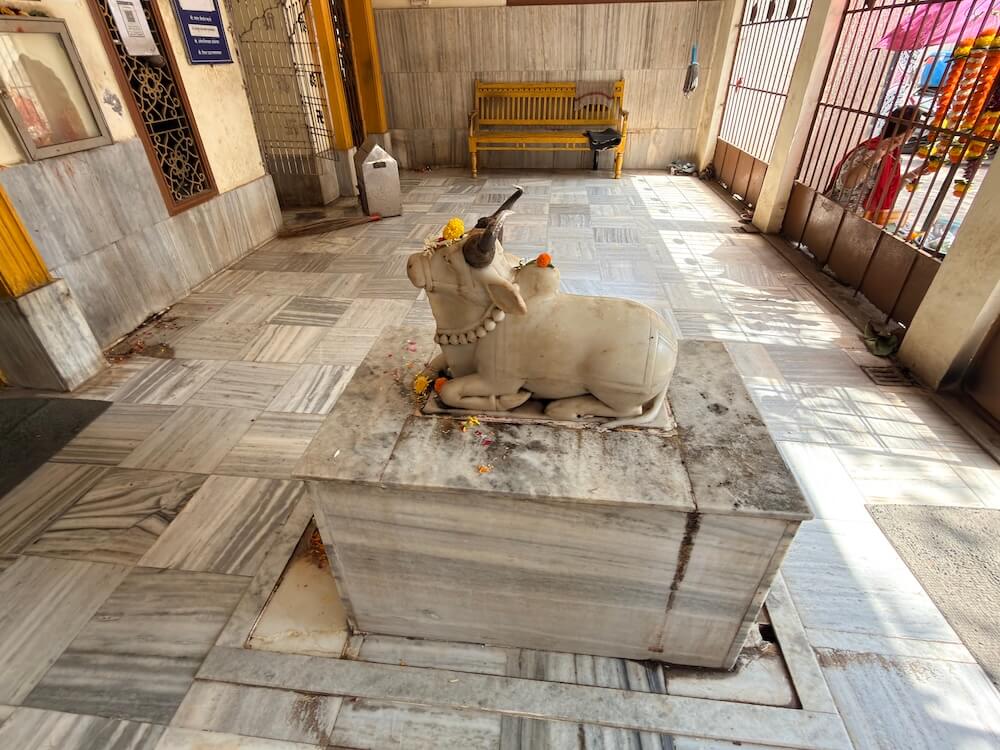
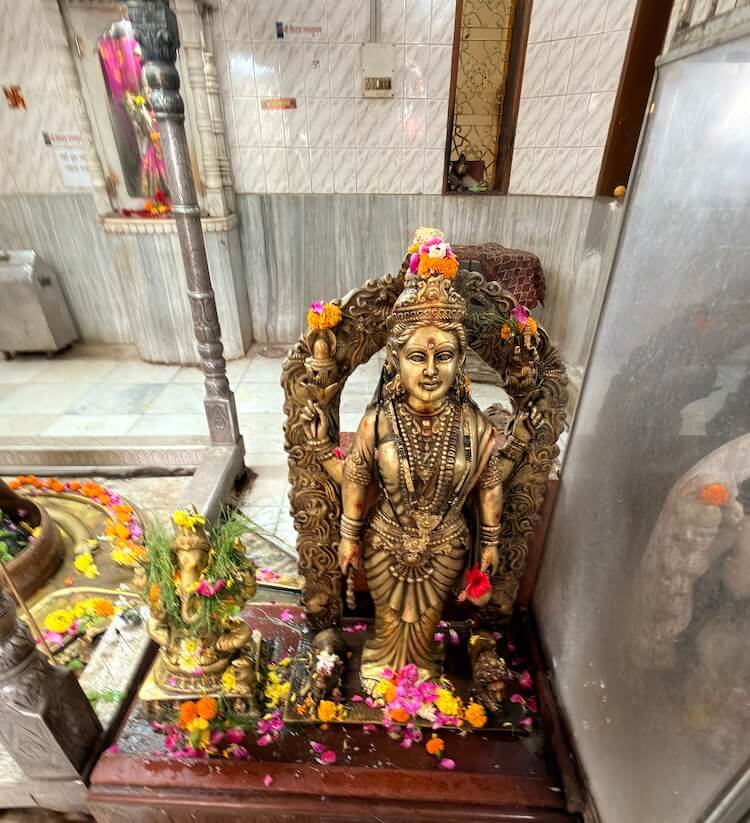
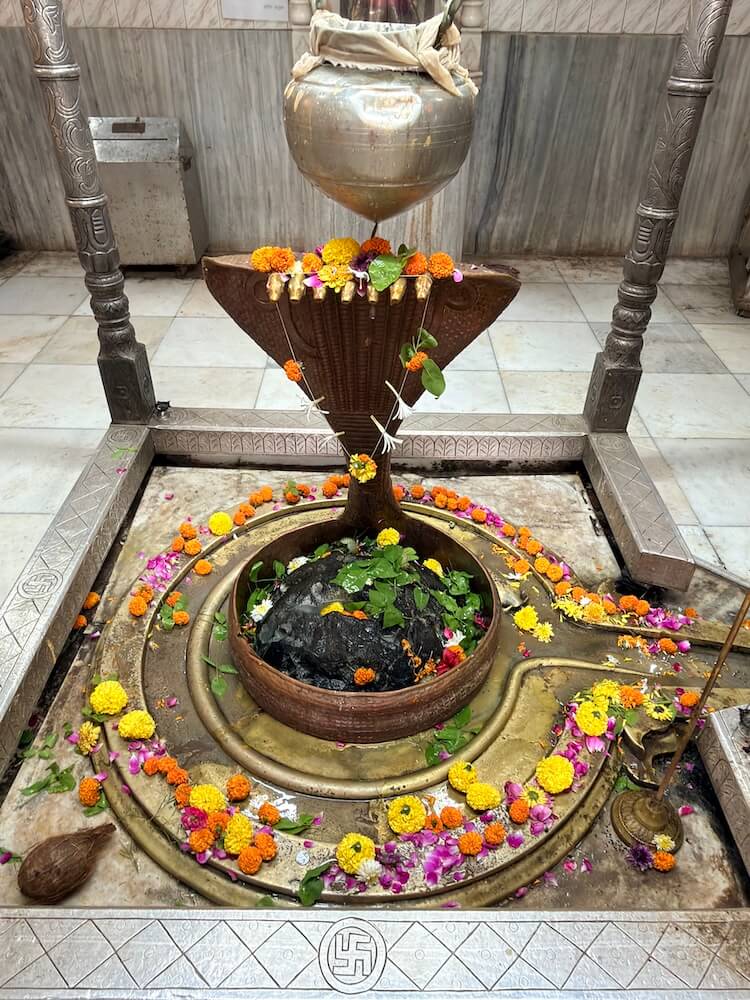
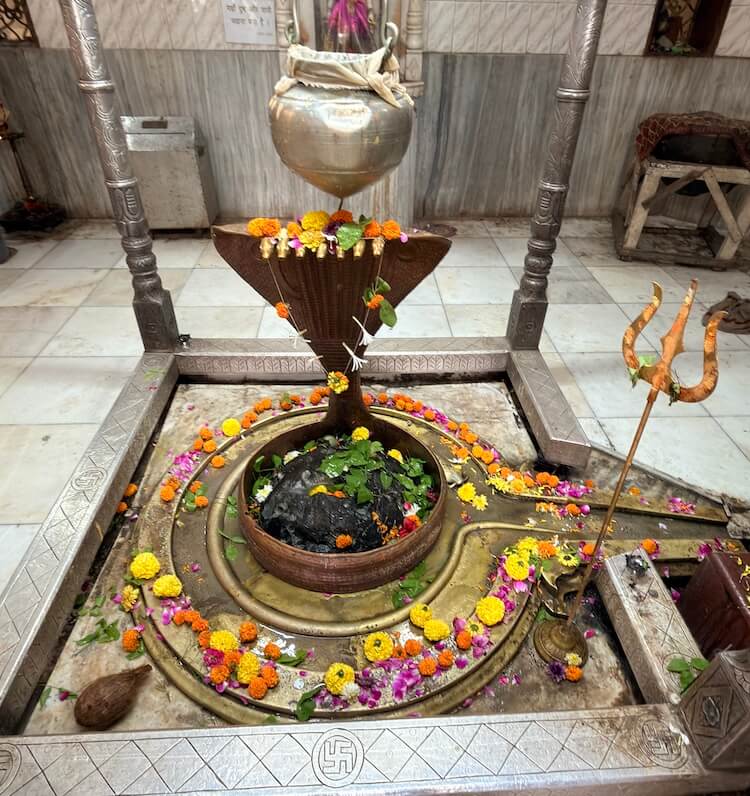
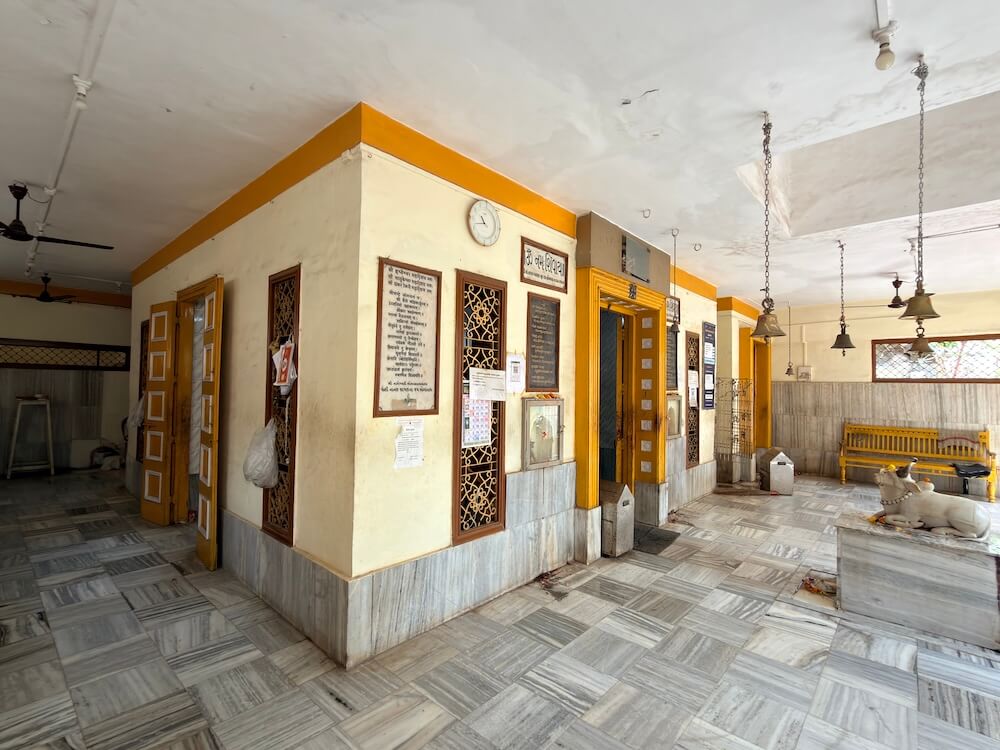
This temple of Walkeshwar is of simple, unadorned construction. The structure of the temple consists of a Sabha Mandap (assembly hall) and a Garbhagriha (sanctum sanctorum). The Sabha Mandap of the temple is 50 feet by 20 feet, wide and spacious. It has a flat roof. In the Sabha Mandap, on a high marble pedestal, there is a beautiful idol of Nandi carved in marble. The Garbhagriha here is also of modern construction and is square-shaped. On its front wall, on both sides of the entrance, there are two small niches. They contain small idols of Ganesha and Bhairava. On the frame of the entrance, at the Lalatbimba position, there is a Kirtimukha. In the area above it, there are colorful idols of Ganesha and Riddhi-Siddhi in a square niche. In the center of the sanctum sanctorum stands a shrine supported by four silver pillars. Within it, on the ground level, the stone Lingam of Valukeshwara is consecrated inside a brass base. This Lingam is encircled by a large copper-crafted serpent king, which also forms a canopy with its hood above. A brass Abhishek vessel is placed over it. To the right of this Shiva Linga stands a highly artistic, standing brass idol of Ganesha and Adishakti in a balanced posture. The idol of Adishakti is four-armed; in her upper right hand, she holds a flower-adorned Shiva Linga, and in her left hand, a lotus flower. Her remaining two hands are lowered, with a Rudraksha mala in the right hand and a Kamandalu in the left. Near the feet of this idol are a lion and Nandi. In a niche on the back wall of the sanctum sanctorum, the idol of Mother Parvati is enshrined. To the right of this sanctum is a sub-sanctum, where an idol of Lakshmi-Narayana, crafted from black stone, is installed on a marble altar. Above the main sanctum of the temple rises an unadorned, tall spire.
Devotees can have Darshan in this temple from 6 in the morning until 8 at night. The Kakad Aarti is performed here at dawn. Worship is conducted in the morning, afternoon, and evening. The specific timings for these rituals are not mentioned. The Maha Naivedya is offered at midday. Shravan is the festive month here. During Shravan, a Laghurudra Abhishek is performed on the Linga daily. A pilgrimage fair is held here on Kartik Purnima and Mahashivratri. During these times, the deity’s palanquin procession is taken out with musical accompaniment. There is a large crowd of devotees during these festivals. The temple is managed by the Gaud Saraswat Brahmin Temple Trust.
This sacred temple stands as a testament to deep spiritual devotion, ancient architectural grandeur, and rich local cultural traditions.
The sanctum sanctorum houses the divine idol consecrated according to ancient Vedic traditions, surrounded by serene courtyards and traditional temple architecture.
Navratri, Maha Shivratri, Annual Temple Jatra & Deepotsav
Compare and book flights, secure top-rated local hotels near the temple, hire reliable guides, and rent cars instantly.
Extend your pilgrimage by visiting other highly sacred temples located nearby.


Add ₹999 more to unlock FREE SHIPPING!
Your sacred cart is currently empty.
Shop Photo FramesFill in your delivery details below to place your order.
Add comment