
Add ₹999 more to unlock FREE SHIPPING!
Your sacred cart is currently empty.
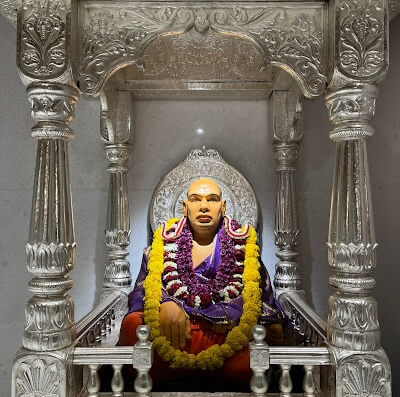
Shop Photo FramesThe Walkeshwar Shri Kashi Math, a branch of the revered religious seat of the Gaud Saraswat Brahmins, is situated on the banks of the Banganga Tank in the Malabar Hill area of Mumbai, near the Walkeshwar Temple. Housed within a magnificent modern structure, this Math contains the Vrindavans (samadhis) of the seventh Guru of the Kashi Math lineage, Madhavendra Tirtha Swami, and the eighteenth Guru, Varadendra Tirtha Swami. Devotees believe that both these great souls still reside in their samadhis, and that their heartfelt prayers are fulfilled when offered with devotion.
The Gaud Saraswat Brahmin community is prominently recognized among Indian communities that have made significant progress in trade and business, as well as in the fields of art and literature. According to information from the article ‘The History of the Gaud Saraswat Konkan Brahmins’ by M. Sheshagiri Prabhu (‘Saraswat Bodhini’, September and October 1926), the Aryans who came from Central Asia first settled in the Punjab region. The tribes in the region of the Panch-Ap, or five rivers, came to be known as ‘Panchajanya’. The progenitor of the tribe living on the banks of the Saraswati River was Sage Dadhichi. In the Rigveda, they are referred to as ‘Saraswat’ or ‘Saraswan’. The descendants of Sage Dadhichi received the identity of ‘Saraswat’. Due to the increasing population in the Saraswati River region, some people migrated eastward to Bengal and Trihotrapur.
According to the Marathi Vishwakosh, the land of Mithila had a total of twelve names. One of them was ‘Tairbhukti’, which became corrupted to ‘Tihotra’. The region north of the Ganges in the present-day state of Bihar is called the ‘Tirhut region’. In ancient times, this part of Bengal and Bihar was called the ‘Gaud Desh’. The Saraswats there came to be known as ‘Gaud Saraswat Brahmins’. According to the ‘Sahyadrikhanda’ section of the ‘Skanda Purana’, after Parashurama settled Gomantaka, he performed a yajna for his world conquest. For the success of that yajna, he brought ascetic and scholarly Saraswat Brahmins from Trihotrapur to Gomantaka, including those of the Bharadwaja, Kaushika, Vatsa, Kaundinya, Kashyapa, Vashistha, Jamadagni, Vishwamitra, Gautama, and Atri lineages. There were 66 clans of these Brahmin sages. They also brought their family deities—Mangeshi, Mahalaxmi, Mahadeva, Shantadurga, Nagesh, Saptakoteshwar, and Mahalasa—to Gomantaka. In the thirteenth century CE, Madhvacharya, the proponent of the Dvaita-Vedanta philosophy of the Vaishnava tradition, visited Gomantaka. At that time, the Vaishnava Gaud Saraswat Brahmins here accepted his Dvaita philosophy. The spiritual and ideological foundation of the Shri Kashi Math Samsthan is built upon this very Dvaita philosophy.
The Kashi Math in Varanasi was established around the year 1542 CE by Madhvacharya Vijayendra Tirtha Swami. For this reason, he is also addressed as ‘Saraswat Dharmapitha Sthanacharya’. Yadavendra Tirtha was appointed as the first Swami of the Kashi Math. The seventh head of this Math, Madhavendra Tirtha, established a branch of the Kashi Math at Walkeshwar around 1742. It is said that Madhavendra Tirtha, who had earned great fame in Kashi, came to Mumbai while on a pilgrimage to Rameshwaram. He purchased a plot of land on the banks of the Banganga in Walkeshwar for the expansion of the Math. In the book ‘The Hindu Temples of Bombay’ (1895) by Krishnarao Raghunathji Navalkar, also known as K. Raghunathji, information is provided that during his stay in Mumbai, Madhavendra Tirtha realized his end was near. Therefore, he had a samadhi built here and attained samadhi. After his samadhi, the local Saraswat brethren collected subscriptions and established the Math over his samadhi using those funds. Madhavendra Tirtha entered the samadhi site and took living samadhi on Shravan Shuddha Panchami (Nagpanchami), Tuesday, 1 August 1775. His samadhi site is referred to as a ‘Vrindavan’. This Math also houses the samadhi of Varadendra Tirtha Swami.
Varadendra Tirtha was the 18th Swami of the Kashi Math. A polyglot, Varadendra Tirtha composed Sanskrit works such as ‘Malabandha’, ‘Chakrabandha’, and ‘Nagabandha’. Like Acharya Vinoba Bhave, he knew Sanskrit, Malayalam, Konkani, Kannada, Tamil, Telugu, Marathi, Hindi, Gujarati, English, Latin, French, Portuguese, Urdu, German, and Japanese. Additionally, he was a scholar of mathematics, astrology, palmistry, and Ayurveda. Interested in modern machinery, the Swami started a printing press named ‘Sachchidananda Mudranalaya’ in Basrur to print the manuscripts of the Kashi Math. During his tenure, he established and renovated many temples. After living in the southern Maths for many years, Varadendra Swami came to Mumbai at the beginning of the twentieth century. He resided in the Math at Walkeshwar. He passed away at this very place on Ashadha Shuddha Dwitiya, Wednesday, 24 June 1914. His Vrindavan was built next to that of Madhavendra Tirtha Swami.
A legend is told about the Vrindavan of Madhavendra Swami that he still resides here in a subtle body. Every morning at dawn, he goes to bathe in the Banganga Tirtha located in front of the Math. At that time, many have heard the sound of his wooden sandals (khadava) here. It is said that when the 19th Swami of Kashi Math, Sukhtindra Tirtha, was staying at Walkeshwar, he once saw an ascetic wearing wooden sandals going towards the tank early in the morning. He also heard the sound of those sandals. Another legend regarding this is that a person named Narsimha from Mulki in South Kannada wanted to test the divine presence of Madhavendra Swami. One night, he slept in front of the Vrindavan, on the path the Swami would take to Banganga. When he woke up the next morning, he was in a different place. He believed that the Swami himself had picked him up from the path and placed him elsewhere. Due to these legends, many devotees come to this Math and bow before the Vrindavan with the hope that their wishes will be fulfilled.
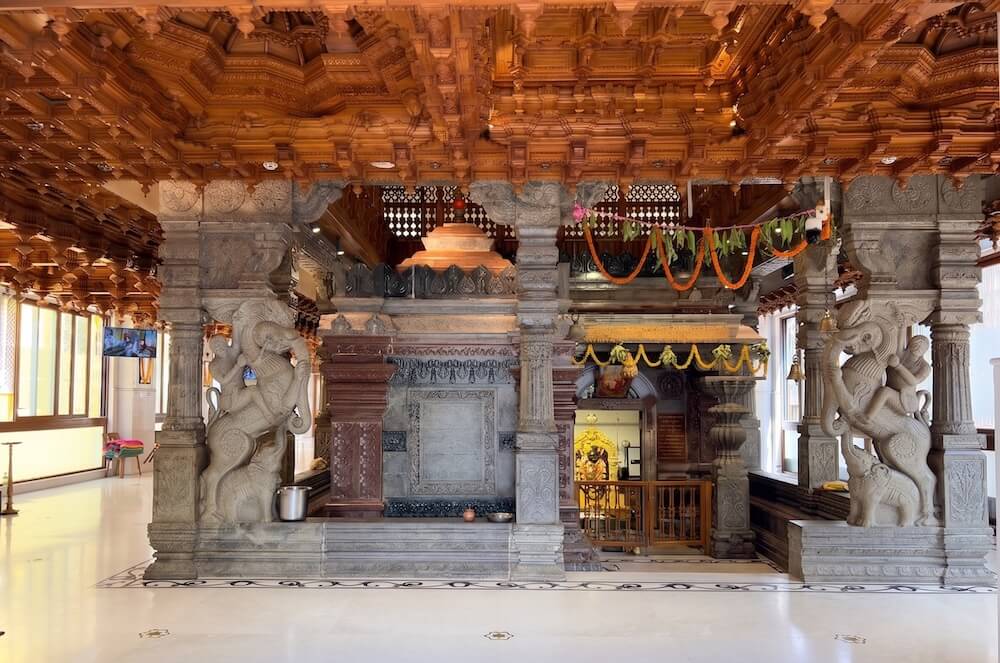
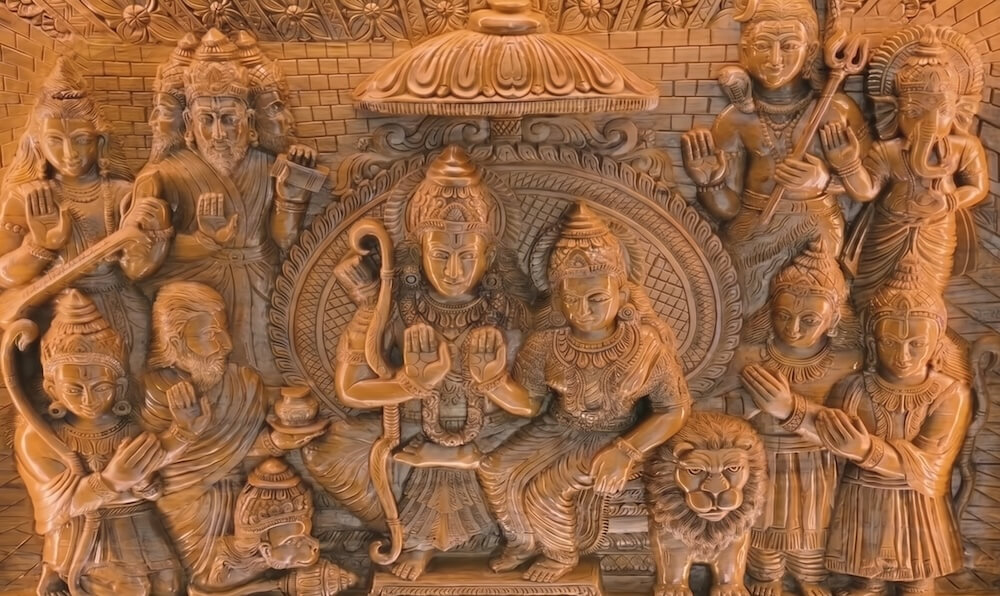
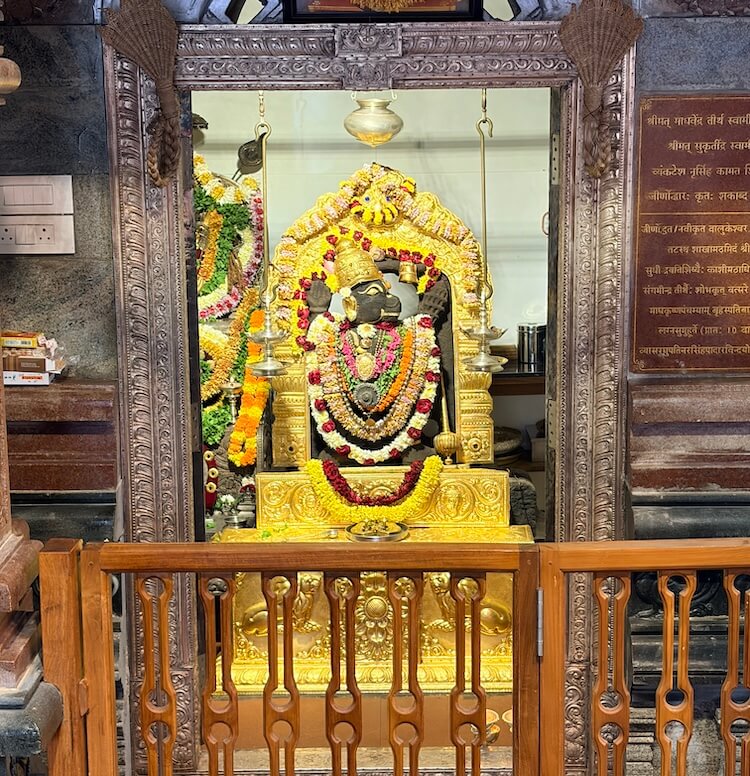
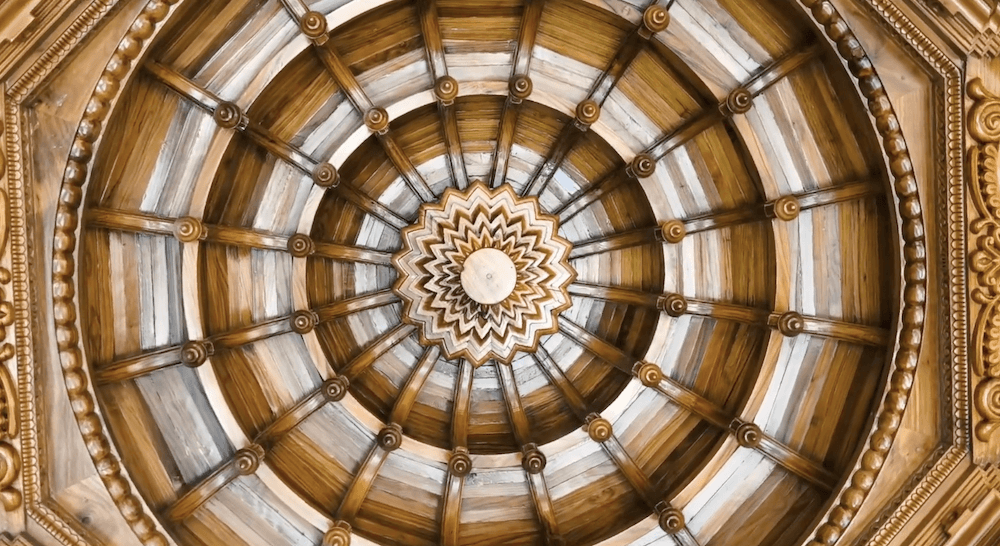
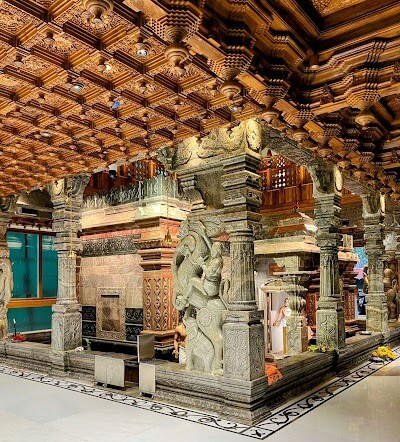
The structure of the Math, established here in 1742 CE, has been renovated many times over the course of time. Following the renovation completed in the year २०२४, the Matha has attained its current grand and spacious form. This Matha building is three stories tall and built in a modern architectural style. The Matha features a magnificent wooden entrance. On both sides of this entrance are two carved semi-pillars. In the center of these semi-pillars on both sides, there is a relief sculpture of the Kashi Matha emblem. One enters the assembly hall (Sabhamandapa) of this Matha after climbing four steps. A special feature of this spacious and high-ceilinged assembly hall is its ceiling. In this wooden ceiling, adorned with extremely fine carvings, sculptures depicting various episodes from the Ramayana are etched. Directly in front, in the assembly hall, is the living Samadhi shrine (Vrindavana) of Madhavendra Tirtha. The form of this Vrindavana includes pillars crafted from carved stone, a sculpture of a warrior mounted on a Vyala near those pillars, distinctive decorative railings on the ceiling, and a spire crafted from pink stone atop it. The Vyala sculpture here is highly remarkable. A Vyala is a fierce-looking creature, also known by names such as Varalaka, Varala, and Vralika. In South India, it is called Yali. According to scholars, this sculpture arrived in India during the Mauryan period from Scythian or Achaemenid sculptural art. Vyala figures are found in large numbers in the architecture of Vijayanagara, which has a special connection to the Madhva tradition. The Vyala figure here is in the form of a Gaja-Vyala, meaning it has the head of an elephant. It has the body of a horse. Beneath it is an elephant, and a brave warrior is mounted upon it. In his poem ‘Vyala-Vijay’, the poet Ramdhari Singh ‘Dinkar’ depicts Krishna standing upon it, saying, “Tan, tan, phan vyala! Ki tujh par main bansuri bajaun” (Stretched, stretched, hood of the Vyala! May I play the flute upon you). He has presented the idea that the Vyala here represents the form of doubt in the human mind. To the left side of this Vrindavana, an idol of Hanuman, crafted from black stone, is enshrined. This idol, approximately three feet in height, is in the Southern style. It is consecrated within a beautiful silver arch (Prabhavali). In this Vrindavana, the metal idols brought by the Swami himself are also worshipped.
In the assembly hall, to the left of the Vrindavana, is the idol of the twelfth Swami of Kashi Matha Samsthan, Surindra, also known as Surendra Tirtha Swami. This smiling marble idol is seated in a silver shrine on a high pedestal against the wall. Behind it is the Vrindavana of Varadendra Tirtha Swami. Near this, the marble idol of the १९th Swami of Kashi Matha, Sukhtindra Tirtha, is also consecrated in a silver shrine. In the spacious assembly hall here, at some distance towards the back, in a separate chamber, is the Vyasa Raghupati Narasimha Temple. Here, the idols of Vyasamuni, Shriram, and Narasimha are consecrated on a silver altar. Adjacent to this is the Sukhtindra Hall. The Matha has a large basement where Homa-Havan is performed. On the second floor, there is accommodation for the disciples and devotees of the Matha, and on the floor above that is the grand hall for the Padya-Puja of the Swamis. The sleeping quarters of the Matha’s Swamis are also located here. This structure is topped by a magnificent spire crafted from red stone.
Daily Nitya-Puja is performed in this temple according to the traditions of Kashi Matha. Three annual festivals are celebrated in the temple. The first festival is celebrated on Shravana Shuddha Panchami, the second on Ashadha Shuddha Dwitiya, and the third on Kartika Vadya Pratipada, which is Padwa. Shravana Shuddha Panchami is the Samadhi day of Madhavendra Tirtha Swami, while Ashadha Shuddha Dwitiya is the Samadhi day of Varadendra Tirtha Swami. On these days, special worship of the Vrindavanas is performed in the morning. At night, the Swami’s palanquin procession is taken out. A Mahaprasada program is also held during these festivals. Apart from this, programs such as Vyasopasana, Bhajans, and Kirtans are regularly celebrated in the temple. Devotees can visit here daily from ७:०० AM to १:०० PM and from ६:०० PM to ८:३० PM.
This sacred temple stands as a testament to deep spiritual devotion, ancient architectural grandeur, and rich local cultural traditions.
The sanctum sanctorum houses the divine idol consecrated according to ancient Vedic traditions, surrounded by serene courtyards and traditional temple architecture.
Navratri, Maha Shivratri, Annual Temple Jatra & Deepotsav
Compare and book flights, secure top-rated local hotels near the temple, hire reliable guides, and rent cars instantly.
Extend your pilgrimage by visiting other highly sacred temples located nearby.


Add ₹999 more to unlock FREE SHIPPING!
Your sacred cart is currently empty.
Shop Photo FramesFill in your delivery details below to place your order.
Add comment