
Add ₹999 more to unlock FREE SHIPPING!
Your sacred cart is currently empty.
Shop Photo FramesThe prosperous commercial area of Mumbai derives its name, Kalbadevi, from the location of this temple. This ancient and modest temple of the Goddess is nestled amidst the crowded buildings of the bustling Kalbadevi Road. Devotees believe that the idol of the Goddess here is *Swayambhu* (self-manifested) and *Jagrut* (awakened/divinely conscious). This Goddess is considered a form of Mother Kali or Kalika. She is the presiding deity (*Aradhya Devata*) for many traders in the Kalbadevi area. Believing that the Goddess’s grace brings prosperity to their businesses, many traders visit regularly for her *darshan*.
Temples of Kalbadevi are found in many villages of the Konkan region. In some places, she is worshipped as Kalambadevi. There is a village named Kalbadevi (Pusale) in Ratnagiri taluka, where she is also known as Kalbadevi Kalika. Kalbadevi is also the primary deity of Malvan, which developed under the protection of the Sindhudurg Fort, whose foundation was laid by Chhatrapati Shivaji Maharaj in 1664 AD. She is considered one of the twelve-five (*barapach*) deities, which include Dev Rameshwar, Dev Narayan, Santeri, Jarimari, as well as Giroba and Gangoba. Chhatrapati Shivaji Maharaj had granted an annual stipend (*varshasan*) to the Kalbadevi temple for her daily worship. Sarkhel Kanhojiraje Angre had immense devotion to this Goddess in her Kalamba form. She is the *Kuldevata* (family deity) of the valiant Angre dynasty, who held power along the Konkan coast. This Goddess is also worshipped as the village deity (*Gramdevata*) in Alibaug, Raigad district. Furthermore, she was the *Kuldevata* of Gambhirrao Suryavanshi, the secretary to Pratap Bimb, the first king of Mumbai.
According to records in the book ‘Mahikavatichi Bakhar’, edited by historian V. K. Rajwade, King Pratap Bimb established his capital at Mahim in the 12th century. This capital was known as Mahim Bimbsthan. After conquering the island, Pratap Bimb invited some of the 66 clans, including the Somvanshi, Suryavanshi, and Sheshvanshi, to settle there. He granted some villages and hamlets to his officials as hereditary *inams* (gifts). Among these, he gave the village of Worli to Gambhirrao Suryavanshi. Prabhavati Devi was the *Kuldevata* of Pratap Bimb, and it is said that he established a temple for her in his capital. At that time, along with this Goddess, he also consecrated the idol of the Suryavanshi family deity, Mother Kalika.
‘The Gazetteer of Bombay City and Island’ (Vol. 1, 1909) mentions the Kalika Devi of Mahim, stating that there was a temple of Kali or Kalika Devi on Mahim Island. This leads to the conclusion that there must have been an independent temple for this Goddess of the Agri-Koli community there. According to the Gazetteer, during the period of Muslim rule, this temple was relocated to the present-day Kalbadevi area. In the 14th century, the first Mubarak Shah was the Sultan of Gujarat. In 1318 AD, he captured the regions of Mahim and Salsette (Sashti). During this time, his army destroyed the Mumbadevi temple here. S. M. Edwards, the author of the Mumbai Gazetteer, noted in his book ‘The Rise of Bombay’ (1902) that “due to this policy of oppression, Mahalakshmi and her sisters temporarily departed from their shores.” At that time, the Mumbai islands were ruled by Nagardev, also known as Nagarsha. In 1347 AD, Malik Nika, a commander of Mubarak Shah, and Nagarsha fought a major battle at Byculla. Nagarsha was defeated, and Muslim rule was established over Mumbai. From this, it can be inferred that the temple of Kalika, or Kalbadevi, of Mahim was relocated sometime after 1318 AD or 1347 AD.
Even after arriving in the Kalbadevi area, the temple had to face relocation once more. This is mentioned in the book ‘Mumbai-che Varnan’ by Govind Narayan Madgaonkar, published in 1863. He wrote, “The Kalbadevi temple is also very ancient, and its exact origin is unknown. However, its current management is with the Palshe Joshis. When the government widened the Kalbadevi road, an order was issued to move this temple back; the old temple was demolished, and the government provided the funds for its renovation and the re-consecration of the Goddess. The entire management was entrusted to the late Raghunath Joshi. Raghunath Joshi was an original settler here and a very prominent gentleman. In the past, these people were the physicians in Mumbai, and even today, they mostly continue the same profession. They also used to perform the priestly duties in Mumbai.” ‘The Gazetteer of Bombay City and Island’ also confirms the event of this temple being moved.
In the 18th century, the British significantly altered the geography of Mumbai. During this century, the British connected the seven islands of Mumbai. Around 1710 AD, the construction of embankments from Sion to Dharavi and Dharavi to Mahim began. These embankments blocked the seawater that used to enter through the creek between Mahim and Sion, reaching up to present-day Prabhadevi. Subsequently, between 1711-12 AD, an embankment was built between the islands of Mahim and Worli. Similarly, the Umarkhadi pass and the creek between Mazgaon and Parel islands were filled in. By 1784 AD, the Hornby Vellard embankment was completed, and the Worli gap was filled. This made a large amount of land available in Mumbai, leading to new settlements. Old settlements and roads were also being restructured. As part of this, in 1784, the same year the Hornby Vellard was completed, the road in the Kalbadevi area was also widened. According to Samuel T. Sheppard’s book ‘Bombay Place-Names and Street-Names’ (1917), the road in the Kalbadevi area from Carnac Road to Parel Road was extremely narrow. A large part of that road was occupied by the Kalbadevi temple. Raghunath Joshi held ownership of this temple. The government negotiated with him extensively and finally decided to acquire the temple site and build a new temple in its place. Accordingly, this new Kalbadevi temple was established in 1784-85 AD.
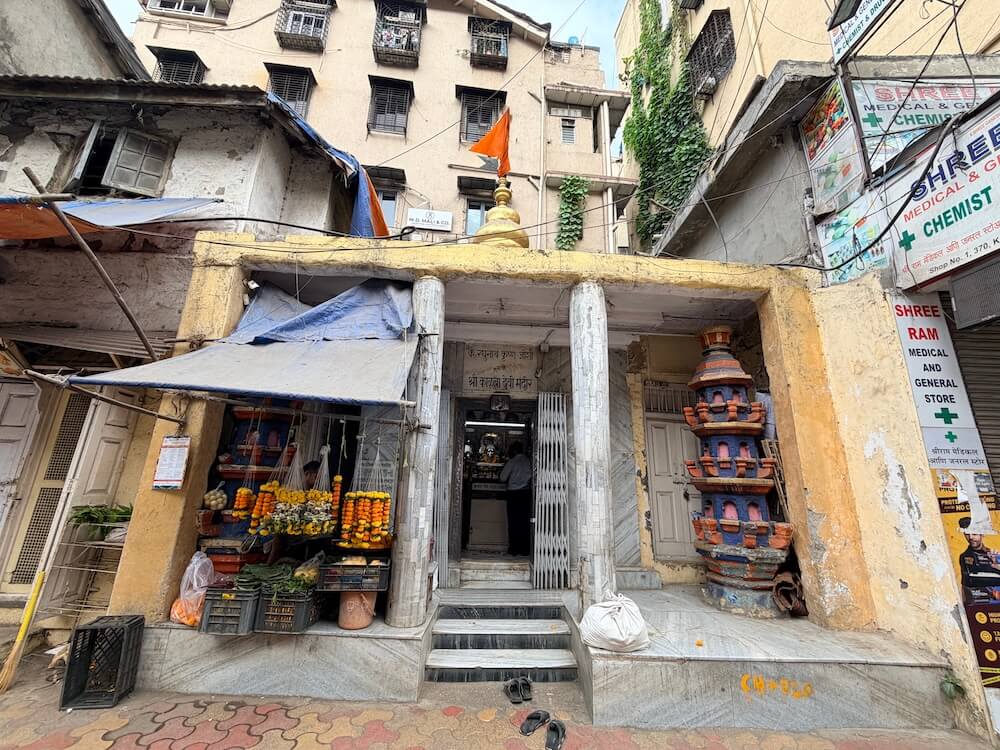
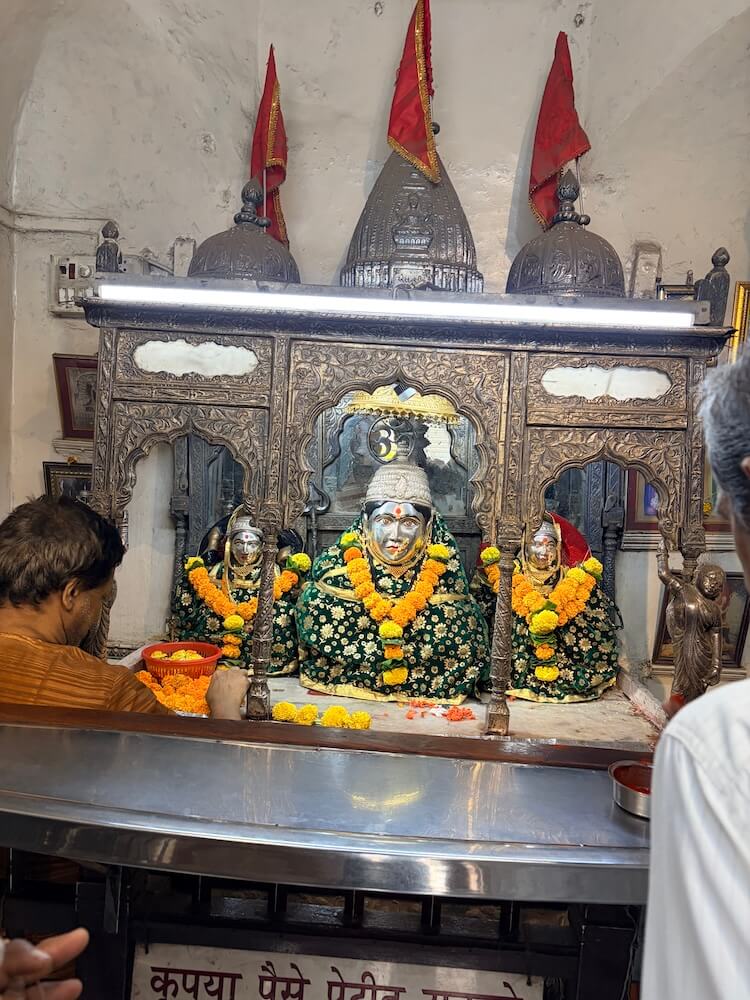
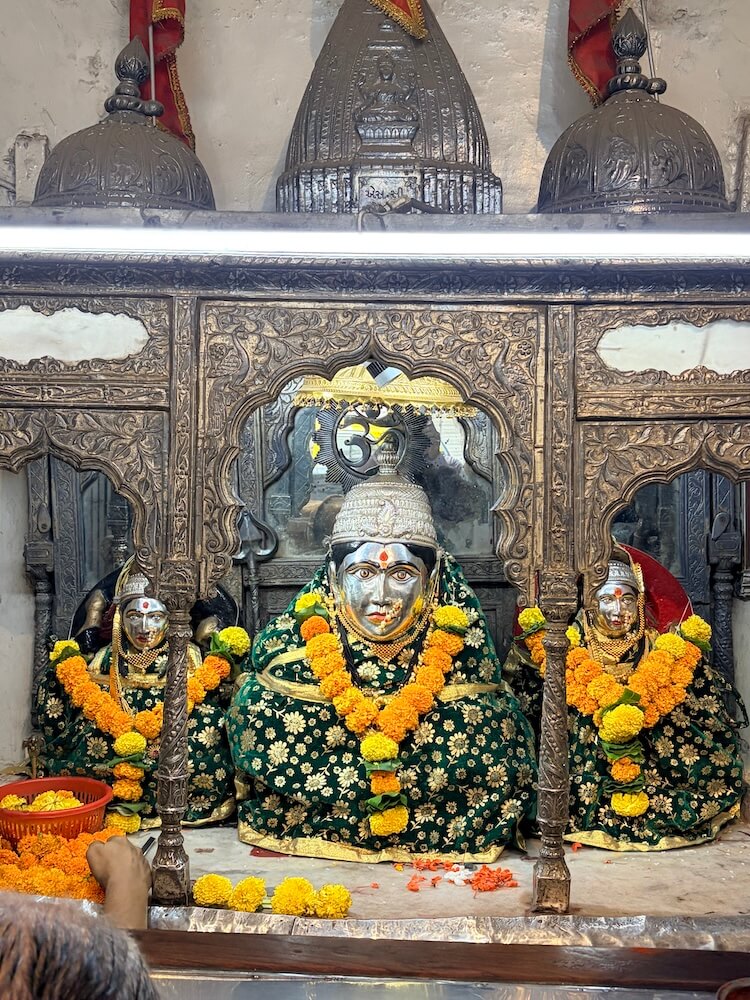
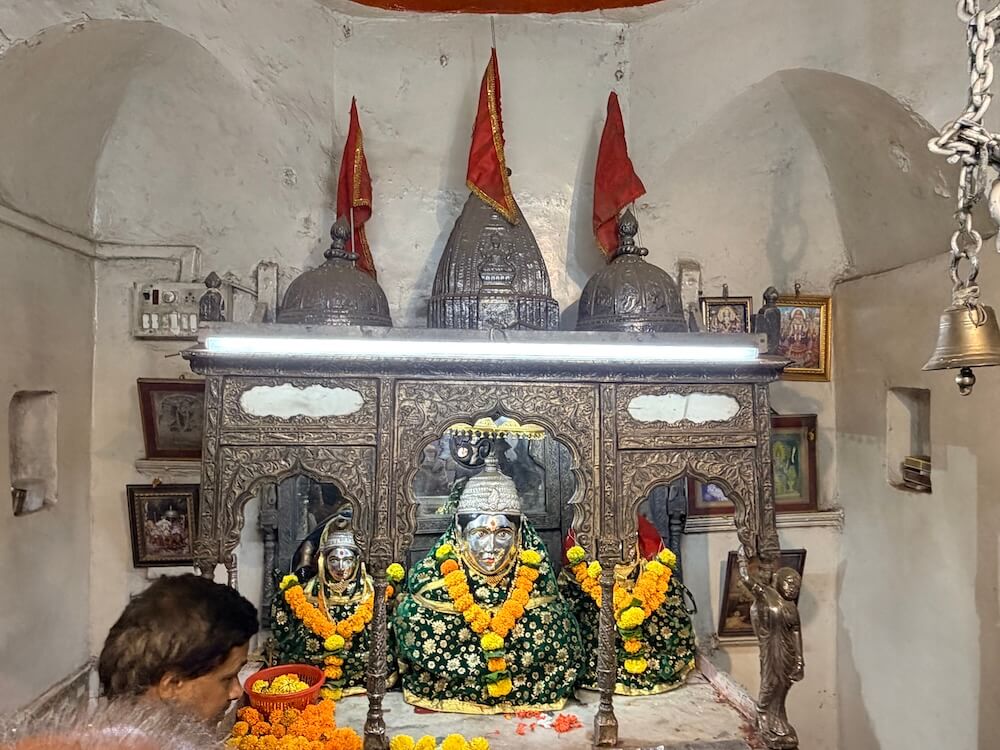
The book ‘Mumbai-cha Vrittant’, published in 1889 by Balkrishna Bapu Acharya and Moro Vinayak Shingne, provides a description of the temple as it stood at that time. They write, “This temple is small and charming. Four Brahmins are seated at the four corners of the dome. There are two deepmalas (lamp towers) at the entrance… This Goddess is also known as Kalika Devi.” For the past 240 years, this Kalika, also known as Kalbadevi temple, has stood at its current location. Over time, tall buildings were constructed around the temple. The temple has been repaired and renovated periodically, which has given it its present appearance. There is a high platform adjacent to the footpath, three steps leading up to it, and a simple entrance to the temple in front. Two stone deepmalas standing at the two corners of the platform preserve the signs of the temple’s antiquity. On one side, there is a small flower garland shop. This is the facade of the temple. A carved silver sheet is inlaid on the door frame of the temple. At the center of the lintel of the frame, there is a carved four-armed idol of the Goddess seated on a lotus. In the sanctum sanctorum, there is a silver canopy with three spires on a high altar. On the front of this canopy, on the side pillars, are two distinctive silver idols of the Goddess’s attendants. In the center of the canopy, the large idol of Kalbadevi is consecrated. The idol has a silver mask. Adorned with large carved eyes, a traditional Maharashtrian nose ring, and a silver crown on her head, the Goddess is dressed in rich garments, jewelry, and flower garlands. Behind the Goddess is a trident, and above her is a silver canopy. Although Kalbadevi is a form of Mother Kali, she is not in a fierce form here. According to the ‘Mahanirvana Tantra’, when Kali is immersed in the act of creation, she is Rajasic and red-colored. When she is immersed in the act of destruction, she is Tamasic and black. When she is in the act of maintaining the universe, she is Sattvic and fair-complexioned. The idol of Kalbadevi here is of such a Sattvic and fair-complexioned nature. On one side of her are two small silver idols of Rajarajeshwari and on the other side, Mother Mahalakshmi. These idols are also in the form of masks. The temple has a dome-shaped spire. On top of it is a large brick-built kalash (finial), and above that is a two-tiered metal kalash.
Devotees can have darshan of the Goddess in this temple from 6:00 AM to 9:00 PM. The Navratri festival is the biggest festival in this temple. This festival is celebrated here with simplicity but great enthusiasm. Devotees believe that this Goddess is ‘Jagrut’ (awakened/manifest) and fulfills their wishes. Therefore, many devotees make vows (navas) to the Goddess. During Navratri, many devotees come here to fulfill their vows. Margashirsha Amavasya is celebrated as the temple’s foundation day. At this time, special worship of the Goddess is performed here. Notably, the fair of the Kalambadevi temple in Digas village of Kudal in Sindhudurg district also takes place in this same month of Margashirsha (Krishna Trayodashi).
This sacred temple stands as a testament to deep spiritual devotion, ancient architectural grandeur, and rich local cultural traditions.
The sanctum sanctorum houses the divine idol consecrated according to ancient Vedic traditions, surrounded by serene courtyards and traditional temple architecture.

Navratri, Maha Shivratri, Annual Temple Jatra & Deepotsav
Compare and book flights, secure top-rated local hotels near the temple, hire reliable guides, and rent cars instantly.
Extend your pilgrimage by visiting other highly sacred temples located nearby.


Add ₹999 more to unlock FREE SHIPPING!
Your sacred cart is currently empty.
Shop Photo FramesFill in your delivery details below to place your order.
Add comment