
Add ₹999 more to unlock FREE SHIPPING!
Your sacred cart is currently empty.
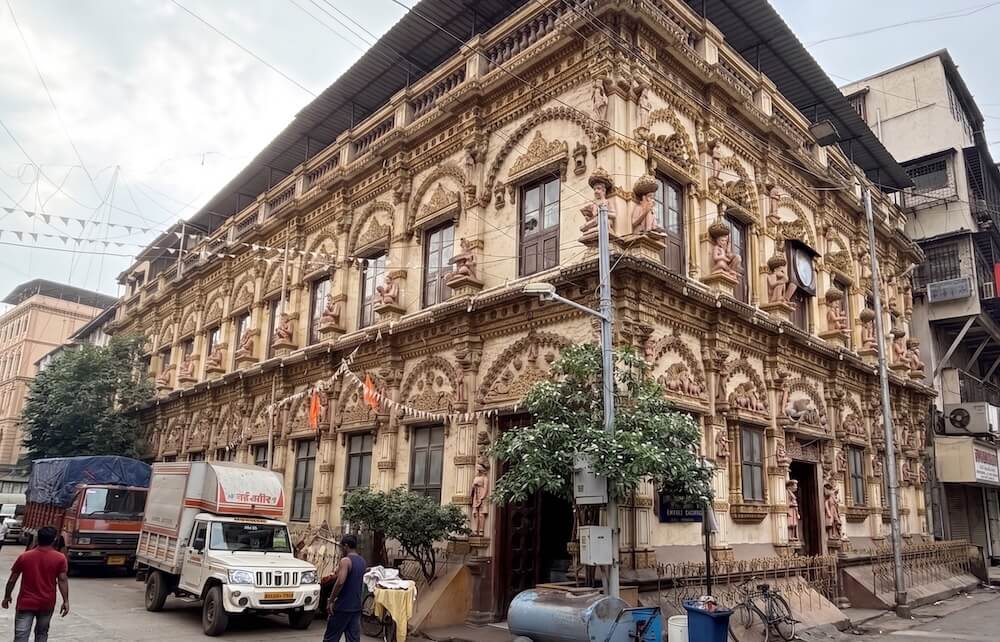
Shop Photo FramesKalbadevi is a bustling area in Mumbai that preserves a rich historical and spiritual heritage. Located on Kalbadevi Road near Ramwadi and Vithalwadi, within a majestic haveli well known as ‘Sundarbagh’, stands the Dwarkadhish Temple dedicated to Lord Krishna. This magnificent architectural creation was brought to life a century and a half ago, inspired by an extraordinary dream experienced by a wealthy merchant. Lord Krishna spent His childhood in Nanda’s palace in Gokul. Fittingly reminiscent of that palace, this temple attracts devotees as well as temple scholars and architects alike.
The history of this temple is intertwined with the history of Mumbai, which was rapidly developing after 1870 during the British era. During this period, two major railway companies initiated new railway routes, connecting the island of Mumbai to distant places. Maritime trade had increased, and business was booming. The American Civil War between 1861 and 1865 and the rise in cotton prices led to a flourishing textile trade in Mumbai. In 1870, there were ten mills in Mumbai, a number that grew to 27 by 1875. Among these textile merchants, Seth Moolji Jetha was a leading name at the time. The Jetha family founded the ‘Moolji Jetha Market’ in 1871, which remains famous in Mumbai today and was once renowned as the largest textile market in Asia. Sundardas Jetha, born into the family of this affluent merchant, built this temple-haveli here during that era.
An inscription on the main entrance of the temple clearly mentions that the consecration (*pratishtapana*) of this Shri Dwarkanathji Temple was performed by Sundardas, son of Thakkar Moolji Jetha, on Jyeshtha Shukla Ashtami, Friday, 11 June 1875. “Aa Shri Dwarkanathjinu Mandir Thakkar Moolji Jetha Sut Sundardase Bandhavyu Chhe. Teni Pratishtha Samvat 1931 Na Jeshth Shu. 8 Ne Shukravare Kari Chhe.” (This temple of Shri Dwarkanathji was built by Sundardas, son of Thakkar Moolji Jetha. Its consecration was performed on Friday, Jyeshtha Shukla 8, Samvat 1931.) A legend is told regarding the construction of this temple. According to it, Moolji Jetha had started the cloth market with the cooperation of Gujarati and Marwari merchants. Hence, he resided on Vithalwadi Road in this very area. He had purchased a plot of land on Kalbadevi Road and planned to build a new house there. Around that time, Lord Krishna appeared to Moolji Jetha in a dream vision one night. In this dream, he received a divine indication that an idol of Lord Krishna was hidden somewhere in his house. Thereupon, he began searching for the sacred idol in his home. Eventually, he discovered the idol in an old wooden chest beneath a staircase. Overwhelmed by this divine indication, Moolji’s family took a solemn resolve to build a grand temple for Lord Krishna. They decided to construct the temple on the very plot on Kalbadevi Road that had been purchased for their residence. Moolji’s son, Sundardas, fulfilled that resolve in 1875. The ancient idol was consecrated in the temple, and it was opened to all. This temple is a magnificent haveli. Today, it is considered the oldest surviving and functional haveli structure in Mumbai, making it of immense significance to Mumbai’s historians and architectural scholars.
Amidst hundreds of small commercial stalls, gold and silver shops, clothing stores, and the clamour of traffic, this glorious hallmark of Mumbai’s history stands tall. Over the past 150 years, minor and major modifications were made to the temple as needed from time to time. In 2024, architect Dhriti Vaidya undertook the conservation and restoration of this haveli-temple. She restored the teakwood pillars, doors, and balcony railings that had been concealed beneath layers of paint for many years. Preserving the temple’s original color scheme, she enhanced its splendor even further.
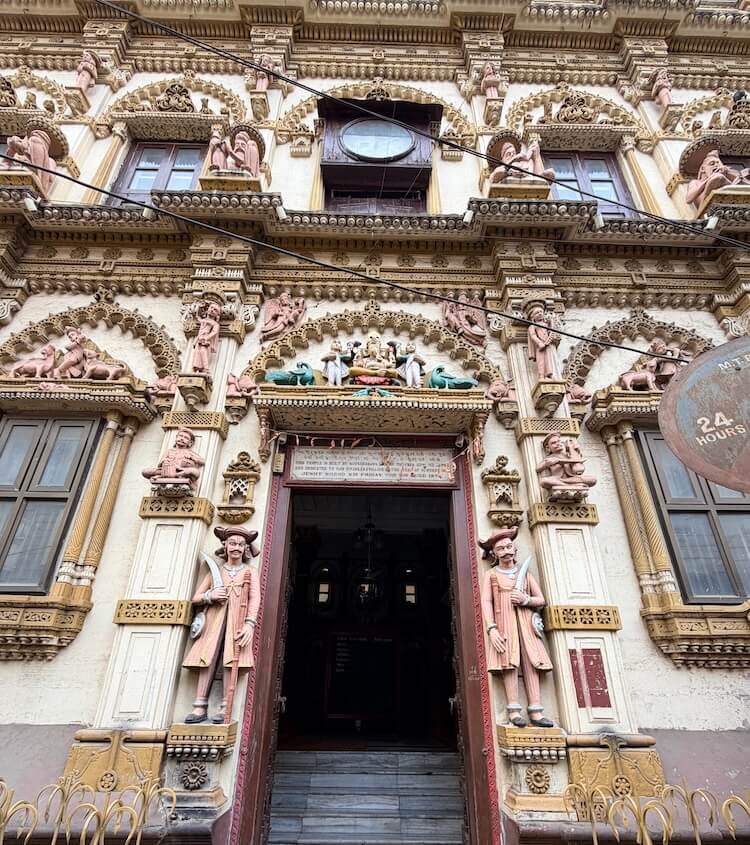
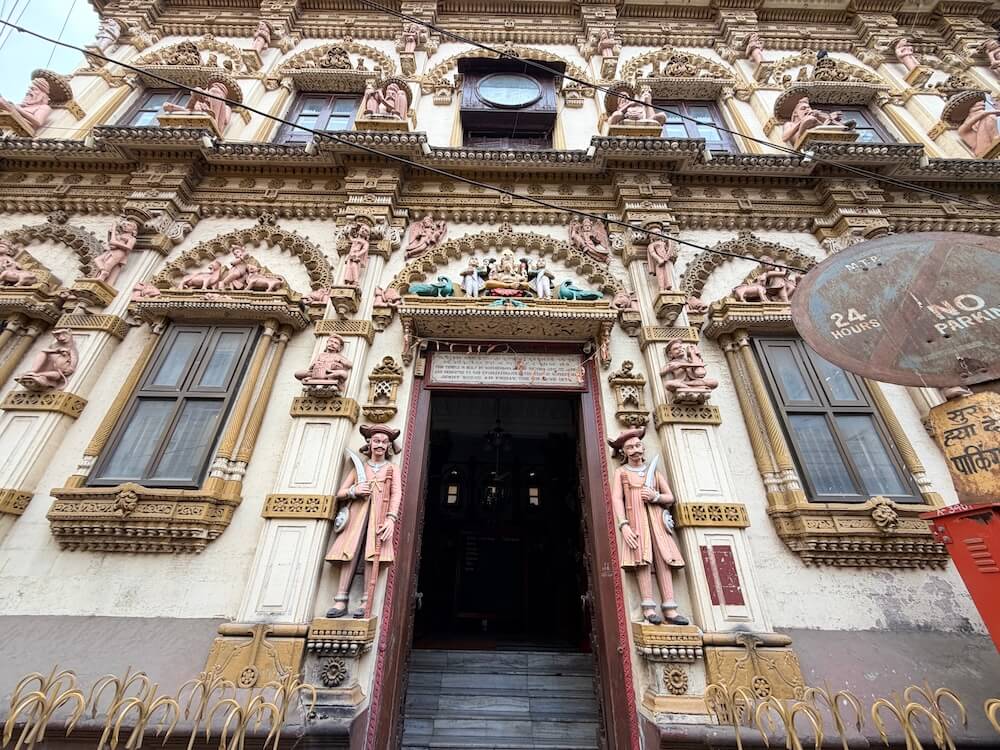
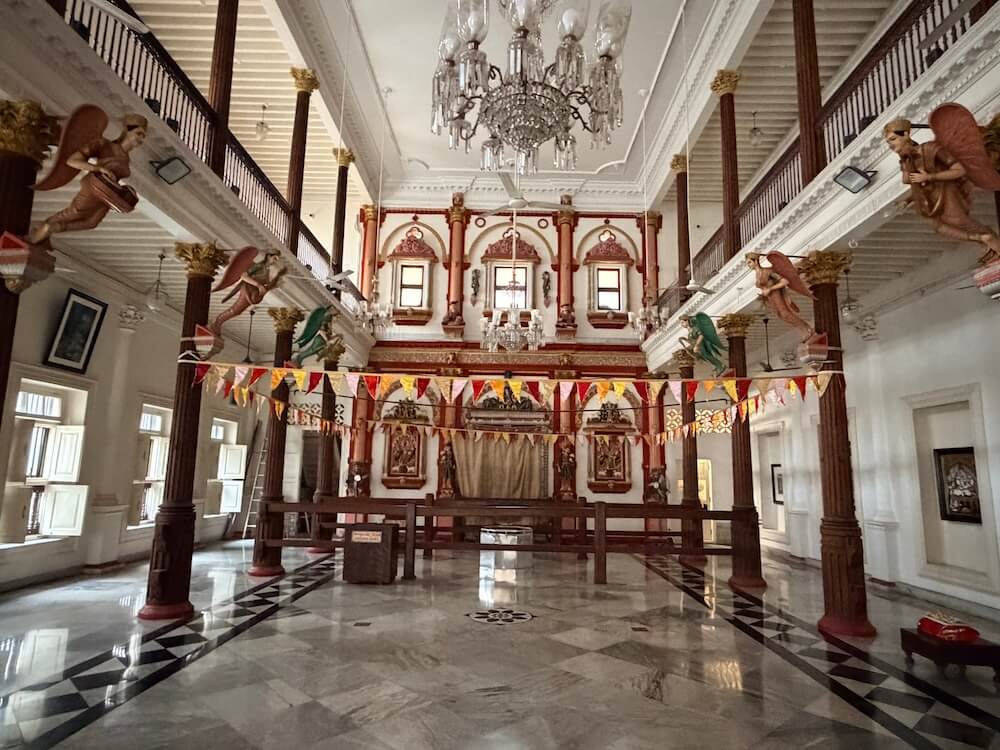
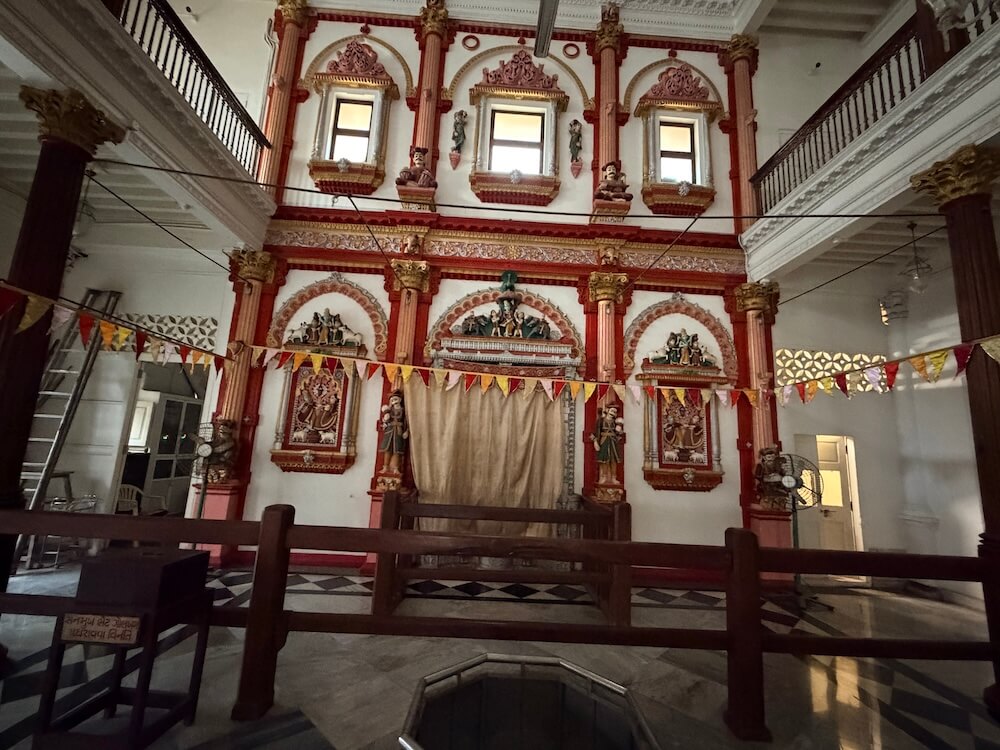
In the book *’Mumbaicha Vrittanta’* (An Account of Mumbai) published in 1889, author duo Balkrishna Bapu Acharya and Moro Vinayak Shingne provided details about the temple. According to their description: “There are two main entrances to enter this temple—one on the west side and the other on the north side. Above the western entrance, Lord Ganesha is carved along with Riddhi and Siddhi, and there is a large clock above it. On the outer northern and western sides, various carvings depict sages, ascetics (*gosavis*), milkmaids (*gawalanis*), monkeys, and more. Someone is seated holding a rosary (*japa mala*), someone is reading a holy scripture, someone with matted hair is arranging his locks, while elsewhere monkeys are engaged in playful antics; such varied and exquisite carving work is beautifully crafted. Upon entering, one beholds a large and grand *sabhamandap* (assembly hall). The floor of this *sabhamandap* is paved with marble stone… There is a balcony on three sides above the *sabhamandap*, and the craftsmanship on this balcony and the pillars is intricately carved… The door leading into the *garbhagriha* (sanctum sanctorum) is silver-plated. On this door, Lord Krishna is depicted with two attendants holding a royal canopy (*chhatra*) over Him. Statues of Jaya and Vijaya are placed on either side of the entrance, and beside them, niche-like shapes depict *gopis* holding hands and playing *fugdi*, with carvings of cows below them. Next to them, a musician playing the *sarangi* and on the other side a tabla player are depicted, with similar depictions of tabla and sarangi players above them as well.”
“The idol of Shri Dwarkanathji is made of black crystal and is seated on a raised pedestal resembling a low wooden throne (*chaurang*)… The seat is always covered with a silk cloth. In the idol’s four hands are the four sacred weapons (*ayudhas*)—conch (*shankha*), discus (*chakra*), mace (*gada*), and lotus (*padma*). All of these are made of silver. Small bolsters are kept by the side of the idol. The idol’s attire is always made of brocade (*kinkhab*), and the turban is styled like those worn by the Maharajas of the Vallabh Sampradaya…”
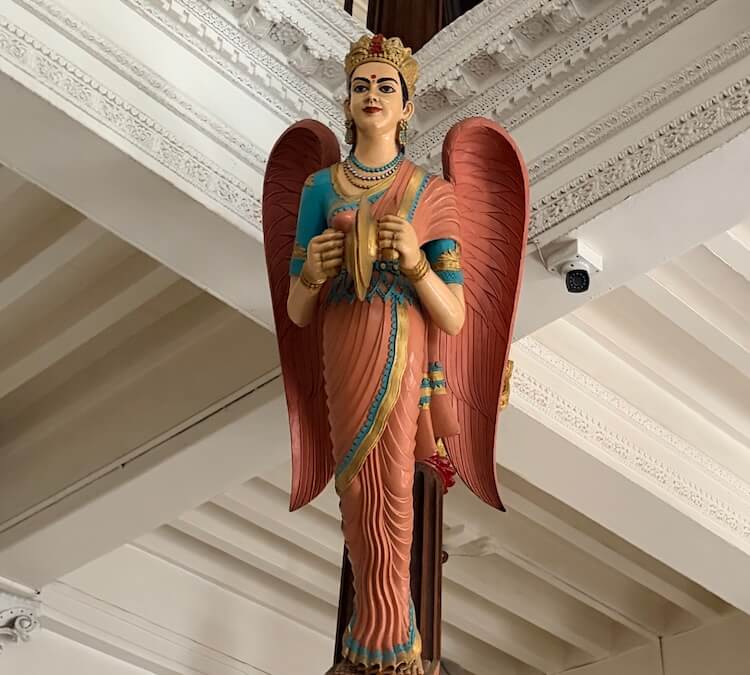
This description of the temple, written 14 years after its establishment, remains fully applicable even today, 151 years later. The temple structure is grand and a tall, two-storeyed edifice. According to the renowned architect Mustansir Dalvi, parallel to colonial architectural styles in Mumbai such as ‘Neo-Classic’, ‘Neo-Gothic’, and ‘Indo-Saracenic’, a ‘Domestic Vernacular’ (indigenous residential) style was taking shape during that era. The Dwarkadhish Temple bears a strong influence of this vernacular style. The outer walls of the temple feature numerous windows. The intricately carved arches above the windows, the idols of Krishna Kanhaiya atop them, the pillars with sculptures of musicians and Surasundaris (celestial maidens), as well as the images of various Rishis (sages) make the outer walls look exceptionally magnificent. On both sides of the temple entrance stand tall sculptures of Dwarapalas (gatekeepers). These sculptures resemble soldiers from the ‘militia’ serving the East India Company. Stepping forward a few feet from this entrance and ascending six steps leads into the Sabhamandap (assembly hall) of the temple. Illuminated by windows, this spacious Sabhamandap features marble flooring. At a short distance from the walls of the Sabhamandap, there are teakwood pillars in the ‘Corinthian style’ on both sides. On the upper portion of these pillars are exquisite wooden carvings of Surasundaris clad in pink, green, and dark blue sarees. Crystal chandeliers hang from the ceiling of the Sabhamandap. On the walls of the Sabhamandap hang watercolor and oil paintings depicting scenes from the life of Lord Krishna. Facing ahead is the grand, two-storeyed Garbhagriha (sanctum sanctorum). In the ornate niches on the front wall of its lower floor are paintings of Radha-Krishna, along with relief sculptures depicting events from Lord Krishna’s life. On both sides of the entrance to the Garbhagriha are tall pillars adorned with tall sculptures of Dwarapalas. This entrance has a silver doorframe and door. Sculptures of Dwarapalas are carved on the lower portion of this doorframe. On the lintel (mandaraka) of the frame is an Ardha-chandrashila flanked on both sides by Kirtimukhas. The upper section (uttaranga) features a relief sculpture of Govardhangiridhari Shri Krishna. Inside, upon a raised altar (vedi), the idol of Lord Dwarkadhish, carved out of black crystal and beautifully adorned with sacred garments and ornaments, is enshrined. On the steps of the altar are silver-crafted idols of cows and horses.
Devotees are permitted entry into this temple from 6:00 AM to 9:00 PM. Various Hindu festivals and celebrations are observed here. Krishna Janmashtami is the grandest festival celebrated here. During this festival, the temple is grandly decorated with illuminations and floral garlands. Devotees from the surrounding areas participate in large numbers in this sacred celebration.
This sacred temple stands as a testament to deep spiritual devotion, ancient architectural grandeur, and rich local cultural traditions.
The sanctum sanctorum houses the divine idol consecrated according to ancient Vedic traditions, surrounded by serene courtyards and traditional temple architecture.
Navratri, Maha Shivratri, Annual Temple Jatra & Deepotsav
Compare and book flights, secure top-rated local hotels near the temple, hire reliable guides, and rent cars instantly.
Extend your pilgrimage by visiting other highly sacred temples located nearby.


Add ₹999 more to unlock FREE SHIPPING!
Your sacred cart is currently empty.
Shop Photo FramesFill in your delivery details below to place your order.
Add comment