
Add ₹999 more to unlock FREE SHIPPING!
Your sacred cart is currently empty.
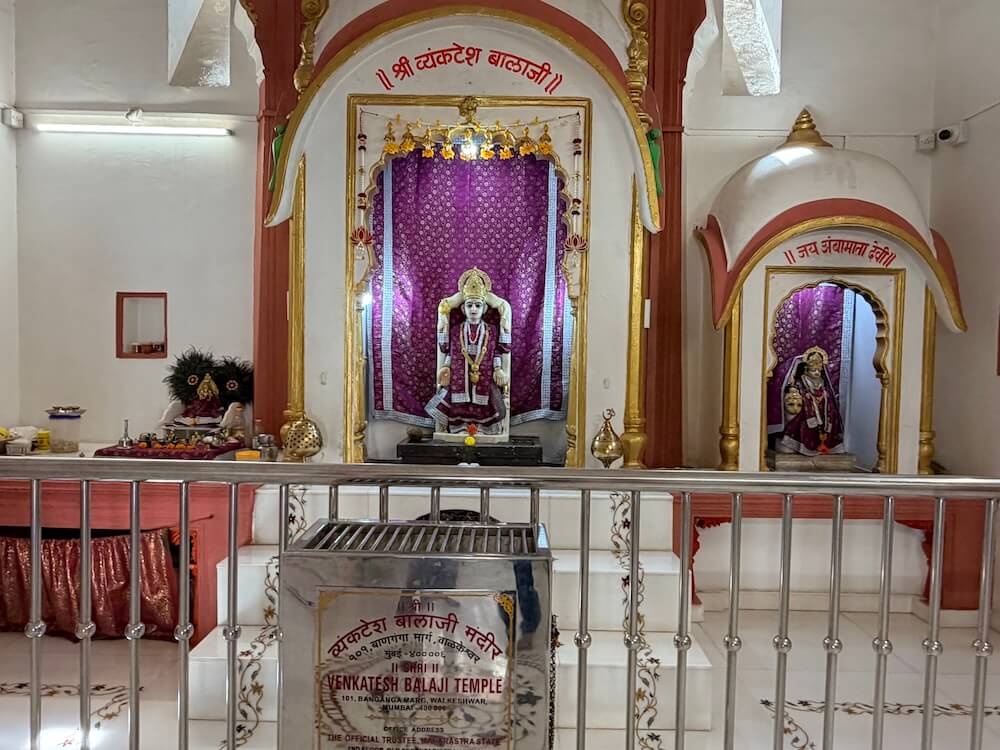
Shop Photo FramesAccording to mythological legends, Balaji is the incarnation of Lord Vishnu on Earth, blessed by Sage Bhrigu. Known in the south by names such as Venkatesh, Venkat, Perumal, and Shrinivas, Balaji is considered a deity of the same essence as Vitthal of Pandharpur. Much like in Tamil Nadu and Andhra Pradesh, Balaji is the family deity (Kuldaivat) for many in Rajasthan and Maharashtra as well. This temple of Venkatesh Balaji, dating back approximately two hundred and twenty-five years, is situated near the Banganga Tirtha on Walkeshwar Hill. It is known as the “Temple of the Open-Eyed Balaji.” This is because, unlike temples in the south, the eyes of the Balaji idol here are not kept covered.
The mythological legend regarding Venkatesh Balaji states that in the Satya Yuga, to test which deity deserved the accumulated fruits of the penance performed by sages, Sage Bhrigu went to seek an audience with Lord Vishnu. To test the Lord, Sage Bhrigu kicked Vishnu on his chest. Upon this, Lakshmi, who resides in Vishnu’s heart, became angry and left the celestial abode for Earth. Lord Vishnu, concerned that Sage Bhrigu’s foot might have been hurt, gently massaged his feet and destroyed the ‘eye of ego’ located on the sage’s sole. Sage Bhrigu then offered all the accumulated fruits of his penance to Vishnu and blessed him, saying, “In the Kali Yuga, you shall fulfill the wishes of every seeker on Earth.” Thereafter, Lord Vishnu established himself on Earth in the form of Balaji and began fulfilling the wishes of his devotees.
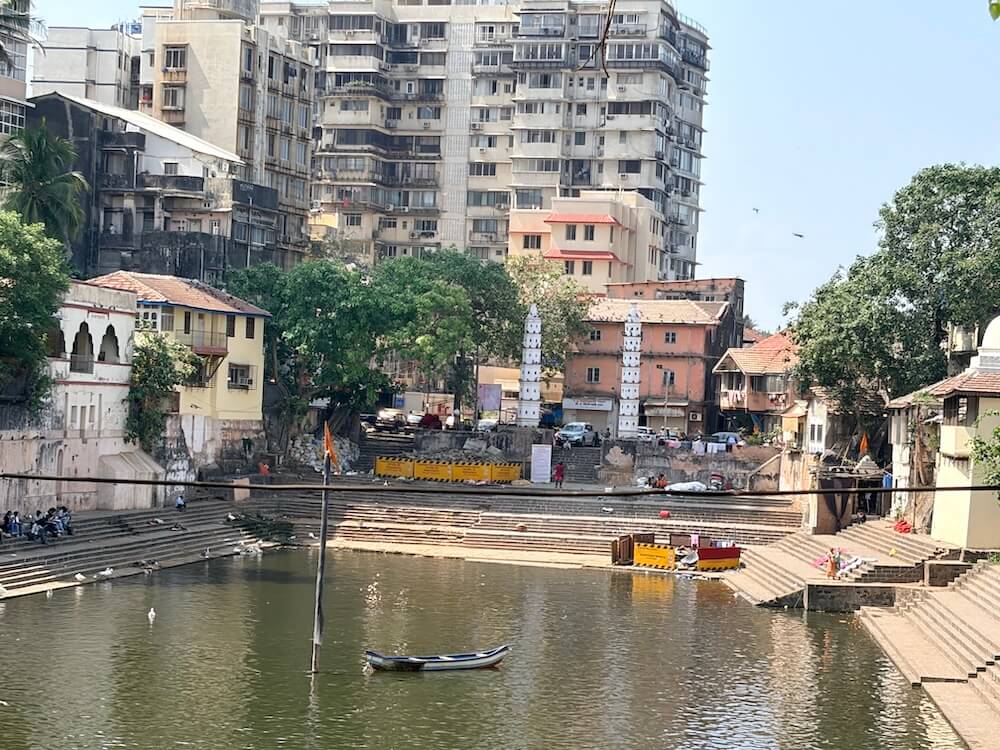
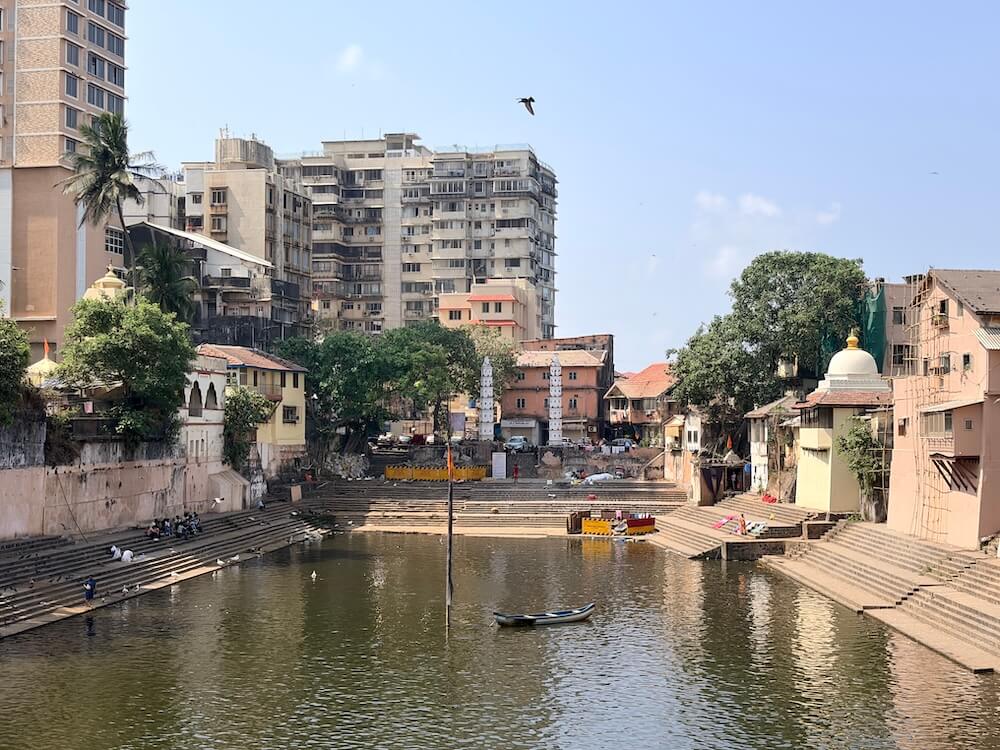
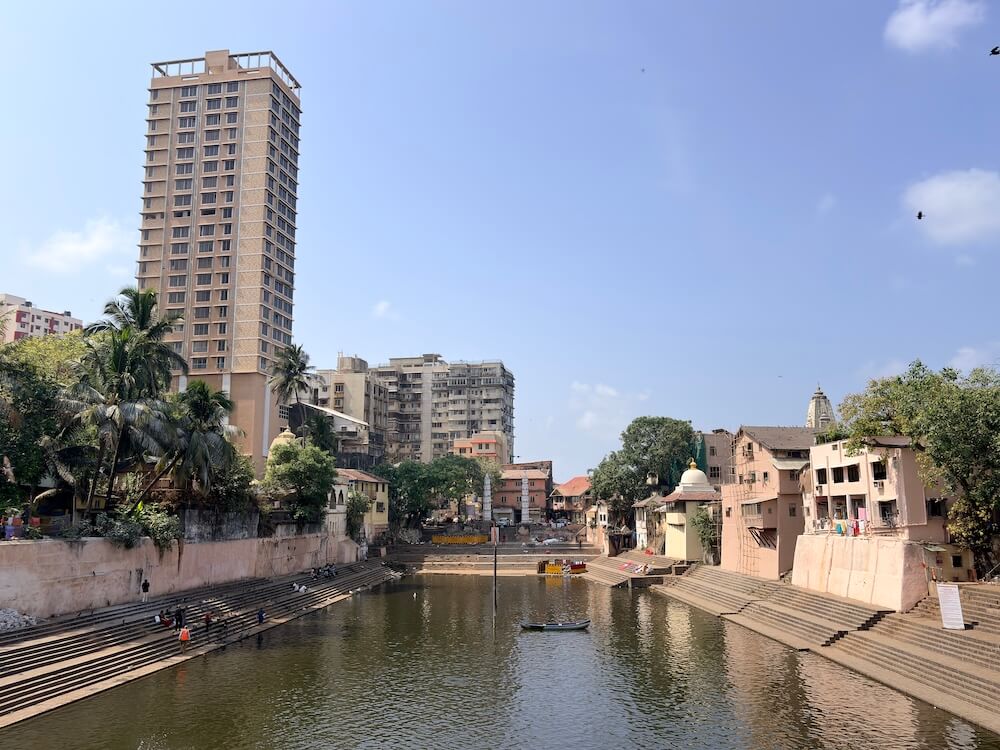
Both Vitthal of Pandharpur and Venkatesh of Tirupati, while not related to the Puranic incarnations of Vishnu, have attained the status of Vishnu-swaroop. Vitthal is considered to be Balakrishna, while Venkatesh is known by the name Balaji. It is said that Vitthal’s wife, Radha, stayed behind in Dindirvan, sulking over a pretext, while Venkatesh’s wife, angered by her husband enduring the insult by Bhrigu, stayed separately, first in Karvir and later in Tiruchanur. Like Vitthal, Venkatesh Balaji keeps his left hand on his waist while bestowing blessings upon devotees with his right hand. This Venkatesh Balaji is the family deity of the Koli community in the Vasai, Virar, and Naigaon regions. The Venkatesh Balaji temple is situated in the eastern corner of the Banganga tank.
This Banganga tank has existed since ancient times. It finds mention in the ‘Mahikavatichi Bakhar.’ The first king of Mumbai, Pratap Bimb, sent his Chief Minister, Balkrishnarao Somvanshi, in the year 1142 to conquer the islands of Mumbai. He conquered the region up to Walkeshwar. The original mention in the Bakhar is as follows: “Yesavya pasun Juhu. Yavat Vahinle. Rajan phar pahon Walkeshwari gele. Banganga dekhili. Hanumanpratima lakshili. Tethe sthir jale divas 5.” This means that Balkrishnarao Somvanshi came to Walkeshwar and Banganga from Vesave and Juhu. He stayed in this area for five days. There are some mythological legends regarding this tank-tirtha. According to a legend published in the newspaper ‘Dnyanodaya’ around the year 1860-61, Lord Shriram came to this place while on his way to Lanka with Lakshman. Here, he installed the Linga of Walkeshwar. At that time, being thirsty, Shriram shot an arrow into the ground to create water. In another story, the creation of the Banganga tank is attributed to Parashurama, the sixth incarnation of Vishnu, who is considered the creator of the land from Bhrigukachchha (Bharuch) to Kerala. While residing on Mount Mahendragiri, Parashurama requested the sea to grant him a small piece of land. When the sea refused, he became enraged and shot an arrow, forcing the sea to retreat from Kutch in the north to Kanyakumari. This created a landmass six yojanas wide and four hundred yojanas long. This landmass is called ‘Saptakonkan.’ This Saptakonkan includes Kerala, Tulang, Saurashtra, Konkan, Karhat, Karnat, and Barbar. One of the fourteen arrows shot by Parashurama fell at the place where Walkeshwar Hill is currently located. Thus, this sacred tirtha was created here. Because Shriram or Parashurama created this tirtha by shooting an arrow, it is called Banganga. Previously, it was also referred to as ‘Bantirtha’ or ‘Patalganga.’
Over different periods, sixteen large temples and several maths were established in the vicinity of this tirtha. The Venkatesh Balaji temple is considered one of the important and ancient temples among them. It is said that this temple was established in the year 1789 according to the wishes of Ramshankar Bhavanishankar Dave. At that time, this hill of Walkeshwar was quite desolate. In some places, there were grazing grounds for cattle. Some people cultivated crops like valpapadi, brinjal, cluster beans, and cucumber here. According to information from Govind Narayan Madgaonkar’s ‘Mumbai-che Varnan’ (1863), people were afraid to go here even in broad daylight in the late eighteenth century. Rama Shenvi Lotlikar owned some land in such a place. He gifted it to his close friend, Dave, through a deed of gift. Dave was a staunch devotee of Balaji. It was his wish that a temple of Balaji be built here. Two trustees appointed by Dave fulfilled this wish. Later, in February 2005, the temple was renovated under the orders of the Mumbai High Court.
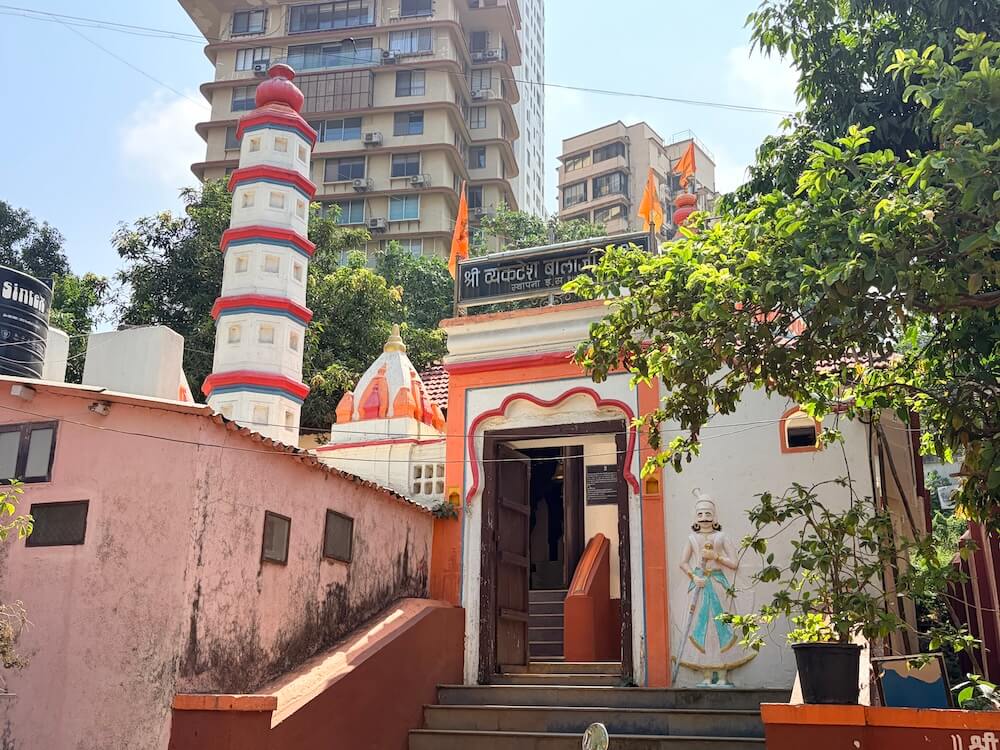
The temple is situated on a small hill adjacent to the Banganga tank. One enters the temple courtyard by climbing nine steps. The courtyard has a simple square entrance. Beside it, on the boundary wall, is a relief sculpture of a gatekeeper (Dwarapala). In this courtyard, to the right on a high pedestal, stands an eight-tiered octagonal lamp pillar (Deepstambha), as well as shrines for Garuda and Siddhivinayak. The Garuda idol here is seated on a serpent in the Virasana posture. In the Siddhivinayak shrine, the idol of Ganesha and Riddhi-Siddhi is carved from a single piece of marble stone.
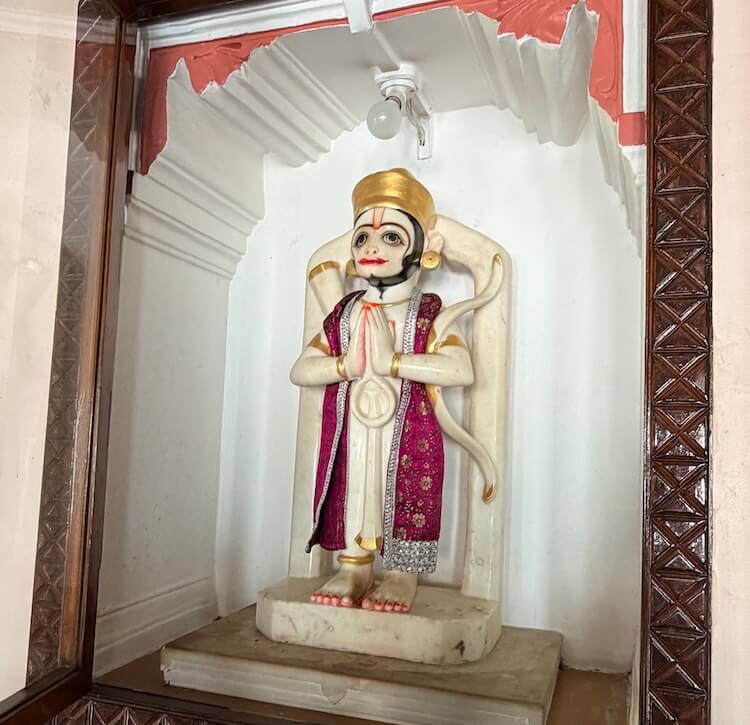
Directly in front, on a high platform, is the Maratha-era wada-style temple of Balaji. The structure of this temple consists of a Sabhamandap (assembly hall), a Garbhagriha (sanctum sanctorum), and a dome-shaped shikhara with a two-tiered kalash on top. One enters the Sabhamandap by climbing five steps. Inside this spacious Sabhamandap, which features a Mangalore-tiled roof, tall square windows with short railings at the base, and a simple wooden door, there is a wooden structure reminiscent of a Peshwa-era wada. At some distance from the walls of the Sabhamandap are carved teakwood pillars. The structure consists of arched gateways, low railings at the bottom, and a flat wooden ceiling above. A glass chandelier is suspended in the center. Directly in front is the sanctum sanctorum of Balaji. On the front wall, in a niche to the left of the entrance, resides a marble idol of Hanuman. In most temples, Hanuman is depicted holding a mace, but here, he is in the form of an archer. In the niche to the right, there is a marble idol of Ganesha. Above the door frame of the temple, at the lintel position, is a small carved idol of Ganesha, with a Kirtimukha above it. Inside the sanctum, on a high marble pedestal against the wall, the marble idol of Venkatesh Balaji is consecrated within a dome-shaped shrine. To the right of this dome, in a smaller dome, resides the idol of Ambamata, mounted on a tiger and holding a sword. To the left of the main dome, there is a small brass idol of Balaji. The idol of Venkatesh Balaji here was brought from South India. In the southern temples of Venkatesh Balaji, pure camphor strips in the shape of an English ‘V’ are applied from the forehead to the eyes of the idol. It is said that Balaji’s eyes are always open and possess immense energy. There is a possibility that the entire universe could be scorched by that energy. To prevent this, they are covered by applying a special type of camphor. Another explanation given for this is that Balaji’s lotus-like eyes are extremely beautiful. Devotees would be so mesmerized by seeing them that they would never want to leave the presence of the idol; hence, they are covered. The camphor is removed only during the time of Nethra Darshan, when devotees can behold Balaji’s eyes. However, in this temple, the eyes of the idol are always open, which is said to be the unique feature of this temple.
Devotees can have Darshan in this temple from 6 in the morning to 8 at night. Friday is considered the day of Venkatesh Balaji; therefore, many devotees especially visit the temple for Darshan on this day. Every year, the annual festival of the temple begins on Ashwin Shuddha Pratipada, the first day of Ghatasthapana. Ashwin Shuddha Ekadashi is considered Balaji’s birthday, and the festival concludes on this day. During this period, religious programs such as Shodashopachara Puja, Bhajans, and Kirtans are organized in the temple. Koli brethren from as far as Vasai participate in this festival in large numbers. The administration of this temple is managed by government-appointed trustees as per the order of the Bombay High Court dated 4 October 1927.
This sacred temple stands as a testament to deep spiritual devotion, ancient architectural grandeur, and rich local cultural traditions.
The sanctum sanctorum houses the divine idol consecrated according to ancient Vedic traditions, surrounded by serene courtyards and traditional temple architecture.
Navratri, Maha Shivratri, Annual Temple Jatra & Deepotsav
Compare and book flights, secure top-rated local hotels near the temple, hire reliable guides, and rent cars instantly.
Extend your pilgrimage by visiting other highly sacred temples located nearby.


Add ₹999 more to unlock FREE SHIPPING!
Your sacred cart is currently empty.
Shop Photo FramesFill in your delivery details below to place your order.
Add comment