
Add ₹999 more to unlock FREE SHIPPING!
Your sacred cart is currently empty.
Shop Photo FramesThe origin of the Shakta sect is believed to date back five thousand years before the Common Era. Subsequently, the text Devi Mahatmya, also known as Durga Saptashati, from the Markandeya Purana, gave a well-planned and systematic form to Shakta worship. Scholars state that there is evidence of the spread of the Shakta sect in countries such as India, Sri Lanka, Indonesia, and Cambodia. The Shakta sect still holds significant influence in Marathwada today, which is why ancient and famous temples of the Goddess can be found throughout this region. The Renuka Devi temple in Dahegaon, located in the Ghansawangi taluka of Jalna district, is one of these ancient temples. Devotees believe that by having darshan of this Goddess, their heartfelt wishes are fulfilled.
According to local tradition, this temple is about four hundred to five hundred years old. A local legend is prevalent regarding this temple. It is said that Shila Devi is the village deity of Bodkha village, near Dahegaon. Shila Devi is believed to be the younger sister of Renuka Devi. In historical times, a great calamity once befell the village of Bodkha. At that time, Shila Devi prayed to her elder sister, Renuka Devi. Renuka Devi then sent her power to Shila Devi in the form of an Aarti. With the strength received from Renuka Devi, Shila Devi averted the crisis that had come upon the village. Since then, as a gesture of gratitude, the tradition of sending a saree and choli as a gift to Renuka Devi has been followed to this day. During the Sharadiya Navratri festival, an Aarti is sent from Renuka Devi’s temple to Shila Devi, and in the month of Vaishakh, a saree and choli are brought from Shila Devi’s temple for Renuka Devi.
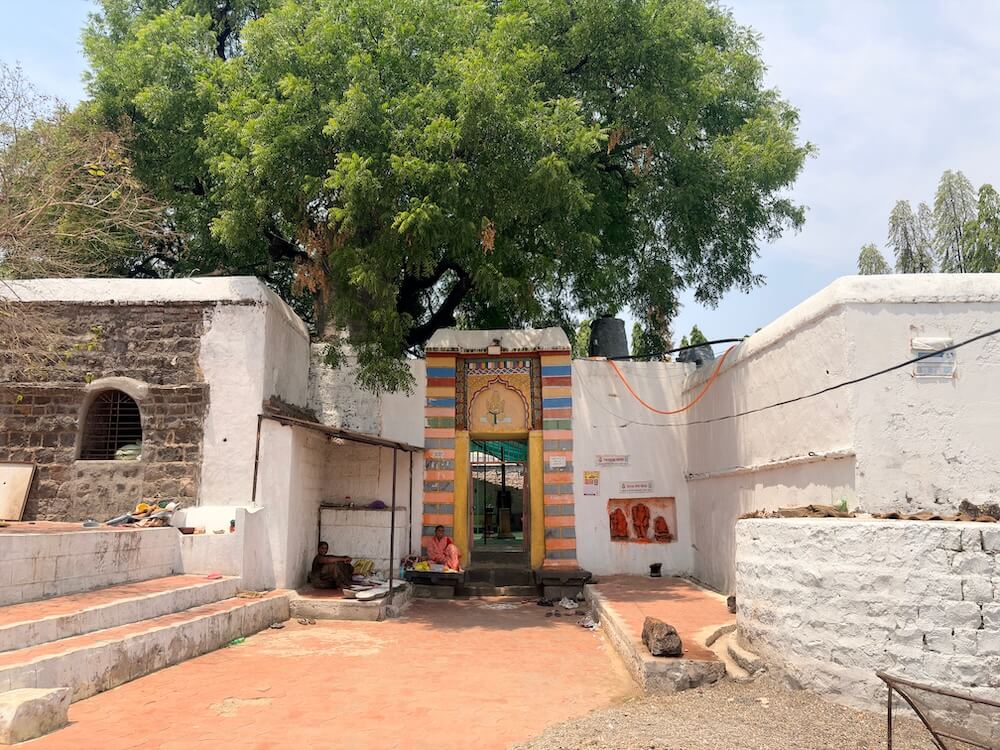
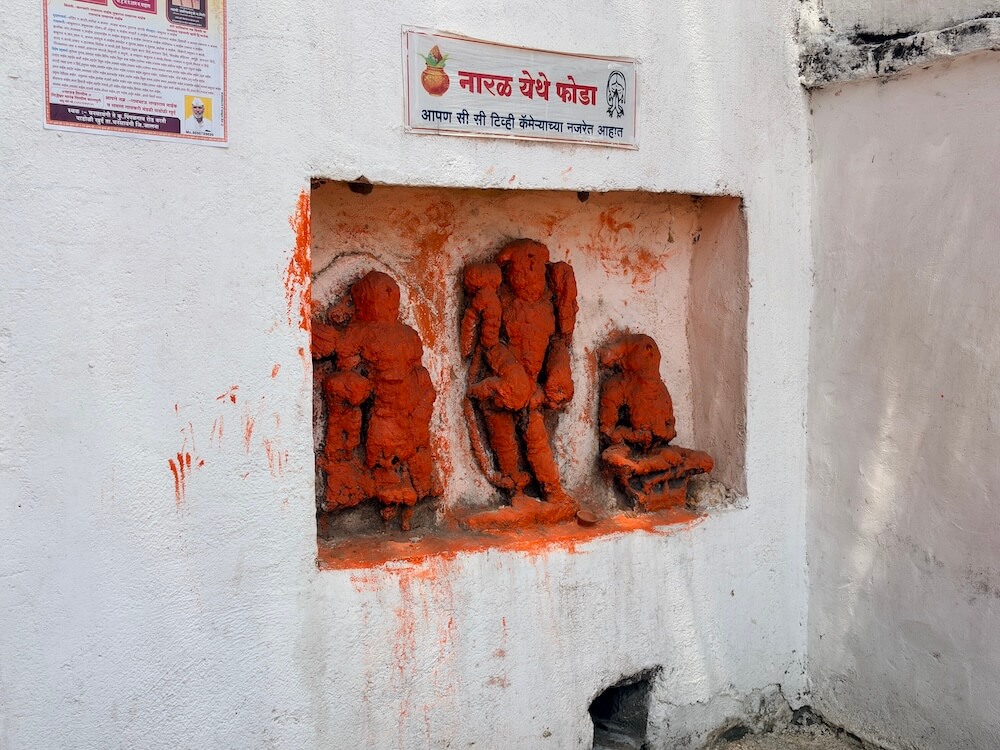
This temple is located near the main road in Dahegaon. There is a spacious area in front of the temple for parking vehicles. The temple has two fortification walls, one of which is ancient and the other newly constructed. There is an entrance gate in the outer new fortification. On both sides of the path leading from this new fortification to the ancient one, there are shops selling worship materials. The second, inner fortification of the temple is from the ancient period. This wall is about fifteen feet high and very sturdy. The entrance to this old fortification is about two feet above the ground, so one has to climb two steps to enter. The door frames of this entrance are carved with beautiful vertical line patterns. On the lintel in the center of the upper panel of the door frame, an image of Ganesha is carved. An arched torana is also visible above the entrance. On both sides in front of this entrance, there are stone platforms called ‘Mrigasana’. Scholars believe that such platforms were provided in ancient times so that devotees coming from afar could take a moment of rest. On the right side of the entrance, in a niche in the wall, are vermilion-smeared idols of Mahakali, Mahalakshmi, and Mahasaraswati. In the spacious courtyard of the temple, residences for priests and attendants, a pilgrim guest house, the temple office, and other buildings have been constructed.
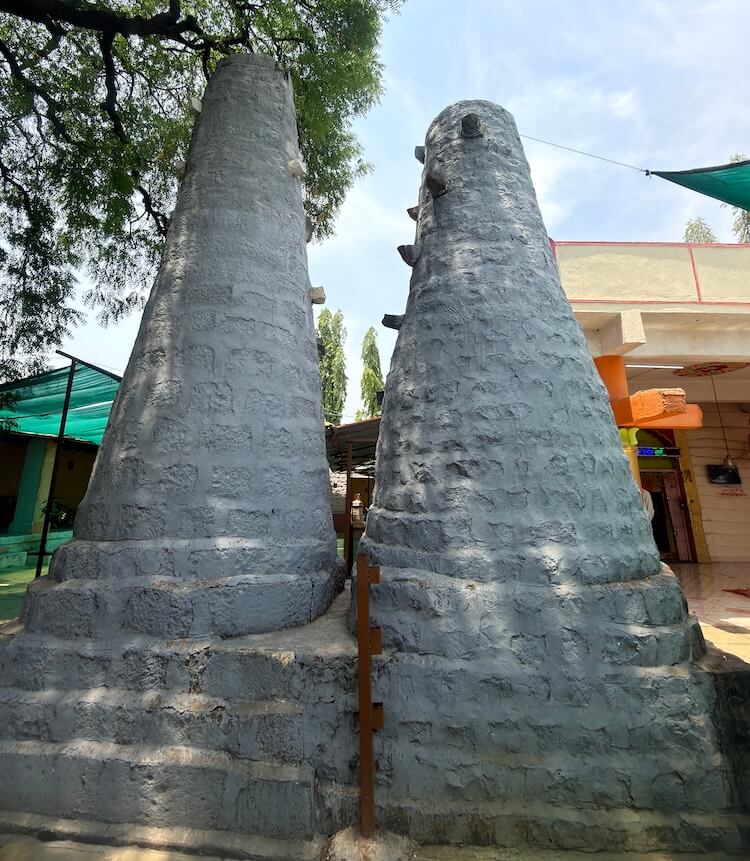
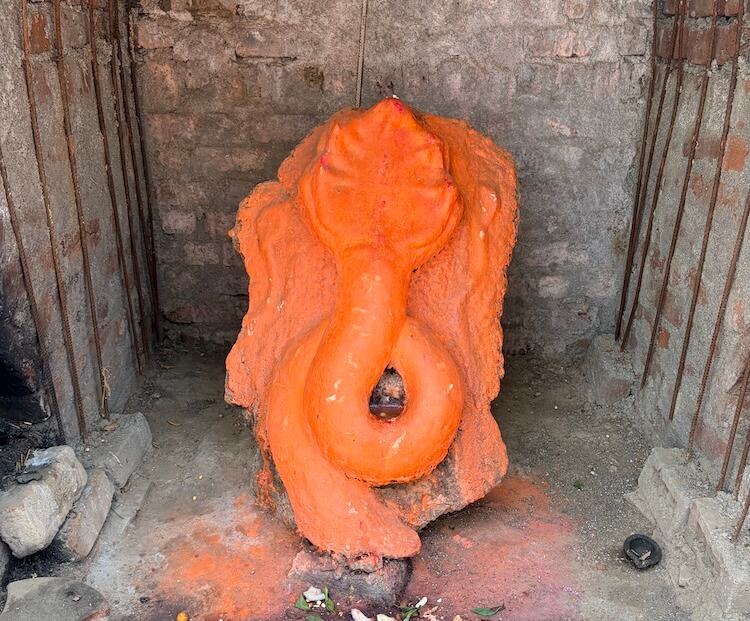
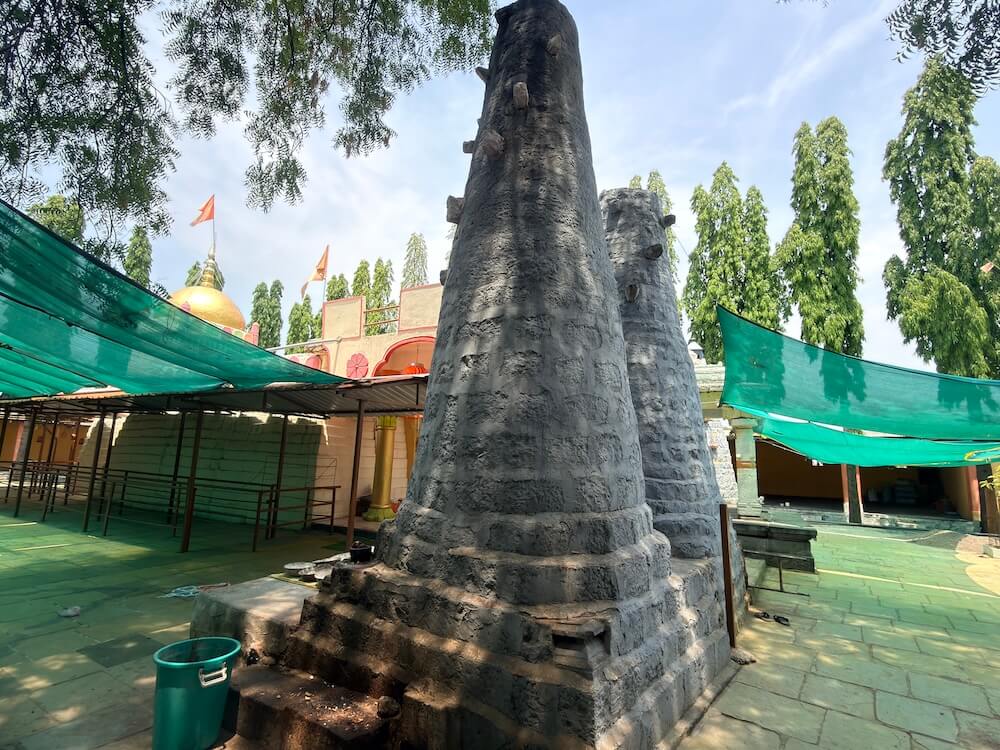
In the courtyard in front of the temple, there are two large platforms. Ancient lamp towers (Deepmala) stand on these platforms. Beside the lamp tower platforms are hero stones (Veergal), ancient sculpted stones, and old idols of Ganpati and the Goddess. In the courtyard, right in front of the temple, there is a platform about three feet high. Four pillars stand at the four corners of this platform. Scholars estimate that this part must have been the Vahan Mandapa (vehicle pavilion) of the temple and that in ancient times, there might have been a sculpture of a lion, the vehicle of the Goddess, here.
The structure of this temple is mainly divided into the Sabha Mandapa (assembly hall), Antarala (vestibule), and Garbhagriha (sanctum sanctorum). In front of the main temple, there is a semi-open Rangamandapa. On a stone seat in the mandapa, there is a sculpture of a lion. Beyond this is the main entrance to the Sabha Mandapa. The frame of this entrance is carved, and there is an image of Ganesha on the lintel. A moonstone (Chandrashila) is carved at the base of the step. In the Sabha Mandapa, there are four rows of ornate pillars, with four pillars in each row. This Sabha Mandapa is enclosed, so the outer pillars are integrated into the walls. All pillars stand on square bases. Various geometric shapes such as squares, hexagons, octagons, and circles are carved on the middle sections of the pillars. A circular pattern is carved on the ceiling of the Sabha Mandapa.
In the Antarala, there are niches on both sides of the entrance to the Garbhagriha. Idols of deities are placed in these niches. Beyond this is the main entrance to the Garbhagriha. There are sculptures of door guardians (Dwarapalas) on both sides of this entrance. The door frame is carved with vertical line patterns. There is an image of Ganpati on the upper side, and small shikhara sculptures are carved on the torana. A moonstone and a Kirtimukha are carved at the step. Wooden doors have been installed at this entrance. Inside the Garbhagriha, on a Vajrapitha (diamond throne), the idol of Renuka Devi in the form of a Taandala (aniconic stone) is enshrined. Adorned with clothes and ornaments, the Goddess wears a silver crown on her head. A silver canopy is hung from the ceiling over the Goddess’s head. The roof of the Garbhagriha has a two-tiered shikhara. The first tier of this shikhara is octagonal in shape. Eight small shikharas in the shape of pillars have been created on the eight corners of this tier. The second tier of the shikhara is like a round dome. At its highest point, the main pinnacle (Kalash) and a flag are placed.
In the courtyard behind the main temple, there is a separate temple of Parashurama. According to mythological references, Parashurama is considered the son of Renuka Devi. A sacrificial fire pit (Yajnakunda) has been built in front of this temple. Inside the Parashurama temple, a stone idol of Parashurama, smeared with vermilion, is installed on a stone Vajrapitha. A round, dome-shaped shikhara is built on the roof of this temple.
The Sharadiya Navratri festival is the main annual celebration of this temple. During this festival, thousands of devotees come here for ten consecutive days to seek the blessings of the Goddess and to fulfill their vows. During the Navratri period, Jagran and Gondhal programs are organized in the temple. Traditional dance and music by Aradhis as well as Waghyas and Muralis are performed in the service of the Goddess. During this Navratri festival, the tradition of sending the honorary Aarti from the Renuka Devi temple to the Shila Devi temple is observed. Throughout the year, various festivals and celebrations such as Chaitra Padwa, Dussehra, Diwali, the months of Margashirsha and Shravan, Nag Panchami, Kojagiri Purnima, Kartik Purnima, and Shakambhari Navratri are celebrated in this temple. The annual fair of the Goddess takes place in the month of Vaishakh. During this fair, a saree and choli are offered as a gift to Renuka Devi from the Shila Devi temple in Bodkha. The number of devotees visiting for the Goddess’s darshan on every Tuesday, Friday, Ashtami, Purnima, and Amavasya throughout the year is very large. Devotees can have darshan here every day from six in the morning until ten at night.
This sacred temple stands as a testament to deep spiritual devotion, ancient architectural grandeur, and rich local cultural traditions.
The sanctum sanctorum houses the divine idol consecrated according to ancient Vedic traditions, surrounded by serene courtyards and traditional temple architecture.

Navratri, Maha Shivratri, Annual Temple Jatra & Deepotsav
Compare and book flights, secure top-rated local hotels near the temple, hire reliable guides, and rent cars instantly.
Extend your pilgrimage by visiting other highly sacred temples located nearby.


Add ₹999 more to unlock FREE SHIPPING!
Your sacred cart is currently empty.
Shop Photo FramesFill in your delivery details below to place your order.
Add comment