
Add ₹999 more to unlock FREE SHIPPING!
Your sacred cart is currently empty.
Shop Photo FramesWhen Shri Krishna came to Pandharpur from Dwarka in search of Rukmini, who had left in anger, He could not resist meeting Pundalik, who was engrossed in the service of his parents. Even though the Lord Pandurang Himself had come to meet him, Pundalik did not allow any interruption in his service to his parents and asked the Lord to stand on a brick. Since then, for the past twenty-eight yugas, Pandurang has been standing on that brick. Thousands of temples of Pandurang, the presiding deity of the Warkari tradition, have been built in villages across Maharashtra. One such famous temple is situated in the village of Pimpalkhed Budruk in the Ghansawangi taluka of Jalna district. Devotees from this region gather here every year with great devotion, carrying a Dindi for the Ashadhi Wari.
Villagers say that this temple is about four hundred years old. A legend is famous among the villagers regarding the establishment of the temple. It is said that in ancient times, a supreme devotee of Vitthal lived in this village of Pimpalkhed. This devotee, who spent twenty-four hours a day in the remembrance of the Lord, had a deep longing for a direct vision of Vitthal. He prayed every day for the Lord to grant him a vision. Pleased by his boundless devotion, the Lord gave him a vision in a dream. The Lord told him in the dream, “I am present in the form of a stone idol in the riverbed of the village.” Following this vision, the devotee searched the riverbed and found a beautiful stone idol there. With the help of the villagers, he took the idol out of the river water, placed it on a bullock cart, and set off for the village. However, the bullocks stopped suddenly at the very spot where the main temple stands today. Despite many efforts by the villagers, the bullock cart would not move forward. Considering this a divine sign, all the villagers came together, consecrated the idol at this very spot, and built the temple here.
Another legend regarding this temple is that when Rukmini, angry with the Lord, left Dwarka and came to Dindir forest, Shri Krishna, in the form of Pandurang, was going to Pandharpur in search of her. During this journey, He stopped for some time in this village of Pimpalkhed to rest. During that period, a demon named Pimpalsur had created great havoc in this area. To completely destroy this demon, Lord Shri Krishna provided valuable assistance to Mahadev. It is the belief of the people in this region that thereafter, Pimpleshwar Mahadev was permanently established here in the form of a Shiva Linga, and Shri Krishna in the form of Vitthal.
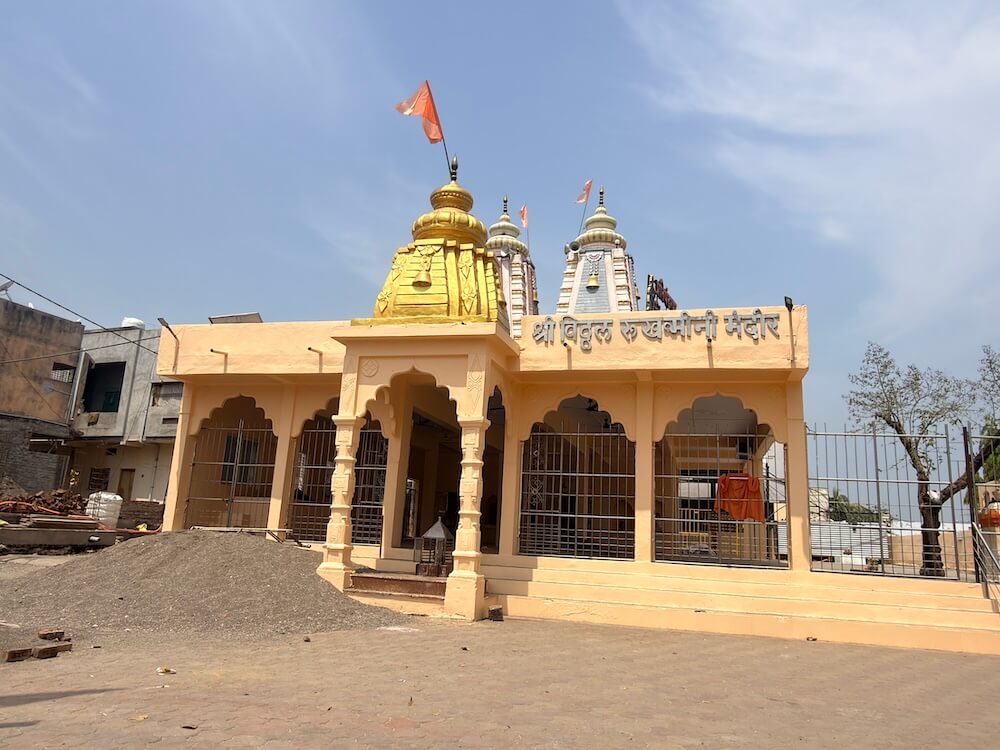
While entering Pimpalkhed after crossing the bridge over the village river, one first sees a grand welcome arch of the temple. This temple is on the right side of this arch. A spacious parking area has been prepared in front of the temple for the devotees. There are many seats on this parking lot for devotees to rest and sit. The temple is fortified on all sides for security, and the main entrance is within this fortification. Upon entering the temple courtyard, one can see an ancient Shiva Linga. This Shiva Linga was found underground while the renovation work of the temple was in progress.
It was previously taken outside the temple, but the temple committee had some bad experiences thereafter. Therefore, the current trustees of the place say that this Shiva Linga has been respectfully re-installed in the courtyard. A Tulsi Vrindavan is built in this very courtyard. Seven beautiful niches are made in the fortification wall next to it. Idols of various saints have been consecrated in these niches. In this same courtyard, the sacred stone of Munjoba is also worshipped on one side.
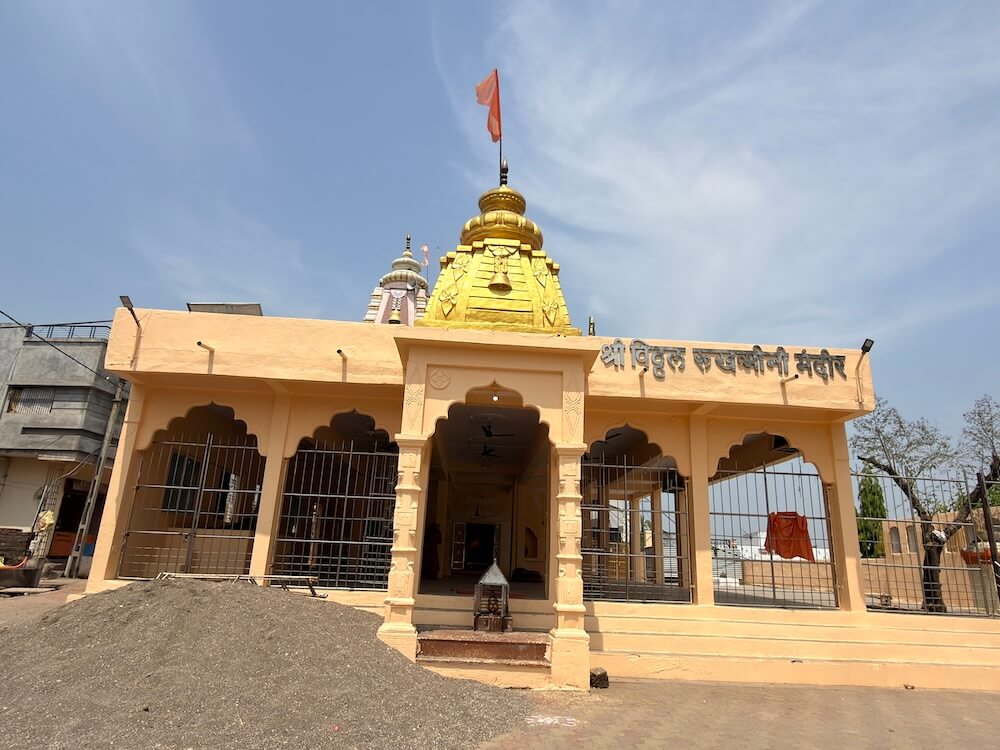
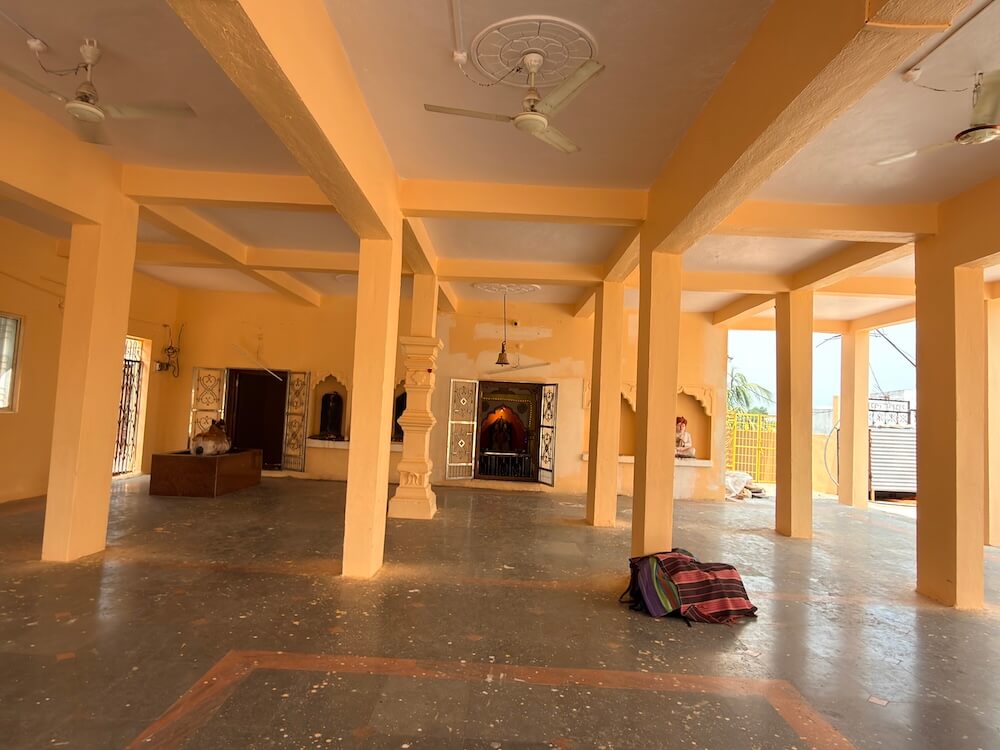
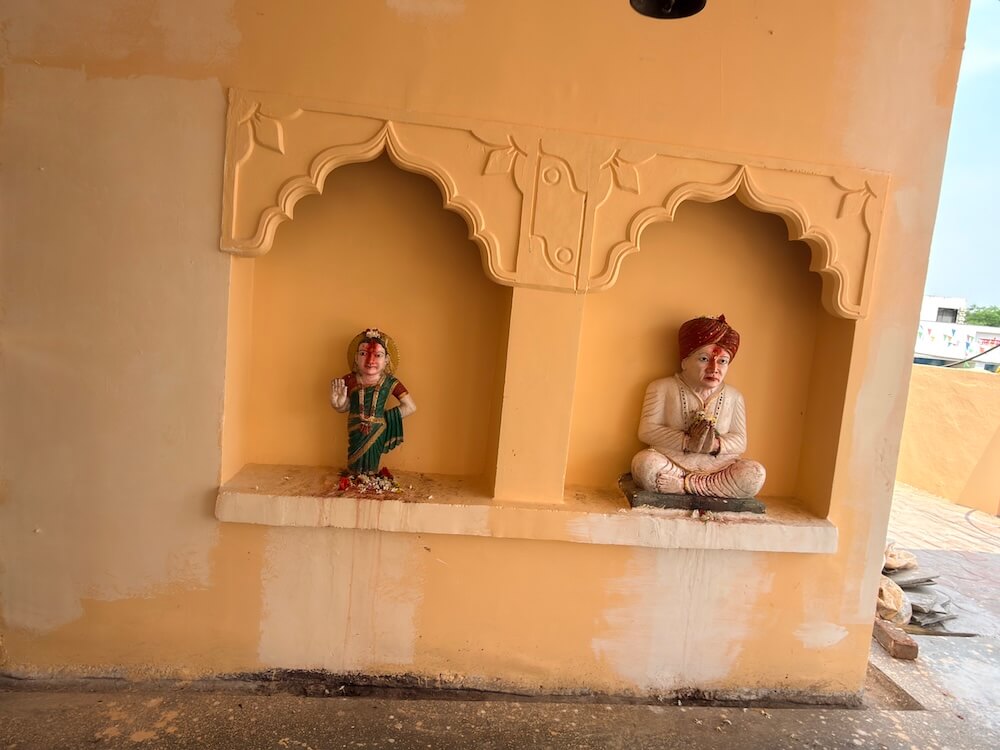
The entire structure of the temple follows the traditional style consisting of a Mukhamandapa (front porch), Sabhamandapa (main hall), and Garbhagriha (sanctum sanctorum). There are two pillars in the front of the Mukhamandapa. Attractive arches are carved on the pillars on all three sides of the Mukhamandapa. After coming through this Mukhamandapa, one reaches the main entrance of the Sabhamandapa. Three steps are built to reach this entrance. A mask of Saint Namdev is installed in a canopy on the topmost step. It is said that like in Pandharpur, there is a Namdev step here as well. A tortoise sculpture is carved on the floor right in front of the entrance in the Sabhamandapa. The Sabhamandapa has sturdy square pillars, and the Garuda pillar among them is decorated with special carvings. The roof of the Sabhamandapa is balanced on beams over the pillars, and a large brass bell is hung from this roof. There is a wheel pattern on the ceiling, that is, the inner part of the roof. In the Sabhamandapa, two niches are made on the right side of the entrance in the front wall of the Garbhagriha. The idols of Uttareshwar Maharaj and Anusuya Mata are seated in them. Also, there are three niches on the left side of the entrance, and in them, an attractive black stone idol of Keshavraj Vishnu, a vermilion-smeared stone idol of Shri Ganesha, and a sacred Nagshila (serpent stone) are installed.
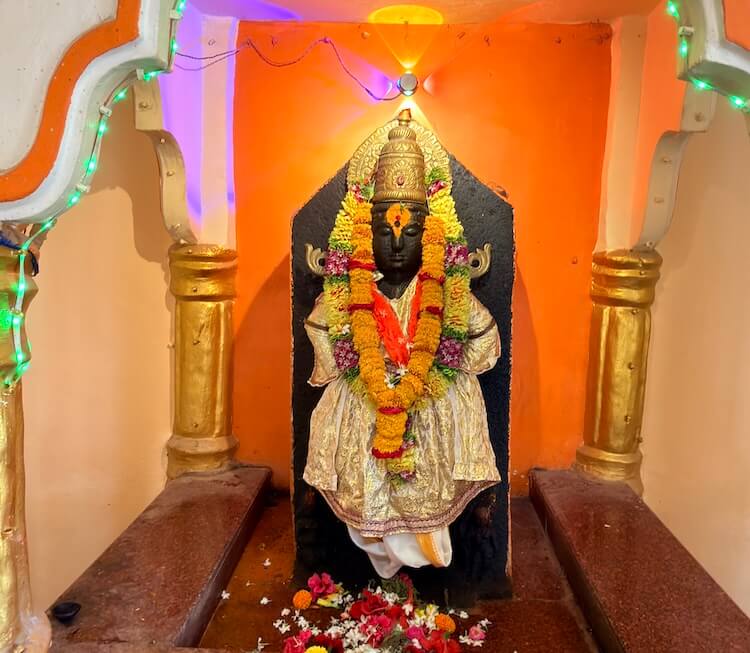
Leaf and flower patterns are carved on the door frames and the lintel of the wooden entrance of the main Garbhagriha. A small sculpture of Ganpati is seated on the lintel of this entrance. In the Garbhagriha, a very charming black stone idol of Vithoba is consecrated in a throne on a high pedestal. A Shiva Linga is clearly carved on the Lord’s head, and both His hands are placed on His waist. On the back slab of the idol, near the Lord’s feet, the figures of Garuda and Hanumant are carved very meticulously.
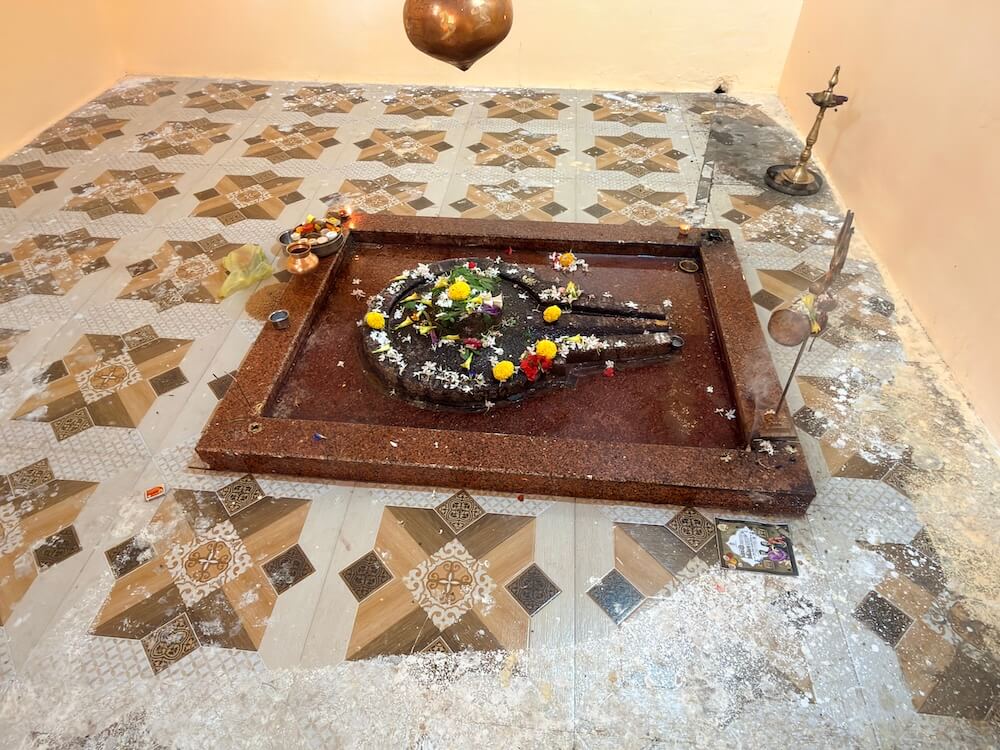
To the left of this main Garbhagriha of Vitthal is the separate Garbhagriha of Pimpleshwar Mahadev. In front of the entrance of this Garbhagriha, a black stone idol of Nandi is seated on a pedestal in the Sabhamandapa. This Garbhagriha of the Mahadev temple is slightly deeper than the floor level of the Sabhamandapa. Four steps are built to descend into it. There is a Swayambhu (self-manifested) Shiva Linga on the floor in this Garbhagriha. A total of three attractive Shikhars (spires) are built on the roof of this temple. There is a beautiful square-shaped Shikhar on the roof of the Mukhamandapa, and on the top of this Shikhar, there are two Amalakas one above the other, and a golden Kalash on them. Separate square Shikhars are built on the roofs of both Garbhagrihas. Two Amalakas each and Kalash are installed on the tops of both these Shikhars.
A large assembly hall has been constructed adjacent to the Vitthal Temple. During various festivals and auspicious occasions, a free food distribution service (Annachhatra) is operated continuously for all visiting devotees. In the courtyard facing the main temple, there is a small shrine dedicated to Mother Rukmini. Right beside the Rukmini temple stands the sacred Maharudra Maruti temple. In front of the assembly hall of this temple, large, ancient stone spheres are placed. It is said that these spheres have been in this very spot for a very long time. Inside the sanctum sanctorum of the temple, a vermilion-anointed stone idol of Maruti is enshrined on a pedestal. Directly in front of this pedestal, a brass festival idol of Maruti is also placed for viewing. There is a square-shaped spire on the roof of this sanctum. On the side facing the temple, there is an ancient stone idol of Saint Chokhamela, which is half-buried in the ground. Furthermore, a bust of Chhatrapati Shivaji Maharaj is installed on a high platform within the courtyard. Next to this statue, an ancient ‘Barav’, which is a historical stepwell built in olden times, still exists today.
Ashadhi Ekadashi is considered the main annual festival of this Vitthal Temple. On this occasion, a five-day fair is celebrated here, starting from Ashadhi Ekadashi and continuing until the full moon day. During this period, thousands of devotees from many surrounding villages arrive at the temple for ‘Darshan’, carrying various ‘Dindis’ and palanquins. Festivals like Vaikuntha Chaturdashi and Mahashivratri are also celebrated with great enthusiasm in this temple. Additionally, the Hanuman Jayanti ceremony takes place here every year. During the month of Shravan, a massive crowd of devotees is seen at the temple throughout the month. A grand ‘Kakada’ festival, which lasts for a full month from Ashwin Shuddha Pratipada to Kartik Shuddha Pratipada, is celebrated here every year. Apart from this, devotees also visit the temple in large numbers during traditional Hindu festivals and celebrations such as Dev Diwali, Makar Sankranti, Dussehra, Diwali, and Nag Panchami. During all festivals, various programs such as Kirtan, Bhajan, and Pravachan are organized in the temple. A large influx of devotees visiting for ‘Darshan’ is always seen at the temple on special days like every Monday, Saturday, Ekadashi, and Purnima. Devotees can have ‘Darshan’ here from six in the morning until nine at night.
This sacred temple stands as a testament to deep spiritual devotion, ancient architectural grandeur, and rich local cultural traditions.
The sanctum sanctorum houses the divine idol consecrated according to ancient Vedic traditions, surrounded by serene courtyards and traditional temple architecture.
Navratri, Maha Shivratri, Annual Temple Jatra & Deepotsav
Compare and book flights, secure top-rated local hotels near the temple, hire reliable guides, and rent cars instantly.
Extend your pilgrimage by visiting other highly sacred temples located nearby.


Add ₹999 more to unlock FREE SHIPPING!
Your sacred cart is currently empty.
Shop Photo FramesFill in your delivery details below to place your order.
Add comment