
Add ₹999 more to unlock FREE SHIPPING!
Your sacred cart is currently empty.
Shop Photo FramesRamdas Swami performed the task of restoring the social fabric of his time by combining strength and spirituality. His text, the Dasbodh, is famous, and his Manache Shlok are also popular among the people. He wrote abundant literature such as Karunashtakas, Aratis, and Stotras. Many institutions that carry forward the legacy of his work are still active today. To awaken society and promote the worship of physical and spiritual strength, he established eleven Maruti temples. Thus, Ramdas Swami, who worked for social awakening and organization to build society, was born in the village of Jamb in Jalna district. Later, the Shri Samarth Sansthan Temple was built at this very birthplace. Many devotees visit here every year in memory of the Swami’s work.
This historical site is about four hundred years old. Ramdas Swami was born in this village at twelve o’clock in the afternoon on Chaitra Shuddha Navami, Shake 1530, which corresponds to 24 March 1608. His original name was Narayan Suryaji Thosar. His mother’s name was Ranubai and his father’s name was Suryajipant Thosar. There had been a Ram temple in their house for generations. Therefore, he felt a deep longing for devotion to Lord Ram from his childhood. This devotion awakened a sense of renunciation in him, and as the Mangalashtakas were being recited at his wedding, he left the altar the moment he heard the word ‘Savdhan’ (Beware). He later followed the path of Sannyasa for the rest of his life. He considered himself a servant of Ram, adopted the name Ramdas, and founded the Ramdasi Sampradaya. He traveled across the country and worked to awaken consciousness in society. He worked in all four fields: social work, politics, religion, and spirituality. On 22 January 1682, the Swami attained Samadhi at Sajjangad. Shankar Shrikrishna, also known as Nanasaheb Dev, registered this Shri Samarth Temple as a public trust in 1943. The institution owns about one thousand acres of land.
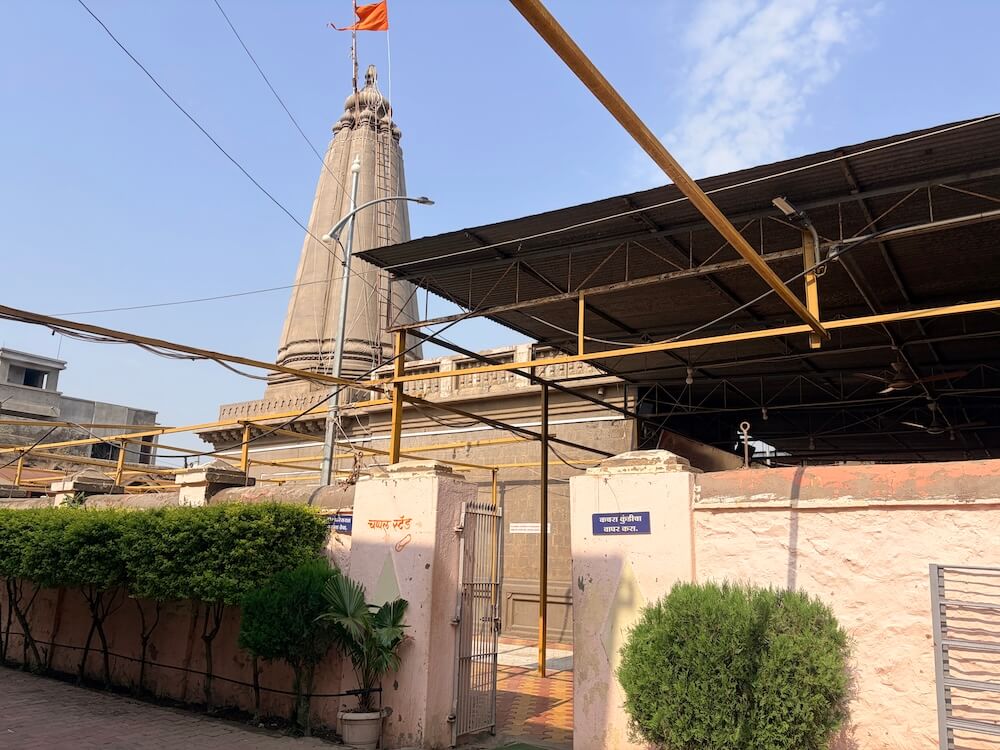
This Shri Samarth Sansthan Temple stands at the Swami’s birthplace, within his ancestral house. After the Swami’s original residence became dilapidated, this new temple was built in its place. The temple has a large fortification wall with a main entrance. Seating arrangements for devotees have been made in the paved courtyard of the temple. A tin roof supported by iron pillars has been installed over this courtyard.
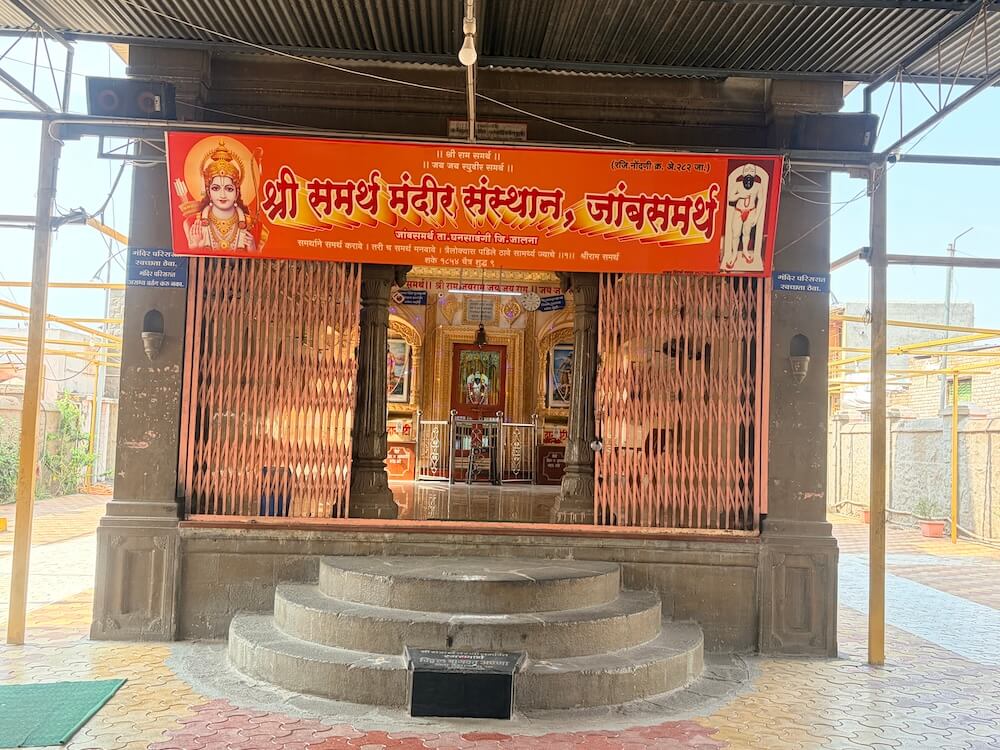
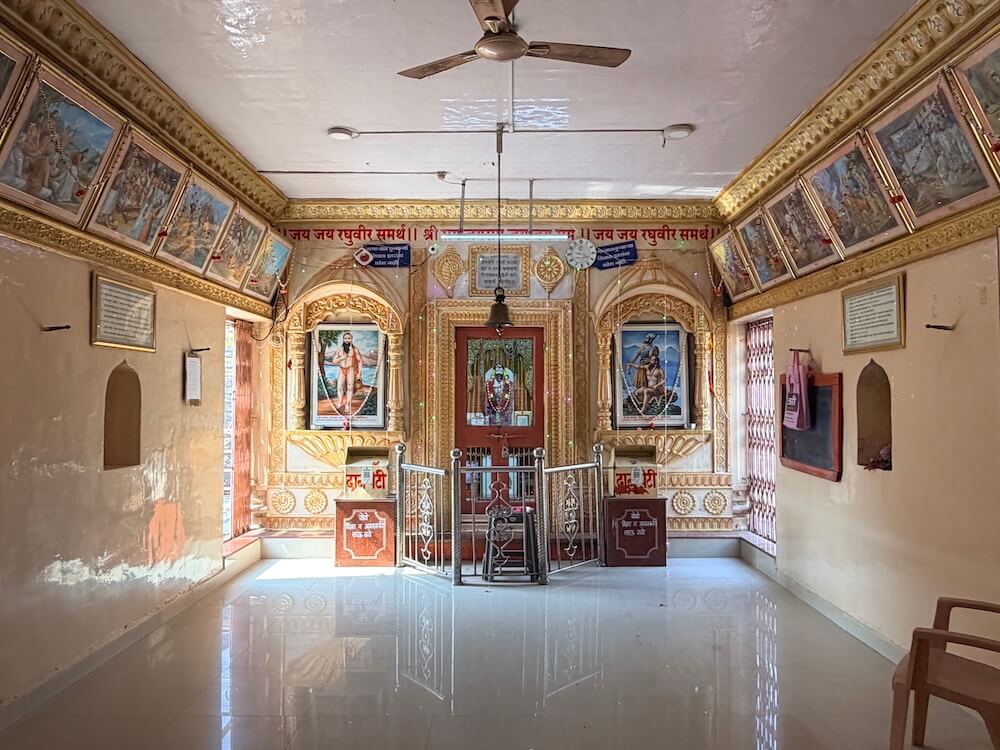
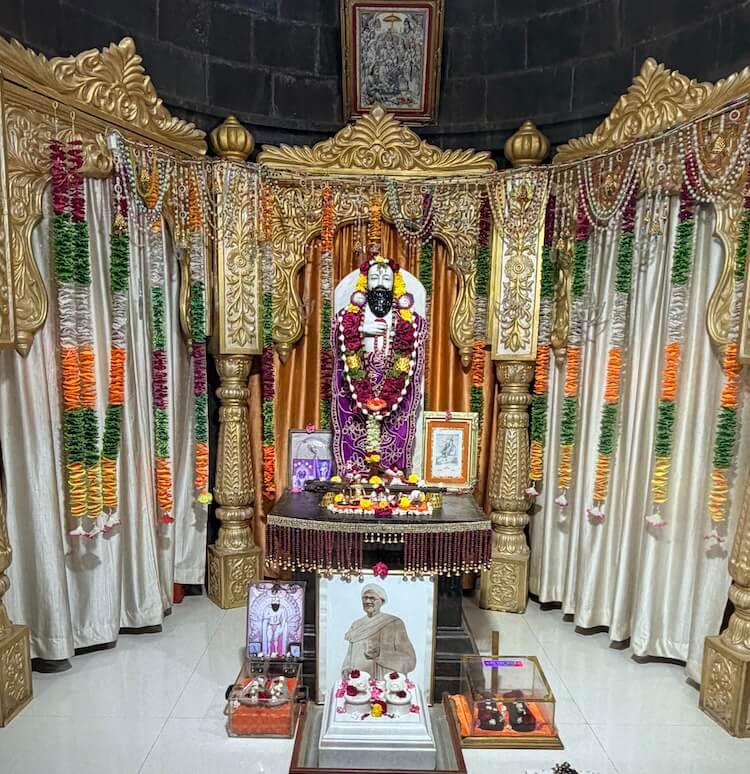
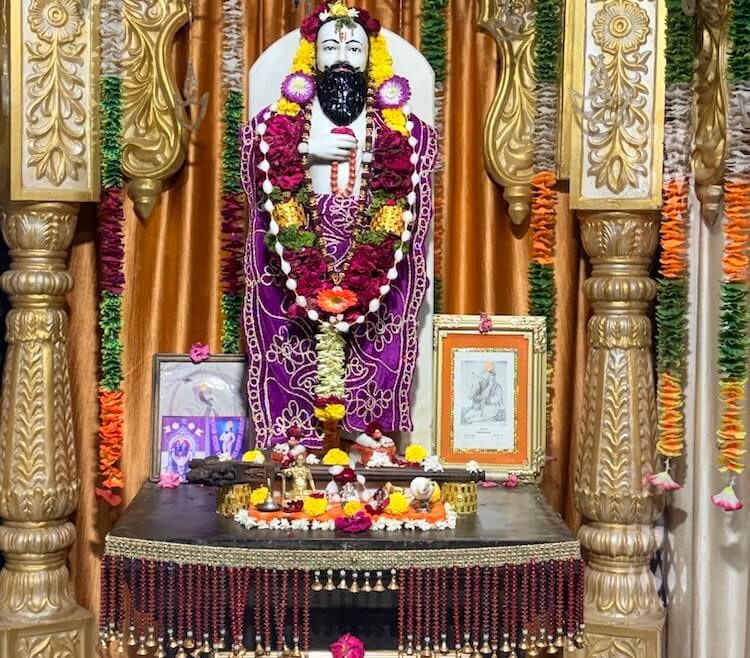
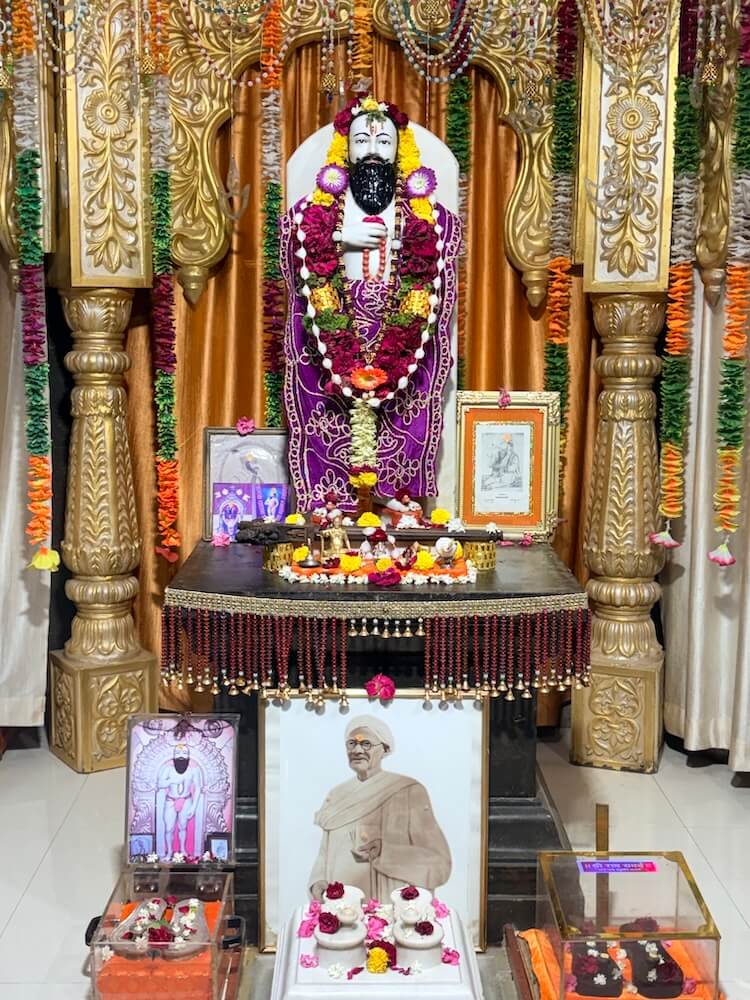
The temple is designed with a Sabha Mandap (assembly hall) and a Garbhagriha (sanctum sanctorum). The entrance to the Sabha Mandap, which is about two feet higher than the courtyard, has three semi-circular steps. The walls of the Sabha Mandap feature paintings depicting various episodes from the life of Ramdas Swami. All these carvings on the walls are painted in golden color. The Garbhagriha is slightly higher than the Sabha Mandap. There is one step at the entrance of this Garbhagriha. The door frames are adorned with floral carvings, and there is an idol of Lord Ganpati on the lintel. Transparent wooden lattice shutters are installed at the entrance. Inside the Garbhagriha, the idol of Ramdas Swami is seated on a Vajrapitha (throne) within a canopy with a roof supported by silver pillars.
A railing has been built for safety around the roof of the Sabha Mandap. Above the roof of the Garbhagriha, there is a tall, circular Shikhara (spire) that tapers towards the top. The upper part of this Shikhara is shaped like a round dome. Around this dome are eight small Amalaka-style spires. At the very top of the dome is an Amalaka and a Kalash.
A short distance from this main temple is a Ram temple. This temple also has its own separate fortification, and the entrance to this fortification has wooden shutters. This entrance, which is about one foot higher than the main road, has two steps. This temple is also designed with a Sabha Mandap and a Garbhagriha. The Sabha Mandap here is about three feet higher than the courtyard. There are Tulsi Vrindavans on both sides of the steps. In the Sabha Mandap, there are square pillars connected to each other by arched toranas on the outer side. This Sabha Mandap was built in recent times, attached to the original temple. Beyond this lies the Garbhagriha, which features stone construction in the Hemadpanti architectural style. In the front wall of the Garbhagriha, there are niches on both sides of the entrance. This entrance to the Garbhagriha is about two feet higher than the level of the Sabha Mandap. The door frames here feature floral carvings, and a sculpture of Lord Ganpati is carved on the lintel. Inside the Garbhagriha, on a Vajrapitha, are silver idols of Shri Ram, Lakshman, Mother Sita, Maruti, and Garuda. All these idols together are called the Panchayatan deities. Here, the idol of Mother Sita is on the right side of Lord Shri Ram. Therefore, Mother Sita is worshipped in the form of Adi Maya Shakti. It is said that these original silver idols were worshipped in Ramdas Swami’s family for generations. A five-tiered circular Shikhara is built above the Garbhagriha. Each tier of the Shikhara has ornate niches containing various deity idols. At the very top of the Shikhara is a lotus-shaped Amalaka and a Kalash.
At some distance from this temple, at the village boundary, there is a Maruti temple. Built of carved stone, this temple stands on a four-foot-high plinth. In front of the temple, on the plinth itself, a Shivling is installed under a Meghadambari (canopy). A turtle sculpture is carved in front of the temple entrance. Since the main entrance of the temple is about four feet higher than the plinth, there are four steps leading to it. The door frames of the entrance have vertical line carvings, a sculpture of Lord Ganpati on the lintel, and a Kirtimukha carved on the architrave. Inside the temple, a vermilion-smeared stone idol of Maruti is installed on a Vajrapitha. The roof of the temple has a two-tiered Shikhara. The first square tier of the Shikhara has small Amalaka-style spires at all four corners, topped with Kalashas. The second tier of the Shikhara is shaped like a round dome. At its highest point, there is an Amalaka and a Kalash. A legend is told that it was in this very temple that Maruti gave a direct vision (Darshan) to Samarth Ramdas Swami.
The main annual festivals here include Ram Navami, Hanuman Jayanti, and Dasnavami. On the occasion of these festivals, devotees from the surrounding areas come to Jamb village for the darshan of Samarth Ramdas Swami, Maruti, and Prabhu Shri Ram. During the festivals, various religious programs such as bhajan, kirtan, pravachan, scripture reading, and parayan are organized in all three temples. Devotees who follow the Ramdasi tradition, in particular, visit here regularly. The day begins at 5:00 AM with the Kakad Aarti. Between 6:30 AM and 7:30 AM, an abhishek is performed on the holy padukas of Shri Samarth, and tirtha is distributed to all devotees who come for darshan. Important religious rituals are conducted in the temple during the afternoon session. At 12:30 PM, the main Naivedya Aarti of Shri Samarth is performed. Following this aarti, meals are arranged for all devotees between 1:00 PM and 3:00 PM. Regular rituals resume in the temple during the evening session. Collective worship of Shri Samarth is conducted between 5:00 PM and 6:30 PM. After the worship concludes, the evening aarti of Shri Samarth takes place at 7:00 PM. Immediately after the evening aarti, the chanting of Ramnam and the name of Samarth is performed in the temple. Following this chanting, the reading of the Shri Dasbodh scripture and a pravachan by Brahmachaitanya Gondavalekar Maharaj are organized between 7:30 PM and 8:30 PM. For the night session, the time for prasad for devotees is set from 8:30 PM to 9:30 PM. The entire daily ritual in the temple concludes at exactly 10:00 PM with the soulful Shej Aarti of Shri Samarth.
This sacred temple stands as a testament to deep spiritual devotion, ancient architectural grandeur, and rich local cultural traditions.
The sanctum sanctorum houses the divine idol consecrated according to ancient Vedic traditions, surrounded by serene courtyards and traditional temple architecture.
Navratri, Maha Shivratri, Annual Temple Jatra & Deepotsav
Compare and book flights, secure top-rated local hotels near the temple, hire reliable guides, and rent cars instantly.
Extend your pilgrimage by visiting other highly sacred temples located nearby.


Add ₹999 more to unlock FREE SHIPPING!
Your sacred cart is currently empty.
Shop Photo FramesFill in your delivery details below to place your order.
Add comment