
Add ₹999 more to unlock FREE SHIPPING!
Your sacred cart is currently empty.
Shop Photo FramesSituated on a high hill a short distance from Girgaon Chowpatty in Mumbai, the Babulnath Temple is one of the ancient Shiva temples in this great metropolis. Nestled on a hill that was once a dense forest of Babul trees, this Shiva temple is a place of deep faith for countless devotees in Mumbai. Devotees believe that the Mahadeva here fulfills all heartfelt wishes. Because of this, there is always a crowd of devotees in this beautiful and grand Shiva temple. On Shravan Mondays and Shivratri, there is not even room to place a foot here. The devotees of Babulnath include everyone from common people to prominent citizens and celebrities.
The history of the Babulnath Temple dates back to the eighteenth century. After the conspiracy of the Barbhai in the Peshwa court, Shrimant Raghobadada, also known as Raghunathrao Peshwa, sought refuge with the British against the Maratha power. He came to Mumbai under British protection. In the year 1779, Raghunathrao Peshwa and the British forces together attacked the Peshwa kingdom. At that time, the army led by Sardar Mahadji Shinde decimated the British forces near Wadgaon. Consequently, the British were forced to surrender. One year after the end of this war, known as the First Anglo-Maratha War, in the year 1780, the local Marathi community built this temple of Lord Shankara on this hill near Malabar Hill.
Various legends are told about this temple. According to the book ‘The Hindu Temples of Bombay’ published in 1895 by Krishnarao Raghunathji Navalkar, alias K. Raghunathji, around 1780, while the ‘Hornby Vellard’ (the Worli embankment, present-day Lala Lajpatrai Marg) was being constructed, a Marathi carpenter named Babul found a Shiva Linga there. He cleared the space on the hill, built a small temple, and consecrated the Shiva Linga within it. The Shiva Linga came to be known as Babulnath after the carpenter, Babul. According to some, there was a forest of Babul (acacia) trees on this hill at that time, and hence the Lord Shiva here was named Babulnath. R. P. Karkaria, the editor of the book ‘The Charm of Bombay’ (1915), a collection of selected articles on Mumbai, has refuted this etymology. He has expressed the opinion that the temple was named Babulnath after the carpenter Babul. Another story regarding this temple appears in the book ‘Bombay Place-Names and Street-Names: An Excursion into the By-ways of the History of Bombay City’ (The Times Press, 1917) by Samuel T. Sheppard. In it, citing Rao Bahadur P. B. Joshi, it is stated that a Yajurvedi Brahmin consecrated the Shiva Linga in this temple. A gentleman named Babalji Hirji Nath of the Somvanshi Kshatriya caste provided the funds for the construction of this temple. Therefore, the temple was named Babulnath after him.
Although there is no consensus on how Babulnath Temple got its name or exactly who built it, it is clear that the original temple here was constructed in or around the year 1780. However, Govind Narayan Madgaonkar has explicitly stated in ‘Mumbai-che Varnan’ that this temple was built by Pandusheth Sonar. Pandusheth Sonar was a renowned merchant of that time and a respected gentleman with influence in the government court. He was the one who built the Mumbadevi Temple in Bhuleshwar. This has been corroborated by Balkrishna Bapu Acharya and Moro Vinayak Shingne in ‘Mumbai-cha Vruttant’ (1889). Krishnarao Raghunathji Navalkar, alias K. Raghunathji, mentions that from the very beginning, this temple became popular due to the beauty of the location and its close proximity to the city. Later, the Gujarati Vani and Bhatia merchant communities decided to rebuild this temple. Subscriptions were collected for this purpose. The reconstruction work began in 1836 and was completed around the year 1840.
Temple trustee Chaitanya Mehta provided information that this entire hill was owned by Pandusheth. After his passing, this property was auctioned. At that time, it was purchased by the Christian community. Later, they sold it to the Parsi Panchayat. There was a dispute over this property between the Parsi Panchayat and the Hindu community. Before 1836, Shrimant Madhavrao Gaikwad, the Maharaja of Baroda, had attempted to mediate to resolve this dispute. After those efforts failed, the matter was taken to the then-court of Mumbai in the year 1808. The court ruled in favor of the Hindus and granted half of the property to them. In 1836, the Bhatia community took over the management of this temple. The construction of the current temple was started at that time and was completed in 1840. In 1960, a disaster struck this temple. During the monsoon of that year, lightning struck the temple. As a result, the temple suffered some damage. It was subsequently repaired.
Notably, the legend currently narrated by the temple trustees and priests combines the stories of Babul and Pandusheth Sonar regarding the origin of this temple. According to this account, Babul worked as a cowherd for Pandusheth. He used to bring cattle to this hill. One of the cows, named Kapila, would release a stream of milk at a specific spot. After Babul informed Pandusheth about this miracle, he excavated the site and discovered a Shivalinga made of black stone. Since it was discovered by Babul, it was named Babulnath.
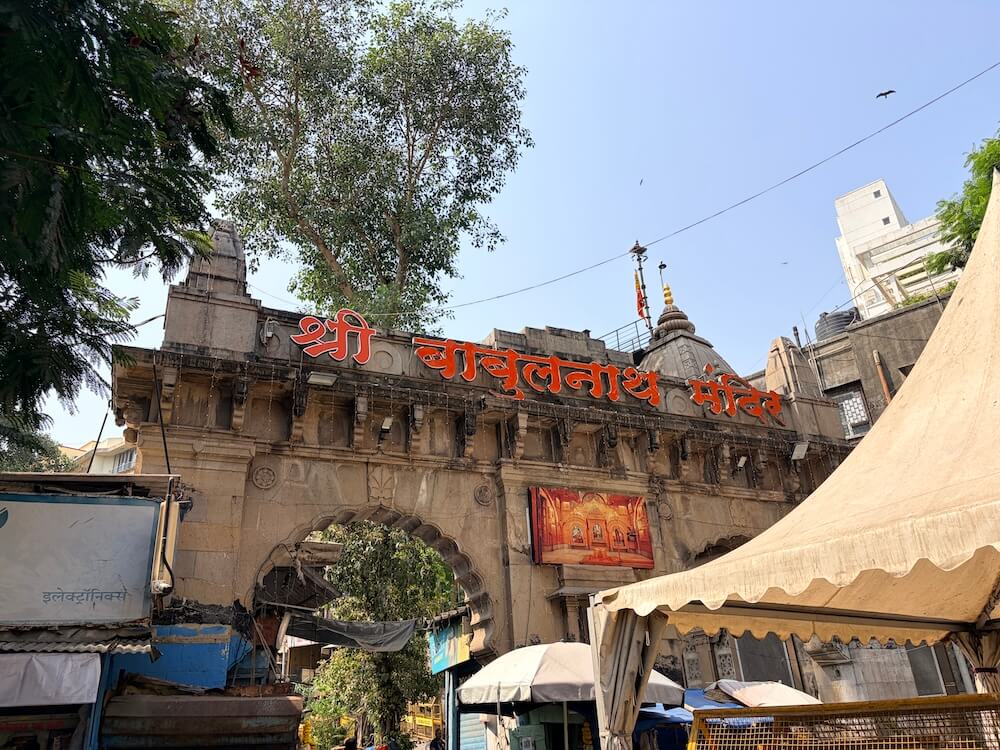
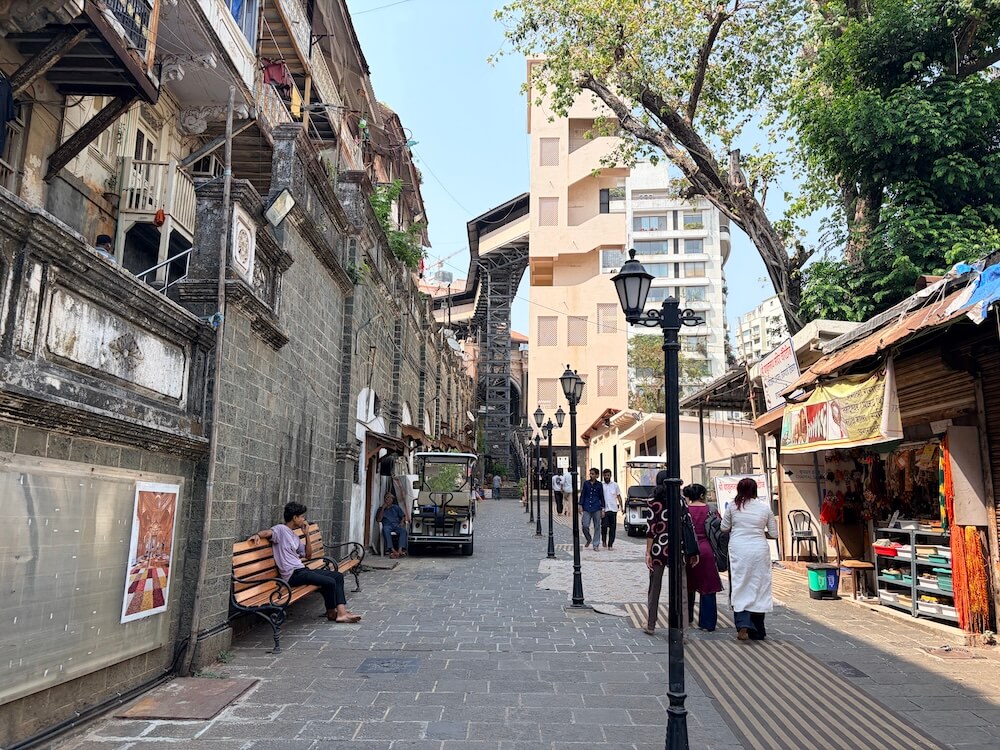
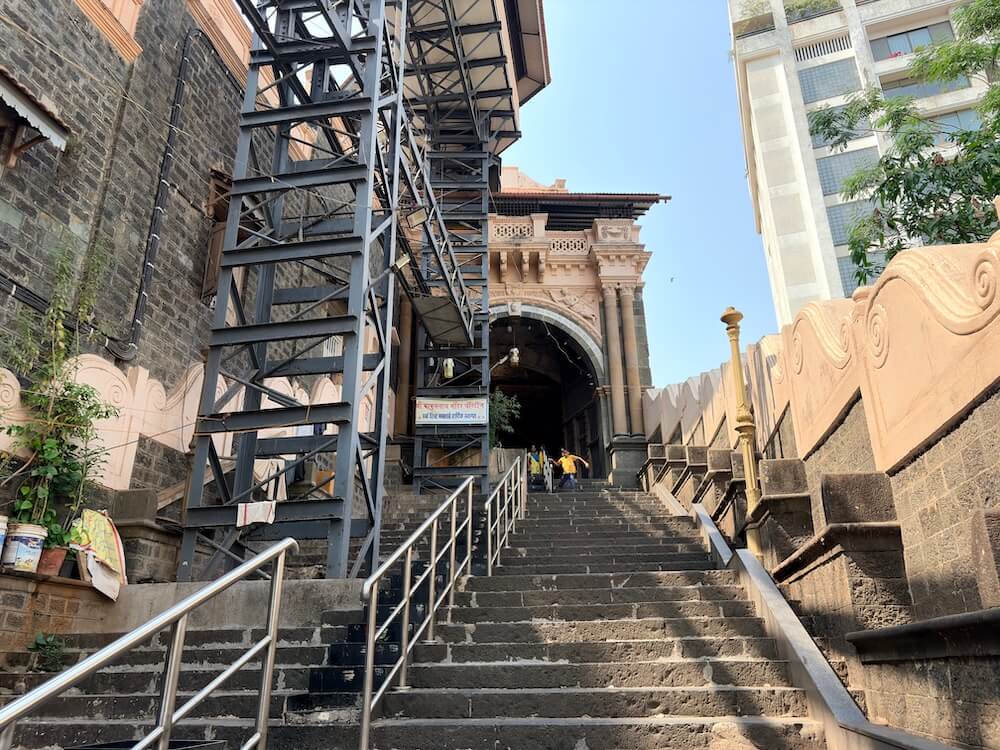
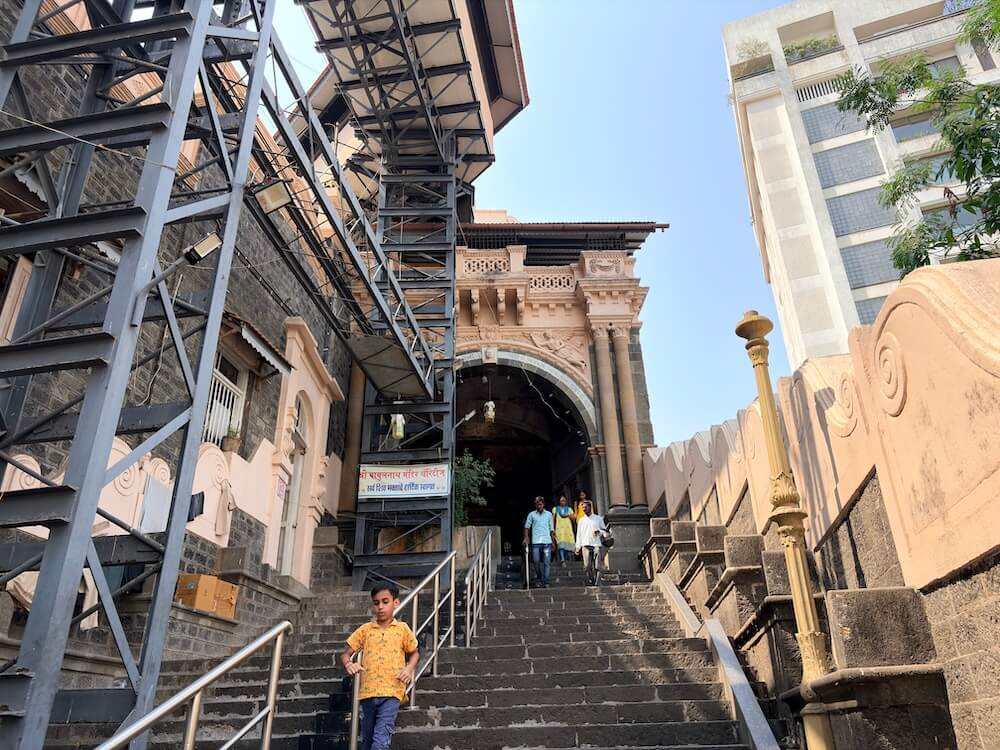
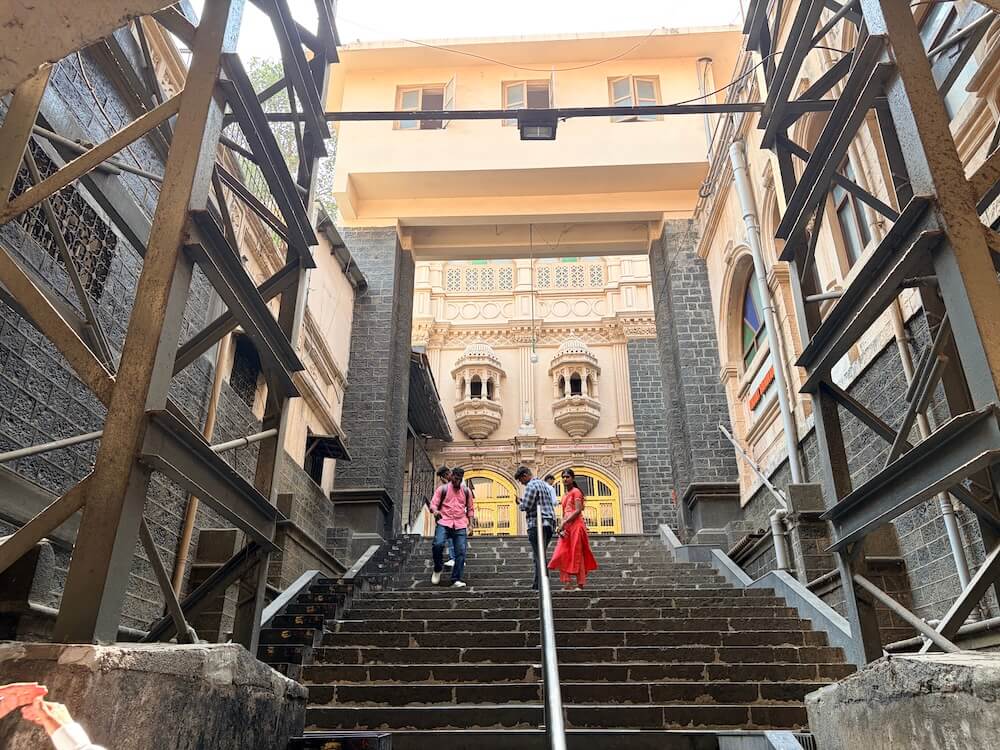
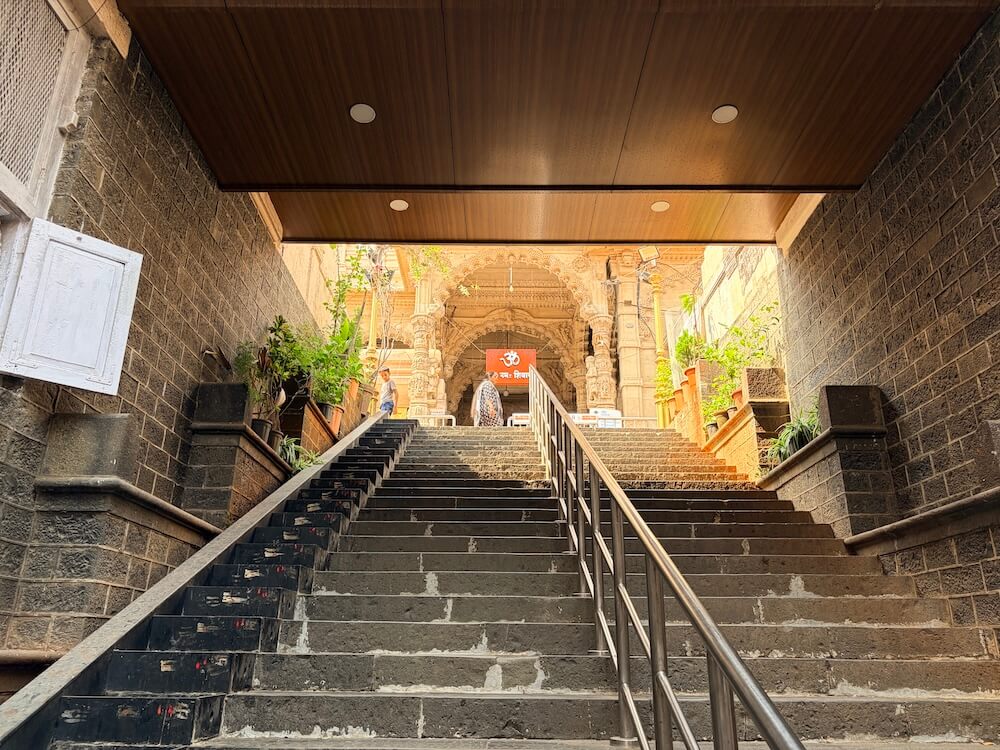
This temple is situated on a hill adjacent to the road known by the name of Babulnath. The temple premises feature a grand stone entrance. On the stone-paved path here, there is a security checkpoint for the temple’s protection at a short distance. Beyond that, the stone steps leading to the temple begin. Two elevators (lifts) have been provided here for the elderly, children, women, as well as disabled or ailing individuals. The temple courtyard has a main gate (Mahadwar) built in the year 1951 using stone and pink sandstone. Further along this stairway path is the ‘Anant Bhavan’ building. This hall, built in the year 2022 by the son of renowned industrialist Mukesh Ambani, Anant Ambani, has been named after him.
After climbing a total of 108 steps, the grand and beautiful structure of the Babulnath Temple appears right in front. In the courtyard of this marble-floored temple, there are two tall lamp pillars. Beautiful sculptures of lions and peacocks can also be seen here. This temple is built on a high plinth in the Nagara architectural style using sandstone. The structure of the temple consists of a grand entrance hall, a main assembly hall, and the sanctum sanctorum. The temple pillars, the arches between them, the makaratoranas (crocodile-shaped arches), the ceilings of the halls, and the parapets of the roofs are adorned with intricate carvings. The carved sculptures of deities on the pillars here are particularly worth seeing. Figures of musicians and ascetics, commonly seen on Gujarati temples, are also present on the parapets of this temple’s roof. In the assembly hall of the temple, there is a large golden-covered idol of Nandi on a golden pedestal. In front of it is the idol of Kurmanarayana. In the assembly hall, on the right side, the idol of Shri Ganesha is seated in a shrine built on a high altar. Beside this idol are the idols of Riddhi and Siddhi. An ancient idol of Ganesha made of black stone is also seated in this shrine. There is also a place for Hanuman here. In the shrine there, stands a metal idol of the mace-bearing Hanuman.
On the front wall of the sanctum sanctorum, the idol of Lord Ganesha is consecrated in the tall, vertical niche on the left, while the idol of Kalabhairava is consecrated in the niche on the right. The entrance to the sanctum sanctorum is adorned with intricately carved gold plating. On the lower part of the door pillars, sculptures of the gatekeepers are carved. The idol of Lord Ganesha is carved on the lintel of the door frame, while the idol of Lord Shivashankara is carved in the center of the upper architrave. On both sides of the idol, there are carved sculptures of elephants and attendants of Shiva. The sanctum sanctorum of the temple is completely covered in gold plating. Inside, on the floor, the stone Shiva Linga of Babulnath is enshrined within a square base covered in silver. A unique feature of this Shiva Linga is that an image of a serpent is carved on one side of it. Beside the base stands a trident. On festive occasions, a golden mask is placed upon the Shiva Linga here. In the alcove within the sanctum sanctorum, idols of Mother Parvati and Goddess Bhagwati are consecrated. An eternal flame has been burning in this temple for many years. It is said that this flame has been burning continuously for about one hundred and fifty to two hundred years.
In the grand pavilion built in the front area attached to the temple, there is the ‘Gajarath’ of Lord Bholeshankar. In the niches located at the lower level here, the idols of Mahakali, Mahasaraswati, and Mahalakshmi are enshrined. In the upper part of these niches is the idol of the camphor-white Lord Shankara. Here, Lord Ganesha and Mother Parvati are seated on the lap of Lord Shankara. Many devotees sit for meditation in this spacious pavilion. Above the sanctum sanctorum of the Babulnath temple stands a tall spire in the Nagara style of architecture, featuring the Urushringa design. Atop it are the Amalaka and the Kalasha, with the sacred flag fluttering in the wind. To the right of the temple, on a high and spacious platform, a beautifully decorated pavilion has been erected. It houses the deities Lakshmi-Narayana, Shitala Devi, Nagadevata, the Shiva Linga of Kashi Vishwanath, and Lord Ganesha.
In this temple, devotees can have darshan every Monday from 6 in the morning to 10 at night. From Tuesday to Sunday, the darshan timings are from 6 in the morning to 9 at night. Aarti is performed here daily from 5:30 to 6:30 in the morning, 11:30 to 12:30 in the afternoon, 5:30 to 6:30 in the evening, and 8 to 8:30 at night. Every Monday, the aarti timing is from 12 to 1 in the afternoon. Various festivals and celebrations are observed in the temple with religious fervor. Maha Shivratri is the grandest of these festivals. During this time, the temple premises take on the appearance of a pilgrimage fair. Approximately five to six lakh devotees come here for darshan on Maha Shivratri. About 5 to 10 thousand devotees visit the temple daily. This number increases on Shravan Mondays.
This sacred temple stands as a testament to deep spiritual devotion, ancient architectural grandeur, and rich local cultural traditions.
The sanctum sanctorum houses the divine idol consecrated according to ancient Vedic traditions, surrounded by serene courtyards and traditional temple architecture.
Navratri, Maha Shivratri, Annual Temple Jatra & Deepotsav
Compare and book flights, secure top-rated local hotels near the temple, hire reliable guides, and rent cars instantly.
Extend your pilgrimage by visiting other highly sacred temples located nearby.


Add ₹999 more to unlock FREE SHIPPING!
Your sacred cart is currently empty.
Shop Photo FramesFill in your delivery details below to place your order.
Add comment