
Add ₹999 more to unlock FREE SHIPPING!
Your sacred cart is currently empty.
Shop Photo FramesIn the Shaiva tradition, the worship of the Shivpindi holds unparalleled significance. The sacred scriptures describe six main types of Shivpindis. Those established by deities are called ‘Devpindi,’ those by demons ‘Asurpindi,’ and Shivpindis consecrated by sages and seers are known as ‘Aarshaling.’ Similarly, ancient pindis from the Puranic era are ‘Puranaling,’ those established by kings and emperors are ‘Manushaling,’ while pindis that manifest naturally are recognized as ‘Swayambhu Shivpindi.’ In Pimpalwandi, Patoda Taluka, Beed District, there is an ancient Shivpindi believed to have been established by Mother Sati herself. As this temple is situated beneath a Peepal (Ashwath) tree, it is called ‘Ashwathaling’ Mahadev, which has been colloquially shortened to ‘Ashwaling.’ It is considered one of the 101 most revered Shivpindis mentioned in the Puranas.
The legend associated with the temple states that Sati performed penance here, establishing a Shivling under the Peepal tree, with the desire to marry Lord Shankar. Pleased by Sati’s penance, Mahadev manifested here. It is believed that Sati and Mahadev first met at this very spot. According to some scholars, this temple was built by Shankaracharya Chandrashekhar Bharati of the Dashanami tradition.
The villagers here say that this temple is approximately seven to eight hundred years old. The first welcome arch of the temple is on the road leading to Pimpalwandi village from the main road. On both sides of the road are platforms about four feet high, and grand pillars stand on these platforms. These intricately carved pillars are connected to each other by arched gateways. Sculptures of doorkeepers are situated next to the pillars on both platforms. The pillars support a balcony, above which are three decorative canopies (meghadambari). In the central canopy, one can see idols of Mahadev and Parvati seated on Nandi. In the right canopy are idols of Ganapati, and in the left canopy, idols of Kartikeya. The main temple is about two kilometers from here. This stone temple, built in the Hemadpanti architectural style, is situated about twenty to twenty-five feet below the road level, hence stairs have been provided to descend. The temple has a strong fortification, with entrances on the front and back sides within this wall. Both these entrances are two-storied. On both sides of the front entrance are square pillars and lamp posts. An arched torana (decorative archway) adorns the entrance. Inside, on both sides of the entrance, are guard rooms, beyond which are intricately carved pillars. The octagonal ceiling (vitana) has circular carvings. On the upper floor of the entrance is the Nagarkhana (drum house). The structure of the rear entrance is also similar.
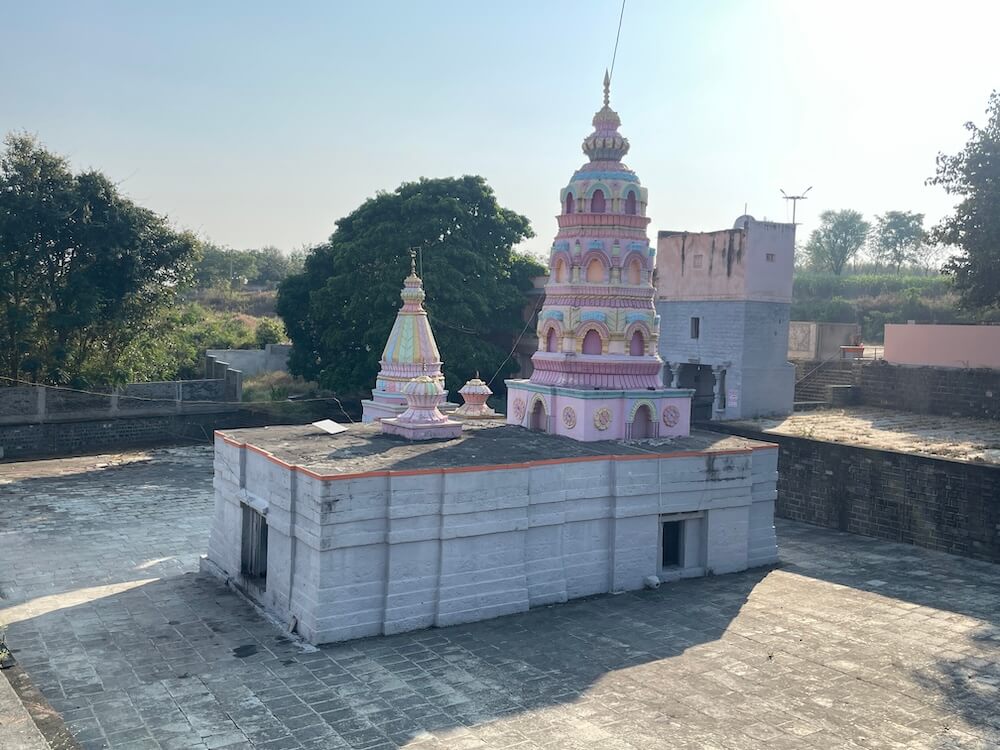
Since the courtyard is deeper than the entrance, there are stairs to access the courtyard. On both sides of the stairs are safety railings, and beyond them are platforms. To the left of the entrance, adjacent to the fortification, is a two-storied building for devotees’ accommodation (bhakta nivas). In the stone-paved courtyard, there is an ancient well. It is said that the water in the well is inexhaustible.
The temple’s layout includes a Sabhamandap (assembly hall), Antarala (vestibule), and Garbhagriha (sanctum sanctorum). In the semi-open Sabhamandap, there are four rows of four intricately carved pillars each. All pillars stand on square bases. Various geometric shapes like squares, hexagons, octagons, and circles are carved on the shafts of these pillars. The ceiling has circular carvings. Adjacent to the Sabhamandap, on the other side, is a small temple housing an idol of Nandi. Below Nandi’s mouth are three human figures. The legend associated with them is that when Nandi entered a gardener’s field, the gardener struck him with a stick. Nandi then ran and sat in Mahadev’s temple. When the gardener’s wife and children learned of this, they were deeply saddened. Therefore, the gardener’s wife and son began to visit the temple daily to offer gram dal and jaggery to Nandi. When the gardener found out, he followed them to the temple. Seeing the stone Nandi actually consuming the dal and jaggery, the gardener begged Nandi’s forgiveness and prayed, ‘Grant us three salvation.’ Nandi then took the three under his protection, and they were all transformed into stone.
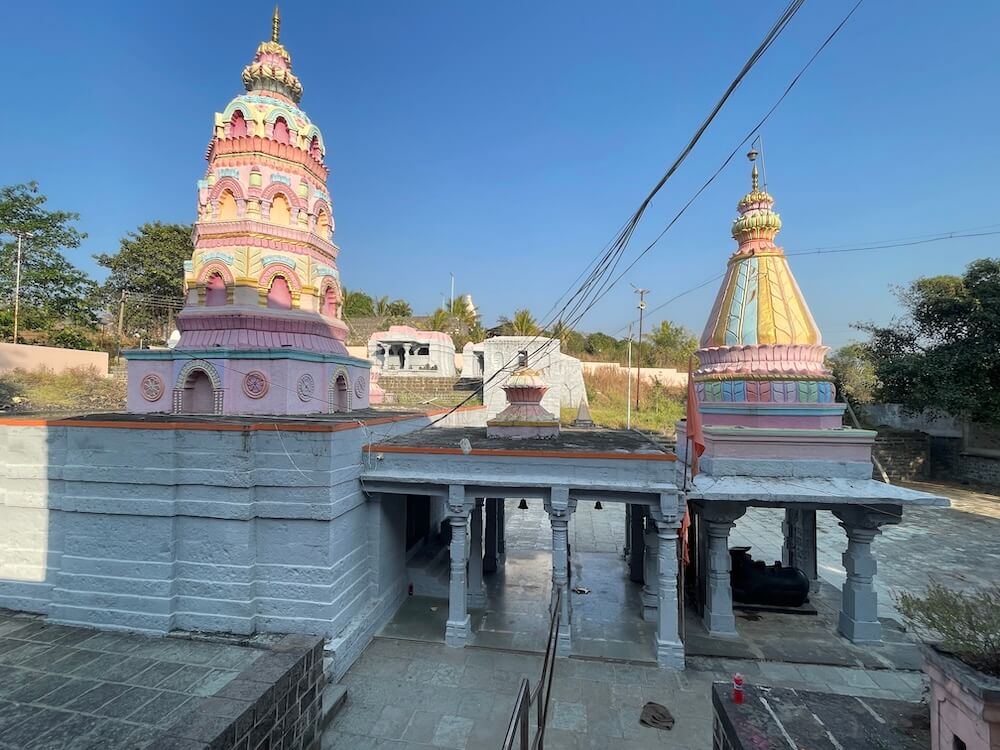
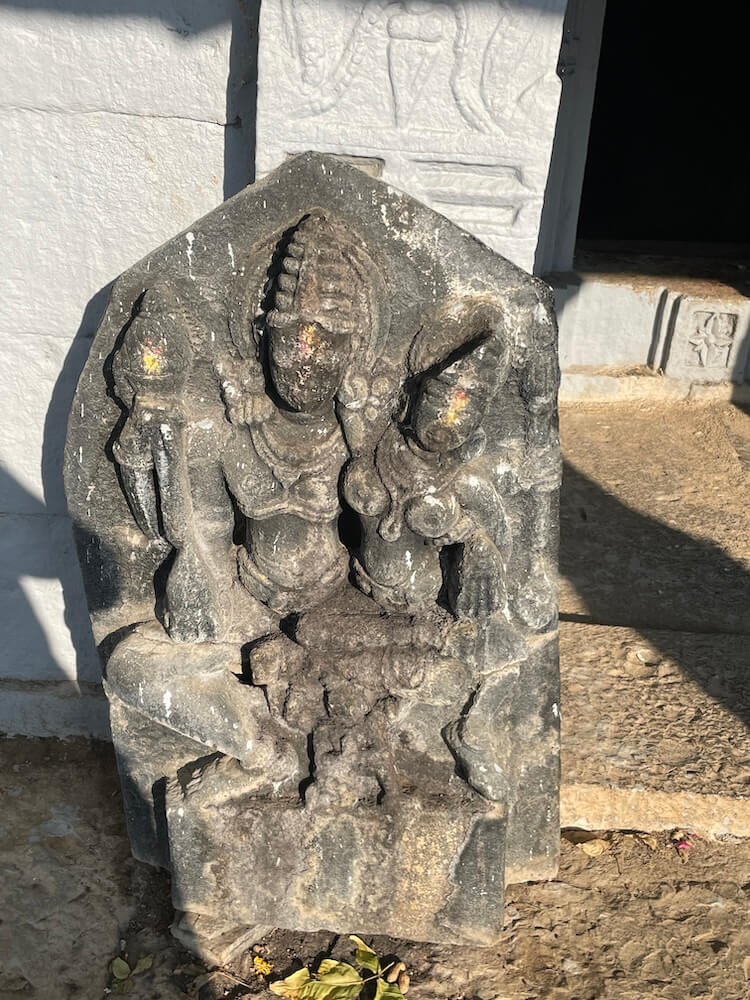
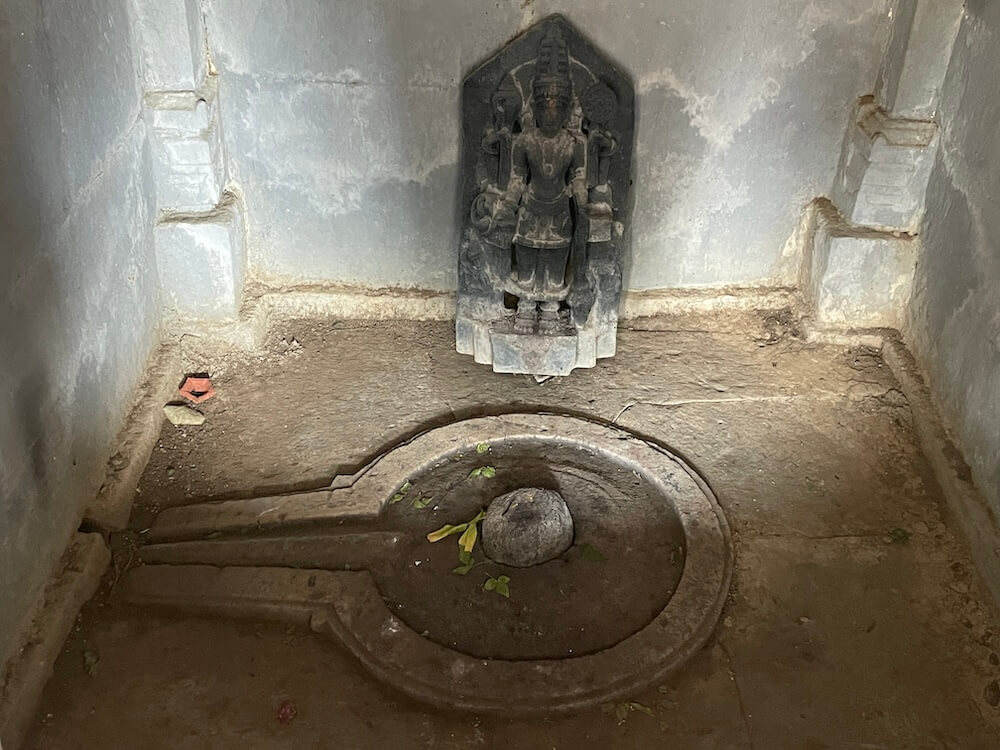
As the Antarala of the temple is at a higher level than the Sabhamandap, there are five steps leading to its entrance. The doorframes of the entrance are adorned with leaf and flower carvings, and a sculpture of Ganapati is on the lintel (lalatabimba). In the Antarala, there are four rows of four intricately carved pillars each. The outer pillars are embedded in the walls. The structure of the pillars is similar to those in the Sabhamandap. There are doors on the right and left sides to exit the Antarala. Further ahead is the Garbhagriha, with a circumambulatory path (pradakshina marga) on its outer side. The entrance to the Garbhagriha has intricately carved doorframes, and a Ganapati sculpture is on the lintel. Inside the Garbhagriha, on the ground, is a Swayambhu Shivpindi. A brass serpent holding a canopy (chhatra) is placed over the Shivpindi, and a copper vessel for ablution (abhishek patra) holding a stream of water hangs from the ceiling. Adjacent to the rear wall of the Garbhagriha, on a vajra pitha (diamond pedestal), are beautifully adorned idols of Uma-Mahesh, decorated with clothes and ornaments. Beside the idols is a brass mask of Mahadev, used during festivals. On both sides of the vajra pitha are brass oil lamps (samai). The ceiling of the Garbhagriha has a four-tiered shikhara (spire). In the square base tier of this shikhara, there are niches (devakoshthake) on all four sides. The second, third, and fourth tiers of the shikhara are octagonal, with eight niches in each tier. At the apex of the shikhara are two amalakas (ribbed stone discs) placed one above the other, and a kalasha (finial) and flag (dhwajapataka) are placed on the amalaka.
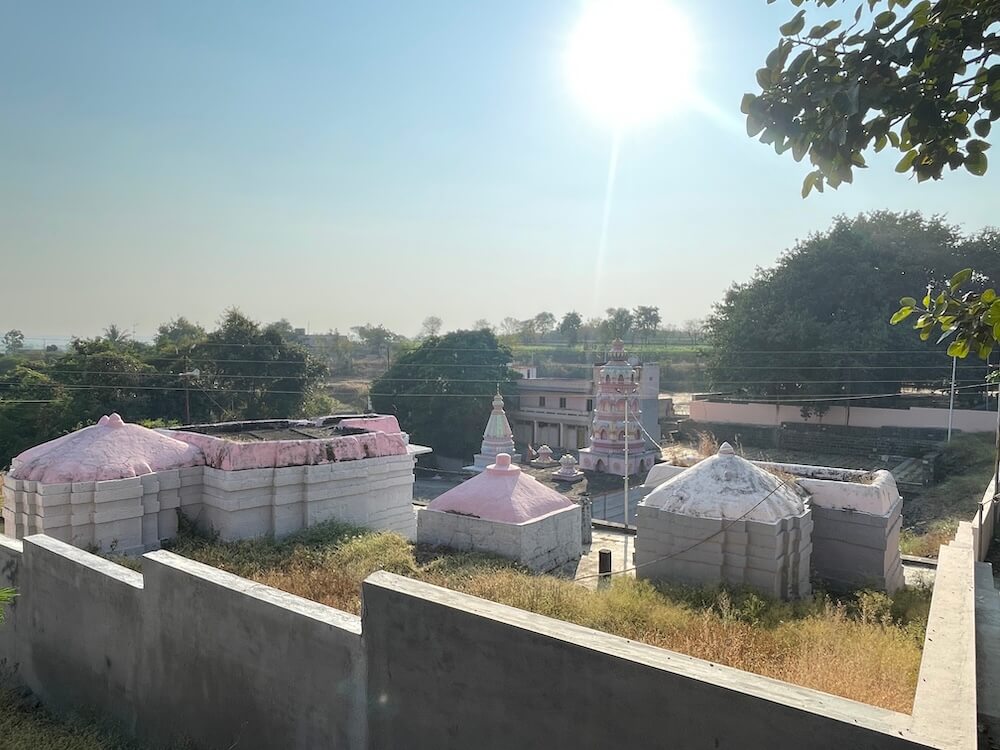
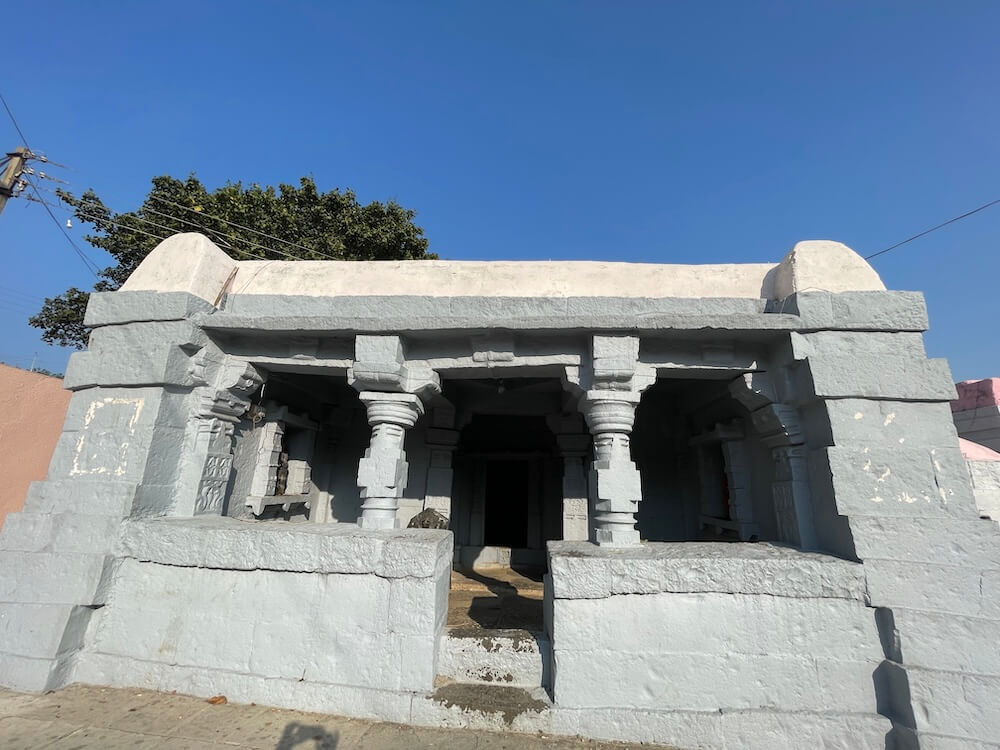
In the temple courtyard, near the rear entrance, is a small temple dedicated to Sati. The priests say that it was at this very spot, under the Peepal tree, that Sati performed penance for Mahadev. After ascending about twenty steps from the rear entrance, one finds the Kashi Vishwanath Temple and Baleshwar Temple. Both these ancient temples have a layout of Ardhamandap (half-hall), Sabhamandap, Antarala, and Garbhagriha. In these temples, the hands on the intricately carved pillars feature sculptures of Yakshas bearing weight. The Garbhagrihas contain Shivpindis. Ancient idols and Shivpindis are placed near the outer walls of these temples. Adjacent to these temples are the Vaishnodevi Temple, Parvati Mata Temple, Khandoba Temple, and other temples. From here, after ascending about fifty steps to the top of the hill, one reaches a pathway covered with paver blocks. A beautiful garden has been developed alongside the pathway, featuring various types of ornamental trees. The garden has seating arrangements for devotees.
As one proceeds along the pathway, one beholds an intricately carved Dharma Dhwaj (religious flagstaff) built of red stone. To the right of the Dharma Dhwaj is the temple of Bharati Buwa. Adjacent to this temple is the temple of Kartikeya Swami. At the entrance of the temple, on both sides, there are peacock sculptures. This temple is opened for darshan only on Kartik Purnima. In front of the Dharma Dhwaj is a stone entrance gate. The entrance has a crescent-shaped torana (archway) adorned with chandelier sculptures. Above the torana, on both sides, are sculptures of celestial maidens (sundaris). The entrance gate has intricately carved wooden doors. Upon entering through the gateway, one sees the samadhi-temples (memorial shrines) of the Mahatmas who presided over the Math. These include the samadhi temples of Dharmabharati Maharaj, Raghunathbharati Maharaj, Gangadharbharati Maharaj Sanjivan Samadhi, and Santoshbharati Maharaj, among others. The ‘Amrit Bharati Vidyalaya’ operates within the temple premises.
The main annual festivals celebrated in the temple are Mahashivratri and the fourth Monday of the Shravan month. Additionally, festivals such as Chaitra Padwa, Sharadiya Navratrotsav, Dussehra, Diwali, and Kartik Purnima are celebrated. During these times, the temple witnesses a large congregation of devotees. Devotees especially come for darshan on Mondays, Tuesdays, Purnima (full moon), Amavasya (new moon), and Pradosh days.
This sacred temple stands as a testament to deep spiritual devotion, ancient architectural grandeur, and rich local cultural traditions.
The sanctum sanctorum houses the divine idol consecrated according to ancient Vedic traditions, surrounded by serene courtyards and traditional temple architecture.
Navratri, Maha Shivratri, Annual Temple Jatra & Deepotsav
Compare and book flights, secure top-rated local hotels near the temple, hire reliable guides, and rent cars instantly.
Extend your pilgrimage by visiting other highly sacred temples located nearby.


Add ₹999 more to unlock FREE SHIPPING!
Your sacred cart is currently empty.
Shop Photo FramesFill in your delivery details below to place your order.
Add comment