
Add ₹999 more to unlock FREE SHIPPING!
Your sacred cart is currently empty.
Shop Photo FramesSituated in the Hingoli district of Marathwada, Aundha Nagnath is an ancient Shiva temple representing a living heritage of Indian culture and magnificent architecture. Among the twelve sacred Jyotirlingas of Lord Shiva that hold supreme importance in Hindu religious tradition, stretching from the Himalayas to Rameshwaram, Aundha Nagnath is revered as the eighth Jyotirlinga. The robust foundation built by the Yadavas in the thirteenth century, the spire bearing witness to the scars inflicted by later Mughal invasions, and the fragrance of Saint Namdev’s supreme devotion make this temple truly unique.
The legend of the demoness Daruka, narrated in the twenty-ninth and thirtieth chapters of the ‘Kotirudra Samhita’ in the Shiva Purana, is associated with the origin of the Nageshwar Linga. In ancient times , in the dense forest named ‘Darukavan’, a demoness named Daruka lived along with her husband, the demon Daruk. The demoness Daruka had performed severe penance and obtained a boon from Goddess Parvati that wherever she went, the forest would accompany her. However, she began to misuse this power and boon. She, along with her husband and their demonic army, harassed the local people and sages. During that time, a devotee of Shiva named Supriya, a Vaishya by birth, was passing along this route with his associates. The demoness Daruka imprisoned Supriya and his fellow Shiva devotees. Even in captivity, Supriya did not abandon his devotion to Shiva. He fashioned a clay Lingam inside the prison and began the continuous chanting of the mantra ‘Om Namah Shivaya’. Pleased by his supreme devotion and earnest cry, Lord Shiva appeared before him. He bestowed the Pashupatastra upon Supriya, vanquished the demoness Daruka, and protected the devotees. On this occasion, the devotees and deities requested Lord Shiva to reside here permanently for the welfare of devotees. Acceding to their prayer, Lord Shiva manifested here in the form of Nageshwar Jyotirlinga. Devotees firmly believe that this sacred place is none other than Aundha Nagnath.
According to a legend, this temple was established by the Pandavas during their period of exile. While wandering, the Pandavas arrived at this Darukavan. The Pandavas possessed a cow that would daily visit a specific spot, release streams of milk from its udder, and perform Abhishekam on that ground. When Bhima witnessed this, out of curiosity, he dug up the earth at that spot. A stream of blood appeared, and beneath it, a self-manifested (Swayambhu) Shiva Lingam was revealed. Thereafter, all five Pandavas together constructed a grand, monolithic stone temple there.
According to numerous references in saintly literature, Saint Shiromani Namdev Maharaj had set out on a pilgrimage along with Saint Dnyaneshwar and other revered saints. During that pilgrimage, all of them arrived at Aundha Nagnath. At that time, while Saint Namdev Maharaj was performing Harikirtan in front of the Nagnath temple, some orthodox priests raised objections. Namdev Maharaj belonged to the Shimpi (tailor) community, which was considered a Shudra caste in those days. These orthodox individuals taunted him about his caste and forbade him from performing Kirtan in front of the temple, driving him away to the rear side of the temple. In the book ‘Bharatiya Sahityache Nirmate Namdev’ written by Madhav Deshmukh and published by the ‘Sahitya Akademi’, this miraculous event is described as follows: ‘All the devotional singers accompanying Namdev came behind the temple. Although Namdev entered a state of profound trance in devotion where “his soul was immersed in the bliss of the Brahman”, the Kirtan lacked its former fervour. Namdev realised this. With deep anguish, he offered a prayer addressed to the Lord. Once before, when a Sultan had captured Namdev and had a cow slaughtered in his presence, Namdev had brought that cow back to life through the power of his devotion. Recalling this incident, Namdev pleaded, “O Vitthala, why are you so cruel at heart now, and why do you not come quickly? You have turned your back on me and are seated inside the sanctum. Now, O Lord of the Universe, look upon me with grace and save me.” As these words escaped Namdev’s lips, the temple, which originally faced east, turned around and began to face west.’ To this day, the entrance of this temple faces west, while the statue of Nandi is located at the back of the temple (towards the east). Generally, a Shiva temple faces east with Nandi seated in front, but here Nandi is situated at the rear of the temple. This anomaly corroborates the legend. Many Abhangas describing the incident where Namdev ‘turned the temple around’ are sung in the Varkari tradition to this day.
Another momentous event that transformed Saint Namdev’s life took place within the premises of this very temple. At the behest of Saint Dnyaneshwar, in order to rid his mind of subtle ego and in search of a true Guru, Namdev Maharaj came to Aundha Nagnath. Here, he approached the great Shaivite saint Visoba Khechar. At that time, Visoba was lying comfortably inside the temple with his feet resting directly upon the sacred Shiva Lingam. Seeing him in this state, Namdev was astonished. Addressing Visoba, he exclaimed, “Wake up, wake up, O blind creature! What are you doing, resting your feet upon the Lord?” Thereupon, Visoba Khechar calmly replied, “My legs do not lift up due to old age; you yourself pick up my feet and place them where the Lord is not present.” An Abhanga regarding this, compiled in ‘Saint Namdevchi Gatha’ edited by H.B.P. Dada Gondkar, goes thus: ‘Visoba Khechar says to Namdev: “Why do you wake my soul? Where is there a place devoid of God? Search and think. O Namdev, wherever God is not present, place my feet there after careful consideration.”‘ (Abhanga No. 296)
When Namdev tried to lift Visoba’s feet and place them elsewhere, wherever he placed the feet, a Shiva Lingam emerged from the ground right there. Stones, soil, walls—everywhere he began to see manifestations of Shiva. ‘Nama sees God everywhere he looks; he finds not a single empty space.’ This miracle opened Namdev’s eyes. He experienced the profound realization that ‘God does not merely reside in an idol, but permeates the entire cosmos.’ He received divine vision and accepted discipleship of Visoba Khechara. Visoba Khechara imparted him the teaching: ‘He who is beyond both name and form, behold, He alone is God, all else is false. Water, land, wood, stone, the individual soul and the cosmos, atoms and molecules—He Himself is witness to all. Knowing this, recognize your own Self beyond. Khechara says, name is indeed the entirety of God.’ (Abhanga No. 298) The samadhi temple of Visoba Khechara, who thus instructed Sant Namdev, is situated in the premises of the Aundha Nagnath Temple. According to some historical sources, his samadhi is located at Barshi beside the Uttateshwar Temple. However, the place of their meeting and receiving spiritual initiation (Gurupadesha) is Aundha Nagnath itself. Owing to this event, the Aundha Nagnath Temple holds a highly significant place in the Varkari Sampradaya.
The written and archaeological history of this temple is primarily associated with the Yadava Empire of Devagiri dating back to the thirteenth century. During the golden age of the Yadava kings of Devagiri, art and architecture flourished greatly in Maharashtra. Hemadri (Hemadpant), the prime minister of the Yadava monarch Ramchandraraya, built numerous temples in the Bhumija architectural style. Consequently, that style came to be known by his name as the Hemadpanti style. The Aundha Nagnath Temple is a supreme example of architecture in this very style.
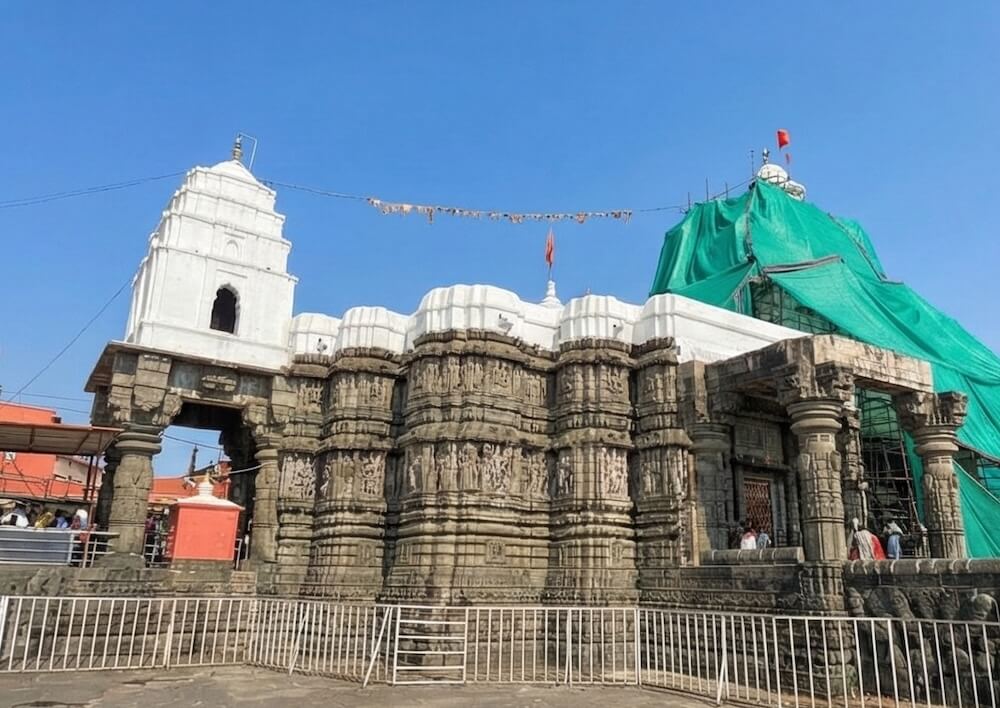
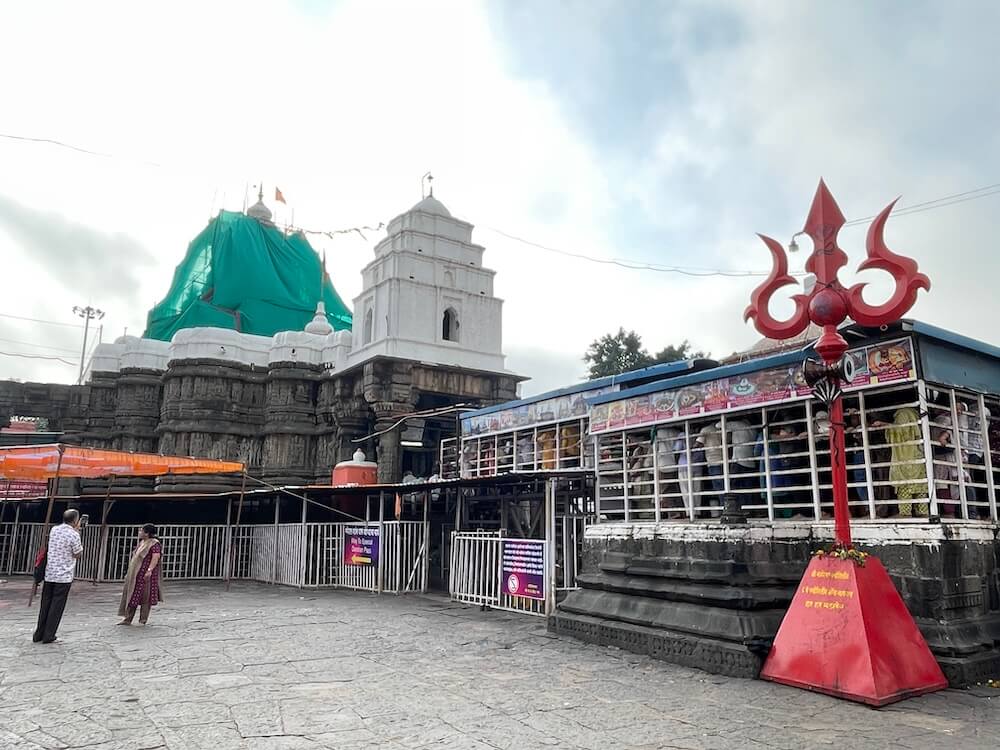
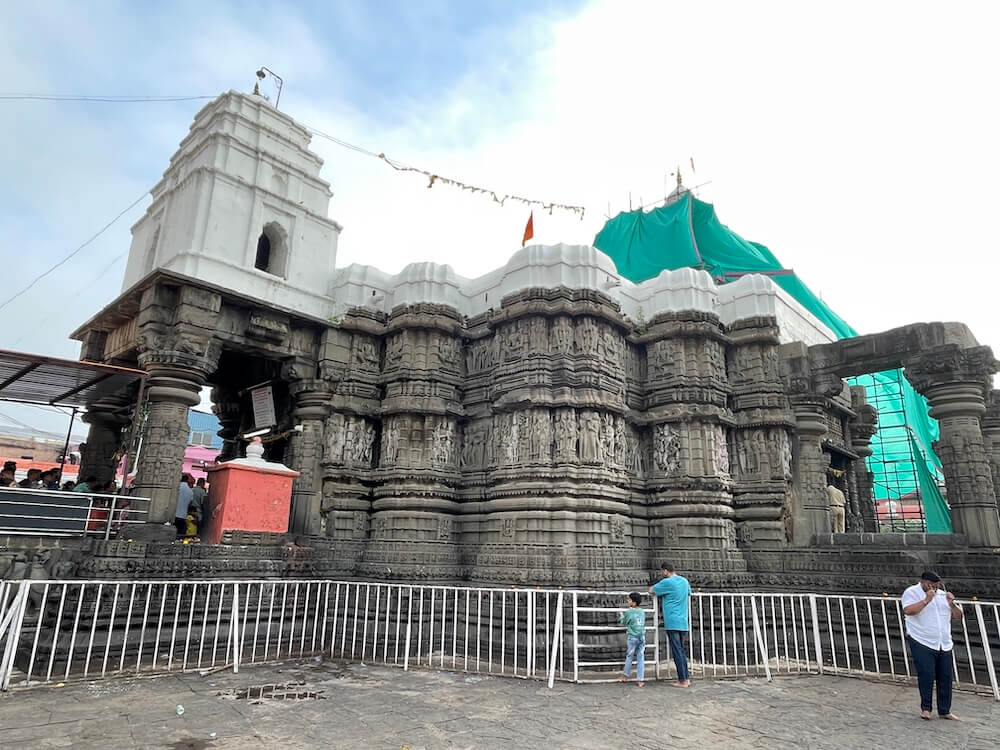
According to the records of historians and the Archaeological Department, the construction of this temple is believed to have taken place between the 12th and 13th centuries. During this period, several magnificent Shiva temples were built across Marathwada and the entire Deccan plateau, among which Aundha Nagnath stands foremost. However, much like many other ancient temples in the country, this temple too has witnessed numerous invasions and destructions over the course of time. Especially during the Mughal rule under the Mughal Emperor Aurangzeb, a major attack was launched on this temple. According to historical references, the original temple was seven storeys high and its grandeur was dazzling. Yet, during the invaders’ onslaught, the upper portion of the temple, the shikhara (spires), and numerous sculptures were devastated. Despite this, the original garbha-griha (sanctum sanctorum), sturdy stone walls, and foundation were so strong that they survived these severe impacts and stand inviolable to this day. Today, upon observing the architecture of the temple, a blend of two distinct architectural styles is clearly visible. The lower portion of the temple, which belongs to the Yadava period, is made of black stone and features intricate carvings, whereas the upper shikhara is of the Maratha period style, constructed using bricks, lime, and plaster. This portion of the shikhara is said to have been restored by Punyashlok Ahilyabai Holkar. However, according to the documents of the Holkar Sansthan, Ahilyabai Holkar had assigned a regular provision of holy waters of the Ganga (Gangechi Kavad) for this deity and appointed personnel for worship. The mention in the documents of the Holkar Sansthan is as follows — ‘Dated 16-4-1784, Kird Mukam Maheshwar list, the work of worship of Shri Aundha Nagnath from the government is entrusted to Vedashastrasampanna Vitthal Bhatt son of Lembakbhatt surnamed Bhopi, residing at Kshetra Amrat.. entrusting this to the government’s Tirtha Purohit, the perennial appointment is as follows.’ For this temple, Ahilyabai had granted a provision of 81 rupees and allocated the revenue from the Mahal in the Ambad pargana for the same.
In Dr. Prabhakar Deo’s book ‘Marathwadatil Prachin Mandir Sthapatya’ (Ancient Temple Architecture of Marathwada), the Aundha Nagnath Temple has been described in great detail and with scholarly precision. He has praised this temple as the ‘Merumani’ (crown jewel) and ‘Devalaya-Chakravarti’ (emperor of temples) of Marathwada’s temple architecture. He compared this temple to the world-renowned Kailasa caves of Ellora. In his opinion, the sculptors of Ellora and the sculptors of Aundha Nagnath must belong to the same tradition or guild, so closely do their works match.
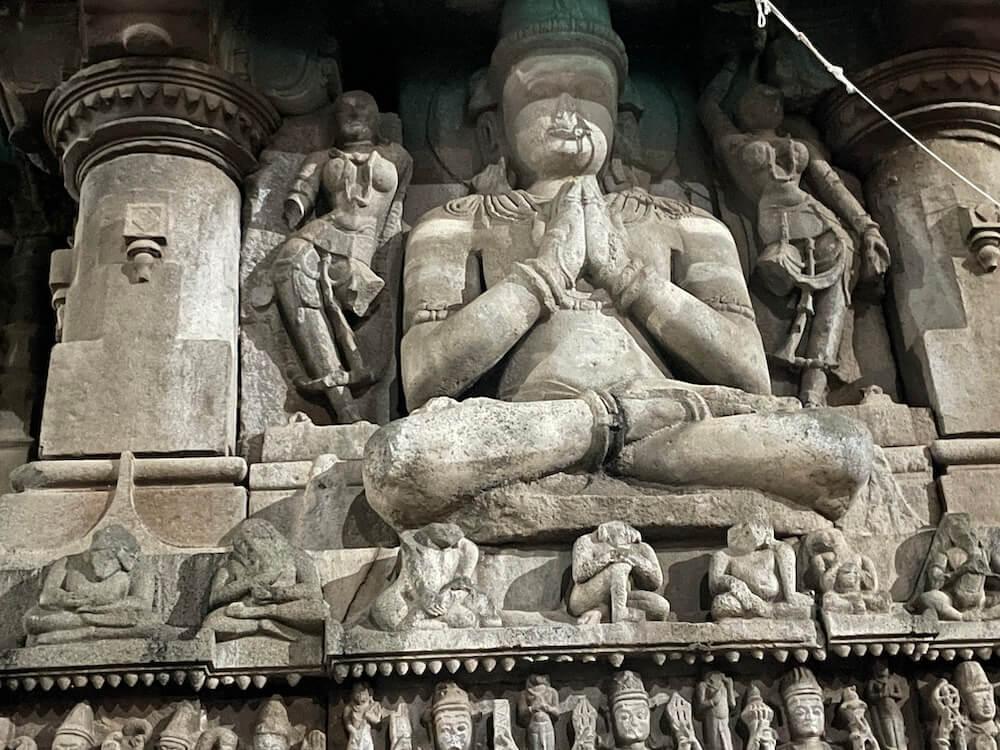
In terms of expanse and grandeur, this is stated to be the largest ancient temple in Marathwada. The temple is surrounded by a sturdy fortification wall 20 feet in height, which gives the temple the appearance of an impregnable fort. There are four magnificent gateways in this fortification. The main temple measures 126 x 118 feet and stands on a 5.5-foot high adhisthana (plinth). The construction of the temple is based on a ‘star-shaped’ (tarakruti) plan. The eight octagonal pillars in the sabhamandapa (assembly hall) of the temple feature extremely delicate artistry. One special sculpture among these depicts three faces and four legs within a single figure. This sculpture is carved in such a manner that when viewed from any one side, the figure appears to be that of a complete person or animal, but when another side is covered, it appears differently. This sculpture bears witness to the ingenuity and skill of the artists of that era.
In many temples across the country, the garbha-griha is at the same level as the sabhamandapa or slightly elevated. However, the main garbha-griha of the Aundha Nagnath Temple is situated underground, in the basement. To have the darshan of Nagnath here, devotees have to descend from the sabhamandapa through a narrow and dark pathway. After descending two flights of stairs, the Swayambhu Shivalinga is situated in a small, serene, and mysterious chamber. To ensure air circulation and prevent any shortage of oxygen within the garbha-griha, specific vents and a ventilation system are provided in the walls.
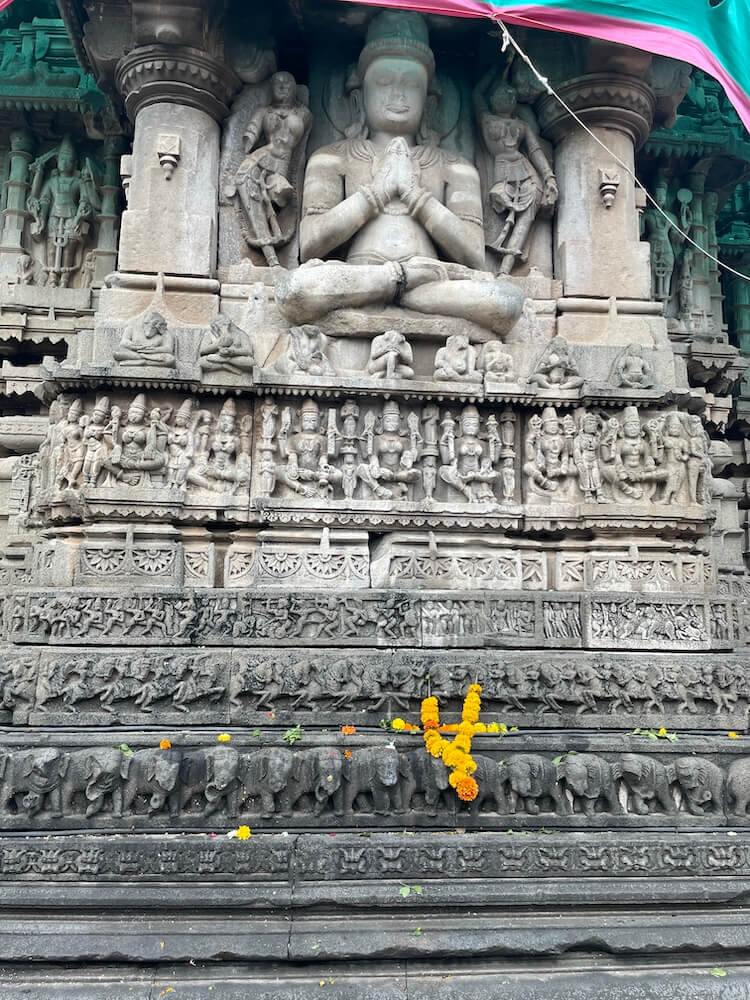
The carvings executed on the exterior walls and pillars of the temple are extremely graceful, intricate, and distinctive. On the adhisthana of the temple are carved rows of elephants (gajathara), horses (ashwathara), and humans (narathara) out of monolithic black stone. Besides these, the walls depict various episodes from the Dashavatara, stories from the Ramayana and Mahabharata, Yakshas, Yakshinis, Apsaras, and various geometric patterns. Several sculptures narrating mythological tales have been carved, such as Shiva and Parvati seated on Mount Kailasa and Ravana attempting to shake Mount Kailasa (Ravananugraha Murti). The height of this temple up to the shikhara is 60 feet. The dazzling white shikhara built upon it using lime is 31 feet in height.
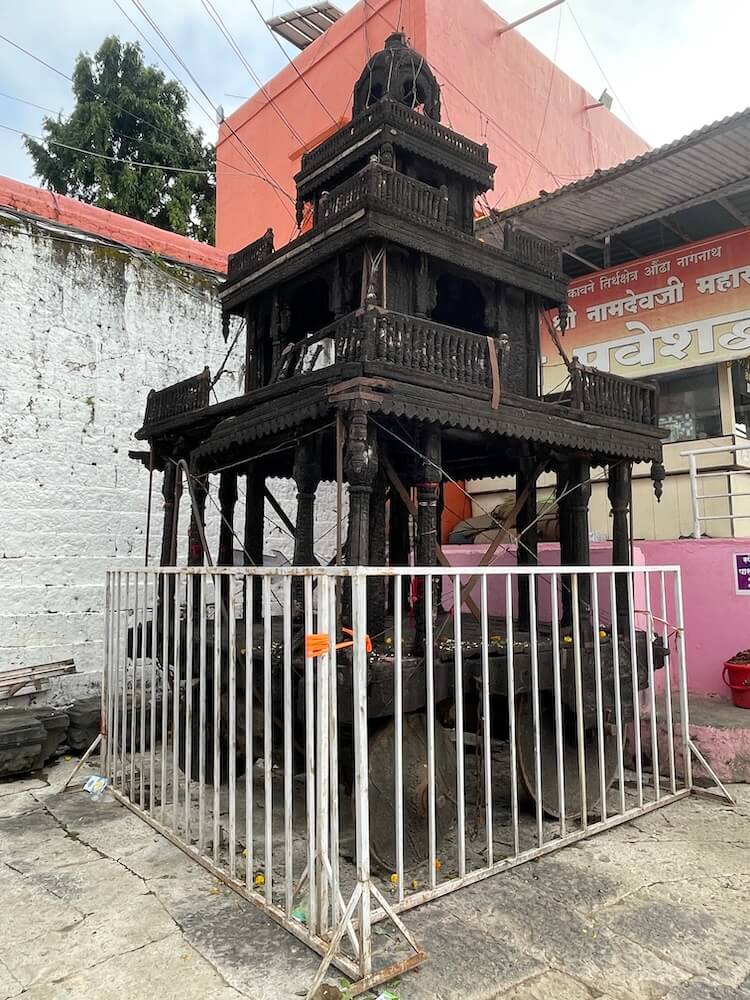
Various religious festivals are celebrated throughout the year at the Aundha Nagnath Temple, but Maha Shivaratri and Vijayadashami are the two major festivals celebrated here with great enthusiasm. During this time, an ocean of devotees gathers here. On Maha Shivaratri, a large five-day fair is held here. The main attraction of this festival is the ‘Rathotsav’ (Chariot Festival). This tradition has a history spanning hundreds of years. The festival idols of Lord Shiva and Goddess Parvati are placed in a large, ornate chariot made of wood. This chariot is decorated with multicolored flowers, garments, and electric lights. There is wooden carving on all four sides of the chariot. This carving resembles the architecture on the temple. Thick ropes are attached to pull the chariot, and thousands of devotees pull this chariot amidst chants of ‘Har Har Mahadev’, ‘Nagnath Maharaj ki Jai’, and ‘Bam Bam Bhole’. This procession starts from the temple courtyard and passes through the main streets of the village with musical bands. At this time, dhol, tasha, lezim troupes, and bhajan mandals lead the chariot. On Maha Shivaratri, thousands of devotees observe a fast, stay awake all night, and break their fast at dawn after worshipping Lord Shiva and receiving the darshan of the chariot.
In the holy month of Shravana, Shiva devotees (Kavadiyas) carrying ‘Kavad’ walk all the way here from various parts of North India and Maharashtra. They bring holy river water in their kavad and perform Jalabhishek on the Jyotirlinga. During this time, special religious rituals such as Rudrabhishek, Laghurudra, Maharudra, and Dugdhabhishek are performed on a large scale. Many devotees take a vow to offer one lakh or more Bilva leaves to the Lord during the month of Shravana. On the day of Vijayadashami, the palanquin of the Lord is taken out for Simollanghan (crossing the border). This day is also celebrated as a major festival. The palanquin of Lord Nagnath is taken with music up to the village border, where the tradition of exchanging gold (Bauhinia leaves) takes place. Apart from this, a large fair is also held here in the month of Magha, which features an agricultural exhibition and a cattle market. Devotees can have the darshan of Lord Nagnath daily from 05.30 in the morning until 09.00 at night.
In the temple premises, there is a stepwell known as ‘Sasu-Sunichi Barav’ (Mother-in-law and Daughter-in-law’s Stepwell). This stepwell is an excellent example of medieval water management. Locally, some folktales related to domestic relations or competition between a mother-in-law and daughter-in-law are prevalent behind its name. The construction of the stepwell is extremely intricate, featuring a beautiful arrangement of steps to descend. Near the temple is an ancient pond named ‘Harihar Tirtha’. The name ‘Harihar’ is a symbol of the unity of Shiva (Hara) and Vishnu (Hari). Devotees wash their hands and feet or take a bath here before having darshan. In front of the temple is the shrine of Saint Namdev Maharaj. It houses an idol of the Maharaj holding a veena.
This sacred temple stands as a testament to deep spiritual devotion, ancient architectural grandeur, and rich local cultural traditions.
The sanctum sanctorum houses the divine idol consecrated according to ancient Vedic traditions, surrounded by serene courtyards and traditional temple architecture.
Navratri, Maha Shivratri, Annual Temple Jatra & Deepotsav
Compare and book flights, secure top-rated local hotels near the temple, hire reliable guides, and rent cars instantly.
Extend your pilgrimage by visiting other highly sacred temples located nearby.


Add ₹999 more to unlock FREE SHIPPING!
Your sacred cart is currently empty.
Shop Photo FramesFill in your delivery details below to place your order.
Add comment