
Add ₹999 more to unlock FREE SHIPPING!
Your sacred cart is currently empty.
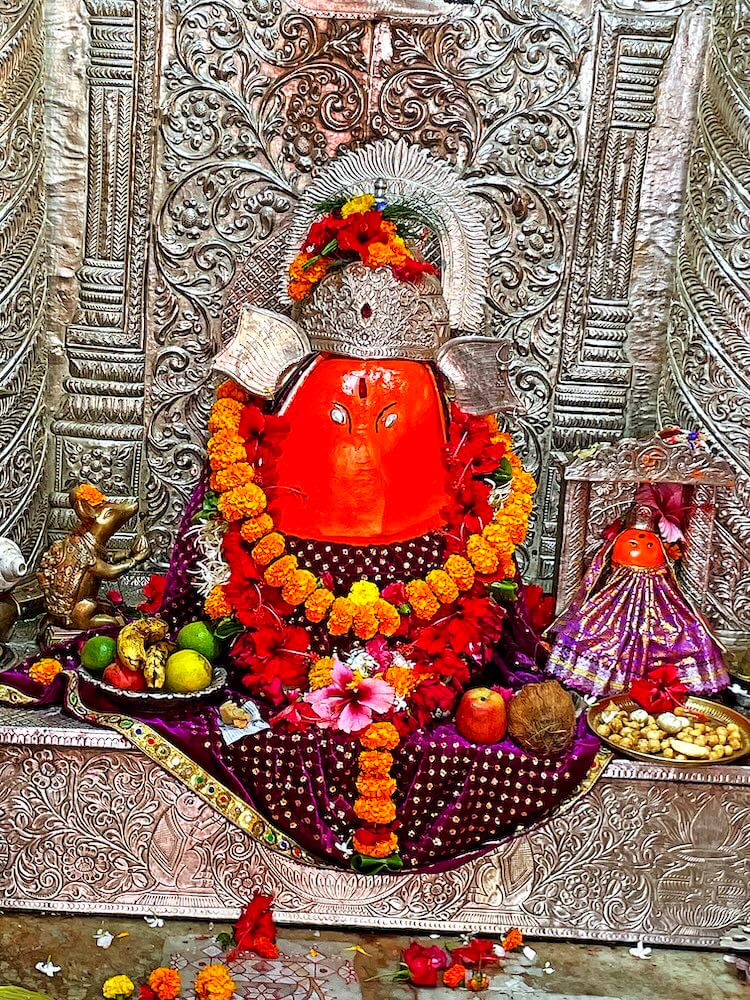
Shop Photo FramesShaiva, Vaishnava, Shakta, Datta, and Ganapatya are the principal devotional paths for followers of the Hindu Dharma. Although it is said that Ganapati migrated from the Konkan region to the rest of Maharashtra during the Peshwa era, this is not entirely accurate. Some ancient temples dating from approximately the seventh to the twelfth centuries feature sculptures of Nritya Ganesha and other forms of Ganesha. These sculptures were carved as revered deities. Since then, thousands of Ganesha temples have been established in villages and towns to this day. This Ganesha temple in Hingoli city was established in the year एक हजार नऊशे ब्याण्णव. This Ganesha, famous as ‘Modakacha Ganapati’ (Ganesha of Modaks), is a jagrut (awakened) deity. Devotees believe that He grants their wishes.
The local priest and trustee, Ramakant Mishkin, established this temple in एक हजार नऊशे ब्याण्णव. He performed the Prana Pratishtha (consecration) of a Ganesha murti that he found. Initially, he offered a vow of one thousand modaks to this Ganapati and presented them to the deity. Witnessing this, other devotees began to make their own vows, and their numbers grew day by day. Today, approximately thirty-five years later, two to three lakh modaks are offered to Ganapati in the temple and then distributed to devotees. Modaks are extremely dear to Ganapati. Hence, the deity here is renowned as ‘Modakacha Ganapati’.
Many legends are prevalent in the Puranas regarding why modaks became so dear to Ganapati. According to one legend, once Mata Anasuya invited Mahadev, Parvati, and Ganapati for a meal. No matter how much was served, Ganapati’s hunger was not satisfied. Then Anasuya prepared modaks with jaggery and coconut. Ganapati loved them so much that He ate nothing else thereafter. Since then, modaks became dear to Ganesha.
A legend is also told about this Ganapati temple, famous as Modakancha Ganapati. After making a wish or a vow, a modak given from the temple is sealed in a box and kept in the household shrine for a year. Every Tuesday and Sankashti Chaturthi, this modak is worshipped with durva grass and flowers. Once one’s wish is fulfilled, this modak, along with the एक हजार आठ modaks vowed, are taken to the temple and offered at the feet of Ganapati.
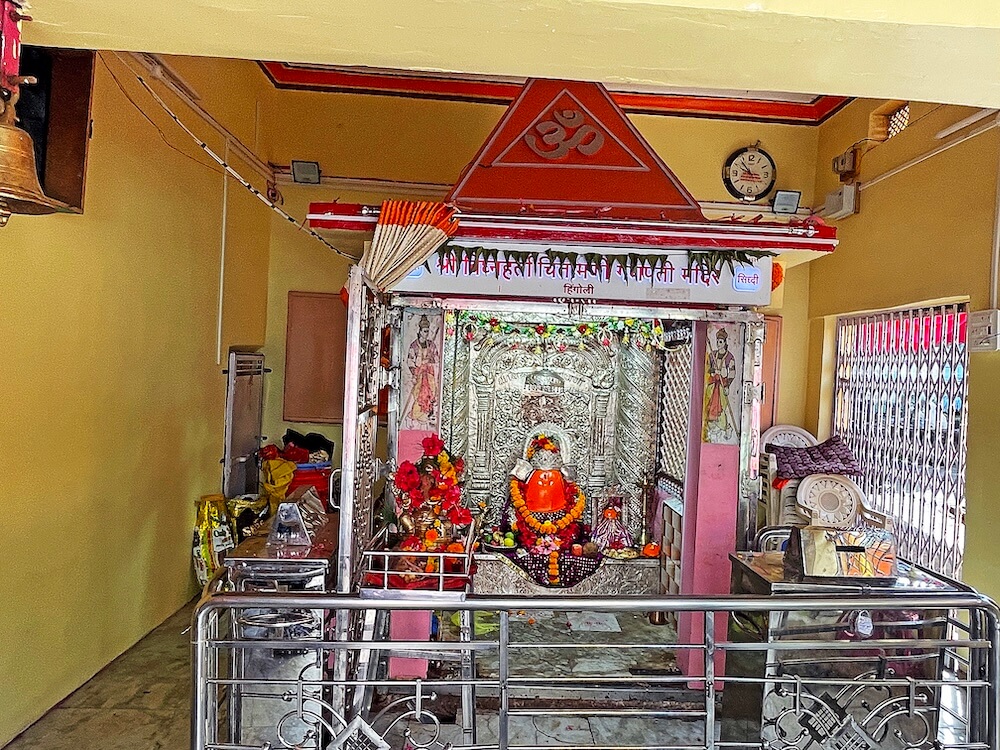
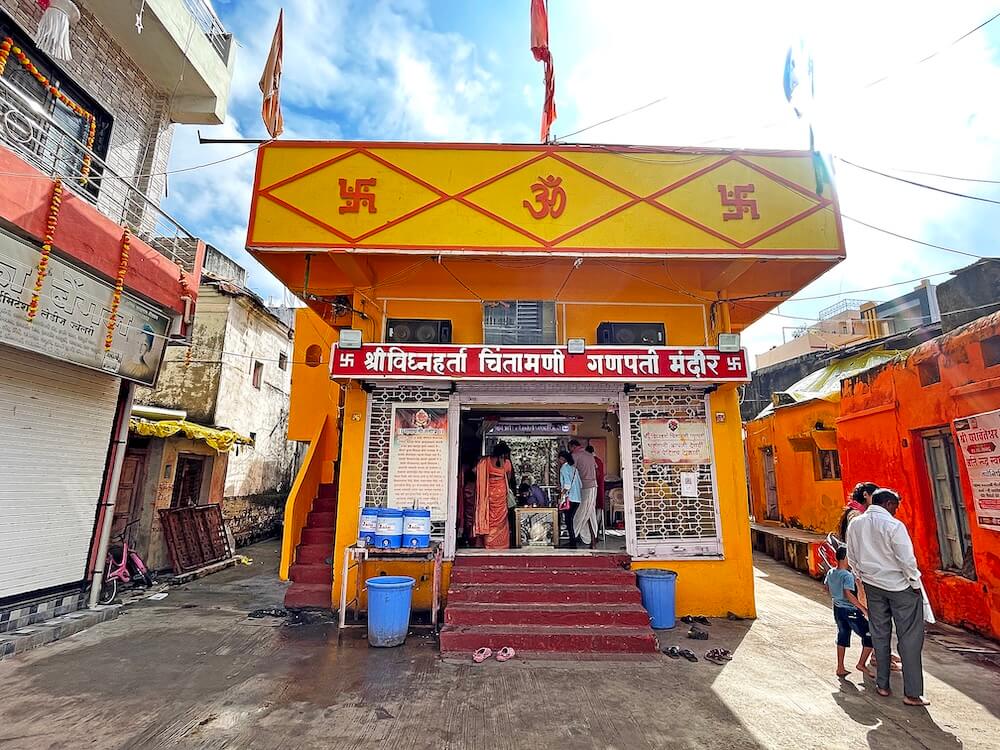
This temple is located in a densely populated area of the city. There is a path leading to the temple from the main road. There is a small open space in front of the temple. The temple’s structure comprises a sabhamandapa (assembly hall), antarala (vestibule), and garbhagriha (sanctum sanctorum). The temple’s construction uses cement concrete in a modern architectural style. The entrance to the sabhamandapa is elevated above the courtyard. This entrance has four steps.
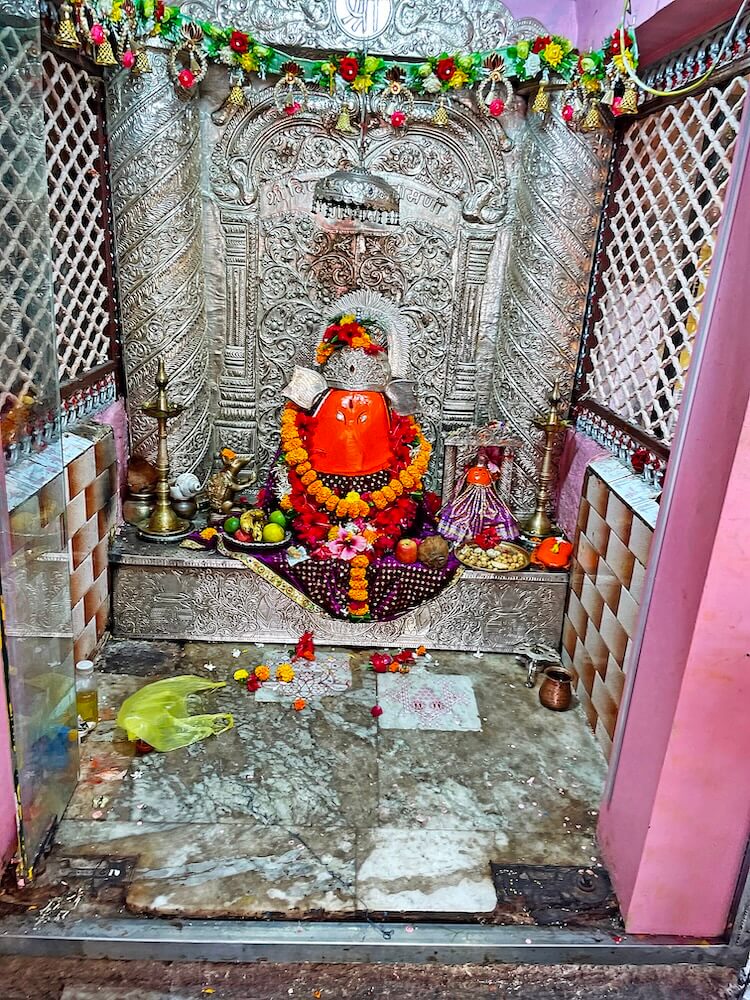
The enclosed sabhamandapa has ventilators for light and air. In the sabhamandapa, opposite the entrance, there is a sculpture of Mushak, Ganapati’s vehicle, on a vajrapeetha. Further inside, stainless steel railings define the antarala. Here, on a table, is the utsava murti (processional deity) of Shri Ganesha. In the center of the sabhamandapa, beyond the antarala, is the garbhagriha. The entrance to the antarala is simple. On both sides of the entrance, dwara-palaka (gatekeeper) paintings adorn the pillars. The entrance to the garbhagriha has iron mesh doors. Inside the garbhagriha, on a silver-plated vajrapeetha, is the sindoor-anointed, self-manifested stone murti of Shri Ganesha. A silver crown adorns the deity’s head. Behind the murti is an intricately carved silver prabhaval (aura).
There is a pradakshina marga (circumambulatory path) on the exterior of the garbhagriha. Above the garbhagriha, located in the center of the sabhamandapa, is a square shikhara (spire) and kalasha (finial). On the left side of the pradakshina marga, there is an exit door from the sabhamandapa. On the exterior of the temple, adjacent to the left wall, there is a staircase leading to the roof.
The ten-day Ganesh Utsav in the month of Bhadrapada is the main annual festival here. For ten days, abhishek (ritual bathing), pujan (worship), bhajan (devotional singing), and kirtan (chanting) are performed for Ganesha. Special pujan is performed on Anant Chaturdashi. In the early morning, after gangodak (Ganga water) and dugdhabhishek (milk anointing), Ganesha is adorned with इक्कीस sovli (sacred garments). Mahabhojan (grand feast) and the prasad of vowed modaks are offered to Ganesha. These modaks are then distributed to devotees. The temple is crowded with devotees every Sankashti Chaturthi, Tuesday, and during festivals and celebrations.
This sacred temple stands as a testament to deep spiritual devotion, ancient architectural grandeur, and rich local cultural traditions.
The sanctum sanctorum houses the divine idol consecrated according to ancient Vedic traditions, surrounded by serene courtyards and traditional temple architecture.
Navratri, Maha Shivratri, Annual Temple Jatra & Deepotsav
Compare and book flights, secure top-rated local hotels near the temple, hire reliable guides, and rent cars instantly.
Extend your pilgrimage by visiting other highly sacred temples located nearby.


Add ₹999 more to unlock FREE SHIPPING!
Your sacred cart is currently empty.
Shop Photo FramesFill in your delivery details below to place your order.
Add comment