
Add ₹999 more to unlock FREE SHIPPING!
Your sacred cart is currently empty.
Shop Photo FramesThe Datta Sampradaya, which nurtures a unique tradition of devotion to Lord Datta in Maharashtra, has flourished for hundreds of years. In the fifteenth century, Swami Narasimha Saraswati systematically propagated and spread the Datta Sampradaya. Nevertheless, devotion to Lord Dattatreya and the worship of the deity fundamentally date back to ancient times. Sects within Hinduism such as Mahanubhav, Nath, Warkari, and Samartha also hold profound faith and devotion for Lord Dattatreya. In the Puranas and five modern Upanishads, Lord Dattatreya is revered as the upholder of Varnasrama Dharma, the epitome of the Guru principle (Guru Tattva), and the preceptor of Yoga. Lord Dattatreya is worshipped at the temple situated on Dattabardi Hill near Hadgaon town in Nanded district. Along with Datta devotees from the district, pilgrims from various traditions visit here in large numbers for divine Darshan.
Situated a short distance from Hadgaon town, this ancient temple built in the Hemadpanthi architectural style stands on Dattabardi Hill. According to the villagers, this temple is seven to eight hundred years old; however, no concrete records or evidence are available regarding this. A legend associated with the temple states that in ancient times, the ashram of a Datta-devotee Rishi (sage) was located on this hill. Desiring a direct divine vision (Darshan) of Lord Dattatreya, he renounced food and water and undertook severe penance at this spot. After twelve years of rigorous austerity, Lord Datta was pleased and asked the sage to request a boon. The sage expressed his desire that the Lord reside permanently on this hill. Pleased by the sage’s devotion, Lord Dattatreya took up residence on this hill along with Mother Anasuya and Father Sage Atri. Hence, the hill earned the name ‘Dattabardi’.
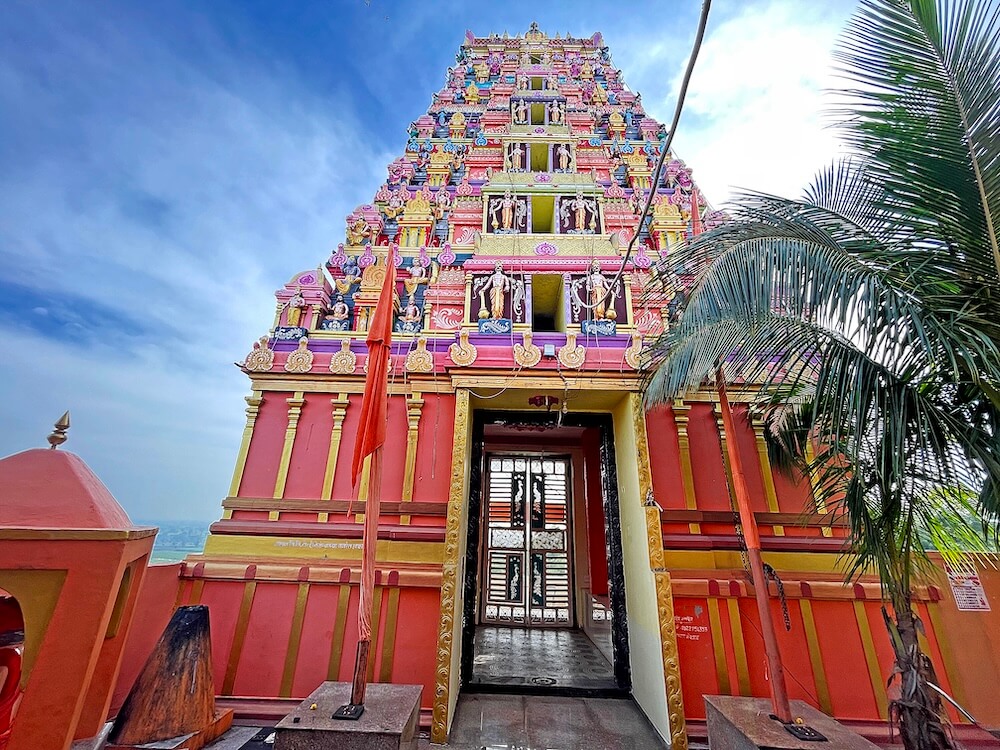
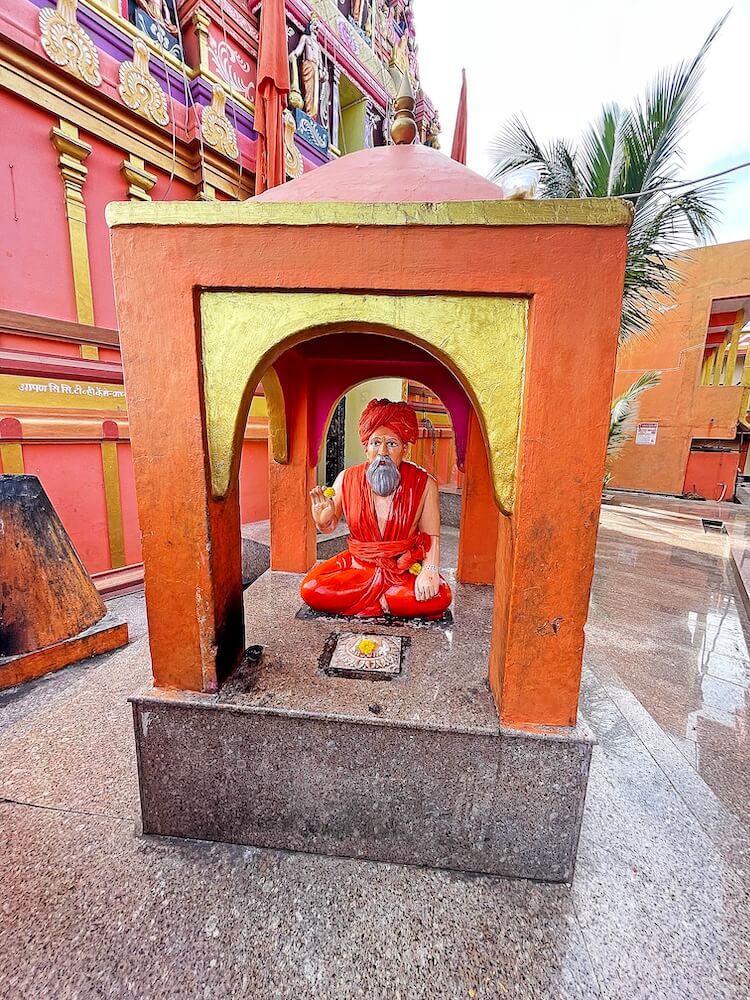
This temple is situated atop a high hill near Hadgaon town. There is a well-paved road leading up to the temple, as well as a spacious parking lot in front of it. Within the sturdy fortification wall surrounding the temple, there is a two-storied entrance gate. On both sides of the gateway, there are three niches (devakoshtakas) each, housing sculptures of various gods and goddesses. The upper floor of the entrance gate houses a Nagarkhana (drum house). On the roof of the entrance gate, there are three canopies (meghdambaris) containing divine sculptures. The entrance features iron mesh gates with an inner wicket door (Dindi Darwaja). This gate is located at the rear of the temple, from where one enters the temple courtyard. On the front side within the fortification wall stands a seven-storey ‘Gopuram’ entrance gate. Each storey of the entrance gate features niches containing idols of various deities, topped by a horizontal Shala-style Shikhara (spire). At the apex of the spire, there are five Kalashas (pinnacles) arranged in a horizontal row. In the spacious paved courtyard, adjoining the fortification wall, are two-storied buildings. These accommodate the Bhakta Niwas (pilgrim rest house), residences for the Mahant, priests, and attendants, a hall for cultural programs, the temple trust office, and other structures. In the courtyard, on the right and left sides of the temple, there are raised platforms featuring Deepastambhas (light towers). Adjacent to the Deepastambhas are the Dhuni Griha (sacred fire hearth) and a Tulsi Vrindavan. Next to the Tulsi Vrindavan are sacred stones representing local deities. The Samadhi (memorial) of the departed Mahant is also located here.
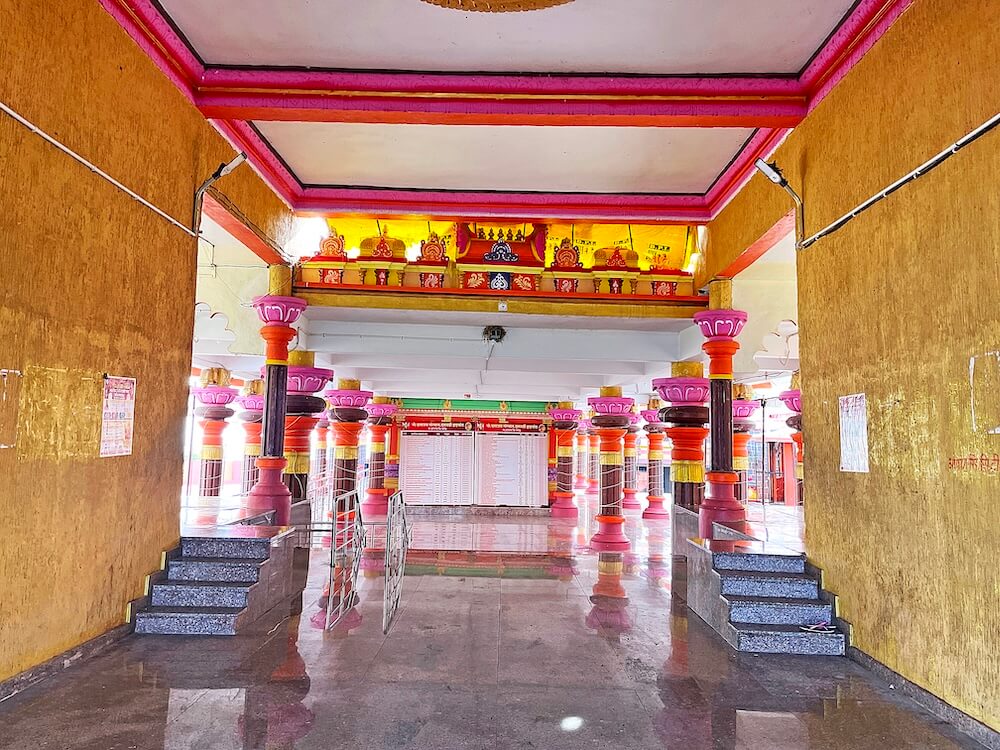
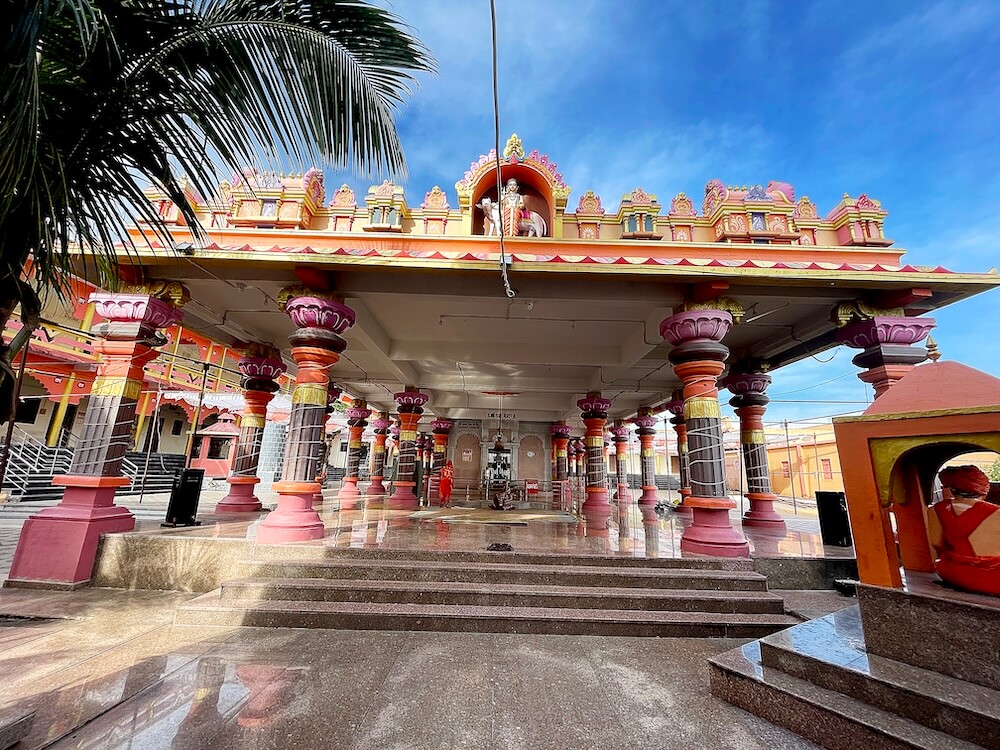
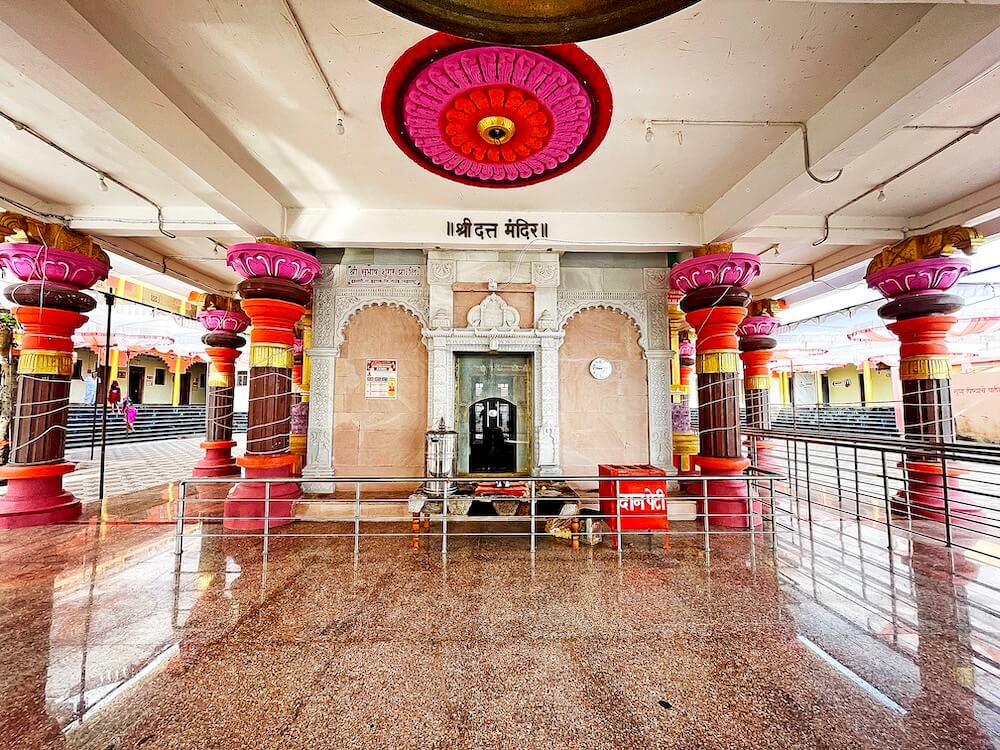
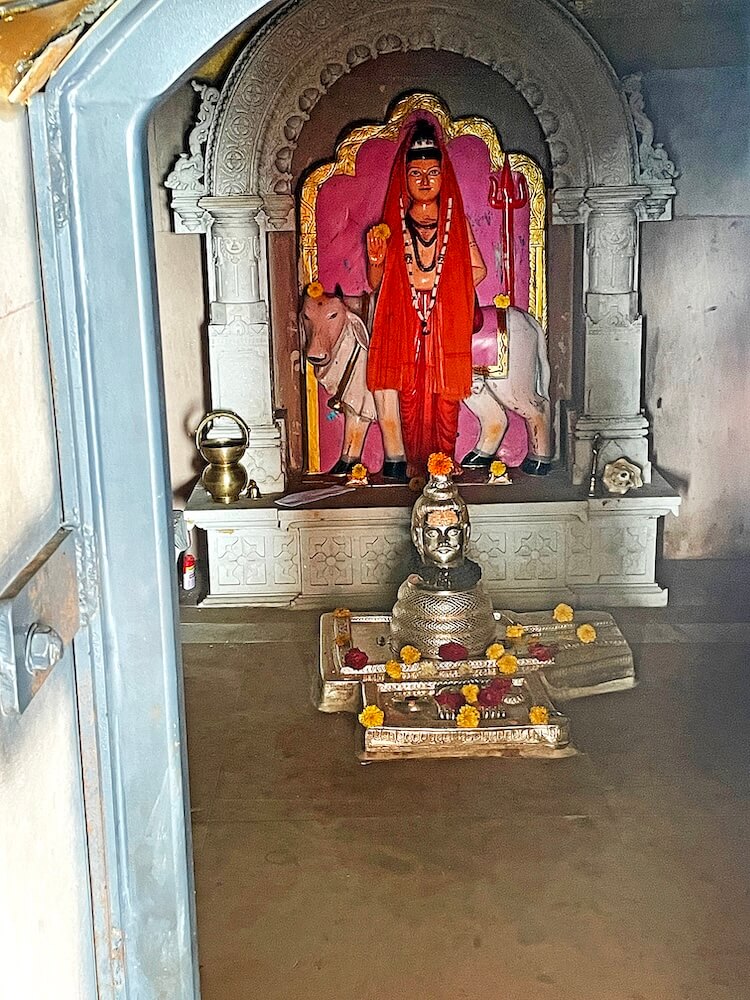
The temple architecture comprises a Sabhamandap (assembly hall) and a Garbhagriha (sanctum sanctorum). The Sabhamandap is semi-open in nature and features circular carved pillars. All pillars stand on circular bases. The pillar shafts display vertical fluting topped with lotus motifs. In the Sabhamandap, directly facing the entrance of the sanctum sanctorum, is a Shiva Pindi (Lingam) and a stainless steel horizontal railing. Here, the Datta Padukas (sacred footprints) are placed on a table. The doorframe of the sanctum sanctorum is carved with floral motifs, and the doorway is fitted with carved wooden doors. Inside the sanctum, a Shivling with a brass mask rests on the floor. Against the rear wall of the sanctum, on a Vajrapeetha (sacred pedestal), resides a two-armed, single-faced (Ekmukhi) idol of Lord Dattatreya. Behind Lord Dattatreya are a cow sculpture and a Trishul (trident), and in front lies a brass Kamandalu (water pot). A circumambulation path (Pradakshina Marga) runs around the exterior of the sanctum sanctorum.
On the roof of the temple, a decorative parapet wall (Bashingi Kathada) runs along all four sides, incorporating miniature spires of Shala and Kuta design. Above the roof of the sanctum sanctorum, an elegant three-tiered circular spire tapers upwards. At the apex of the spire are three stacked Amalakas topped with a Kalasha.
On the same hill, a short distance from the Datta Temple, stands the temple dedicated to Mata Anasuya, Goddess Annapurna, and Goddess Renuka. A Deepamal (pillar of lights) stands in front of the temple. The structure of this temple comprises a Sabhamandap and two sanctums. The Sabhamandap has two entrances at the front. As the temple stands at an elevated height above the courtyard, steps lead up to the entrance. The Sabhamandap is enclosed, but features windows for light and air. Glass inlay work (Meenakari) adorns both the outer and inner walls of the sanctums. The entrances to both sanctums are fitted with carved wooden doors.
In the sanctum on the left, brass idols of Mata Anasuya and Ekmukhi Shri Dattatreya are enshrined on a Vajrapeetha. In the sanctum on the right, brass idols of Goddess Renuka and Goddess Annapurna are enshrined on a Vajrapeetha. Behind the Anasuya temple lies the temple of Sage Atri, which houses a Shivling on the floor. At the other end of the hill is the temple of Sayamay, the sister of Mata Anasuya.
The main annual festival of Datta Jayanti is celebrated here with immense enthusiasm. On this occasion, a seven-day Harinam Saptah (week-long devotional chanting) is organized. For seven continuous days, events such as Bhajans, Kirtans, discourses (Pravachans), classical music performances, and Mahaprasad are held at the temple. On the final day, a grand Palkhi (palanquin) procession of Lord Dattatreya is taken out. Major festivals throughout the year—such as Guru Purnima, Hanuman Jayanti, Ganesh Jayanti, Sharadiya Navratri, Chaitra Padwa, Dasara, Diwali, Kojagari Purnima, Kartik Purnima, and the holy month of Shravan—are celebrated at the temple. Thousands of devotees from the surrounding region arrive here for divine Darshan during all festivals. During the Simhastha Kumbh Mela, the Mahant of Datta Shikhar visits to meet the Mahant of Dattabardi. There is a daily rush of devotees coming for Darshan at the temple, with Thursdays drawing particularly large crowds of worshippers.
This sacred temple stands as a testament to deep spiritual devotion, ancient architectural grandeur, and rich local cultural traditions.
The sanctum sanctorum houses the divine idol consecrated according to ancient Vedic traditions, surrounded by serene courtyards and traditional temple architecture.
Navratri, Maha Shivratri, Annual Temple Jatra & Deepotsav
Compare and book flights, secure top-rated local hotels near the temple, hire reliable guides, and rent cars instantly.
Extend your pilgrimage by visiting other highly sacred temples located nearby.


Add ₹999 more to unlock FREE SHIPPING!
Your sacred cart is currently empty.
Shop Photo FramesFill in your delivery details below to place your order.
Add comment