
Add ₹999 more to unlock FREE SHIPPING!
Your sacred cart is currently empty.
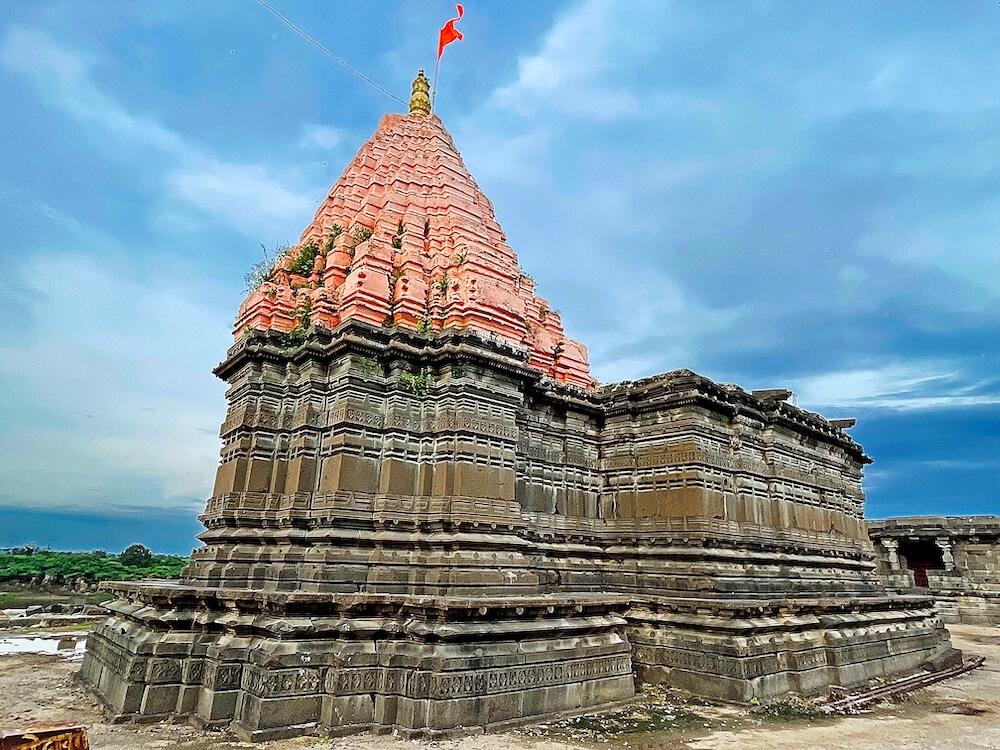
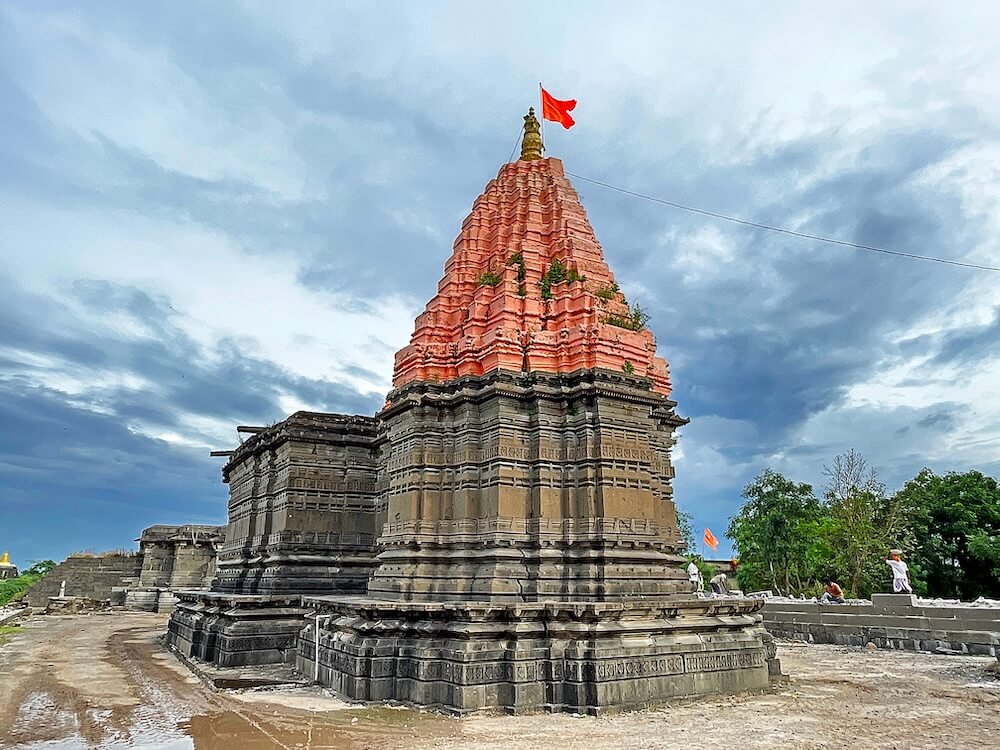
Shop Photo Framesराहेर, a village nestled on the banks of the sacred Godavari River in Nanded district, bears witness to a profound spiritual heritage. It is in this hallowed land that the Bhog Narsimha Temple, built during the Yadav dynasty in the thirteenth century, stands. This temple, with a history spanning approximately eight hundred to one thousand years, is revered as an exquisite manifestation of Hemadpanti architectural style and ancient sculpture. This abode of Bhagwan Narsimha, who liberated the devotee Prahlad, is known as a ‘Jagrut Devsthan’ – a living, awakened shrine. Devotees hold immense faith in this deity, who rushes to answer their calls and fulfills their vows.
Throughout our sacred land, there are numerous temples dedicated to Narsimha, who vanquished Hiranyakashipu and rescued his devotee Prahlad. Among these, the Narsimha temples in Ahobilam in Kurnool district of Andhra Pradesh, Yadadri in Telangana, Sholingur in Tamil Nadu, and Etawah in Uttar Pradesh are particularly renowned. These temples, dating back approximately eight hundred to one thousand years, are splendid examples of ancient architecture and sculpture. In Nanded district, along the banks of the Godavari River, there are many Narsimha temples. Among them, the Khadkya Narsimha shrine and the Bhog Narsimha Temple in Raher village, Naygaon, are especially famous. In the year एक हजार नऊशे त्र्याऐंशी, due to the rise in the Godavari River’s water level caused by the Pochampad project in Andhra Pradesh, the village was resettled two kilometers away. However, this ancient temple remained steadfast in its original location.
This temple, built in the Hemadpanti stone style, is believed to date back to the time of the Yadav king Bhoja the Second in the thirteenth century. It is said that within the precincts of this temple on the Godavari’s banks, revered saints such as Balgir Maharaj, Maindev Prabhu, Chakradhar Swami, and the saint-poet Dasganu resided, and it was an important center for the Mahanubhav sect. The legend of this temple recounts that Maindev Prabhu of Raher, a devout devotee of Lord Narsimha, would regularly visit the Narsimha temple in Ahobilam, Andhra Pradesh. In his old age, it became impossible for him to travel to Ahobilam. He then implored the Lord to come to his village. The Lord agreed to come from Ahobilam to Raher on the condition that Maindev Prabhu would walk behind Him but never look back. Upon reaching the village entrance, Maindev Prabhu looked back, and at that very moment, the Lord disappeared into a rock. That spot is now known as Khadkya Narsimha. It is believed that King Warangal Prabhu was blessed with a child after making a vow to Khadkya Narsimha, and in gratitude, the king built the Bhog Narsimha Temple.
In front of the temple, there is a spacious parking area, from which one enters the temple courtyard. At the rear of the temple, within the fortification, there is an entrance known as the ‘Naivedya Dwar’ (Offering Gate). It is said that during the Yadav period, the deity’s offerings would enter through this gate. The temple’s structure comprises an Ardhamandapa (half-hall), a Sabhamandapa (assembly hall), an Antarala (vestibule), and a Garbhagriha (sanctum sanctorum). The Ardhamandapa has five steps, with balustrades on both sides. The Ardhamandapa itself also has balustrades. On these balustrades, on either side of the entrance, are two circular, intricately carved Vaman pillars. Within the Ardhamandapa, there are stone benches (kaksasana) on both sides, leading to the entrance of the Sabhamandapa. This entrance has five door jambs (dwarashakha). The first three door jambs are adorned with creeper and floral motifs. The third carved pillar-jamb features a projecting balcony (sajja). The other two door jambs have vertical ridge patterns. A deity image is carved on the lintel (lalatabimba), and miniature temple spires (shikharashilpa) adorn the architrave (uttaranga).
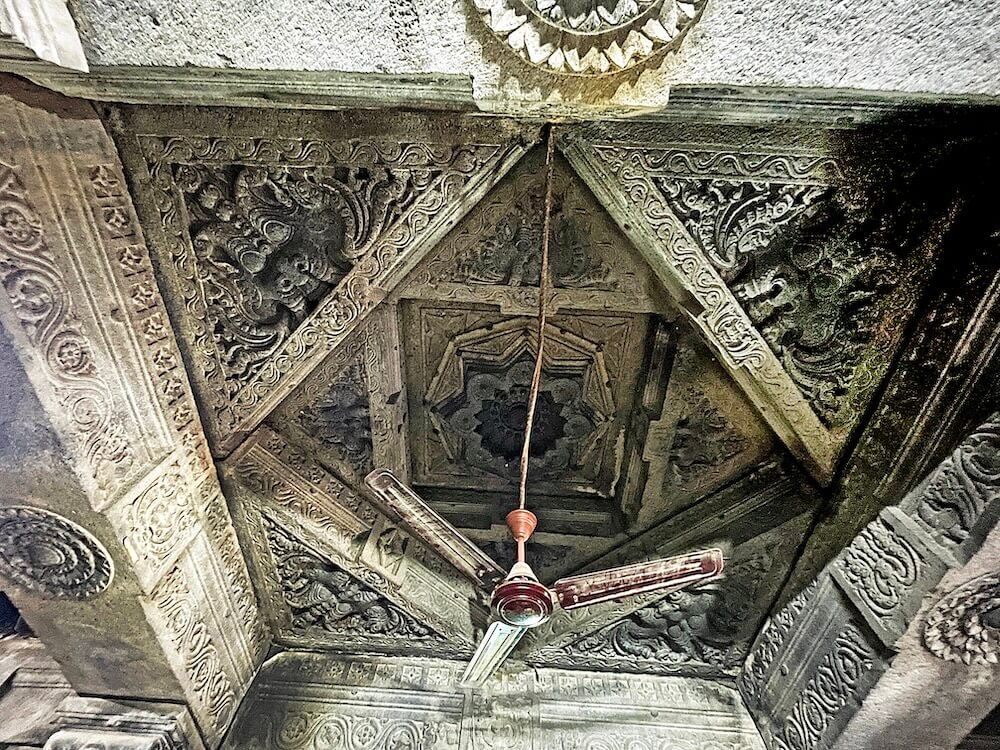
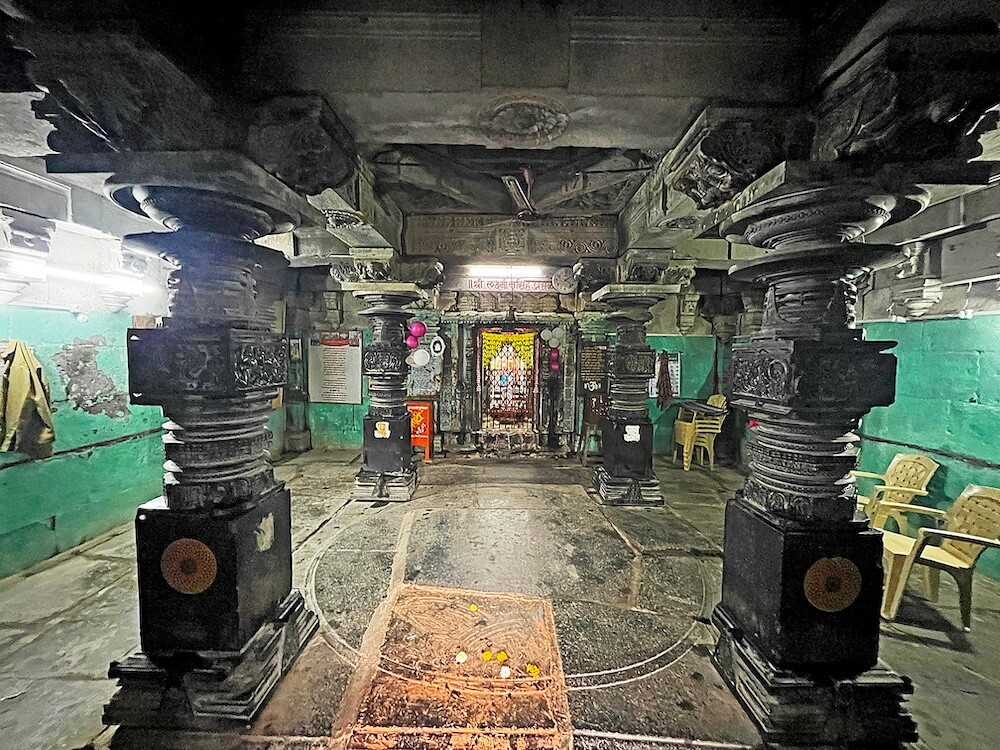
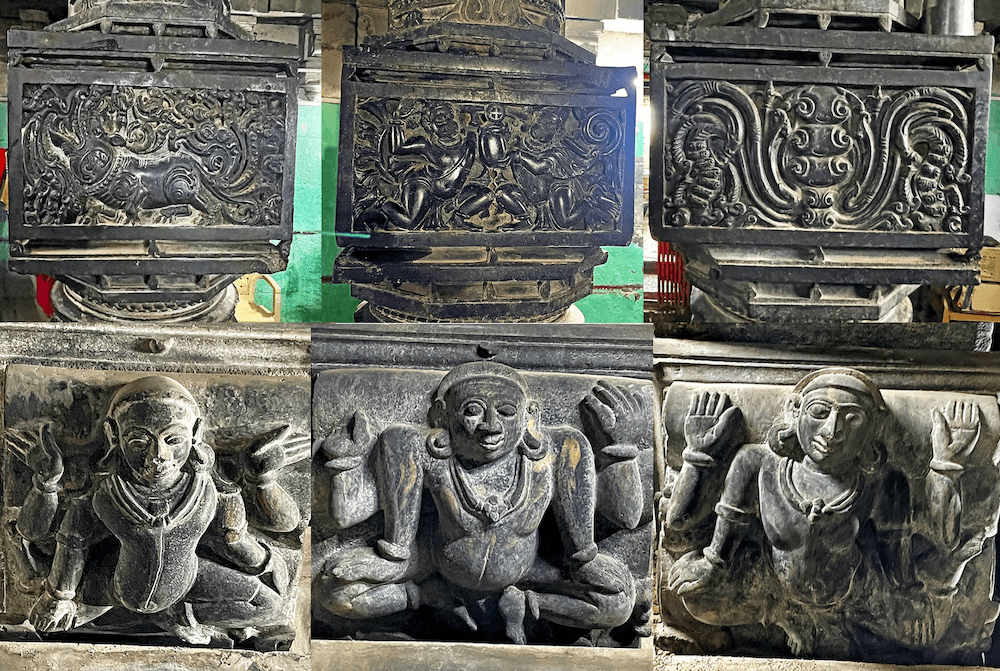
The Sabhamandapa features four rows of four intricately carved pillars each. The outer pillars are integrated into the walls. The pillar bases are broad and square. The lower approximately three feet of the pillar shafts are square. The upper parts are in various geometric shapes such as circular, hexagonal, or octagonal. The square sections of the pillars are carved with diverse patterns, Kirtimukha (face of glory), Makarmukha (crocodile face), and Mayurayugala (pair of peacocks) sculptures. At the top of the pillars are brackets (kani) supporting corbels (hasta). Beams rest on the corbels, and the roof rests on the beams. The brackets, corbels, and beams are all intricately carved. Yaksha sculptures adorn the corbels, appearing to support the roof with their raised hands. The ceiling (vitana) features a circular pattern with a stone chandelier in the center. In the middle of the four pillars in the Sabhamandapa, there is a circular ‘Rangshila’ (colored stone slab) a few inches high on the floor. The enclosed Sabhamandapa has windows (gavaksha) for ventilation.
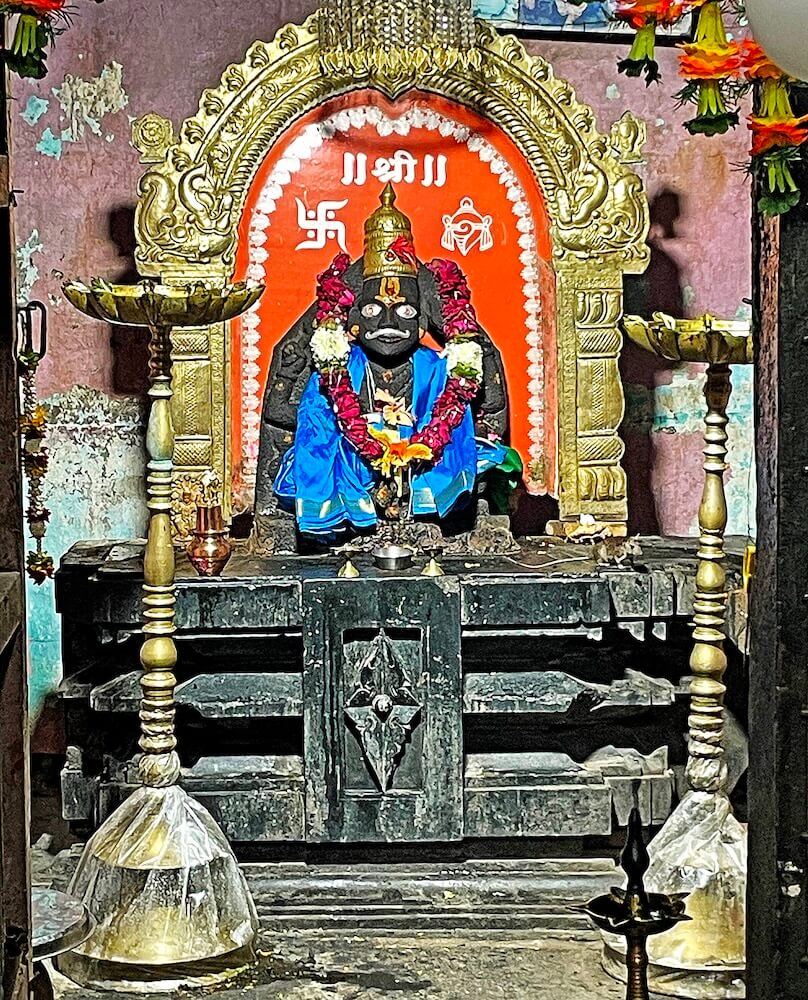
Further ahead is the entrance to the Antarala. The door jambs of this entrance are adorned with leaf and flower motifs. A deity sculpture is on the lintel. The pillar-jambs have projecting balconies, and miniature temple spires are on the architrave above them. The threshold (mandaraka) has a moonstone (chandrashila). The entrance to the Garbhagriha here is similar in design to the Antarala entrance. Inside the Garbhagriha, on a Vajra Pitha (diamond pedestal), is a four-armed idol of Lord Narsimha in the Padmasana (lotus posture). The idol holds a conch, discus, mace, and lotus in its hands. Silver eyes and a mustache adorn the idol. A golden crown rests on its head. On the prabhavali (aura) behind the idol, there are pillar carvings on both sides and a Makara Torana (archway with mythical sea creatures) at the top. The torana features conch, discus, flag, and lotus sculptures. The Vajra Pitha and the idol are crafted from black stone. The Vajra Pitha is adorned with floral carvings. In the Garbhagriha, in the rear wall, there is a square and narrow window-like opening. Beyond it, in a hollow chamber, is said to be the samadhi (tomb) of the deity’s devotee, Maindev Prabhu.
This Ekajangha (single-band) structured temple stands on an Adhishthana (plinth) approximately four feet high. The Adhishthana has six layers: Adhahpada, Kani, Pushpathara, Upana, Kumbha, and Manchi. The outer walls feature layers of leaf, flower, and geometric patterns. The roof has a projecting balcony on all four sides, with water spouts (pranale) to drain rainwater. The square shikhara (spire) above the Garbhagriha is of the Phansana type, resembling a tapering pyramid. At the apex is an Amalaka (fluted disc) topped with a Kalasha (finial). Although the shikhara on the original temple is ancient, it is believed to have been constructed in a later period.
Near this temple is the Khadkya Narsimha Devsthan. The rock into which Lord Narsimha disappeared and the Narsimha idol are located here. This spot is usually submerged under the river water. It can be seen when the water recedes in April and May. Close by is the ancient eleventh-century Yoga Narsimha Temple, but it is completely neglected. The structure of this temple is similar to that of the Bhog Narsimha Temple. The deity’s idol here is in a yogic posture. In a deep pool within the riverbed is the Agnya Narsimha shrine. It is entirely submerged underwater. This shrine never emerges from the water. The villagers here say that if Agnya Narsimha were to emerge from the water, a calamity could befall the world. The Chakradhar Swami Math and the birthplace of Saint Balgir Maharaj are also nearby.
At the temple, the main annual festival of Nṛsiṁha Jayantī is celebrated with great devotion and enthusiasm. During this time, various religious programmes such as bhajans, kīrtans, music, and mahāprasāda are organised at the temple. Many devotees visit the temple during the festivals for darśana of the Lord and to fulfil their vows.
Navratri, Maha Shivratri, Annual Temple Jatra & Deepotsav
Compare and book flights, secure top-rated local hotels near the temple, hire reliable guides, and rent cars instantly.
Extend your pilgrimage by visiting other highly sacred temples located nearby.


Add ₹999 more to unlock FREE SHIPPING!
Your sacred cart is currently empty.
Shop Photo FramesFill in your delivery details below to place your order.
Add comment