
Add ₹999 more to unlock FREE SHIPPING!
Your sacred cart is currently empty.
Shop Photo FramesIn Hindu Dharma, places sanctified by the touch of deities, sages, saints, and great souls are considered sacred pilgrimage sites. Among these, pilgrimage sites and temples situated on the banks of rivers are held in special regard. One such ancient temple is located on the banks of the Godavari River in the Nanded district. This temple, with its exquisite stone masonry in the Hemadpanti style, is famous throughout the region. It is believed that Sage Markandeya performed penance here, and pleased by his devotion, Mahadeva appeared before him to grant him darshan. Consequently, devotees hold a deep faith that this Jagrut (awakened) Mahadeva responds to the calls of his devotees and fulfills their vows.
Villagers state that this temple, located two kilometers from Markand village, dates back approximately one thousand years. According to ancient legend, when Sage Markandeya, born to Sage Mrikandu and Marudvati, learned that he was destined for a short life, he pleased Mahadeva and was granted a lifespan of seven Kalpas. (According to Hindu Puranas, one ‘Kalpa’ is equivalent to one day of Lord Brahma. In human calculation, this amounts to 4,32,00,00,000 years.) According to another legend, a great debate took place in an assembly of gods and sages on the subject of ‘Whether Karma is superior or Knowledge’. At that time, Sage Markandeya firmly expressed the opinion that ‘Karma is superior’. However, to reach a final decision on this dispute, all the gods sought the intervention of Mahadeva. Ultimately, Mahadeva ruled that Sage Markandeya’s assertion was correct. It is said that this divine assembly was held on the banks of the Godavari River, at the very site of the current temple.
The temple is situated on the banks of the Godavari River. There is a paved road leading up to the temple, and a parking area is available. From the parking area, there are approximately 25 steps leading to the temple courtyard. There are stainless steel railings on both sides of the steps. Additionally, a central railing divides the steps into separate paths for ascending and descending. In the clean courtyard paved with paver blocks, to the left of the stairway, there is an ornate Tulsi Vrindavan on a five-tiered pyramid-like pedestal. There are lamp niches (deep-koshtakas) in the walls of the pedestal and the Vrindavan. This spacious courtyard has seating for devotees. The Markandeshwar Temple stands in front of the Tulsi Vrindavan, with an ancient Shiva temple to the side.
The Markandeshwar Temple stands on a plinth (adhisthana) that is higher than the courtyard level. The temple structure consists of a Mukhamandapa (entrance porch), a Sabhamandapa (assembly hall), and a Garbhagriha (sanctum sanctorum). The Mukhamandapa has railings on both sides with pedestals adjacent to them. There are ornate half-pillars on the railings on both sides of the Mukhamandapa. The pillar bases are circular, and the shafts are of various geometric shapes such as hexagonal, octagonal, and square. Above the pillars are circular moldings (kani) and brackets (hasta). On the brackets rest the beams, and above the beams is a roof that slopes downwards towards the front.
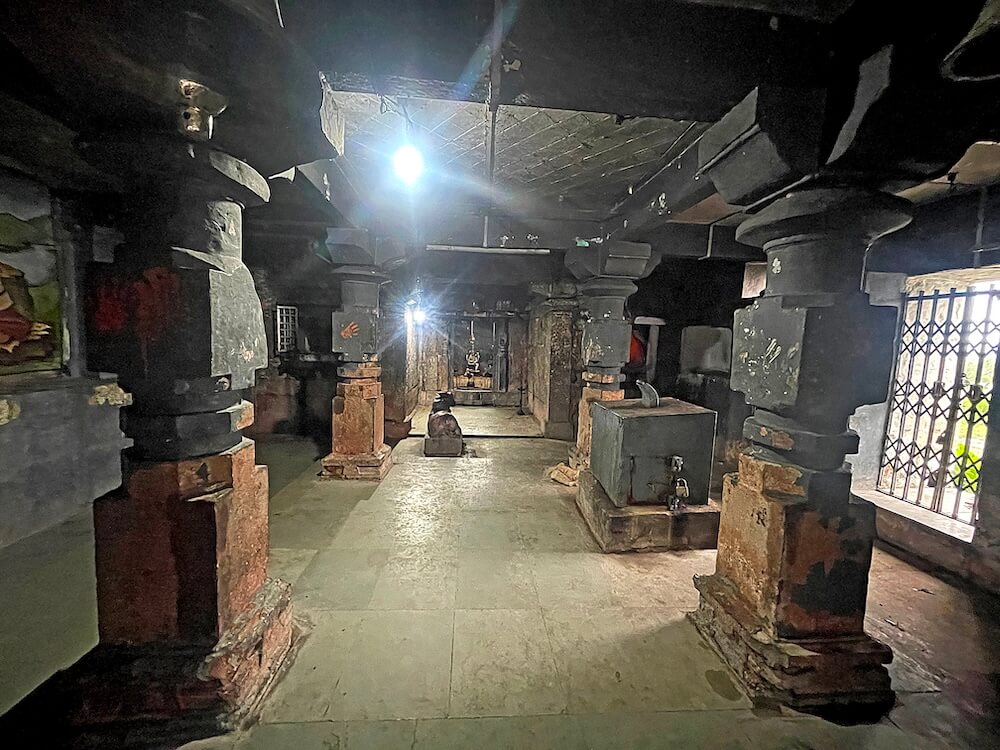
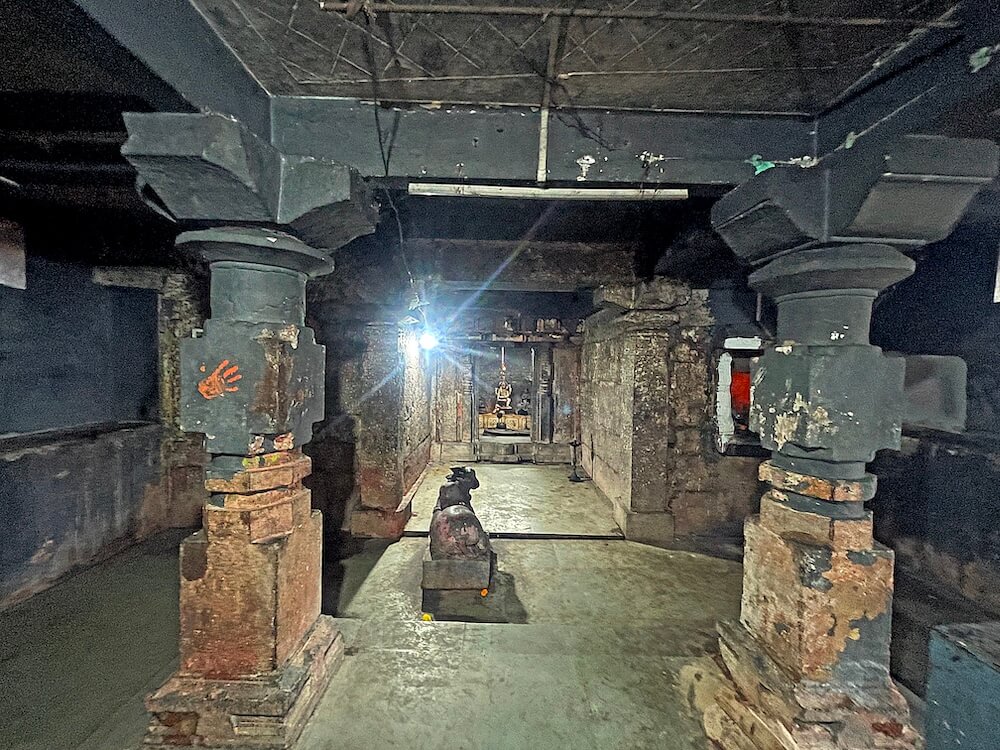
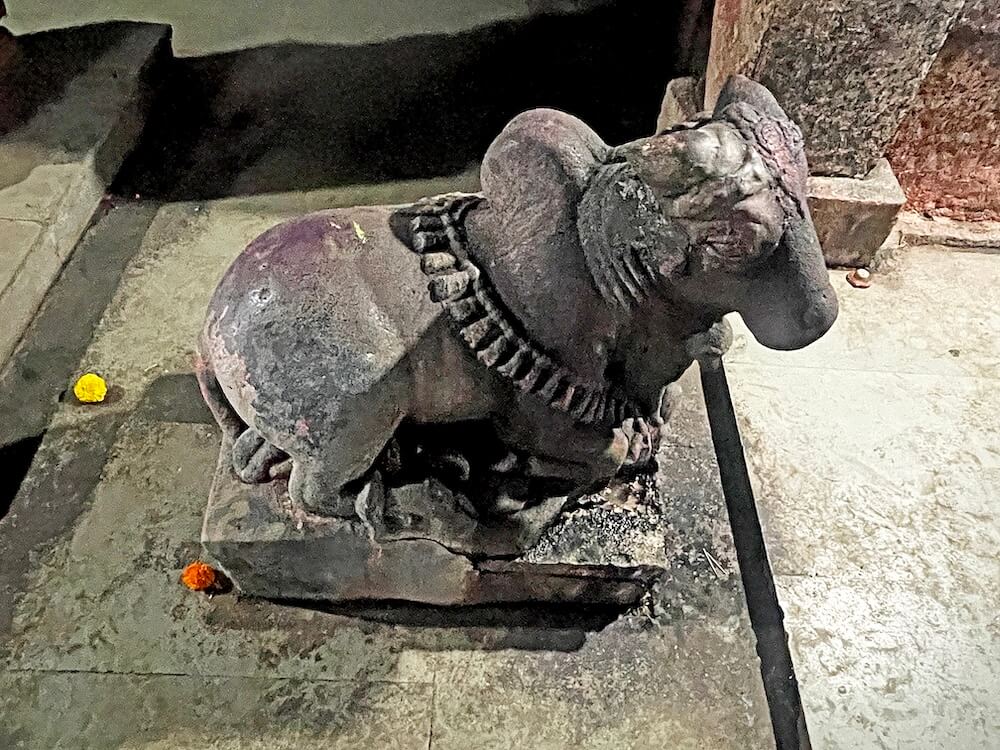
Further ahead is the entrance to the Sabhamandapa. This entrance has iron grilled sliding doors. Inside this enclosed Sabhamandapa, there are four rows of four ornate pillars each. The outermost pillars are embedded in the walls. The lower three feet of the pillars are square, while the upper parts are of various geometric shapes like square, hexagonal, octagonal, and circular. At the top, there are circular moldings and brackets. In the center of the Sabhamandapa, on a Vajrapitha (throne), is a black stone idol of Nandi. On the right side, on a pedestal, is an iron donation box (hundi).
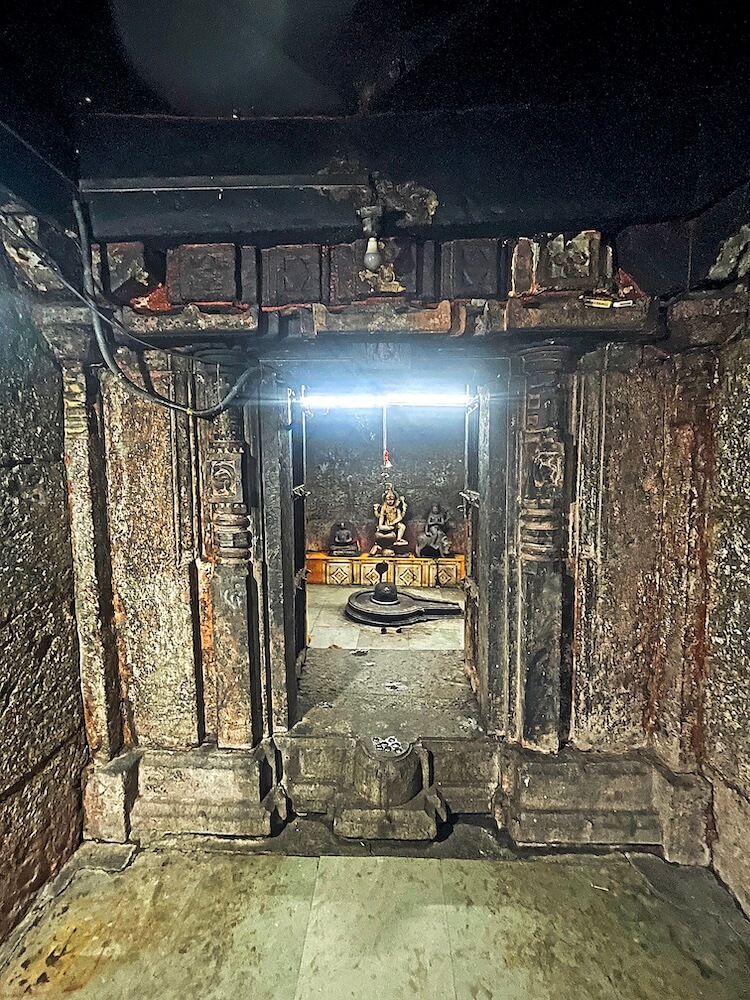
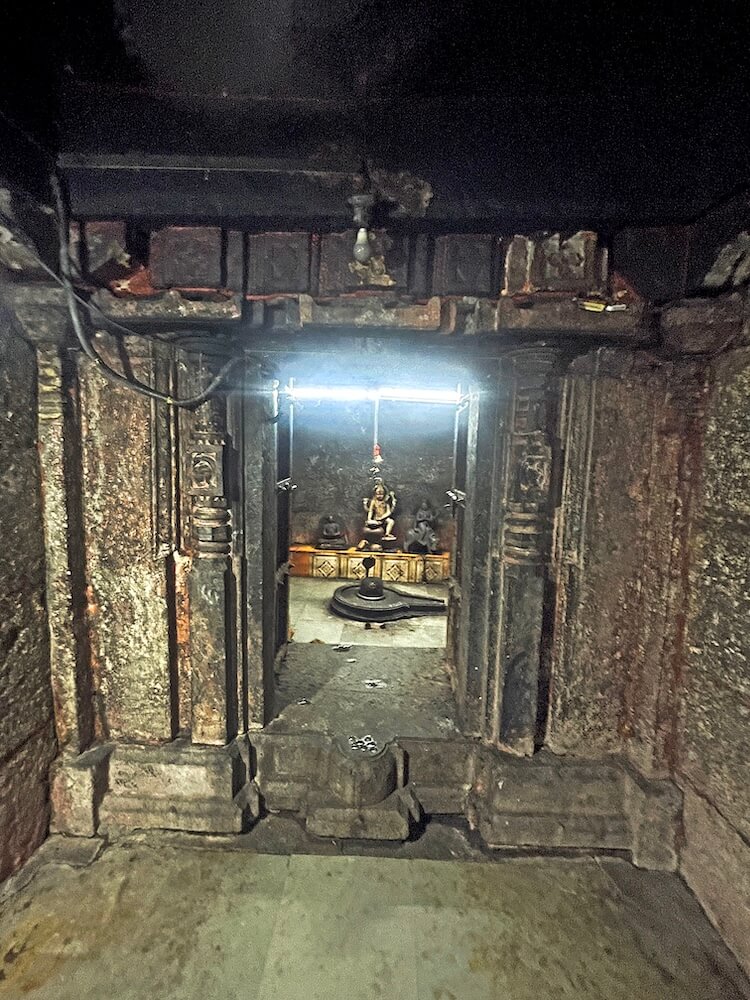
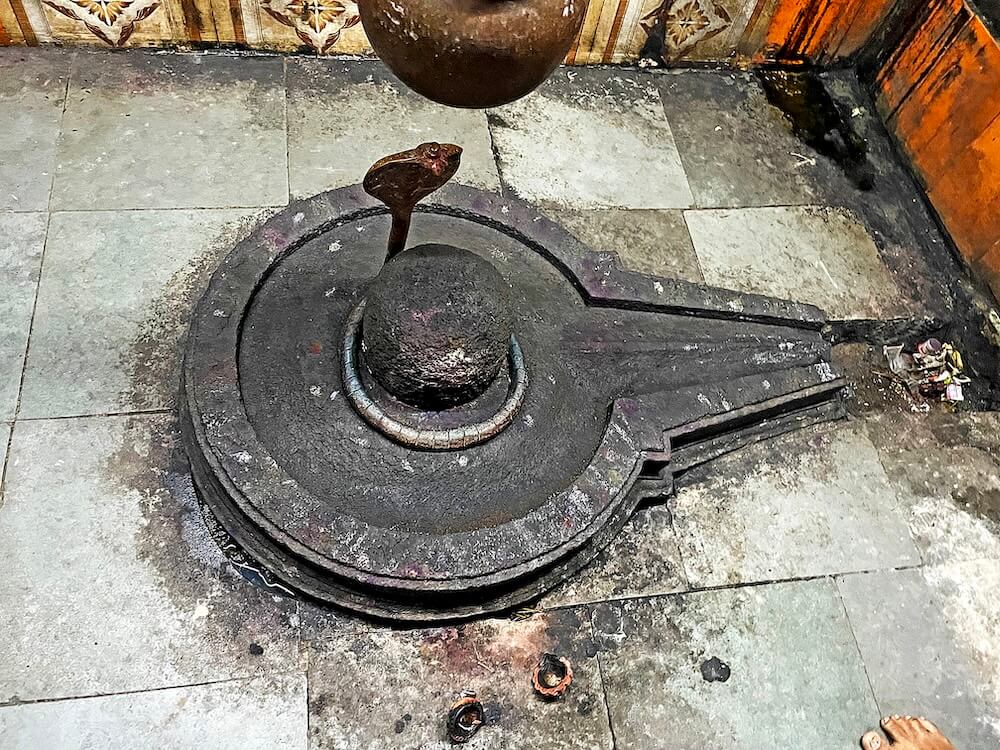
Further ahead is the entrance to the Antarala (vestibule). On both sides of the entrance are square, ornate pillars. Beside the pillars are niches for deities. In the right-side niche is an idol of Ganapati, and on the left are idols of Vitthal-Rukmini. Beyond the Antarala is the entrance to the Garbhagriha. The door frames are carved with floral and leaf motifs. On the lintel (lalatabimba) is an idol of Ganapati, and the architrave is decorated with floral carvings. Above the ornate pillar branches is a balcony (sajja), and on the threshold is a moonstone (chandrashila). In the center of the Garbhagriha, on the floor, is the Shiva Linga. Above the Shiva Linga is a five-hooded brass serpent holding a canopy. A vessel for performing Abhisheka (ritual bathing) is suspended from the ceiling. Near the back wall of the Garbhagriha, on a Vajrapitha, is a sculpture of Sage Markandeya in a meditative posture, holding a Shiva Linga in his hands. Beside it is an idol of the child Sage Markandeya embracing the Shiva Linga. In this sculpture, Mahadeva is depicted with his hand placed on the sage’s head. Next to this idol is an image of Yama seated on a buffalo. On the roof of the Mukhamandapa is a square Shikhara (spire) with four ornate pillars. On the front wall of the Shikhara, there are lotus carvings and a niche containing an idol of Ganapati. The temple roof has a protective railing on all four sides. In the six niches on the front side, there are idols of deities including Ganapati, Mahadeva, Rama, and Krishna.
Adjacent to the Markandeshwar Temple is another ancient Shiva temple. This temple is structured with a Sabhamandapa, Antarala, and Garbhagriha. The Sabhamandapa has four rows of four ornate pillars each. On the ceiling, there is a circular carving with a stone chandelier in the center. From the Antarala, one proceeds to the entrance of the Garbhagriha. On both sides of the Garbhagriha entrance are ornate pillar branches, and on the lintel is an idol of Ganapati. The architrave above the doorway is carved with sculptures of various deities. One must descend three steps to enter the Garbhagriha, which is at a lower level than the Antarala. In the center of the Garbhagriha, on the floor, is the Shiva Linga. Near the temple parking area, on the banks of the Godavari River, there is a built-up ghat with steps.
Mahashivratri is the main annual festival celebrated in the temple with great enthusiasm. During the annual festival and on all Mondays of the month of Shravan, Laghurudra and Maha-Abhisheka are performed for the deity. Throughout the day, programs such as Bhajans, Kirtans, and music are organized in the temple. On these occasions, hundreds of devotees from the surrounding five-village radius come here for the darshan of the deity and to fulfill their vows.
This sacred temple stands as a testament to deep spiritual devotion, ancient architectural grandeur, and rich local cultural traditions.
The sanctum sanctorum houses the divine idol consecrated according to ancient Vedic traditions, surrounded by serene courtyards and traditional temple architecture.
Navratri, Maha Shivratri, Annual Temple Jatra & Deepotsav
Compare and book flights, secure top-rated local hotels near the temple, hire reliable guides, and rent cars instantly.
Extend your pilgrimage by visiting other highly sacred temples located nearby.


Add ₹999 more to unlock FREE SHIPPING!
Your sacred cart is currently empty.
Shop Photo FramesFill in your delivery details below to place your order.
Add comment