
Add ₹999 more to unlock FREE SHIPPING!
Your sacred cart is currently empty.
Shop Photo Frames‘Atri’ signifies a state beyond the three Gunas (Trigunatita), and ‘Anasuya’ signifies a mind free from jealousy; knowledge is born from these qualities. Hence, Dattatreya is considered the embodiment of knowledge, and for this reason, the Dattatreya Avatar is regarded as the eternal incarnation of the Supreme Lord. This is also known as the Avinash (indestructible) Avatar. The worship of the Dattatreya Avatar has been practiced in Goa since the sixteenth century. The Datta Mandir in the village of Sankhali is an ancient link in this tradition of worship. Known as the ‘Gangapur of Gomantak’, legend has it that Lord Datta Maharaj himself came to this place to visit his devotee.
The religiously intolerant Portuguese entered Goa in 1510. Thereafter, they committed unspeakable atrocities against the Hindus and Muslims here. They demolished temples and mosques and forcibly converted many. Historian Dr. Pandurang Sakharam Shenvi Pissurlencar, who was the Director of the Archives department during the Portuguese regime, published a comprehensive list of temples destroyed by the Portuguese in the provinces of Tiswadi, Salcete, and Bardez between 1540 and 1567. Not a single temple of Dattatreya was included in that list. The Portuguese destroyed the temples in Salcete in 1567. Subsequently, they imposed a ban on the construction of temples. However, even after this, there is a mention in Portuguese records of a Datta Mandir in Keloshi, Salcete. The record states, ‘In the village of Keloshi in Salcete, there is a field named Amba-set. It was donated to the Dattatreya temple by Mhalu Shenvi.’ That document is dated 1 September 1583. This is an important record of Dattatreya worship in Goa. Around the year 1569, the Jesuits in the island of Goa summarized some Marathi religious texts into the Portuguese language. ‘Yogaraja Tilak’ was one such text. This text is referred to as a Dattatreya scripture. In the book ‘Devbhumi Gomantak’, temple scholar Vinayak Narayan Shenvi Dhume has expressed the opinion that Dattatreya worship spread significantly in Gomantak in the centuries that followed.
The construction of the Datta Mandir at Sankhali began in 1881-1882. According to Shenvi Dhume’s book, the idol of Dattatreya was consecrated here on 5 April 1882 (Chaitra Vadya Dwitiya, Shake 1804). The legend regarding this temple is that a devotee of Lord Vitthal named Mhalu Kamat lived in Sankhali at that time. He had performed penance in Pandharpur for a year. His son, Laxman Mhalu Kamat, was a devotee of Dattatreya. Every year, he would go to Narsobawadi to recite the Gurucharitra. Because he belonged to the Gaud Saraswat caste, some people at Narsobawadi would insult him from time to time. They would unnecessarily interrupt his bhajans and worship, causing him distress. Yet, the devotee Kamat did not allow any break in his service. Once, while he was sitting in the corridor of the temple at Wadi reading the Gurucharitra, some other devotees of Dattatreya insulted him unbearably by speaking nonsense without any reason. Deeply saddened, Kamat burst into tears. Words involuntarily escaped his lips: ‘O merciful Guru Maharaj, You are omniscient. I consider today’s insult to me as an insult to You.’ That same night, he had a vision of Datta Guru in a dream. In it, Datta Guru told him, ‘Do not worry. All your desires will be fulfilled. Soon, I will come to your village.’
Around this time, a woman named Mathurabai Yesu Bodke from Sankhali, in memory of her late husband, had an Audumbar tree planted with due rituals through the family priest, Rameshwar Bhatt Pitre. Previously, there was a cremation ground at this site. Over time, it was decided to build a platform around the tree. As the money given by Mathurabai was insufficient, Laxman Kamat provided the remaining funds. While digging the foundation for that platform, a golden snake, a pair of silver padukas (footprints), and idols of Maruti and Ganesha were found. The priest took the golden snake. The pair of padukas was kept in the presence of the deity, and since the Maruti and Ganesha idols were broken, they were immersed in the river. The construction of this platform was completed on Ashwin Krishna Dwadashi, Shake 1801 (1879 AD). Later, Laxman Kamat and other villagers collected donations and built a sanctum sanctorum right next to this platform. A black stone idol of one-faced Dattatreya in Kurmasana (tortoise posture), brought from a sculptor in Bori, was installed here. After this, the villagers decided to build a large temple for Datta here. During this period, Laxman Kamat’s brother, Vasu Kamat, once had a dream. In it, a Sannyasi said to him, ‘I am tired from crossing the Sahyadri mountains. Show me a quiet place to rest.’ To this, Vasu Kamat told the Sannyasi, ‘You will be comfortable at the homes of the Brahmins here.’ However, the Sannyasi refused and chose the spot near the Audumbar platform. He walked there quickly and disappeared as soon as he reached it. Vasu Kamat told this dream story to Laxman Kamat. Realizing that this Sannyasi was none other than Datta Maharaj himself, Laxman Kamat said, ‘Datta Maharaj has chosen the site for the temple.’ Subsequently, a grand temple of Datta was erected at this place. During this construction, a shortage of wood materials arose. At that time, the then Portuguese Governor General of Goa, Rafael Andrade, ordered the forest officials to provide 30-40 trees to the temple, thus resolving the problem. The woodwork in this temple was done by a carpenter named Pandurangji from the village of Bandivade. The construction of the temple cost eight and a half thousand rupees at that time. A new idol made of white marble was brought from Mumbai for this temple. The ceremony of the temple’s establishment took place from Chaitra Shukla Purnima to Chaitra Vadya Dwitiya in the Chitrabhanu Samvatsara, Shake 1804. On this occasion, along with the idol of Datta, the Shri Padukas, as well as idols of Ganapati, Maruti, and Annapurna Devi as family deities, were installed.
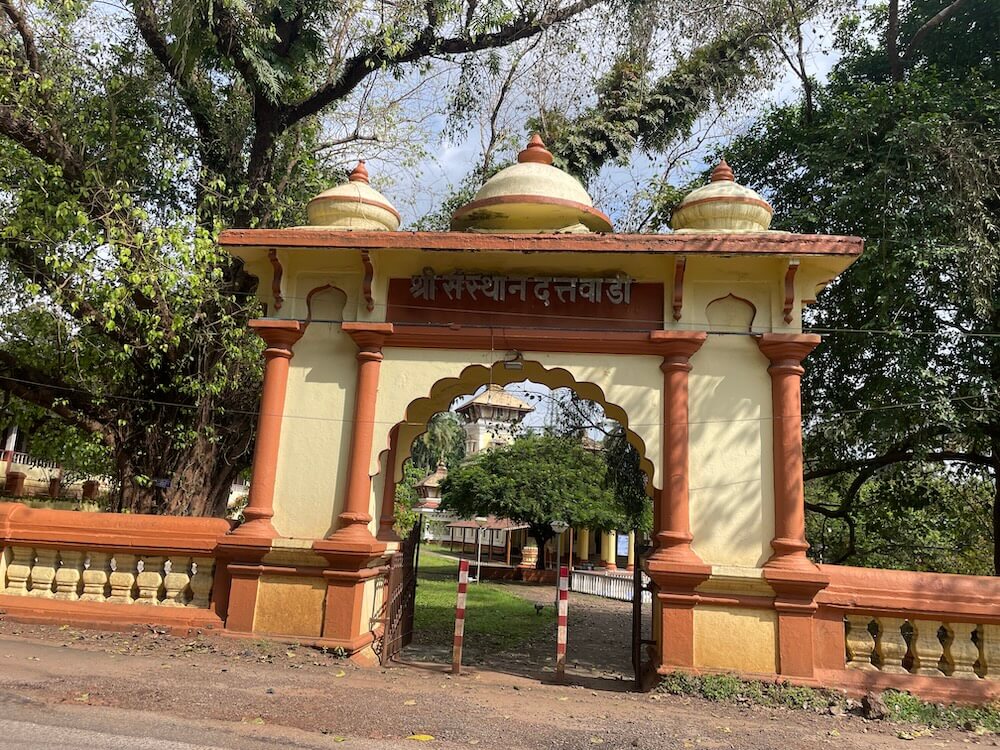
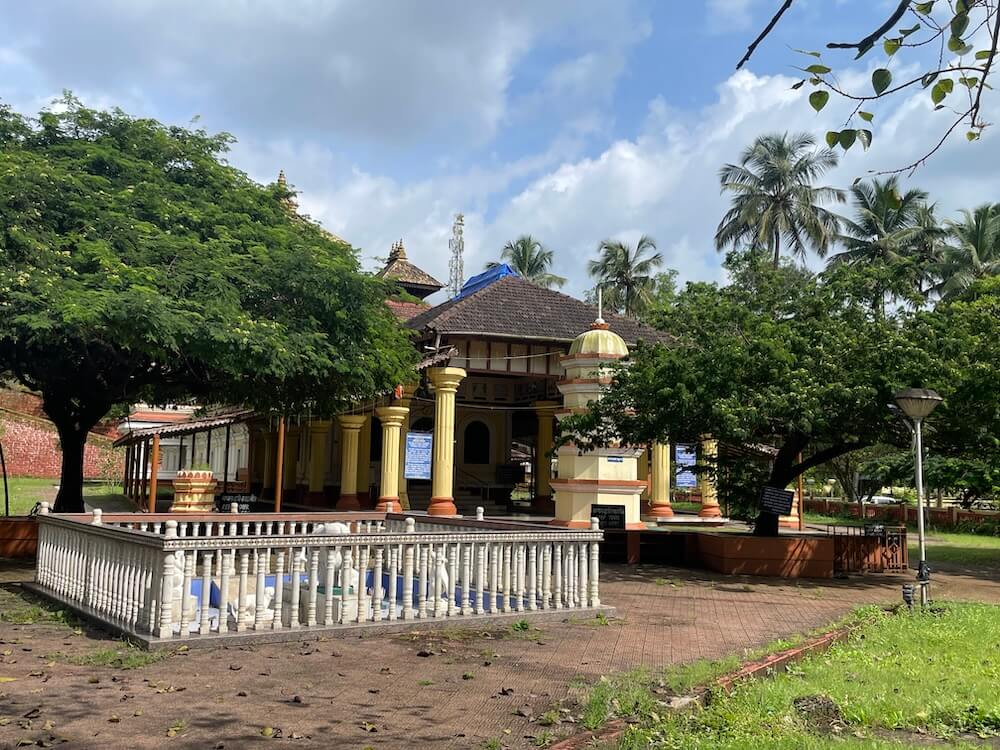
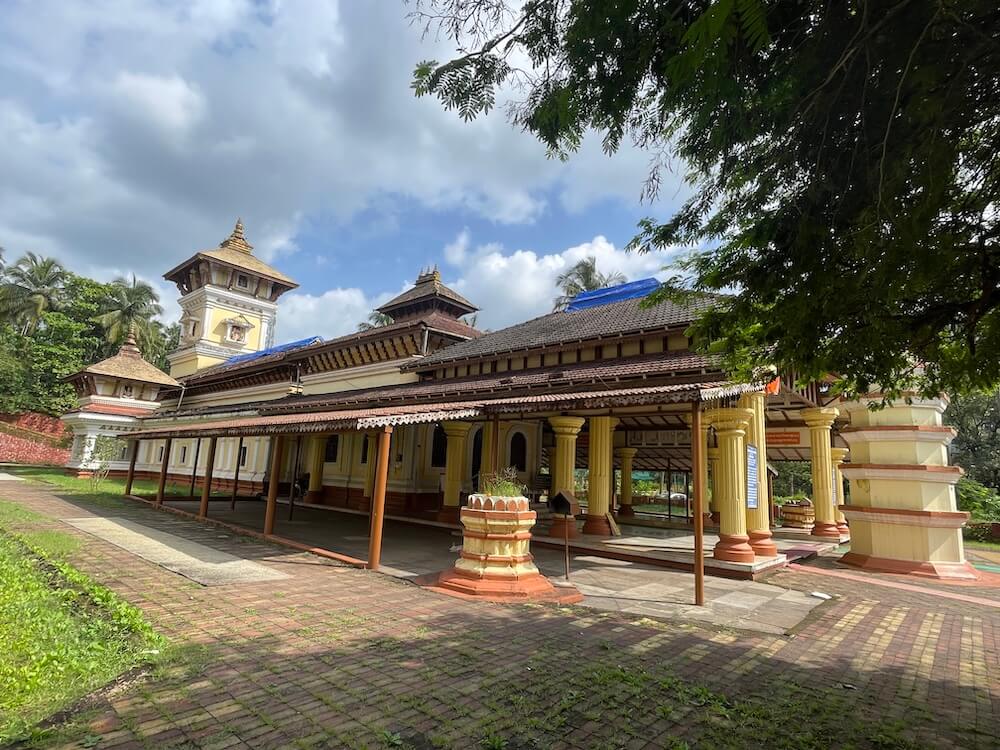
This temple of Dattatreya is situated in a large area known as Dattawadi on the Mapusa-Bicholim road. The premises have a large entrance gate with an arched archway. As one moves forward from here, there is a small square-shaped pond in front. In it, there are sculptures of a Kapila cow bowing to the padukas of Datta Guru, as well as dogs. The cow accompanying Datta Guru is considered a symbol of the Earth, while the dogs are considered symbols of the Vedas. This memorial sculpture has been erected in memory of the centenary celebration of the Datta Mandir. It is said that the concept for this was by the poet laureate B. B. Borkar, known as ‘Bakibab’.
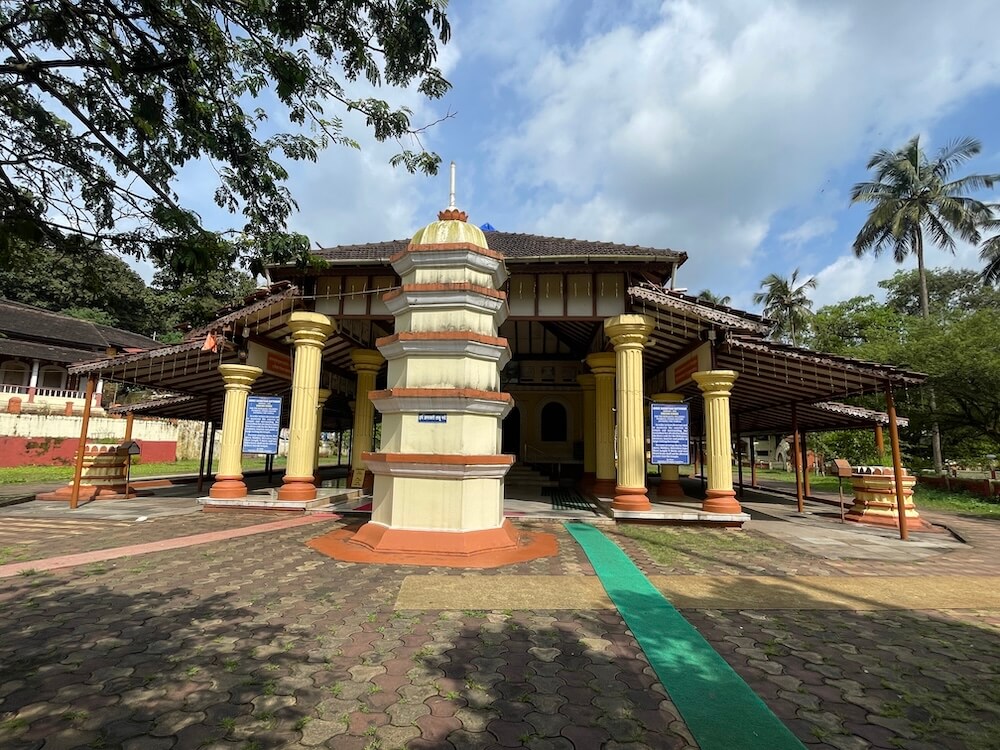
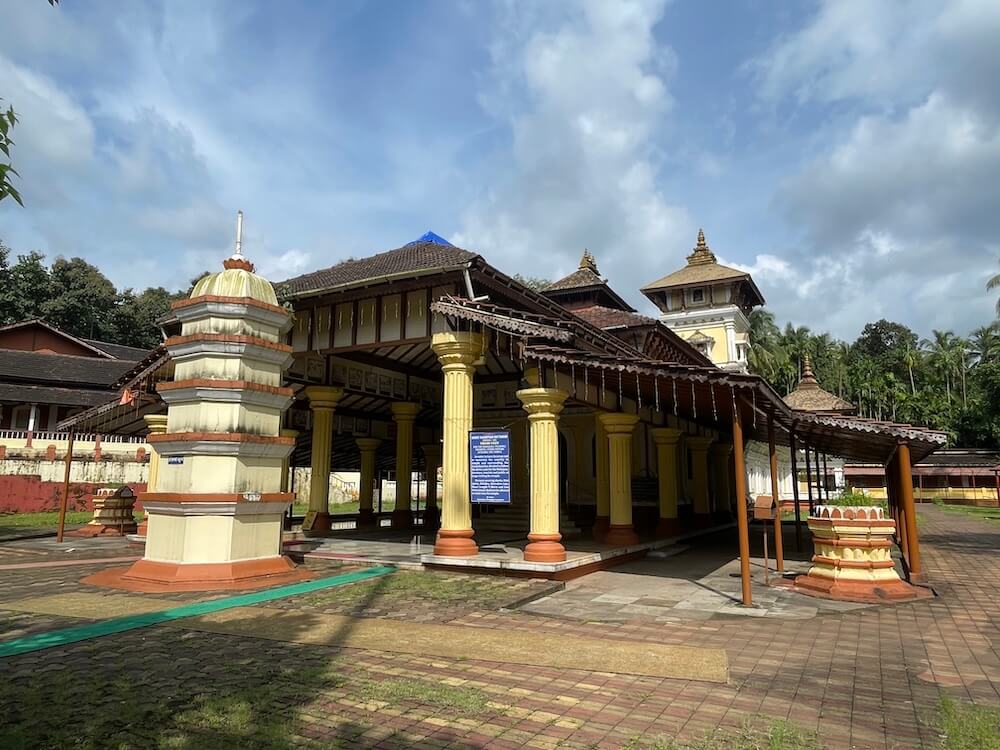
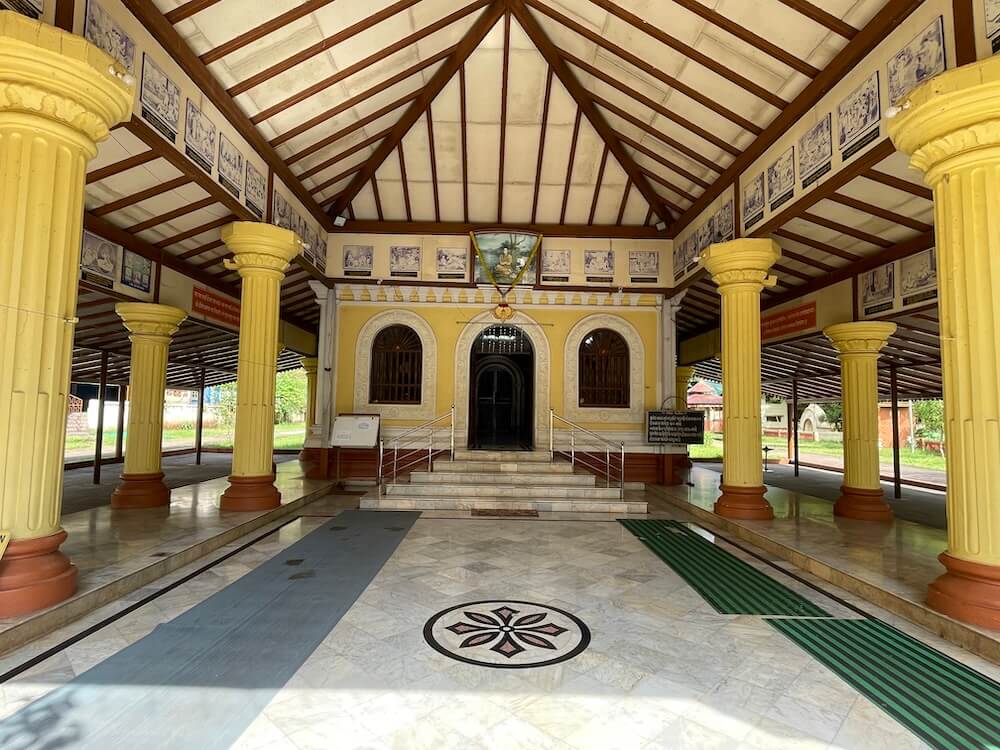
Near this memorial sculpture stands a small lamp pillar. In front of it stands the grand temple of Dattatreya. The temple structure consists of a spacious open-style assembly hall with a sloping tiled roof, two large semi-halls, and the sanctum sanctorum. On the ceiling of the assembly hall, several black-and-white paintings depicting the life of Dattaguru are displayed. From here, one enters the main semi-hall of the temple. Above the arched entrance of this semi-hall, a beautiful painting of Dattaguru in an ascetic guise is placed. This semi-hall is paved with marble tiles and features a beautiful chandelier on the ceiling. Beyond this is another large semi-hall. In the upper part of its entrance, there is a three-faced idol of Dattaguru in the center, with a Kirtimukh above it. In the middle of the semi-hall, there is a row of wide, circular pillars connected to each other by large arches. On one side here, the palanquin of Dattaguru is kept. A large brass bell and several glass lanterns are hung from the ceiling.
In the niches on the front wall of the sanctum sanctorum, there are idols of Ganesha and Shankara. The entrance to the sanctum is adorned with intricate carvings. At the base of the door pillars, figures of gatekeepers are carved, while an idol of Ganesha is placed at the lintel. Above that is a Kirtimukh. Inside, on a high pedestal, the three-faced idol of Dattatreya, sculpted in marble stone, is enshrined. The spires of this temple are distinctive. Here, the semi-hall has entrance porches on the left and right sides. Above these are large spires with roofs sloping in all four directions. The sanctum sanctorum of the temple has a three-tiered, square-shaped spire structure. It features a tiled roof sloping in all four directions, topped with a pinnacle. Behind the temple, a large platform has been built around an Audumbar tree.
Festivals such as Ram Navami, Narasimha Saraswati Jayanti, Vijayadashami, Guru Dwadashi on Ashwin Vadya १२, and Tripuri Purnima on Kartik Shuddha Purnima are celebrated with great enthusiasm in this Dattatreya temple. During festivals and on every full moon day, a palanquin procession is held here. In this procession, the deity’s palanquin is taken out at १०:३० at night. On days like Guru Dwadashi, Guru Pratipada, Datta Jayanti, and the temple’s anniversary, the deity’s idol is carried in a silver palanquin, while for other festivals, it is carried in a wooden palanquin. Datta Jayanti is the largest festival here. This celebration begins from Margashirsha Shukla Saptami. Until the full moon day, a Kirtan program is held here every night. On the day of the full moon, the ceremony of the birth of Datta takes place in the evening. On the occasion of this festival, cultural programs like Lalita are also performed. Thousands of devotees from Goa, as well as Karwar and Konkan, participate in this festival.
This sacred temple stands as a testament to deep spiritual devotion, ancient architectural grandeur, and rich local cultural traditions.
The sanctum sanctorum houses the divine idol consecrated according to ancient Vedic traditions, surrounded by serene courtyards and traditional temple architecture.
Navratri, Maha Shivratri, Annual Temple Jatra & Deepotsav
Compare and book flights, secure top-rated local hotels near the temple, hire reliable guides, and rent cars instantly.
Extend your pilgrimage by visiting other highly sacred temples located nearby.


Add ₹999 more to unlock FREE SHIPPING!
Your sacred cart is currently empty.
Shop Photo FramesFill in your delivery details below to place your order.
Add comment