
Add ₹999 more to unlock FREE SHIPPING!
Your sacred cart is currently empty.
Shop Photo FramesShrī Tulajā Bhavānī of Tulajāpur is known by various names in different scriptures, such as Tvarajā, Turajā, Tvaritā, Tulajā, and Ambā. She is the family deity of Chhatrapati Shivājī Mahārāj. A murti of Devī Bhagavatī, similar to that of this Shaktipeeth deity, is situated in the village of Khāṇḍoḷā in the Antruj Mahāl of Gomantak. The Devī’s temple here is approximately four hundred and fifty years old. The yātrā of this Devī, who is the beloved deity of many in this region, is famously known as ‘Mālyāñcī Jātrā’. Thousands of devotees participate in this yātrā, which takes place on Phālgun Shuddh Dvitiyā.
Bhagavatī is considered a form of Ādyashakti Devī. The greatness of this Devī is described in the scripture ‘Durgā Saptashatī’, which narrates the story of the Devī’s origin. It states that in ancient times, at the end of a kalpa, the entire world was submerged in water. At that time, Bhagavān Viṣṇu was asleep in yoganidrā on the serpent couch of Sheṣa. From the wax in His ears, two asuras, Madhu and Kaiṭabha, were born. Once, when they saw Brahmadev, they rushed to attack him. Brahmadev then sought refuge with Viṣṇu, but He was asleep. To awaken Him, Brahmadev began to praise Devī Bhagavatī. The Devī was pleased and, ‘from Viṣṇu’s mouth, eyes, and ears, from His stomach, heart, and arms, She emerged and gave darshan to Brahmadev at that very moment.’ In this way, Viṣṇu was freed from yoganidrā. The Devī bestowed power upon Him and ‘enchanted those asuras with Mahāmāyā’, enabling Viṣṇu to slay them.
According to the legend in the ‘Tulajā Māhātmya’ of Shrī Tulajā Bhavānī Devī, in the Kṛta Yuga, a demon named Kukkuṭa attempted to dishonour a chaste woman. At that time, she mentally invoked Pārvatī. Mother Pārvatī then appeared there in the form of Bhavānī and slew the demon Kukkuṭa. As he was dying, this demon assumed the form of Mahiṣāsura. Because the Devī slew him, She is enshrined in Tulajāpur in the form of Mahiṣāsuramardinī. This very form of Devī as Mahiṣāsuramardinī is enshrined in the temple at Khāṇḍoḷā.
The history of this temple is that in the twelfth century CE, an idol of Devī Bhagavatī in the form of Mahiṣāsuramardinī was installed in the village of Haldoṇe. It is said that the Devī’s idol was brought from Tulajāpur. In the year one thousand five hundred and ten CE, the Portuguese entered the islands of Goa. Their religious fanaticism and cruelty made life difficult for the Hindus here. The Jesuits, a sect of orthodox Christians, inflicted untold atrocities upon the Hindus. Not only scriptures and temples, but even people were burned during that time. After the establishment of the Inquisition in one thousand five hundred and sixty CE, the scale of these atrocities increased tremendously. During this period, to protect the idols in temples located in areas under Portuguese control, they were relocated. This included the idol of the Devī from Haldoṇe. In one thousand five hundred and sixty-seven CE, the Mahājans of this place secretly moved the Devī’s idol to Maye in Bicholim Talukā. The area where the idol was installed there is called Haldoṇavāḍā. This was the Devī’s first relocation. After this, the Devī’s second relocation was carried out from Maye to the village of Khāṇḍoḷā. At this time, the pañcāyatan deities Shrī Dāḍ, Rāvaḷnāth, Siddhanāth, and Lakṣmīnārāyaṇ were also relocated. In due course, a magnificent temple for the Devī was constructed here. During the Portuguese rule, in one thousand nine hundred and twenty-eight, this temple was registered under colonial laws (Regulamento Mazania). Through this, the temple received recognition from the Portuguese government.
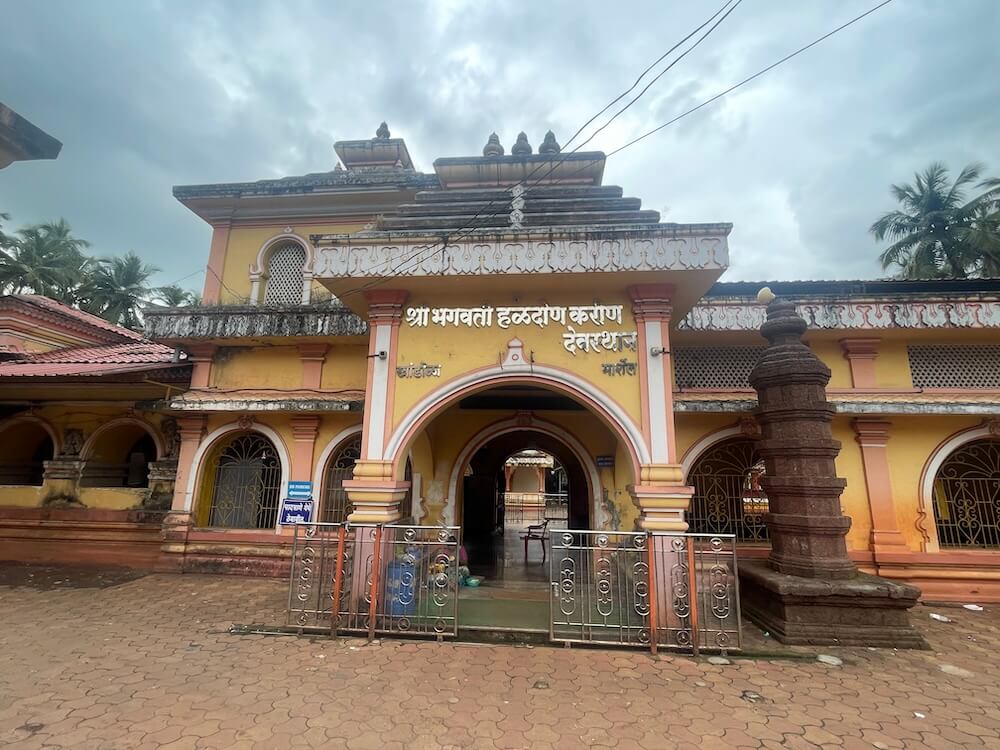
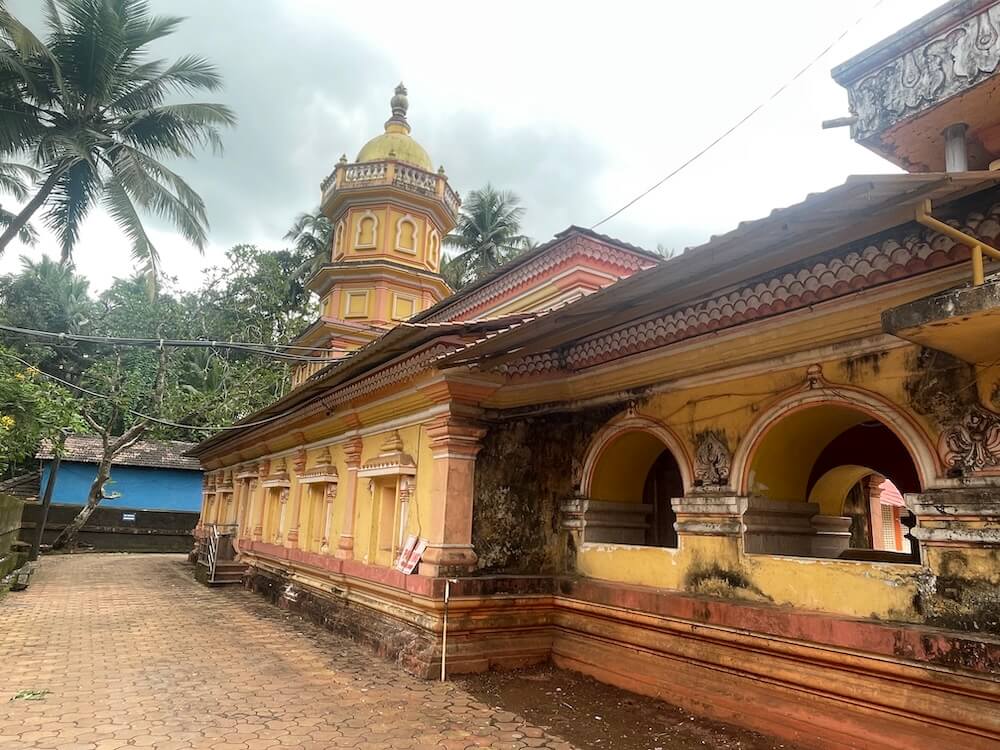
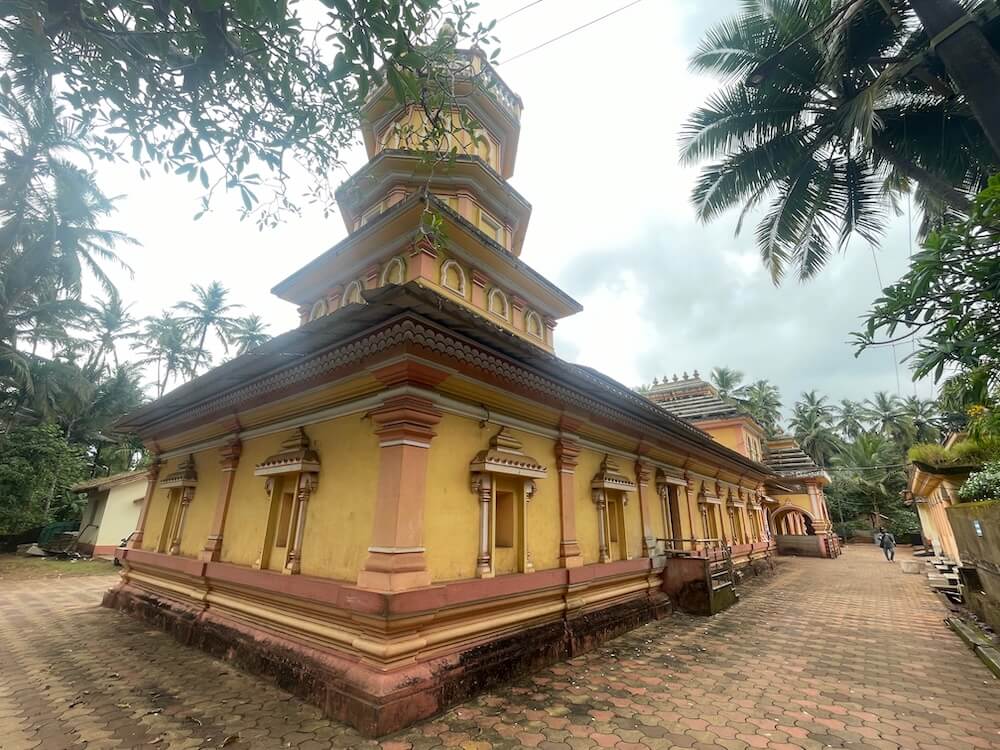
This grand temple, built in the Gomantak architectural style, has a layout comprising a Mahādvār (main entrance), Sabhāmaṇḍap (assembly hall), Ardhamandap (half-hall), Mahāmaṇḍap (grand hall), Antarāḷ (vestibule), and Garbhagṛha (sanctum sanctorum). The Mahādvār has an arched entrance and a shikhara in the style of a South Indian gopuram above it. To the right of the entrance, on a platform built of red laterite stones, stands a Dīpastambha (lamp tower). The temple’s Sabhāmaṇḍap is semi-open. The Sabhāmaṇḍap has large arched windows and entrances. Benches are arranged on the sides for devotees to sit. A small stage has been built on one side of the Sabhāmaṇḍap. The Ardhamandap has an arched entrance built of stone. On both sides of it, in niches in the walls, are idols of Dvārapālas (gatekeepers). Above the entrance is a large idol of Gaṇeśa. The Ardhamandap is of a semi-open type. There are stone benches within the broad arches of the outer walls. The Mahāmaṇḍap has an arched entrance of marble stone. Inside, at some distance from the outer walls, there is a row of circular pillars. These pillars are connected to each other by large arches. In the upper ceiling parts, images of the Devī in various forms are placed in wooden shrines. Three brass bells and a large chandelier hang from the ceiling. From the Mahāmaṇḍap, there is a pradakṣiṇāpatha (circumambulatory path) around the Garbhagṛha.
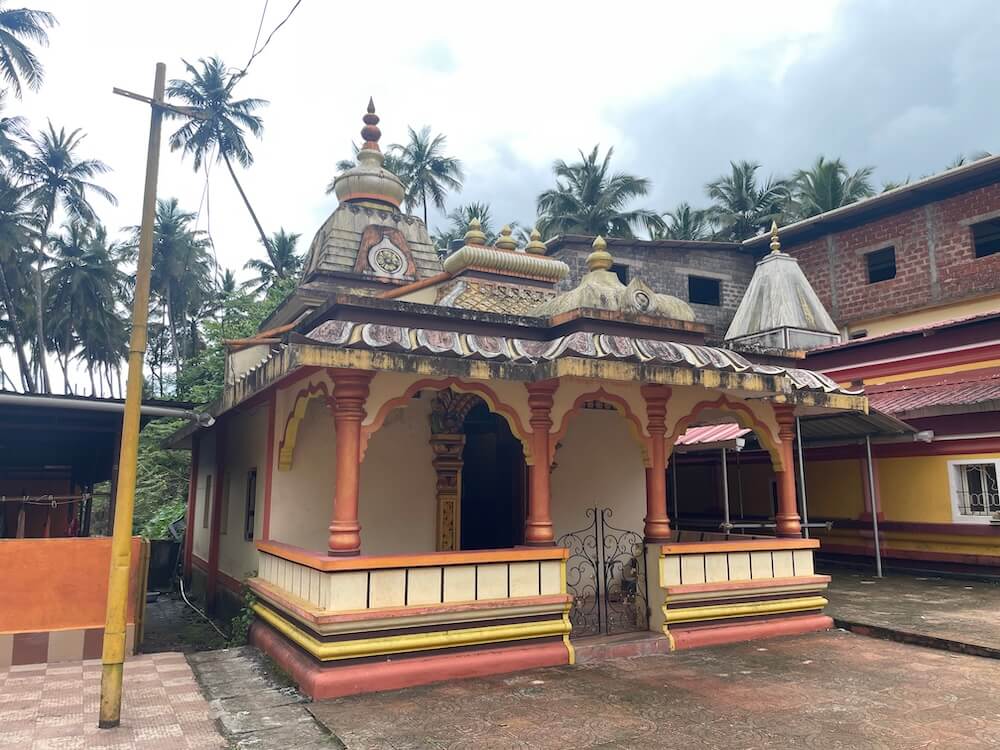
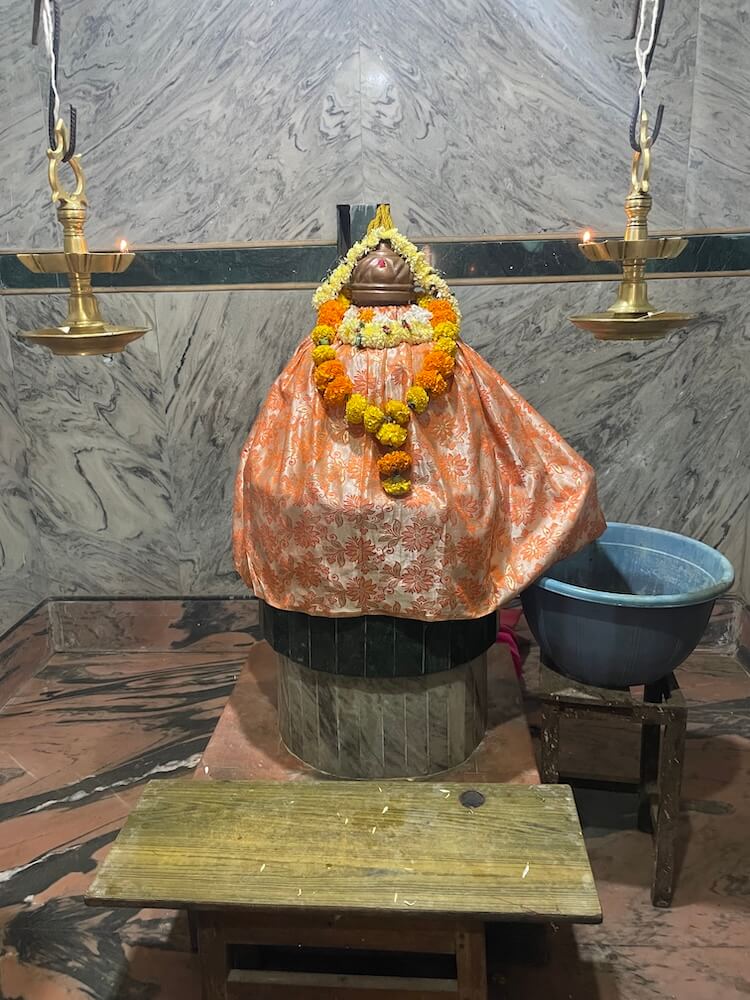
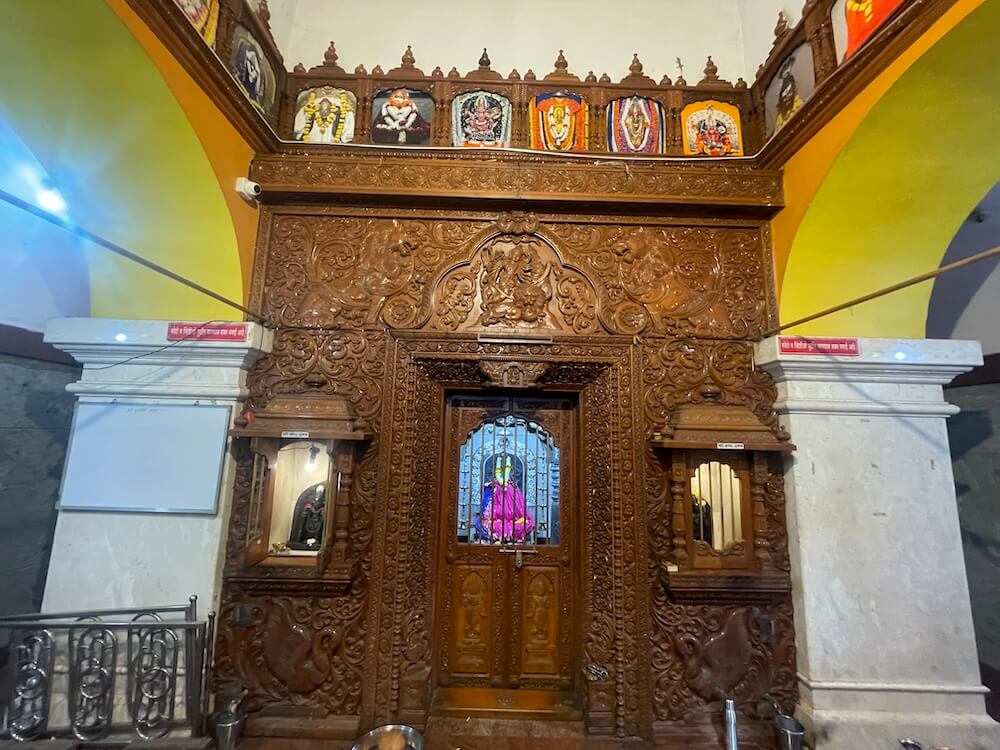
The front wall of the Garbhagṛha is entirely made of wood, with intricate carvings. At the lalāṭabimba (lintel) of the entrance is an idol of Gaṇeśa. On the uttarāṅga (upper part of the doorframe) is a wooden sculpture of Mahiṣāsuramardinī. In the wooden shrine to the left of the entrance, an idol of Khetupuruṣa is enshrined, and to the right, an idol of Grāmapuruṣa. Inside, in a large silver shrine, the Devī’s idol is consecrated on a vajrāsana. This idol, carved from black stone, is adorned with garments, ornaments, and flower garlands. Holding a shield and sword, this Devī in the form of Mahiṣāsuramardinī has a large silver prabhāvaḷī (aura) and a silver chatra (umbrella) behind Her. Kīrtimukha is carved on the Devī’s shrine as well as on the prabhāvaḷī. On both sides of the idol are tall brass samayā (lamps). To the right of the Garbhagṛha, in a niche along the pradakṣiṇāpatha, an idol of Anantapuruṣa made of black stone is enshrined. Above the Garbhagṛha is a tall shikhara with three tiers. The lowest tier here is square, and the upper two tiers are octagonal. This shikhara has a large dome with a balcony on the side and a kalaśa (finial) on top. Within the temple precinct are shrines for the deities Sāterī, Dāḍ, Rāvaḷnāth, Siddhanāth, Lakṣmīnārāyaṇ, Jośīpuruṣa, and Mallināth Puruṣa. Within the precinct, there are also some old-style Dīpastambhas built of red stone, as well as a Tulasī Vṛndāvan.
Here, devotees may have darshan of the Devi from सकाळी आठ ते रात्री आठ. In the temple, along with daily worship and rituals, various Hindu festivals and celebrations are observed with great devotion. Navaratri is a significant festival at this temple. Here, on Ashwin Shuddha Pratipada, Ghatasthapana is performed. At that time, the ceremony of Rujavan Ghalane, which involves sowing nine types of grains, is carried out. On Dussehra, a grand Shibikotsav of the Devi takes place here. During this Utsav, the Tarangs of Shri Ravalnath and Shri Siddhanath are adorned and taken in a procession around the temple prakara. Following this, the Kaulprasada ceremony is also held. Mahaparvani is a grand festival at this temple. On this day, the Devi’s palanquin is taken out. On this very day, the Divajotsav is celebrated here. This Yatra here is known as ‘Malyanchi Jatra’. A Male is an earthen lamp shaped like a chandelier, approximately चार feet high and दोन feet wide. This lamp holds बावन्न wicks. On the night of the Jatra, a Mod, a man possessed by the Devi’s divine presence (Sanchar), carries these lit Males on his head. On this day, all the married women (Savashni) of the village light Divajas and circumambulate all the temples in the Panchayatan. Thousands of devotees attend this traditionally celebrated event. The Mahajan Kulavis of this Devi are spread across Goa, Maharashtra, and Karnataka. Kamat, Chati, Chari, Naik, Kambli, Pandit, Joshi, and Wagh are the सात Wangadi (families) of the Devsthan. The original meaning of Wangadi is companion or associate. Bhagawati is the deity of these सात families. All these people make it a point to attend this Jatra. There is a Bhaktinivas (devotee accommodation) in the temple premises.
This sacred temple stands as a testament to deep spiritual devotion, ancient architectural grandeur, and rich local cultural traditions.
The sanctum sanctorum houses the divine idol consecrated according to ancient Vedic traditions, surrounded by serene courtyards and traditional temple architecture.
Navratri, Maha Shivratri, Annual Temple Jatra & Deepotsav
Compare and book flights, secure top-rated local hotels near the temple, hire reliable guides, and rent cars instantly.
Extend your pilgrimage by visiting other highly sacred temples located nearby.


Add ₹999 more to unlock FREE SHIPPING!
Your sacred cart is currently empty.
Shop Photo FramesFill in your delivery details below to place your order.
Add comment