
Add ₹999 more to unlock FREE SHIPPING!
Your sacred cart is currently empty.
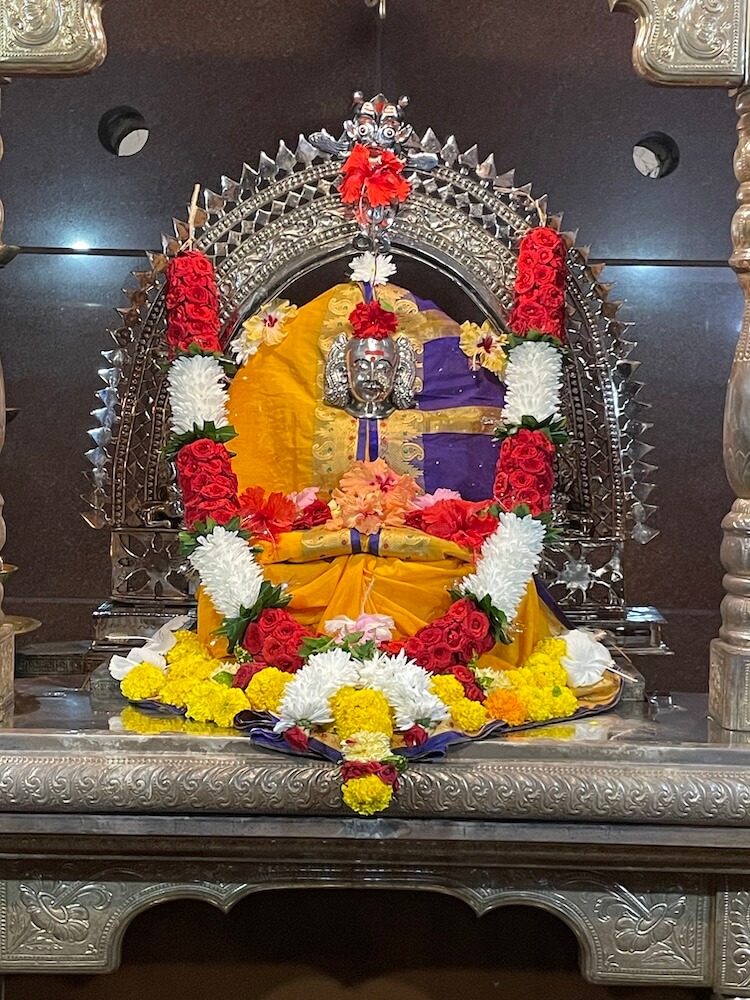
Shop Photo FramesThe only temple in all of Goa dedicated to the deity named Mandodari or Mandodari is located in the village of Betki. Gomantak is the land created by Lord Parashurama. It is a matter of surprise for many that there should be a temple of Goddess Mandodari in this land. However, the temple here is not of Ravana’s wife Mandodari, but of the water deity Mandodari. To distinguish her from Ravana’s wife, the name is pronounced here as ‘Mandodari’ instead of ‘Mandodari’. The festival of this deity is celebrated as ‘Navotsav’, and there is a tradition of not cooking food in the village on that day.
It is said that this temple must have been built at least five hundred years ago during the settlement of the village. According to the legend mentioned in the book ‘Devbhumi Gomantak’ by temple researcher Vinayak Narayan Shenvi Dhume, people started the work of settling this village in ancient times. But there was a difficulty; there was a lack of water within the village limits. So, the people decided to dig a pond on the hilltop here. No matter how much they dug, they could not find a spring. Then the people decided to leave this settlement and go elsewhere. At that same time, a Yogi appeared in the village. The people presented their problem before him. He then told them that they would find plenty of water in this very pond, but for that, a divine sacrifice would have to be made.
This sacrifice meant that two human beings, one male and one female, would have to be sacrificed at this place. Hearing this, the people became worried. No one was ready to sacrifice a person from their own family. A poor Brahmin woman lived in that village with her two young children. One day, taking advantage of her being away for some work, some people lured her son and daughter to the excavation site and sacrificed them there. After this, a large amount of water accumulated there. The village was established at this place. When the Brahmin woman returned, she learned that her children had been sacrificed. Her grief knew no bounds. In her rage, she cursed the village, saying, “No one shall settle in this village for the next 24 generations. No fire shall be lit in the hearths of the village. No food shall be cooked.” After this, she abandoned her home and left the village. The people were terrified by this curse. They realized that if the woman did not revoke the curse, the destruction of their lineage was inevitable. So, they all went together and sought refuge with her. For the welfare of the village, she swallowed her grief and revoked the curse, saying that instead of 24 generations, fire should not be lit and food should not be cooked in the village for only 24 hours. The village seemed to be reborn due to her revocation of the curse. In memory of this, ‘Navotsav’ is observed in the village every year. On this day, not a single hearth in the village is lit, and no food is cooked. This tradition is followed even today. According to one legend, the girl sacrificed for this pond was named Mandodari and the boy was named Narbando. The villagers later established temples for both these siblings here. Mandodari is worshipped here in the form of a water deity as the mother of that pond. Navotsav, the temple foundation day, is celebrated in the first week of April.
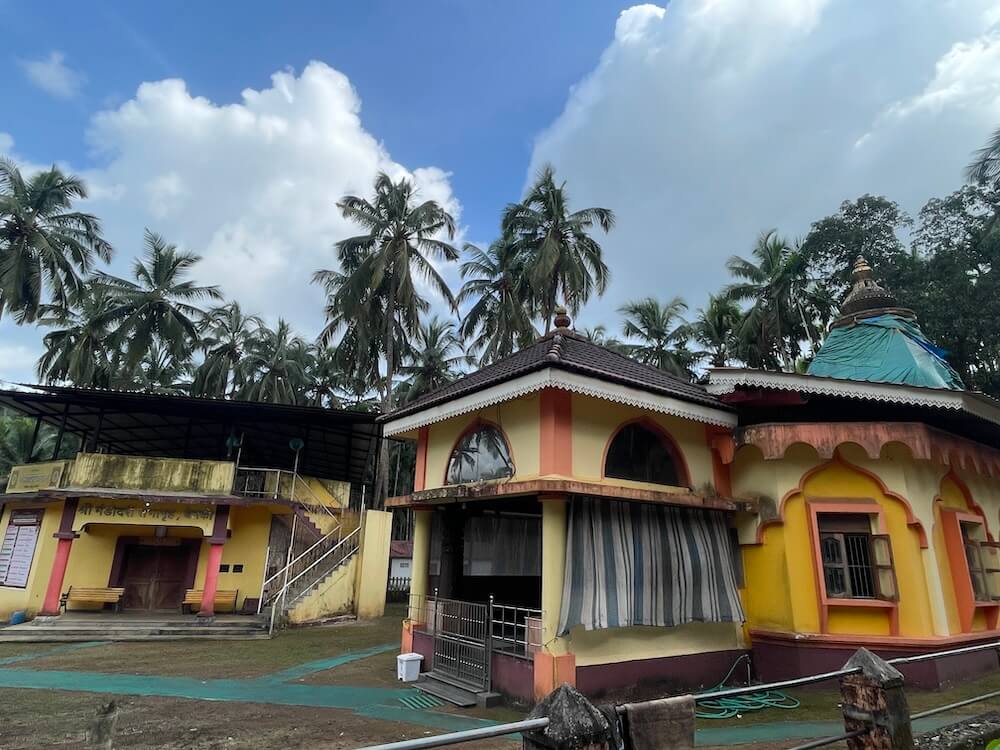
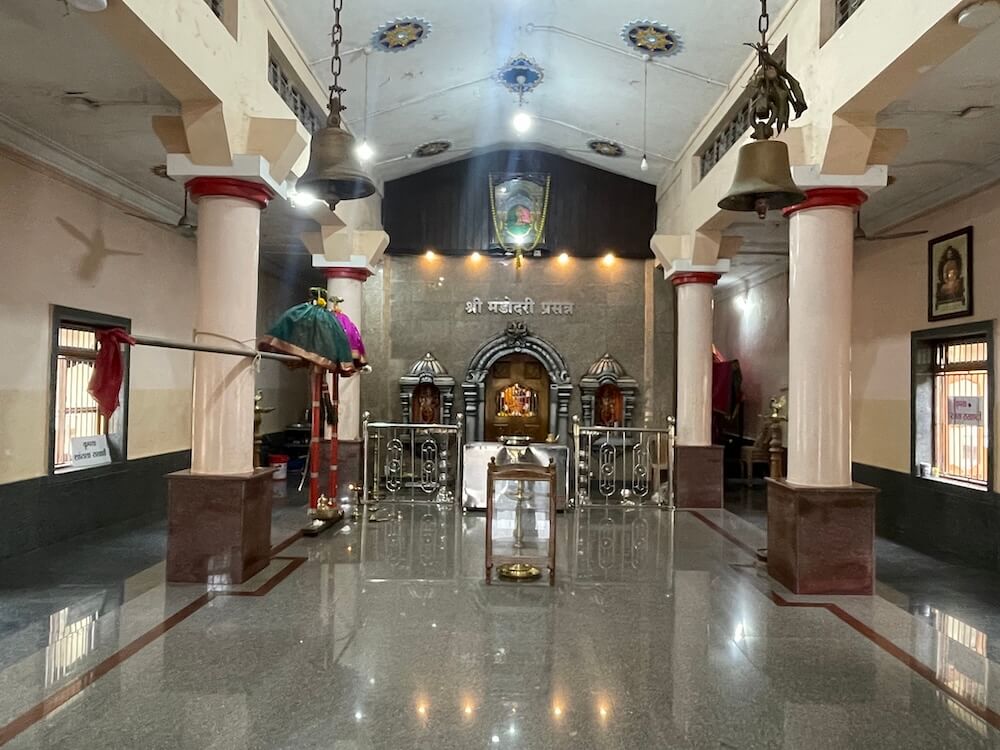
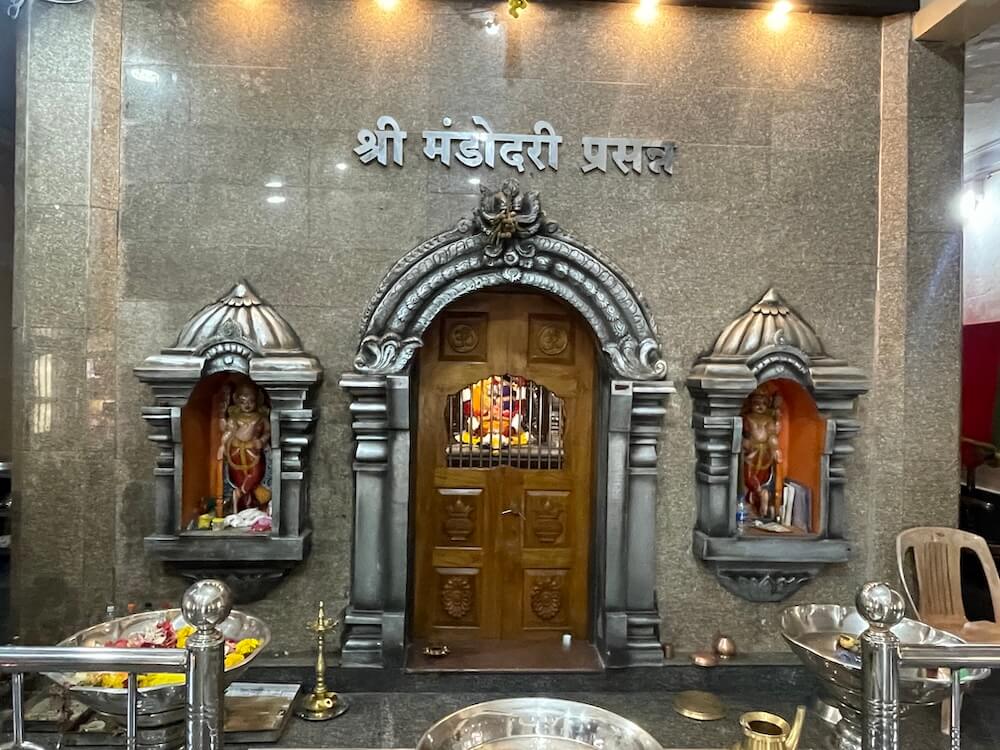
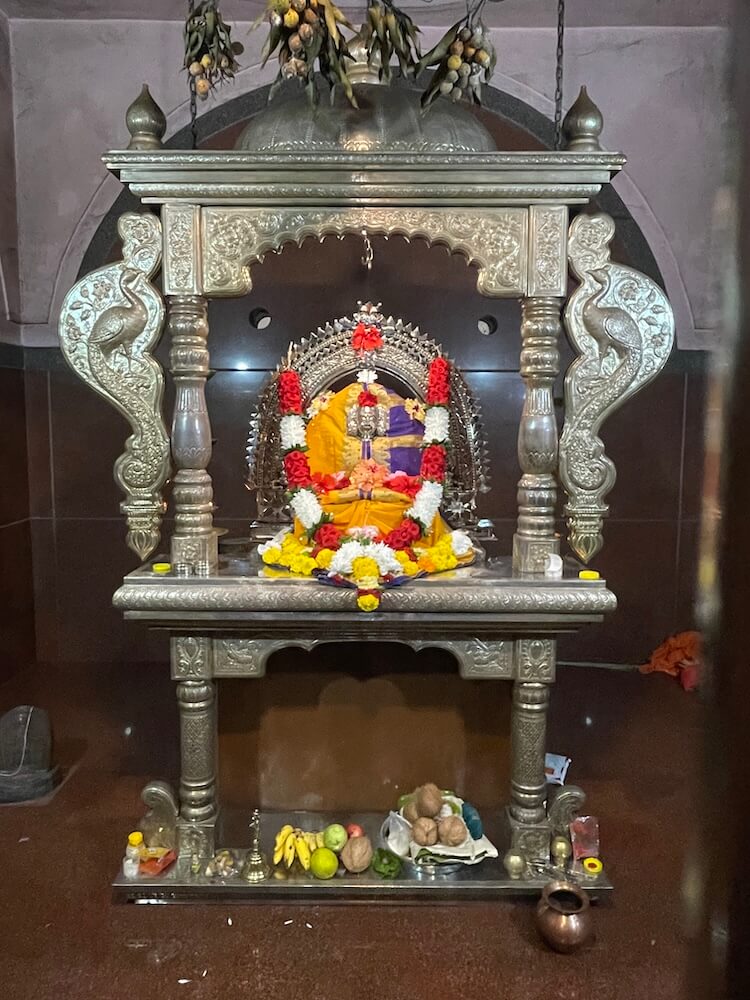
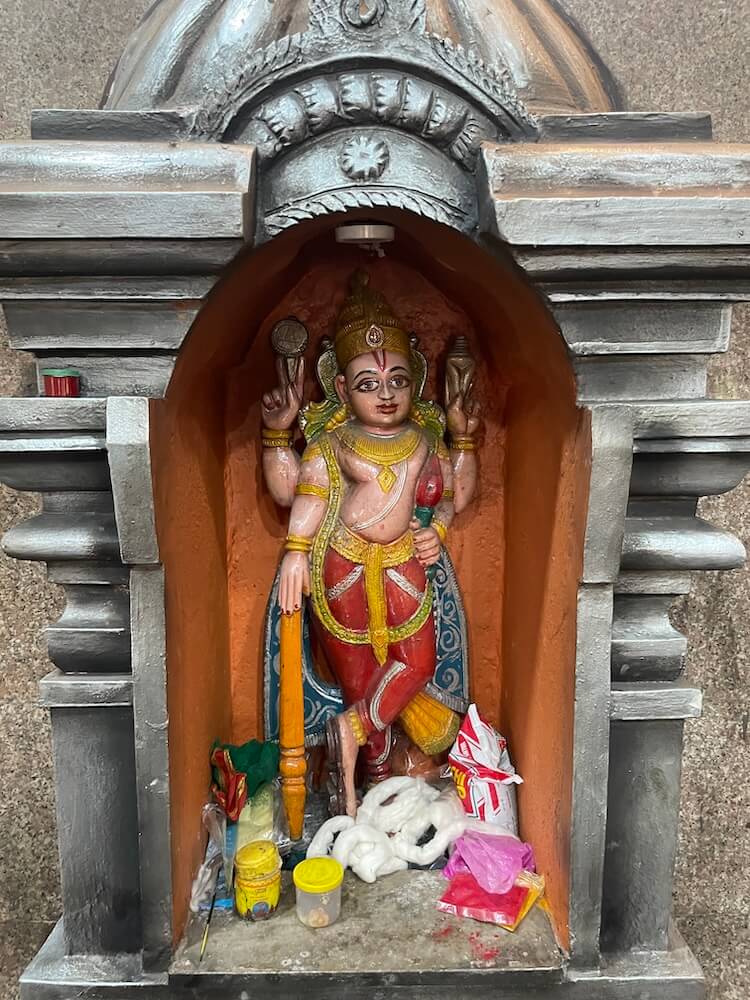
The temple of Goddess Mandodari is situated in a large courtyard in an area rich with coconut and areca nut groves. The structure of this temple consists of a Mukhamandapa (front hall), Sabhamandapa (main hall), and Garbhagriha (sanctum sanctorum). The Mukhamandapa is semi-open with a sloping tiled roof. It has ‘Kakshasanas’ (stone benches) and four large circular wooden pillars. These are intricately carved. At the top of the pillars are ‘Taranghastas’ (bracket figures). Wooden construction resembling a balcony is built on the beams above them. From here, one enters the Sabhamandapa of the temple. The Sabhamandapa has an arched stone entrance with intricate carvings. Inside the Sabhamandapa, there is a row of pillars at a distance of a few feet from the left and right outer walls. Brass bells are hung from the sloping roofs on both sides. Two ‘Tarangkathis’ (ceremonial poles) are kept on the left in the hall. In the center, there is a tall ‘Samai’ (oil lamp) in a glass case. From this Sabhamandapa, there is a circumambulation path around the Garbhagriha. On both sides of the entrance to the Garbhagriha, there are two niches shaped like shrines. These niches contain idols of Vaishnava Dwarapalas (gatekeepers). The entrance to the Garbhagriha is made of wood, and its arch is carved. A ‘Kirtimukha’ is carved at the center of the lintel. Inside, in a tall shrine, the idol of the Goddess in the form of a mask is seated. Behind the Goddess is a finely carved silver ‘Prabhaval’ (halo). The shrine is also covered with silver sheets. The temple has a spire that tapers towards the top on all four sides. It is topped with a large ‘Amalaka’ and a ‘Kalasha’.
In the vicinity of this temple, there are temples of Laxmi Ravalnath, as well as Mulmaya Sateri and Grampurush. Behind the idol of the Goddess in the Sateri temple here, there is a large anthill. To the left of the Mandodari temple is a large hall. A stage is built at some distance in front of the temple. A short distance from here, in the temple courtyard, a grand brass ‘Deepastambha’ (lamp pillar) shaped like a Samai is installed on a large pedestal. At the base of this lamp pillar is an image of a tortoise. On the occasion of the Navotsav celebrated in the first week of April, the villagers offer the ‘Maha Naivedya’ of the first rice from their fields to the Goddess. Only after that do they use the new rice for consumption. This custom has also been followed here since ancient times. Apart from this, the Sharadiya Navaratri festival is celebrated with great pomp in this temple from Ashwin Shukla Pratipada to Dashami, according to the institutional tradition. A special puja of the Goddess is performed here every Friday.
This sacred temple stands as a testament to deep spiritual devotion, ancient architectural grandeur, and rich local cultural traditions.
The sanctum sanctorum houses the divine idol consecrated according to ancient Vedic traditions, surrounded by serene courtyards and traditional temple architecture.
Navratri, Maha Shivratri, Annual Temple Jatra & Deepotsav
Compare and book flights, secure top-rated local hotels near the temple, hire reliable guides, and rent cars instantly.
Extend your pilgrimage by visiting other highly sacred temples located nearby.


Add ₹999 more to unlock FREE SHIPPING!
Your sacred cart is currently empty.
Shop Photo FramesFill in your delivery details below to place your order.
Add comment