
Add ₹999 more to unlock FREE SHIPPING!
Your sacred cart is currently empty.
Shop Photo Framesis where the Divine Mother, whose glory was described by Sant Eknath as ‘Ramavardayini’, and from whom Chhatrapati Shivaji Maharaj sought blessings before every endeavour with the sacred intention of establishing indigenous rule in Maharashtra, resides. This very Devi, the Kulswamini of Samarth Ramdas Swami, just as She was of Shivraya, is the revered deity of the Maharashtra land. Along with Her Shaktipeeth in Tuljapur, temples dedicated to this Devi are situated in many places across the state. Among them, one ancient temple stands in Agar. This Devi is the Kuldevata for many families, and thus, the temple is always bustling with devotees eager for Her darshan.
Maharashtra is blessed with three and a half Shaktipeethas of the Devi. The Tuljabhavani Mandir in Tuljapur is the third complete Shaktipeetha. The Devi Bhagavat also mentions Tuljapur among the fifty-one Shaktipeethas. The Puranic legend of this Devi, known by various names such as Tvaraja, Turaja, Tvarita, Tulaja, and Amba in different scriptures, is narrated in the ‘Tulja Mahatmya’. It states that in the Krita Yuga, a Brahmin named Kardam resided in this region. At the time of his demise, his wife, Anubhuti, was pregnant. Therefore, she could not perform Sati with her husband. After giving birth some days later, she began performing penance on the banks of the Mandakini River. One day, a demon named Kukkut, who had come there for hunting, saw her. Enchanted by her radiant beauty, he became infatuated with her.
This demon touched Anubhuti’s body. At that moment, the devout lady earnestly invoked Mother Parvati in her heart. Hearing her call, Parvati Herself appeared there in the form of Bhavani and slew the demon Kukkut. Because She swiftly came to the aid of Her devotee, this Devi came to be known as Turaja or Tvarita. An associated tale with this legend recounts that as the demon Kukkut was dying, he assumed the form of Mahishasura. The Devi then slew him. Hence, She is also worshipped in Her form as Mahishasuramardini. According to the story in ‘Bhavartha Ramayana’, after Sita’s abduction, as Shri Rama was journeying south in search of Sita, Mother Bhavani Herself appeared before Him at one place. At that time, the Devi bestowed a boon upon Shri Rama for the slaying of Ravana. It is for this reason that Sant Eknath referred to the Devi as Ramavardayini. The legend of this Devi bestowing the ‘Bhavani Talwar’ upon Chhatrapati Shivaji Maharaj is well-known in Maharashtra. In a chronicle composed by Krishnaji Anant Sabhasad around the year १६९७ CE, with the permission of Chhatrapati Rajaram Maharaj, approximately १७ years after the Mahasamadhi of Chhatrapati Shivraya, it is mentioned that when Afzal Khan advanced, Maharaj went to Pratapgad. There, he resolved, ‘Whatever happens, we shall fight to the death. There shall be no compromise.’ That very night, Maharaj received a divine vision from ‘Shri Bhavani of Tuljapur, who appeared in person and declared, “I am pleased. I shall assist you in every way. Through your hands, I shall have Afzal Khan slain.”‘ This chronicle does not mention the Bhavani Talwar. However, after receiving Bhavani’s blessings, Maharaj, by his own valour, slew Afzal Khan.
The exact date of construction of this temple of Maharashtra’s Kuldevata in Agar is not definitively known. However, it is said that the temple was built during the Yadav period in the thirteenth century. After its renovation some years ago, the temple acquired its present form. This renovation was carried out while preserving the temple’s old stone structure.
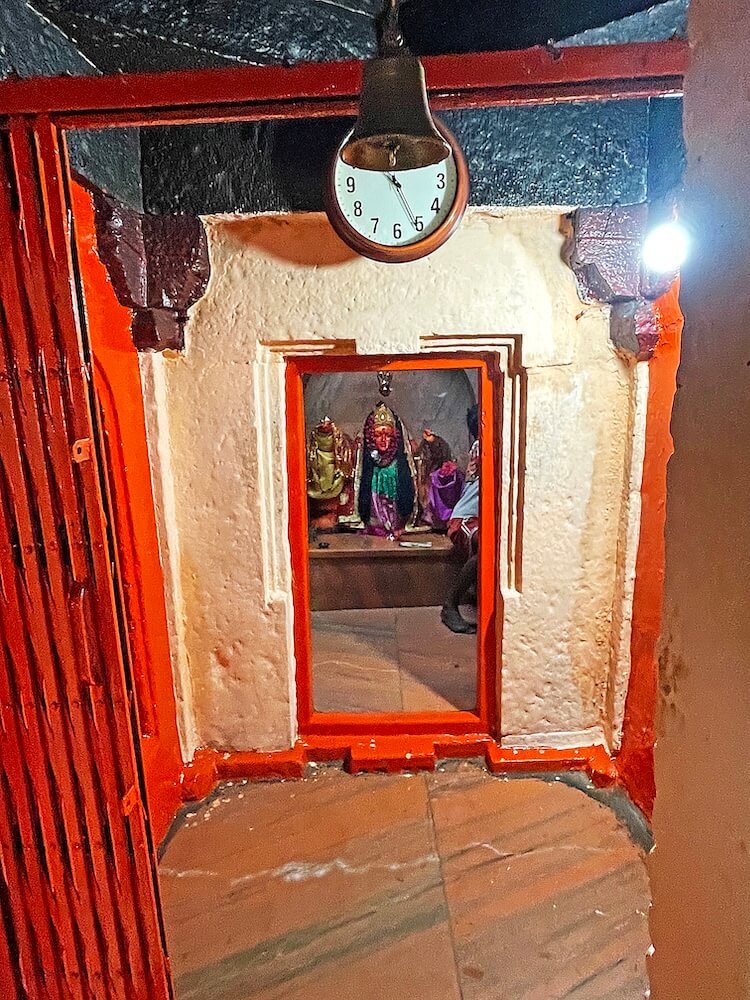
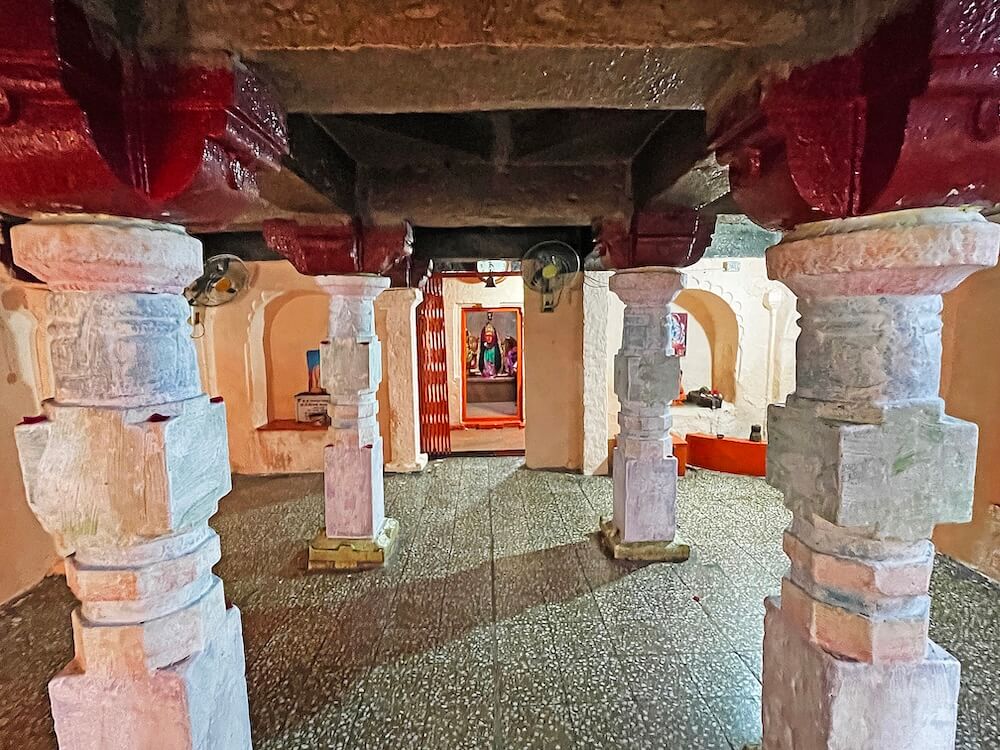
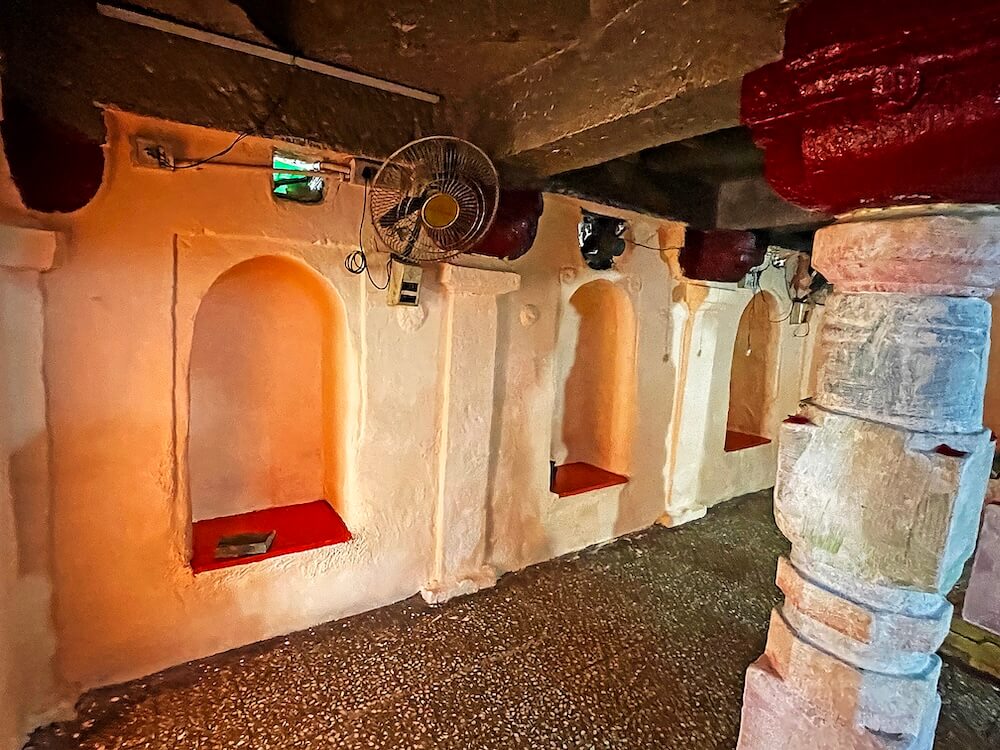
The ancient temple of Bhavani Devi is situated on a raised platform beside a lake in the central part of Agar village. One ascends approximately ten steps to enter the mandap in front of the temple. For the convenience of devotees, there are benches for sitting and a tin shed above in this mandap. The temple’s structure comprises a Mukhmandap, Sabhamandap, Antarala, and Garbhagriha. There are three entrances to the temple’s Mukhmandap. One can enter the temple through the central doorway. This Mukhmandap was built in a later period in front of the original temple. At the entrance to the Sabhamandap, there are pillar branches on both sides. On the Lalatabimba, there is an idol of Ganesha, and below it, a Kirtimukha. This Hemadpanti style temple’s Sabhamandap has four stone pillars. These pillars, standing on pillar bases, are of various shapes from bottom to top. The walls of the Sabhamandap contain many Devakoshtakas and Gavakshas.
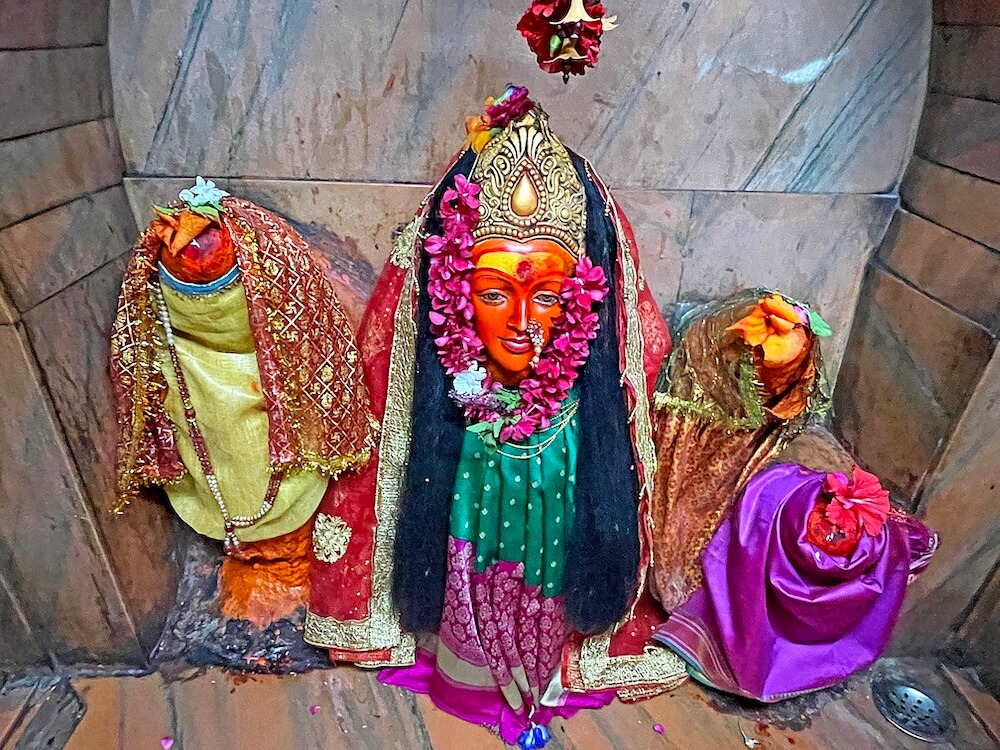
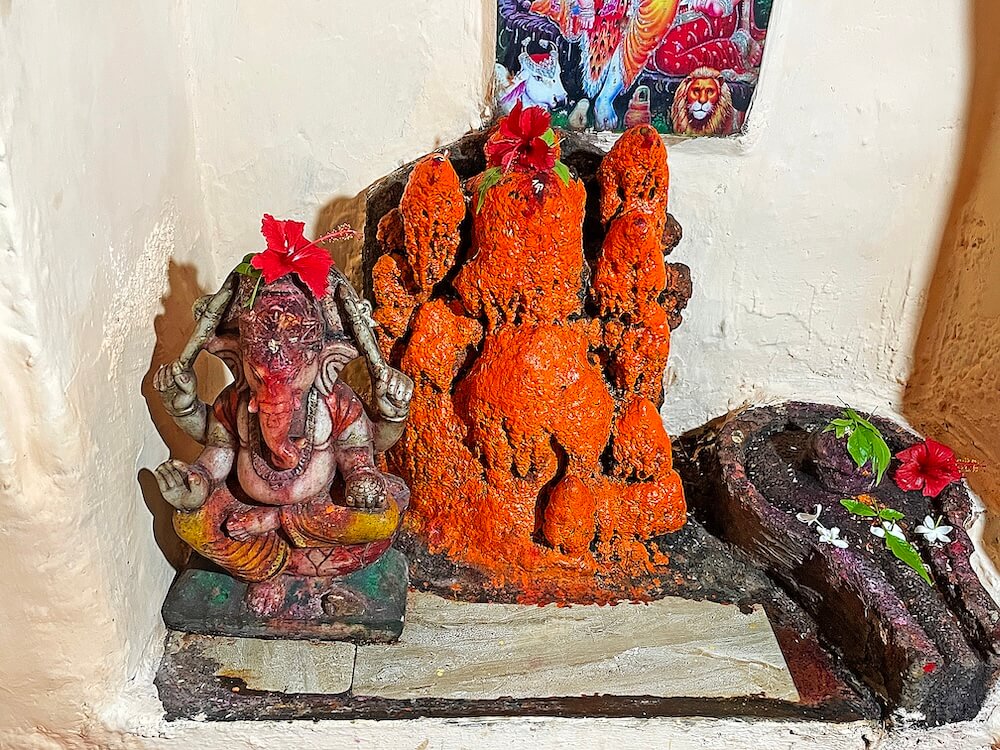
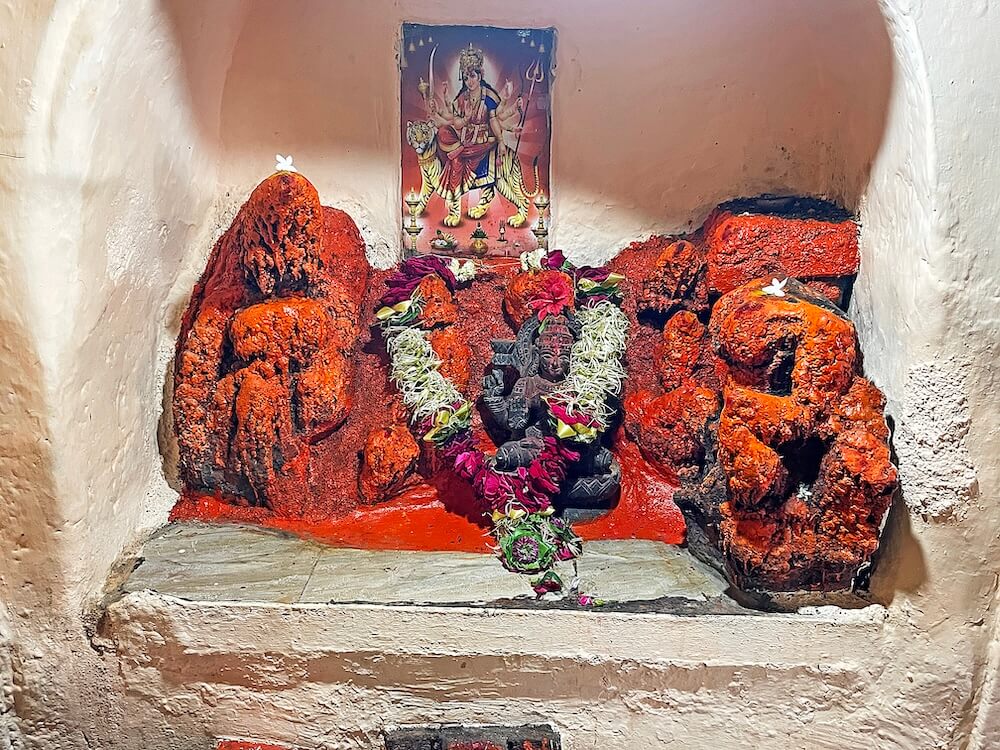
In the Devakoshtakas on the frontal wall of the Antarala within the Sabhamandap, there is an ancient idol of Ganesha and a Shivlinga on the right, while on the left, there is an image of Gajanan Maharaj. From this Antarala, one enters the Garbhagriha. On the Vajrapeetha in the Garbhagriha, there is a vermillion-smeared idol of Bhavani Devi. This Devi wears a crown on Her head, a malvat on Her forehead, and a nath in Her nose. The Mukhmandap of this temple has a small shikhara. However, there is no shikhara over the Sabhamandap and Garbhagriha. Some remnants of the old temple can be seen in the temple premises, including fragments of the old temple’s doorway sculptures, which feature intricate carvings.
Daily worship and rituals are performed in this temple. This Devi is renowned for swiftly responding to the calls of Her devotees. Therefore, many devotees come here for darshan. Many devotees make vows before the Devi. Upon the fulfillment of their vows, devotees tie a toran of coconuts outside the Garbhagriha. Newlywed couples from the surrounding area begin their married life by seeking the blessings of this Devi. In this temple, the chanting of the Devi’s name is observed from Gudi Padwa to Hanuman Jayanti. Both the Chaitri and Sharadiya Navratrotsavas are celebrated here with great enthusiasm.
This sacred temple stands as a testament to deep spiritual devotion, ancient architectural grandeur, and rich local cultural traditions.
The sanctum sanctorum houses the divine idol consecrated according to ancient Vedic traditions, surrounded by serene courtyards and traditional temple architecture.
Navratri, Maha Shivratri, Annual Temple Jatra & Deepotsav
Compare and book flights, secure top-rated local hotels near the temple, hire reliable guides, and rent cars instantly.
Extend your pilgrimage by visiting other highly sacred temples located nearby.


Add ₹999 more to unlock FREE SHIPPING!
Your sacred cart is currently empty.
Shop Photo FramesFill in your delivery details below to place your order.
Add comment