
Add ₹999 more to unlock FREE SHIPPING!
Your sacred cart is currently empty.
Shop Photo FramesThe current Dharashiv district in the Marathwada region has been considered prosperous since ancient times. In this very district, at Ter, are some of the oldest temples in Maharashtra, dating back to the second to third centuries. The district hosts a large number of temples and monasteries belonging to the Shaiva, Vaishnava, Shakta, Nath, Giri, and Puri traditions. In the village of Yeramala in Kalamb Taluka of this district lies the ancient and famous temple of Goddess Yedeshwari. Devotees hold a deep faith that the awakened Goddess here fulfills their vows. The showering of turmeric during the Goddess’s annual fair is particularly famous.
It is believed that Yedeshwari is a form of Parvati, Tulja Bhavani, and Ambabai. According to some legends, she is said to be part of the Saptamatrika, Chausath Yogini, and Navadurga series. There are a large number of devotees of Goddess Yedeshwari in states like Maharashtra, Karnataka, Andhra Pradesh, and Telangana. The temple is said to be eight hundred to one thousand years old. A legend regarding the Goddess states that while Lord Shriram was wandering in search of Sita, Mother Parvati, to test him, assumed the form of Sita and stood before him. Lord Shriram recognized the Mother in an instant, and the question, “Mother, are you acting foolishly (yedi)?” escaped his lips. At that very moment, Mother Parvati settled here in the form of an idol and became famous by the name Yedeshwari. According to some scholars, this shrine, located in an area influenced by the Banjara community, bears the imprint of the Goramati language. The name Yedeshwari is believed to have evolved from the Goramati word ‘Yadi’, meaning ‘Mother’.
The first welcome arch of the temple is on the road leading from the Yeramala bus depot to the temple. On the path from the village to the temple is the Kallol Kund. This rectangular pond, built of dressed stone, has steps on one side for descent, and the walls on the other three sides feature niches containing idols of Maruti, Ganpati, and Mahadev. A plaque placed near the pond states the legend that this pond was created by Lord Dattatreya for Mother Parvati’s bath. Water from this pond is taken daily for the Goddess’s bath. On the bank of the pond is a temple of Ekamukhi Dattatreya. The temple of Goddess Yedeshwari is about half a kilometer away from the pond.
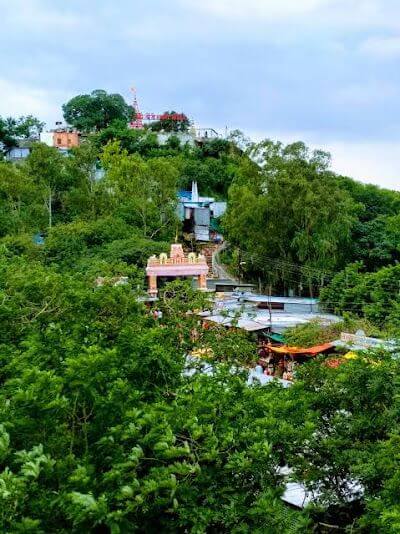
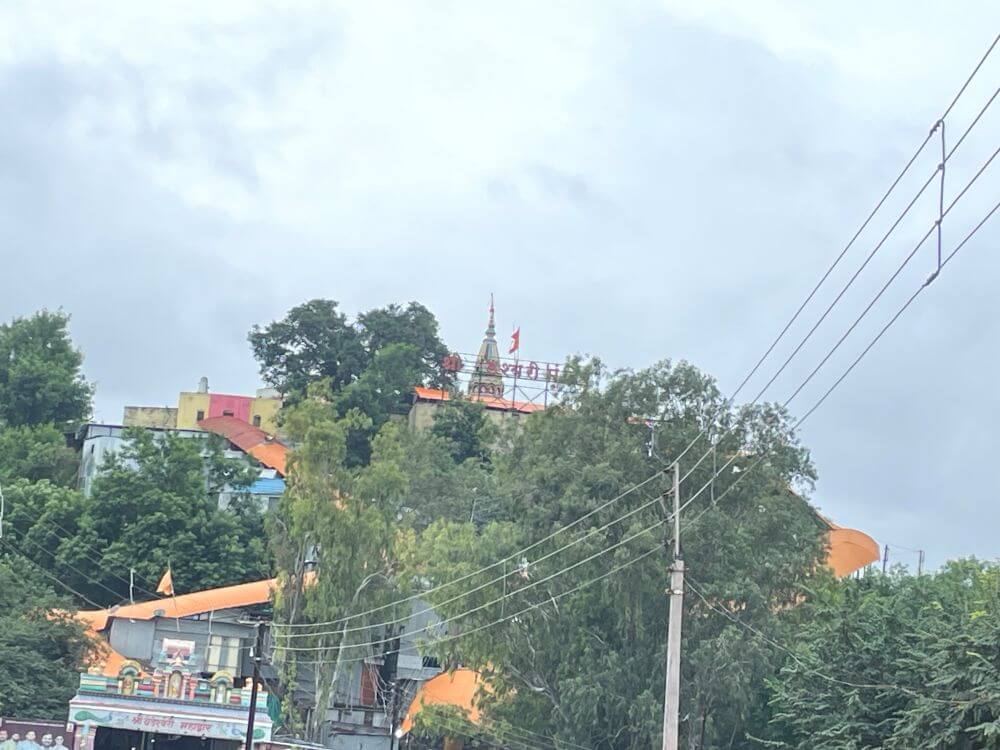
This temple is situated on a hill about ๔๐๐ feet high in the Balaghat mountain range. There is a tradition of performing a circumambulation of the hill. A thread is tied to a tree at the foot of the hill and carried all the way around the entire hill. This circumambulation path is about two kilometers long and is paved with paver blocks.
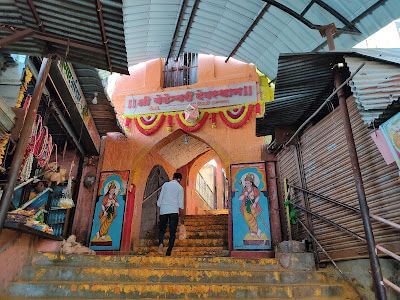
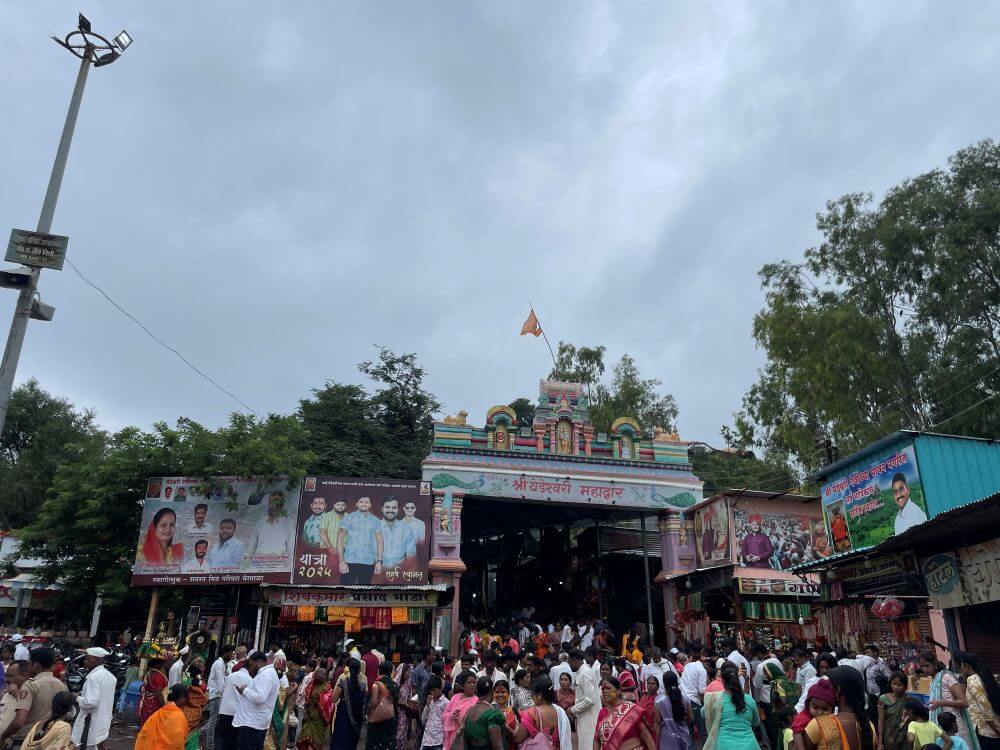
At the foot of the hill, there is a parking lot and many shops selling food, worship materials, and other items. From here, there are ๒๐๔ steps leading to the temple. The entire stairway is covered by a corrugated metal roof shaped like an elephant’s back. From the starting point of the stairway to the temple, there are shops selling various goods and worship materials on both sides. There are seats at regular intervals on the stairway for devotees to rest. At the starting point of the stairway is the second welcome arch of the temple. The arch features ornate square pillars on both sides with various sculptures and carvings of the gatekeepers Jaya and Vijaya. On the cornice above the pillars are three niches. The central niche contains Ganpati, the left one contains Goddess Yedeshwari, and the right niche contains a face sculpture.
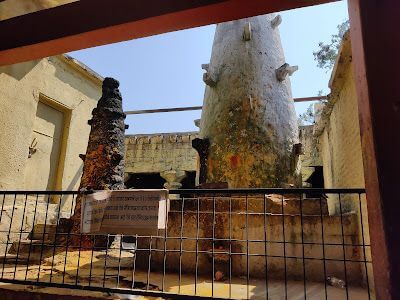
On this stairway, after ๕๐ steps, there is an ancient lamp pillar. After climbing about ๑๘๐ steps, one reaches the main two-story entrance of the temple. Paintings of gatekeepers are depicted on both sides of the entrance. It is said that there used to be a music gallery on the floor above the entrance. In the temple courtyard, the management of the darshan queue has been arranged for the convenience of devotees. Beside the bridge of the darshan queue is a circular stone lamp pillar. Further ahead is the entrance to the assembly hall (Sabhamandap). In the assembly hall, there is a brass lion sculpture on the floor. The assembly hall has four rows of four ornate pillars each. All the pillars here are covered in silver plating. The ceiling between every four pillars is octagonal and ornate. The enclosed assembly hall has ventilators for airflow. The outer pillars of the assembly hall are embedded in the walls. It is said that the temple has a total of ๑๐๑ stone pillars.
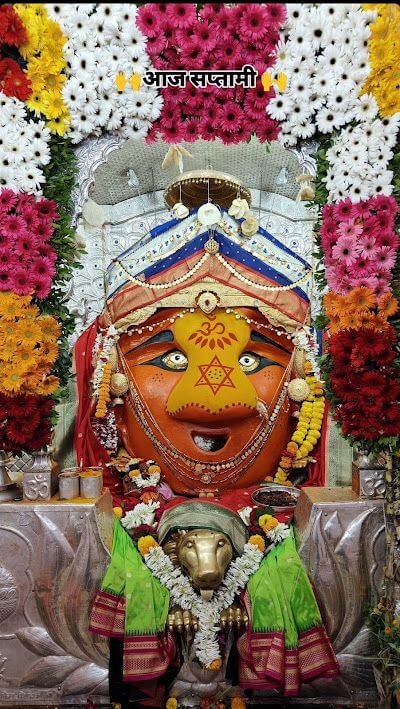
Further ahead are the vestibule (Antaral) and the sanctum sanctorum (Garbhagriha). In the sanctum, the self-manifested (Swayambhu) stone of Goddess Yedeshwari is placed in an ornate silver shrine. The crown, face, eyes, and bindi on the idol are all made of silver. On the outer side of the temple, attached to the back wall of the sanctum, is the stone of Lord Kalbhairav in a canopy. On the roof of the sanctum is a circular, three-tiered spire that tapers upwards. The tiers of the spire are divided by replicas of lotus flowers. The first two tiers of the spire each have twelve niches containing idols of various deities. The third tapering tier has vertical rib carvings, and at the top are two Amalakas placed one above the other, topped by a finial (Kalash).
In the temple courtyard, adjacent to the assembly hall, is the Narsimha temple. Here, there is a vermilion-smeared stone of Lord Narsimha and stones of other deities. Beside this temple is the temple of Janai Devi. This temple contains two vermilion-smeared stones. In the courtyard, on the right side, is a temple with a vermilion-smeared stone idol of Matangi Devi. Further ahead is an ancient tamarind tree. Under this tree, on a platform, are the marble footprints of Shriram. It is said that these footprints were received from the Shriram temple in Ayodhya. Apart from this, there are temples of Ganpati, Shridatta, Khandoba, Tulja Bhavani, Mahadev, and Mhasoba in the courtyard.
Chaitra Purnima is the main annual fair of the Goddess, which is celebrated here with great enthusiasm. On the day after the full moon, the Goddess is seated in a palanquin and taken in a procession to a temple in the village orchard, where she stays for five days. It is said that during this time, lime stones appear in the ground in the orchard. After five days, the Goddess returns to her main temple in a palanquin procession. There is a tradition of whitewashing the Goddess’s temple with this lime once a year. The Goddess’s fair is also held during Shravan Purnima, Kojagiri Purnima, Magh Purnima, and Navratri. During all these festivals, thousands of devotees from states like Maharashtra, Karnataka, Andhra Pradesh, and Telangana come for darshan and to fulfill their vows.
This sacred temple stands as a testament to deep spiritual devotion, ancient architectural grandeur, and rich local cultural traditions.
The sanctum sanctorum houses the divine idol consecrated according to ancient Vedic traditions, surrounded by serene courtyards and traditional temple architecture.
Navratri, Maha Shivratri, Annual Temple Jatra & Deepotsav
Compare and book flights, secure top-rated local hotels near the temple, hire reliable guides, and rent cars instantly.
Extend your pilgrimage by visiting other highly sacred temples located nearby.


Add ₹999 more to unlock FREE SHIPPING!
Your sacred cart is currently empty.
Shop Photo FramesFill in your delivery details below to place your order.
Add comment