
Add ₹999 more to unlock FREE SHIPPING!
Your sacred cart is currently empty.
Shop Photo FramesSamarth Ramdas Swami, the author of monumental works like the *Dasbodh* and *Manache Shlok*, visited 1,029 villages and established 1,100 *maths* (monasteries) during his lifetime. Very few of these remain today. Swami initiated countless disciples, among whom Kalyanswami was his chief disciple and scribe. He remained by Samarth’s side like a shadow and transcribed the entirety of Samarth’s literary works. The Samadhi Mandir of Kalyanswami is located on the banks of the Sina River in Domgaon. Devotees believe that Kalyanswami’s presence is still felt here, and bowing down at this site brings peace to the mind.
This Samadhi Mandir is approximately 250 years old. After Kalyanswami passed away in Paranda in 1714 AD, his last rites were performed on the banks of the Sina River in Domgaon. The Samadhi Mandir was constructed at this site 59 years after his passing. Kalyanswami’s birth name was Ambaji Krishnaji Kulkarni; he was born in Babulgaon in 1636 AD. He remained with Samarth from 1648 to 1678. His *gurubandhu* (fellow disciple), Anant Kavi, wrote, “Kalyan writes the entire ocean of the Swami’s poetry.” In 1678, at the behest of Samarth, Kalyanswami came to Domgaon and remained here until the end of his life. He initiated many disciples here. He named the Sina River ‘Shramapariharini’ (remover of fatigue) and composed an *Aarti* for the river.
The temple is situated in the vicinity of the Sina Kolegaon water project, also known as the Kalyan Sagar reservoir. A road built over the dam leads to the temple. Surrounded by the reservoir on all four sides, this place is adorned with natural beauty. The temple premises are paved with blocks. New structures, including a garden, a community hall (*Mangal Karyalaya*), and a temple office, have been recently constructed.
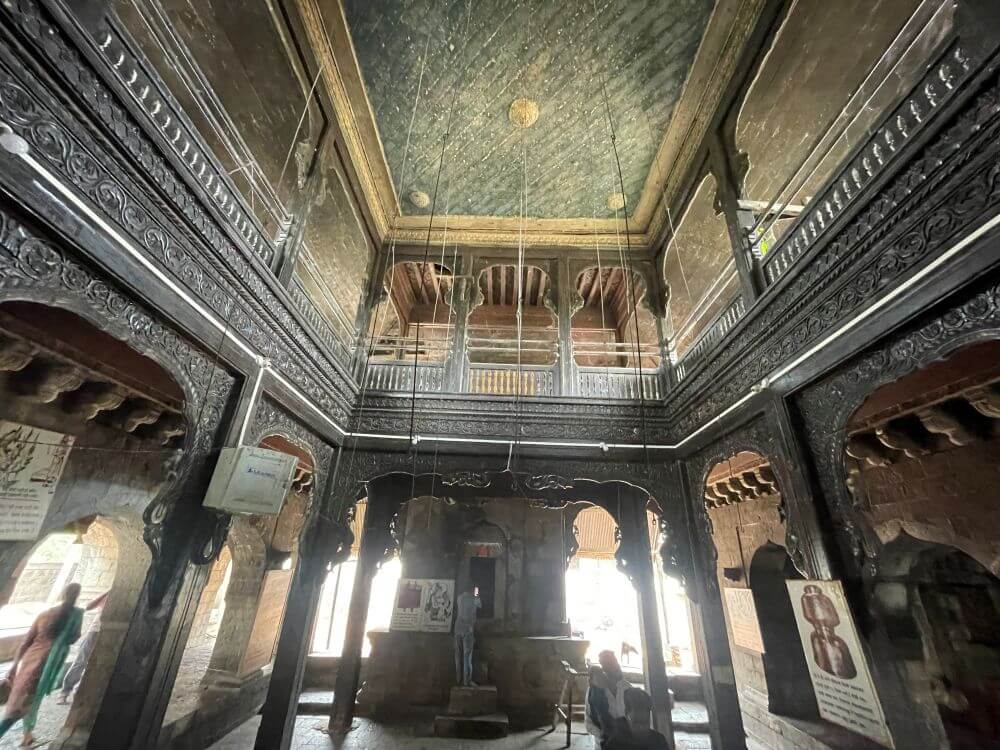
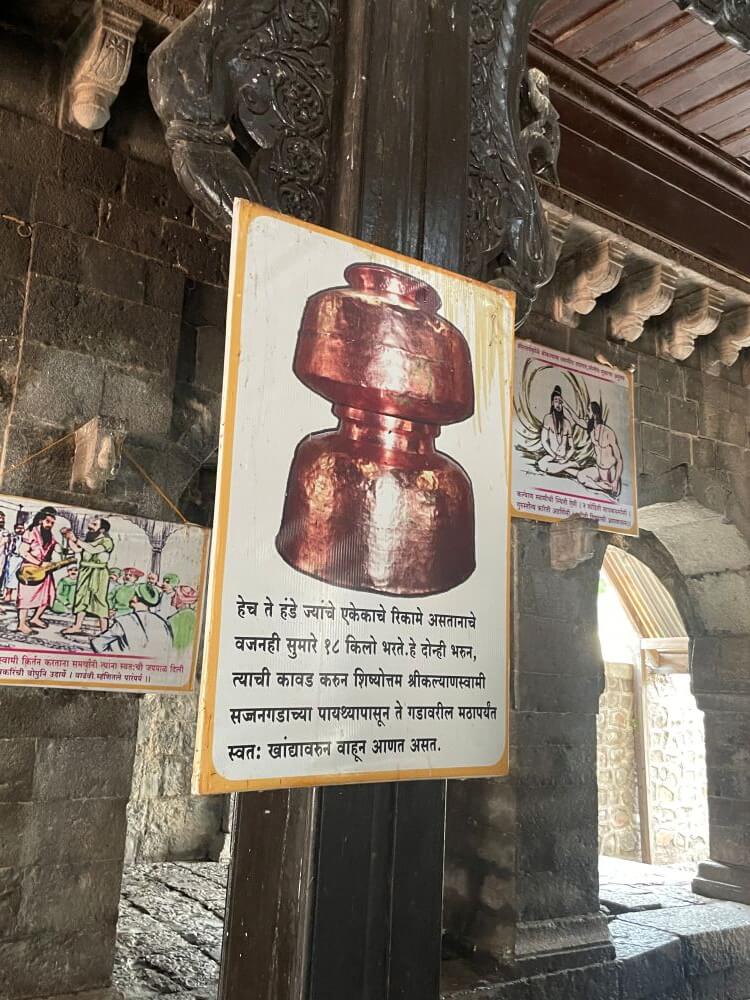
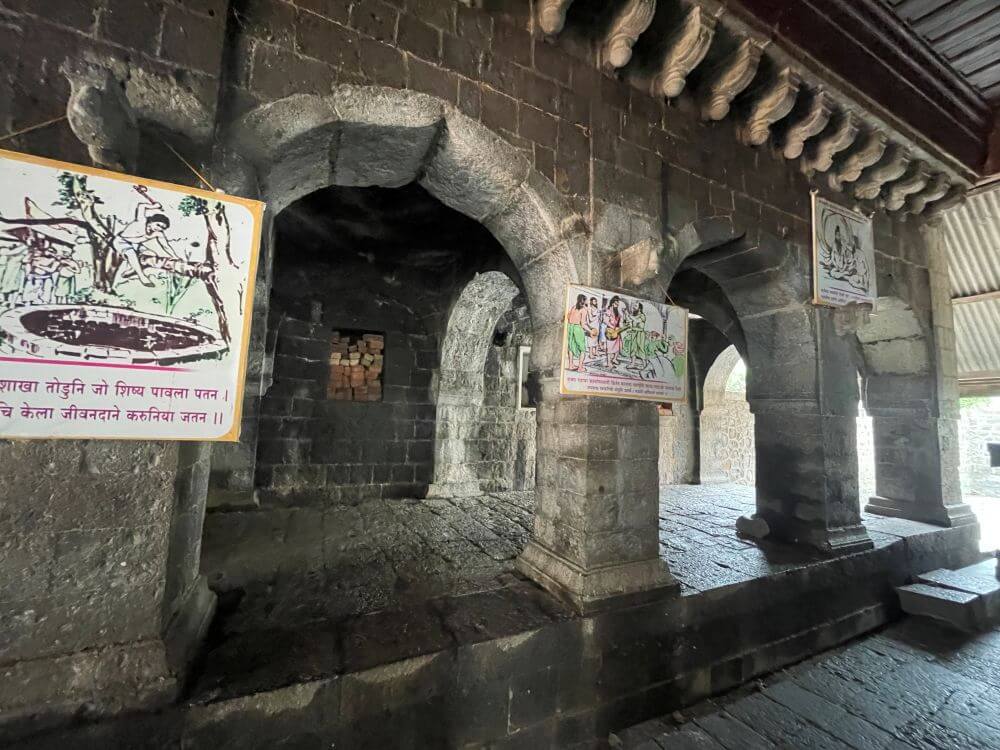
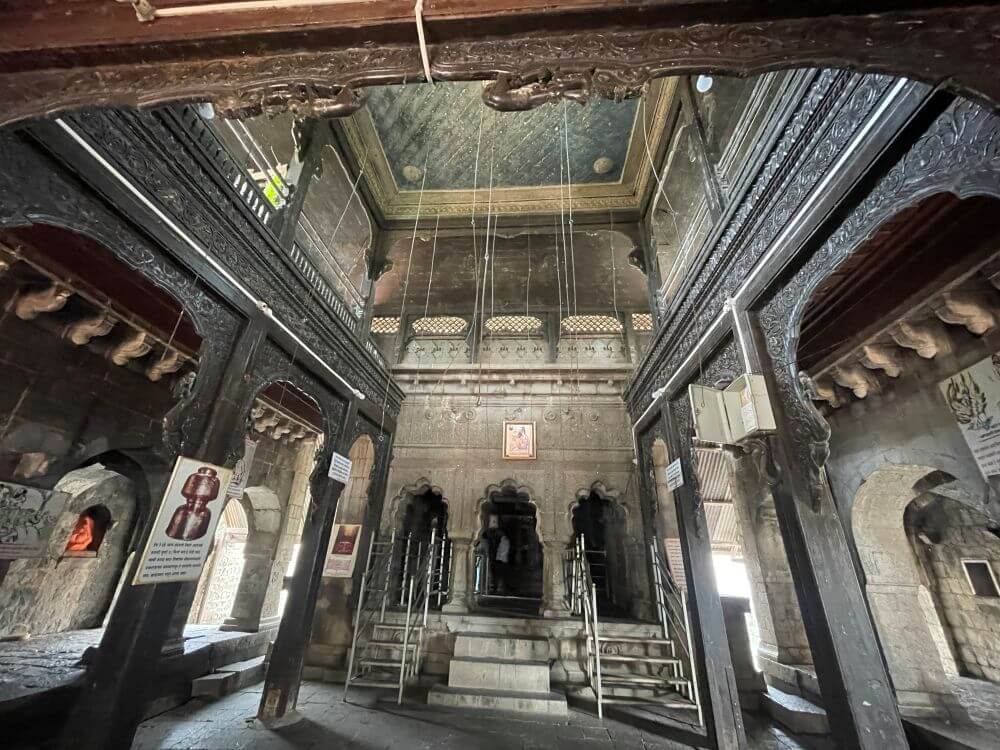
The temple is enclosed by a sturdy stone wall about fifteen feet high, featuring a grand entrance gate. The entrance has square pillars on both sides and ornate wooden doors. From here, one enters the temple courtyard. Ahead lies the two-story wooden *Sabhamandap* (assembly hall) of the Shri Kalyanswami Samadhi Mandir. This open-style hall has four ornate pillars on each side, which support the railings of the upper floor balcony. The ceiling of the *Sabhamandap* is intricately carved. The hall displays pictorial information depicting key events from Kalyanswami’s life.
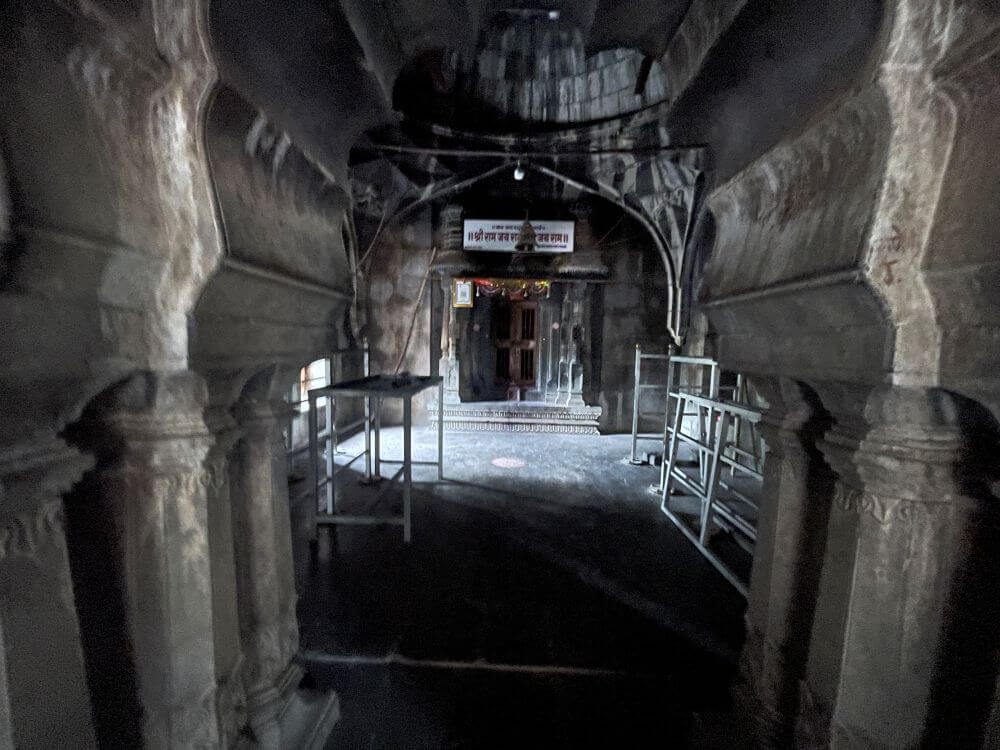
Further ahead are the stone-built *Antaral* (vestibule) and the *Garbhagriha* (sanctum sanctorum). The entrance to the *Antaral* features four ornate pillars connected by three arched gateways. The walls are adorned with circular patterns and animal sculptures. In the center is a portrait of Kalyanswami. The wall niches feature stone chandeliers at the bottom. The enclosed *Antaral* has doors on the left and right leading to the circumambulation path. A niche in the *Antaral* houses a copy of the *Dasbodh* in Kalyanswami’s own handwriting. The stone pillars in the *Antaral* are decorated with various carvings. The entrance to the *Garbhagriha* is embellished with pillar carvings and floral motifs, with an image of Maruti (Hanuman) on the lintel. In the center of the *Garbhagriha* floor lies Kalyanswami’s sandy stone Samadhi. The Samadhi is adorned with *Padukas* (footprints) and a *Shivling*, with verses from the *Bhagavad Gita* inscribed upon it.
Against the back wall of the *Garbhagriha*, on a *Vajrapitha* (throne), are idols of Shri Ram, Lakshman, Sita, and Maruti housed in a *Makhar* (shrine). The temple roof features a four-tiered square *Shikhara* (spire) in the *Bhumija* style. Each tier of the *Shikhara* contains miniature temple sculptures. The top of the *Shikhara* is crowned with a *Stupi*, a silver *Kalash*, and a flag.
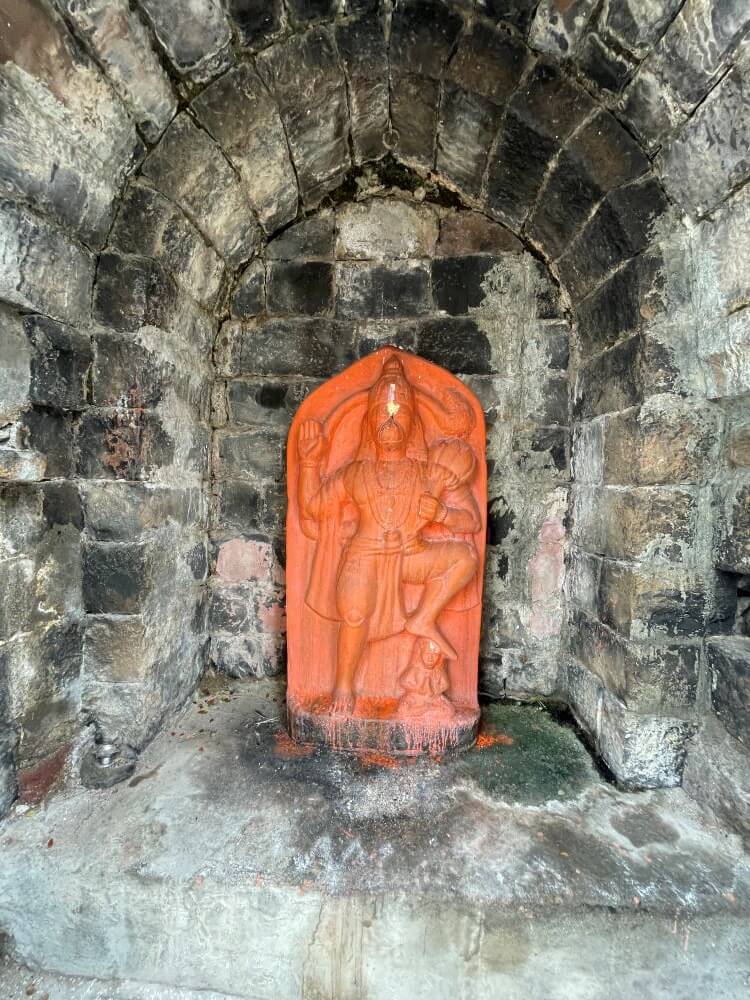
Directly opposite the Kalyanswami Samadhi Mandir, on the other side of the wooden *Sabhamandap*, is the Samadhi Mandir of Mudgalswami. The door frame of this temple features vine-like carvings and circular patterns on both sides. An image of Maruti is on the lintel. The temple houses the Samadhi of Mudgalswami and an idol of *Das Hanuman* (Hanuman with folded hands) against the back wall. The temple roof has a four-tiered *Bhumija*-style *Shikhara* topped with a *Stupi* and a silver *Kalash*. Both sides of the wooden *Sabhamandap* have galleries (*ovaris*). All the pillars here are connected by crescent-shaped arches. The ceiling between every four pillars is octagonal and carved. The walls of the left gallery feature sculptures of the eleven Maruti idols established by Ramdas Swami at various locations. Additionally, there are four stone inscriptions in the temple.
Three main annual festivals are celebrated at the temple. The annual festival from Chaitra Padwa to Ram Navami is celebrated for nine days. Dasnavami (Magh Vadya Navami) is celebrated for three days. Ashadh Shuddha Trayodashi, the death anniversary of Kalyanswami, is celebrated here with great enthusiasm. During these festivals, Ram Katha, Bhajans, Kirtans, discourses, and recitations of the *Dasbodh* are held. Many tourists also visit to witness the beauty of this shrine located on the banks of the vast reservoir.
This sacred temple stands as a testament to deep spiritual devotion, ancient architectural grandeur, and rich local cultural traditions.
The sanctum sanctorum houses the divine idol consecrated according to ancient Vedic traditions, surrounded by serene courtyards and traditional temple architecture.
Navratri, Maha Shivratri, Annual Temple Jatra & Deepotsav
Compare and book flights, secure top-rated local hotels near the temple, hire reliable guides, and rent cars instantly.
Extend your pilgrimage by visiting other highly sacred temples located nearby.


Add ₹999 more to unlock FREE SHIPPING!
Your sacred cart is currently empty.
Shop Photo FramesFill in your delivery details below to place your order.
Add comment