
Add ₹999 more to unlock FREE SHIPPING!
Your sacred cart is currently empty.
Shop Photo FramesIn an agrarian nation, the significance of water sources is unparalleled. Thus, to ensure the safety and good condition of natural water sources, they have been granted the protection of sacred shrines. To impress upon the common folk the importance of water sources, legends, customs, traditions, and deities that underscore this significance have been linked to these shrines. The ancient and renowned temple of Shri Bhatai Devi, connected to one such legend, is located in Bhadaṇe village in Dhule taluka. Devotees believe that the awakened Goddess grants wishes and, by Her grace, childless women are blessed with motherhood.
The legend concerning the temple recounts that when Devi Bhatai, the mother of nine sons, was traveling and arrived at this spot, She felt thirsty. She asked Her eldest son, Bhaṭu, to fetch water. To obey his mother’s command, Bhaṭu went to a nearby well, dipped a vessel into it, and brought back water. However, he did not notice that a fish had come into his vessel along with the water. When the Devi took the vessel in Her hands to drink, Her gaze fell upon the fish. Realizing that Her son’s carelessness would have caused Her to incur the sin of taking a life, the Devi’s anger became uncontrollable, and She commanded Her son to disappear from Her sight.
Thinking it better to end his life than to endure separation from his mother, Bhaṭu released the fish back into the well from which he had drawn water and there gave up his life. Once Her anger subsided, the Devi repented having cursed Her son and bestowed a boon upon that well: any woman who bathes in its water and then comes for My darshan will be blessed with progeny. Even today, many childless women bathe in this well and then proceed for the Devi’s darshan. It is said that an unwritten rule here is that children born through the vow to Shri Bhatai Devi must be named Bhaṭu or Bhaṭi.
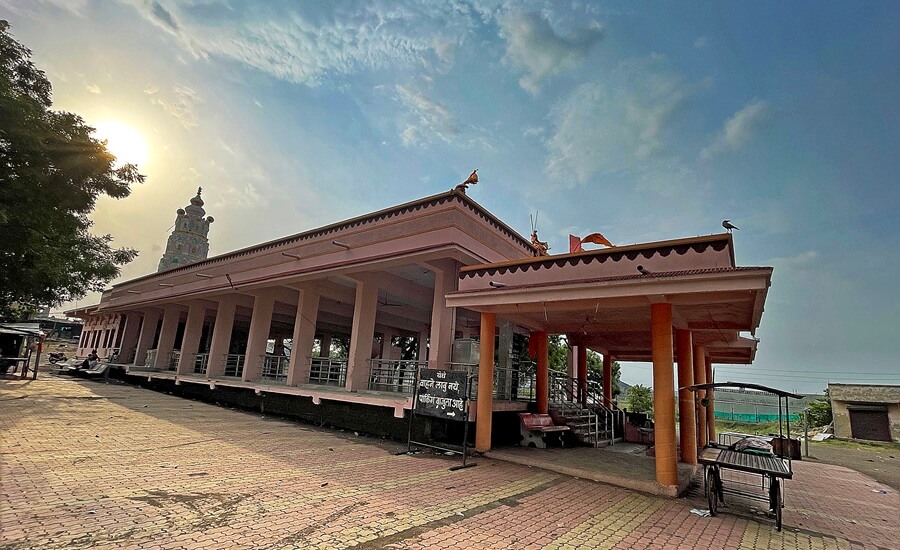
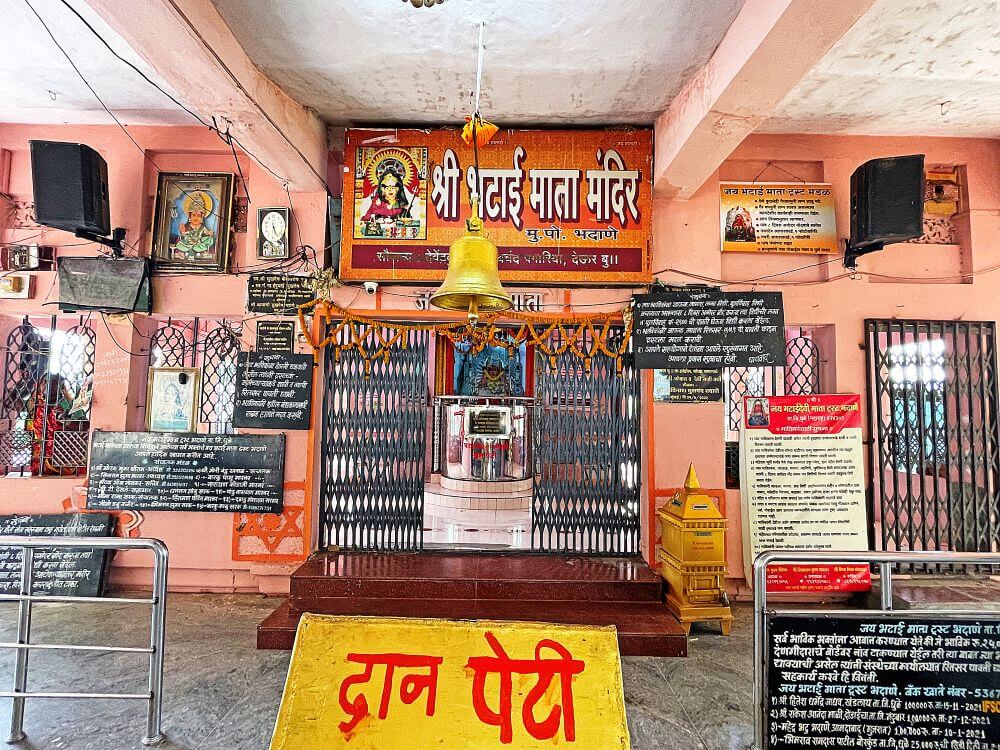
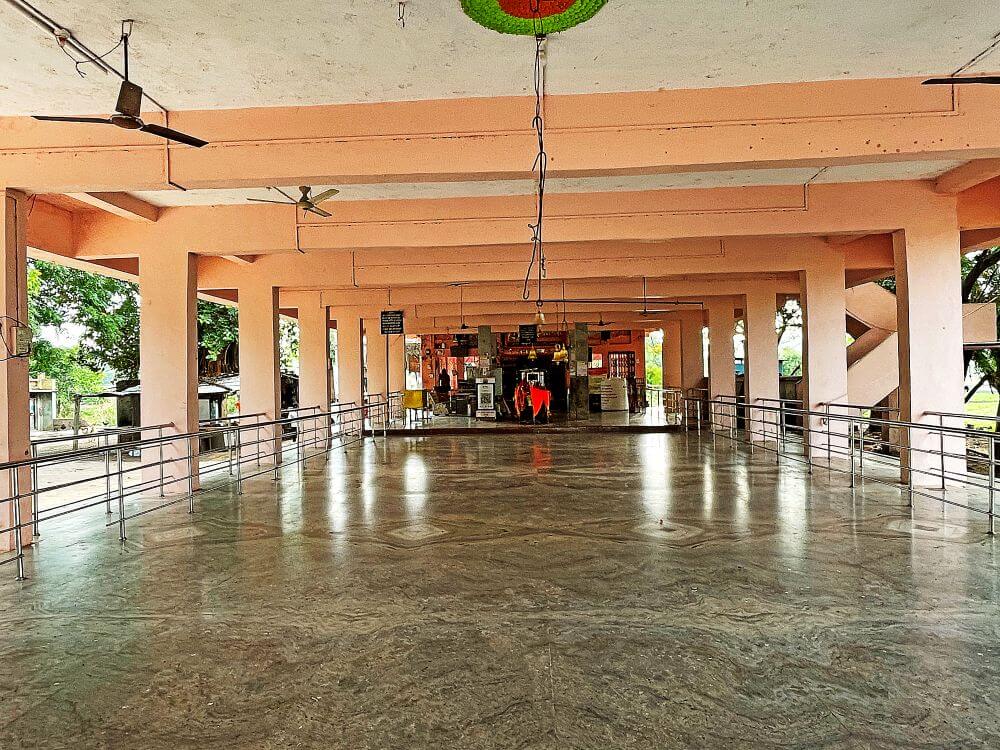
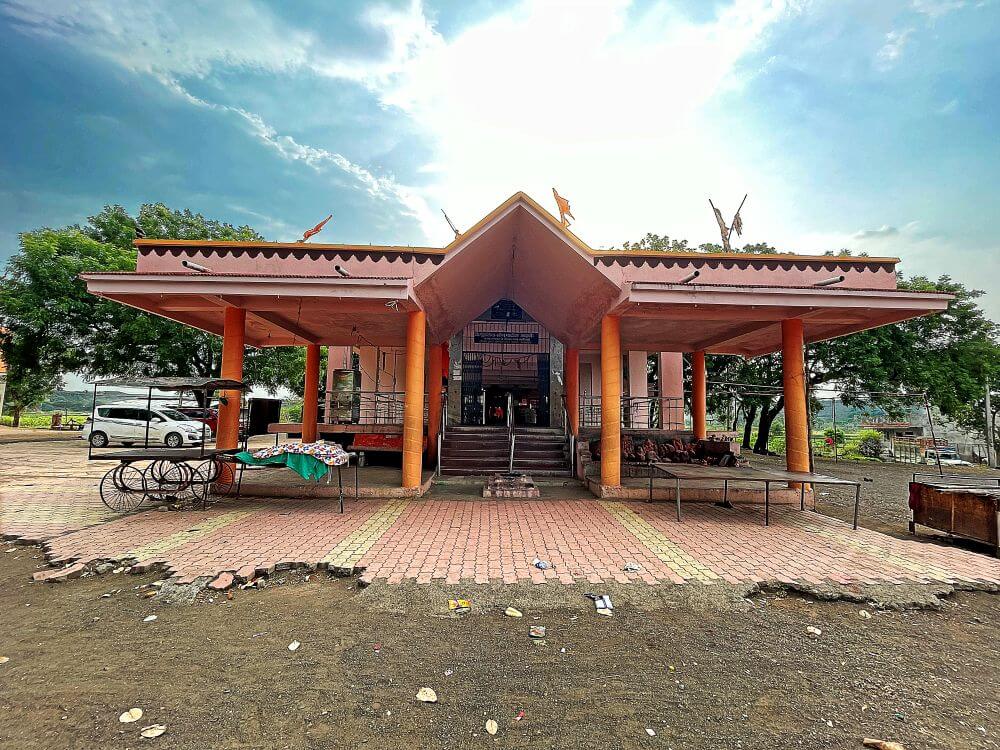
As one approaches the temple from Bhadaṇe village, there is a welcoming archway on both sides of the road, featuring two square, ornate pillars topped with a balcony. In the center of the balcony, within a cloud-shaped canopy, is an idol of Shri Gaṇapati, surmounted by an ornate spire. After proceeding some distance from here, one enters the temple courtyard, which is paved with paver blocks. Villagers say that this temple of Shri Bhatai Devi is seven hundred to eight hundred years old. After its renovation in the year one thousand nine hundred and eighty-four, the temple has acquired its present form. The temple’s structure comprises a mukhamandapa (entrance hall), a sabhamandapa (assembly hall), an antarāḷa (vestibule), and a garbhagṛha (sanctum sanctorum). The roof of the mukhamandapa, supported by eight circular pillars, slopes in the center and is flat on both sides. There is a yajñakuṇḍa (fire pit) in the mukhamandapa. One enters the sabhamandapa by ascending seven steps from the mukhamandapa. Beside the steps are some ancient sculptures and stones.
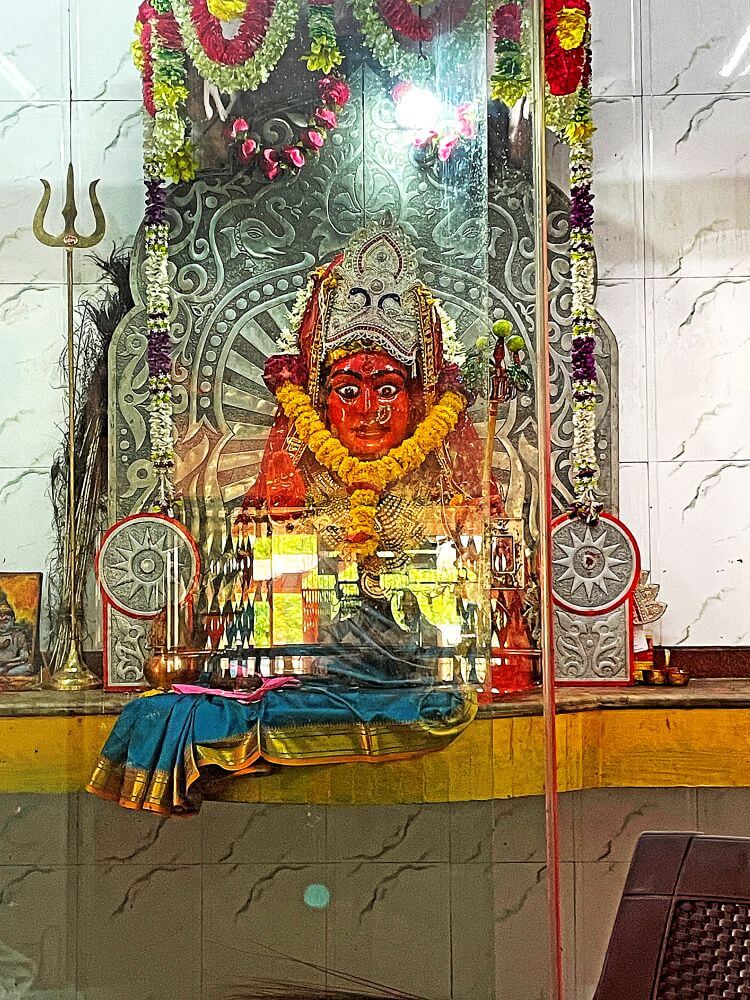
The open-style sabhamandapa has nine square pillars on each outer side. In the center of the sabhamandapa is a tortoise idol made of black stone. Further ahead is the antarāḷa, and beyond that, the garbhagṛha. The entrance to the garbhagṛha has three doorframes adorned with floral and leaf carvings. The laḷāṭapaṭṭī (lintel) of the outer doorframe is crescent-shaped. Inside the garbhagṛha, on a vajrapīṭha (diamond pedestal), is a two-armed idol of Shri Bhatai Devi. The Devi’s left hand holds a triśūla (trident), and Her right hand is in the abhaya mudrā (gesture of fearlessness). The Devi wears a crown on Her head. The Devi’s idol has two depressions on Her chest. In these depressions, two laddu-shaped stones, placed beside the idol, are used to seek a divine verdict regarding childbirth. Devotees believe that if the stone on the right side falls, it signifies the blessing of progeny.
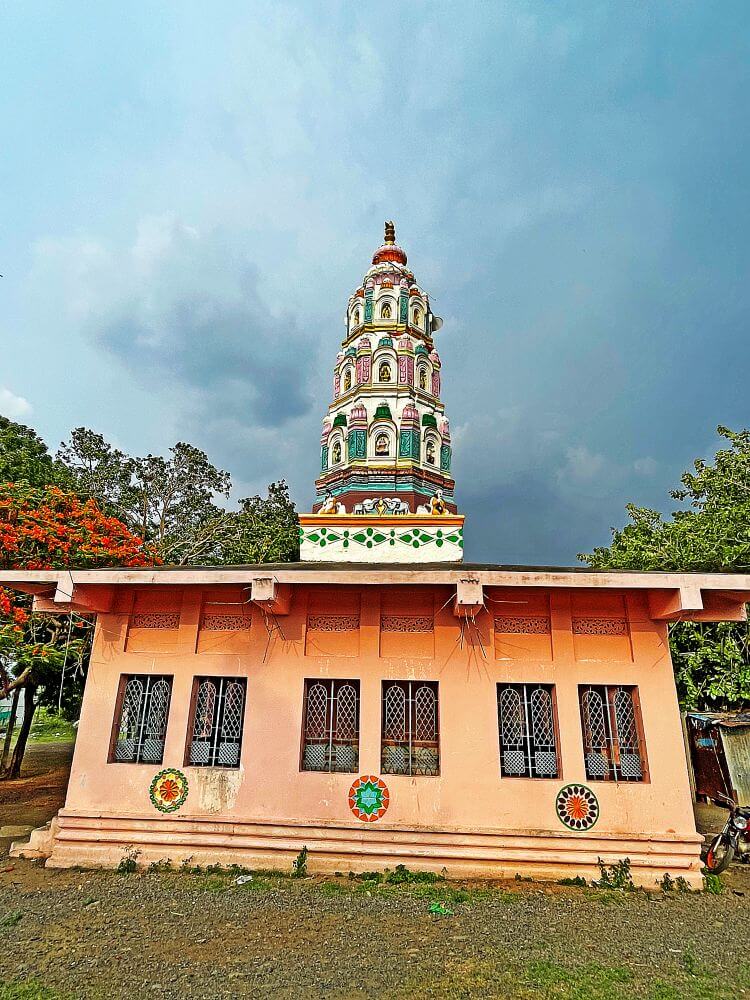
In front of the idol are brass pādukās (footprints), and behind it is an ornate silver prabhāvaḷa (aura). In the prabhāvaḷa, at the bottom on both sides are peacocks, and in the upper part are leaf and floral carvings. In the center at the top is a lotus, and on both sides are majestic elephants. Above the prabhāvaḷa is a chatra (umbrella). The temple roof features a six-tiered śikhara (spire). On all four corners of the square base tier are idols of saints and lotus petal carvings along the sides. In the second octagonal tier, each side has a raised archway with elephant sculptures on both sides. The third, fourth, and fifth tiers each have eight devakoṣṭakas (niches for deities), containing idols of various deities. Each devakoṣṭaka and the ornate pillars on both sides of the koṣṭaka feature raised śikharas and āmalakas (finials). In the sixth tier of the śikhara, there are two āmalakas placed one above the other, topped by a kalaśa (pot finial) and dhvaja patākā (flag banners).
At some distance from the temple is a water well. It is said that Devi’s son Bhaṭu gave up his life in this very well. The well, with its stone parapet, has steps leading down into it. Inside the well’s walls are devakoṣṭakas containing deity images. On the well’s edge are two stone idols, said to be Devi’s sons, Bhaṭu and Goṭu. Devotees believe that women desiring progeny will be blessed with children if they bathe in this well and then, while still wet, have darshan of the Devi.
In the Devi’s temple, festivals such as Chaitra Navarātrī, Śāradīya Navarātrotsava, Śākambharī Navarātra, Dasrā, and Dīpāvalī are celebrated with great enthusiasm. Various programs are organized in the temple during all festivals. During all festivals and family rituals, a naivedya (offering) of varaṇbaṭṭī and brinjal curry, dear to the Devi, is offered. Shri Bhatai Devi is considered the Goddess of welfare. Devotees worship this Devi for peace and happiness in the home, health, and prosperity, as well as success in agriculture and business. Devotees visiting for the Devi’s darshan offer a prasāda naivedya of roḍge (baked bread), varaṇ (lentil soup), bhājī (vegetable), and baṭṭe (dumplings) baked over a fire in the temple courtyard. This naivedya is first offered to Shri Bhatai Mata and then to Bhaṭu-Bhaṭi, as is the custom.
This sacred temple stands as a testament to deep spiritual devotion, ancient architectural grandeur, and rich local cultural traditions.
The sanctum sanctorum houses the divine idol consecrated according to ancient Vedic traditions, surrounded by serene courtyards and traditional temple architecture.
Navratri, Maha Shivratri, Annual Temple Jatra & Deepotsav
Compare and book flights, secure top-rated local hotels near the temple, hire reliable guides, and rent cars instantly.
Extend your pilgrimage by visiting other highly sacred temples located nearby.


Add ₹999 more to unlock FREE SHIPPING!
Your sacred cart is currently empty.
Shop Photo FramesFill in your delivery details below to place your order.
Add comment