
Add ₹999 more to unlock FREE SHIPPING!
Your sacred cart is currently empty.
Shop Photo FramesNestled amidst lush green forests, the deep blue sea, and silver sandy beaches, the famous temple of Lord Mahadeva is located at the holy site of Harihareshwar in Shrivardhan taluka. This temple, the family deity (Kuldaivat) of the Peshwas, is a place of faith for millions of devotees. Renowned since ancient times, this sacred site is celebrated as the ‘Dakshin Kashi’. There are historical records of Chhatrapati Shivaji Maharaj, Sambhaji Maharaj, Sarkhel Kanhoji Angre, and many members of the Peshwa dynasty visiting this temple for darshan. A unique feature of this place is the firing of a cannon during the festivals of Mahashivratri and Kalbhairav Jayanti. This tradition has been observed continuously since 1733.
The legend of the temple states that when Vamana asked King Bali for three paces of land, he placed his first step on Earth, the second on Heaven, and the third on Bali’s head. However, there is a different belief in the Konkan region. The second step placed by Vamana is of Harihareshwar. fell upon this sacred land. Because of this, the land is considered even more holy. According to another legend, thousands of years ago, while wandering in search of peace, Sage Agastya arrived in this picturesque region of Harihareshwar. Here, he beheld four Swayambhu (self-manifested) Shiva Lingas, and his mind became tranquil. He performed penance here and consecrated the deities Kalbhairav and Yogeshwari Devi. Consequently, this region became a Siddhasthan (a place of spiritual accomplishment).
The Harihareshwar temple is situated at the very spot where the Savitri River, originating from Mahabaleshwar, merges into the Arabian Sea. While the exact period of the temple’s construction is unknown, it is believed to have been built during the latter part of the medieval era. The temple that stands today on the site of the ancient structure is said to have been erected by the Bhat family of Shrivardhan, who had the honor of becoming the Peshwas of Swarajya. In 1723 A.D., the temple was nearly destroyed in a fire. At that time, Bajirao Peshwa (I) completely reconstructed the temple, and Chandrarao More built the pradakshina path (circumambulatory path) around it.
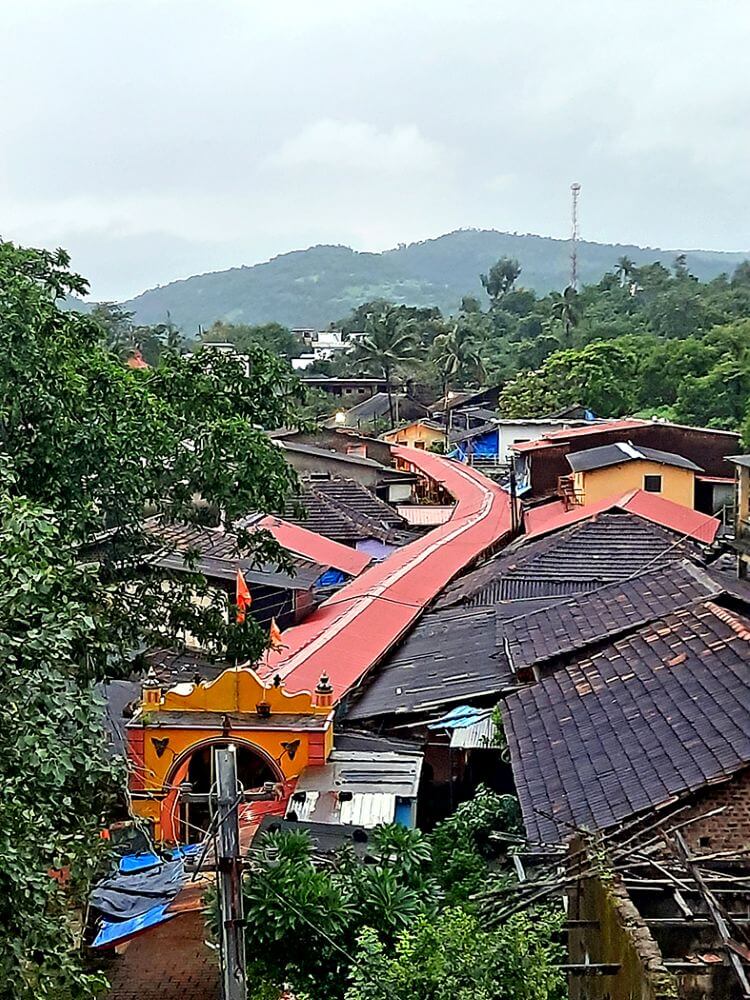
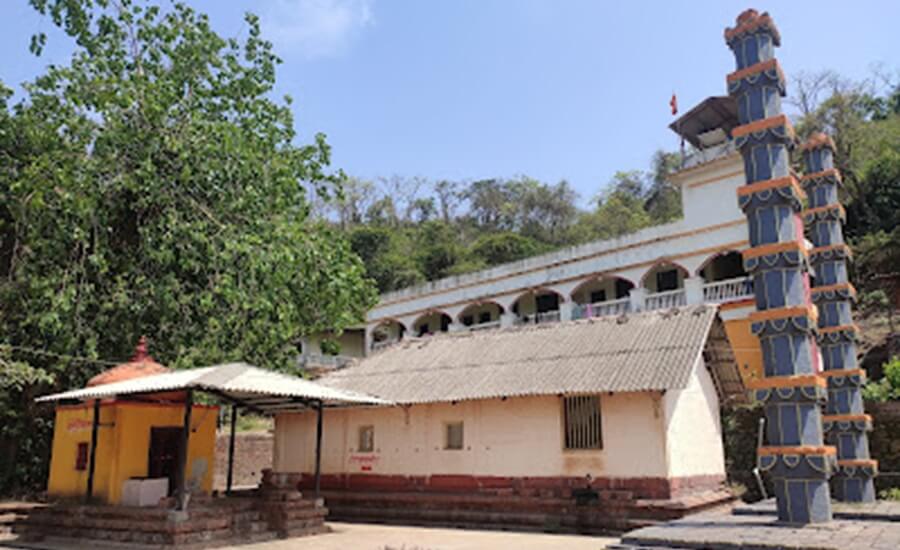
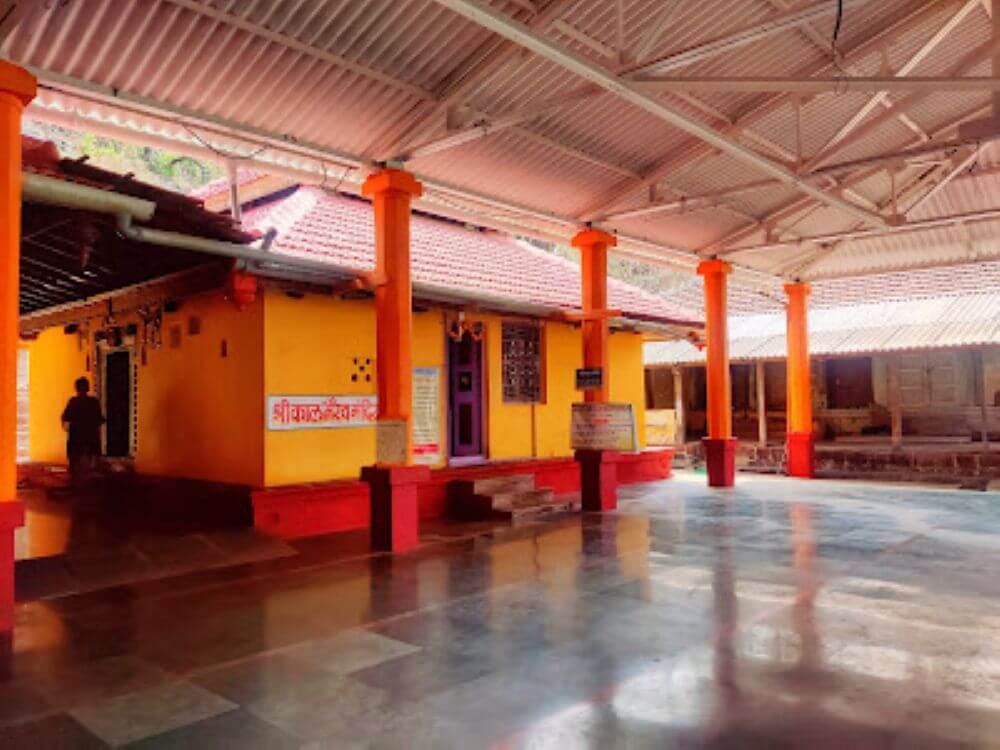
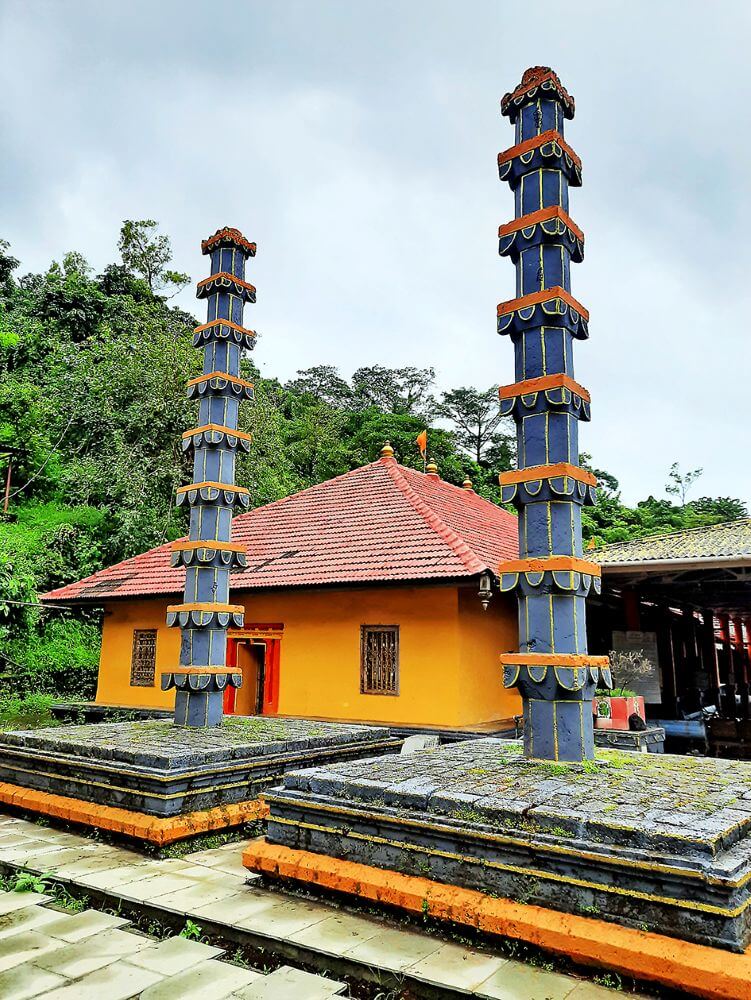
The Harihareshwar temple is situated at the foothills of four hills: Brahmagiri, Vishnugiri, Shivgiri, and Parvatigiri. There are seashores to the north and west of this temple. Due to this natural formation, this place is called ‘Devghar’ or ‘Abode of God’. From the parking area, a paved path made of laterite stone leads through a large archway to the temple. There are many shops selling worship materials along this path. From here, one enters the temple courtyard. In the courtyard, in front of the temple, there are tall lamp pillars (Deepstambhas) on two large platforms. Right in front of them is the two-storied, tiled-roof temple of Harihareshwar, and next to it is the temple of Kalbhairav. Here, first It is customary to have darshan of Kalbhairav, followed by Harihareshwar, and then have darshan of Kalbhairav once again. This sequence of darshan is followed by all the devotees who visit here. A large mandap has been erected in front of both these temples for the convenience of the devotees.
One enters the Sabha Mandap (assembly hall) through the entrance of the Kalbhairav temple, which is situated on a high jagati (platform) above the ground. The temple structure consists of a Sabha Mandap and a Garbhagriha (sanctum sanctorum). A queue system for darshan is arranged in the Sabha Mandap. To seek liberation from evil forces, devotees are seated near an intricately carved wooden pillar in the center of this hall, from where the tradition of ‘Kaul Lavne’ (seeking divine guidance or permission from Kalbhairav) is performed. Kaul is sought here daily between 11 AM and 2 PM. In the Garbhagriha, there are stone idols of Kalbhairav and Yogeshwari Mata. The back slabs behind both these idols are covered with brass plates. These plates feature carvings of dwarpals (gatekeepers), a five-hooded serpent, Kirtimukha, and the Sun. It is said that the significance of the Kalbhairav here is immense. In other temples, the idol of Kalbhairav usually faces south, but the idol here faces north. Devotees firmly believe that by having darshan of this Kalbhairav, one is freed from demonic afflictions.
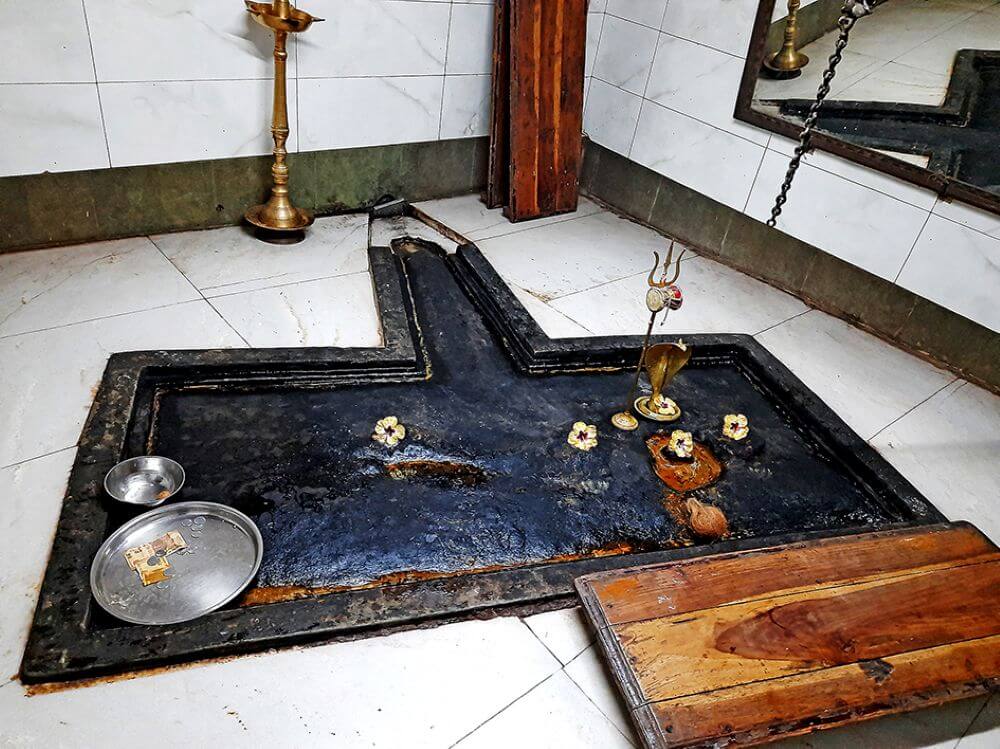
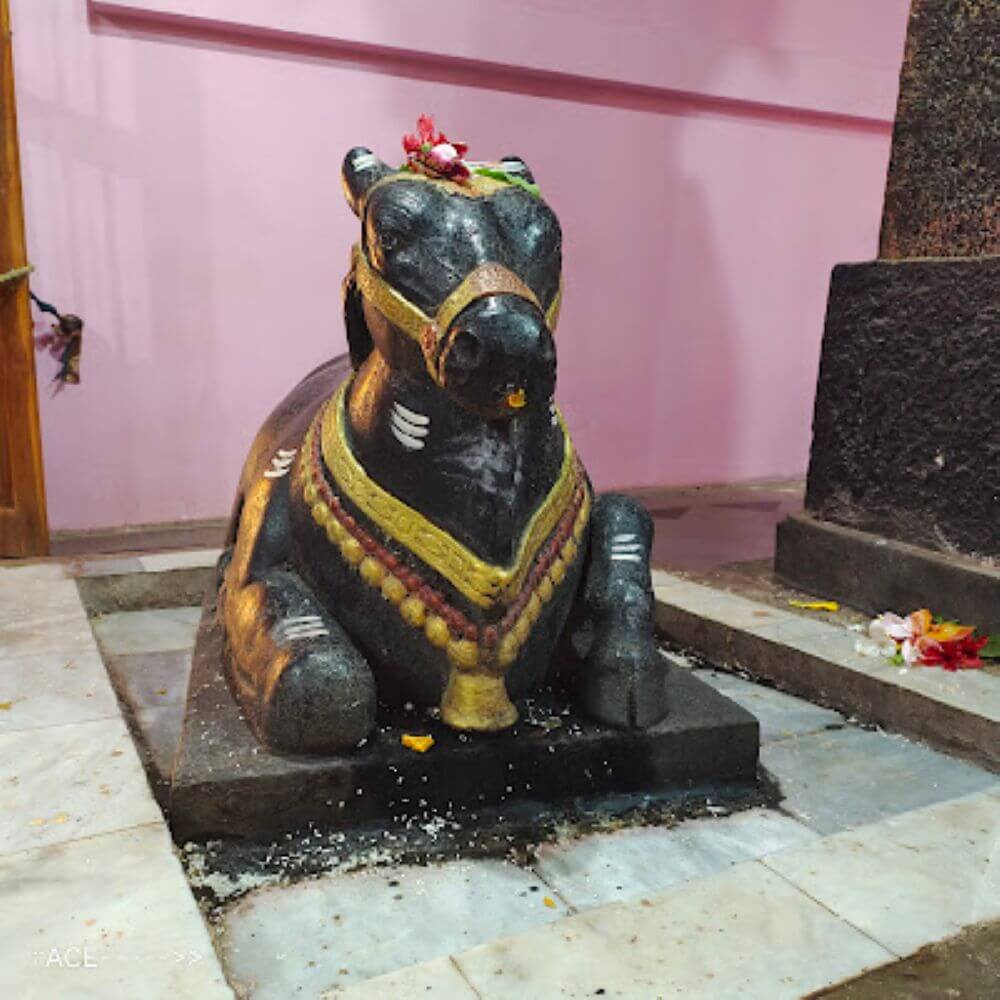
After having the darshan of Kalbhairava, devotees proceed to the adjacent Harihareshwara. devotees come for darshan. Like the Kalbhairav temple, the Harihareshwar temple is also structured with a sabhamandapa (assembly hall) and a garbhagriha (sanctum sanctorum). Upon entering the sabhamandapa from the main entrance, there is an idol of Nandi carved from a single stone on a platform to the left, and an idol of Lord Ganesha on a platform to the right. On the front wall of the garbhagriha, there are sculptures of dwarapalas (gatekeepers) on both sides of the entrance. The garbhagriha here is of the ‘patallingi’ type, meaning it is situated three to four feet below ground level. One can reach this sanctum by descending four steps from the sabhamandapa. The Shiva Pindi (lingam) located here is considered extremely rare. On this large, square-shaped Pindi, the positions of Brahma, Vishnu, Mahesh, and Adimaya Parvati are marked. The four protrusions on the Pindi are believed to be their symbols. These deities, representing the four principles of creation, preservation, destruction, and divine energy, are enshrined here in one place. It is said that due to the penance performed by Sage Agastya, Brahma, Vishnu, Mahesh, and Parvati manifested here in the form of this lingam.
In the temple courtyard, there are shrines dedicated to Lord Ganapati and Lord Hanuman. All these temples feature traditional tiled roofs. There is also a well in the vicinity known as Brahmakupa. It is said that this well was dug by Lord Brahma himself. Although this temple is located on the seashore, the circumambulation path (pradakshina marg) passes over a hill and, in some places, directly through the seawater. Therefore, this circumambulation can only be performed during low tide.
Harihareshwar is considered the most excellent place for granting liberation to restless souls. While post-death rituals are performed in many places today, certain religious texts mention that these rites attain their true purpose only when performed at specific sacred locations. Harihareshwar is one such place. Rituals like Gatishraddha, Narayan Nagbali, and Tripindi Shraddha, intended to liberate restless souls, are performed here. All these rites take place at the Shukla Tirtha. Festivals such as Mahashivratri, Kartik Shuddha Ekadashi, Chaitra Navami, Ashadhi Ekadashi, and Kalbhairav Jayanti are celebrated with great fervor at Harihareshwar. Thousands of devotees visit this temple for darshan every day.
This sacred temple stands as a testament to deep spiritual devotion, ancient architectural grandeur, and rich local cultural traditions.
The sanctum sanctorum houses the divine idol consecrated according to ancient Vedic traditions, surrounded by serene courtyards and traditional temple architecture.
Navratri, Maha Shivratri, Annual Temple Jatra & Deepotsav
Compare and book flights, secure top-rated local hotels near the temple, hire reliable guides, and rent cars instantly.
Extend your pilgrimage by visiting other highly sacred temples located nearby.


Add ₹999 more to unlock FREE SHIPPING!
Your sacred cart is currently empty.
Shop Photo FramesFill in your delivery details below to place your order.
Add comment