
Add ₹999 more to unlock FREE SHIPPING!
Your sacred cart is currently empty.
Shop Photo FramesThe beautiful temple of Kalambadevi, a Goddess in whom countless devotees have immense faith as the one who rushes to answer the calls of her devotees and fulfills their vows, is located in Digas. A unique feature of this temple is that Dussehra is celebrated here with great fervor; however, it is observed on the ninth day of Navratri instead of the tenth day (Ashwin Shuddha Dashami). On this day, the divine wedding ceremony of the deities is also performed with great pomp and traditional music.
Kalambadevi is considered a form of the primordial energy, Durga. The Puranas describe two forms of Durga: the fierce (Raudra) and the gentle (Saumya). In her Chandi form, she is found with four, eight, ten, or eighteen arms. The idol of Kalambadevi at Digas is four-armed and holds weapons. Sarkhel Kanhojiraje Angre had immense devotion to Kalamba Devi. She is the family deity (Kuldevata) of the Angre clan and the village deity (Gramdevata) of Alibaug in Raigad district. The family of Kanhoji Angre originally hailed from Kalose in Pune district, but Kanhoji was born in the village of Harne in Ratnagiri district. Due to the valor displayed by him and his naval fleet along the Konkan coast, Chhatrapati Rajaram Maharaj honored him with the title of ‘Sarkhel’. Temples of Kalambadevi, the revered deity of the valiant Angre family who held sway over the Konkan coast, are found in many villages across the Konkan region.
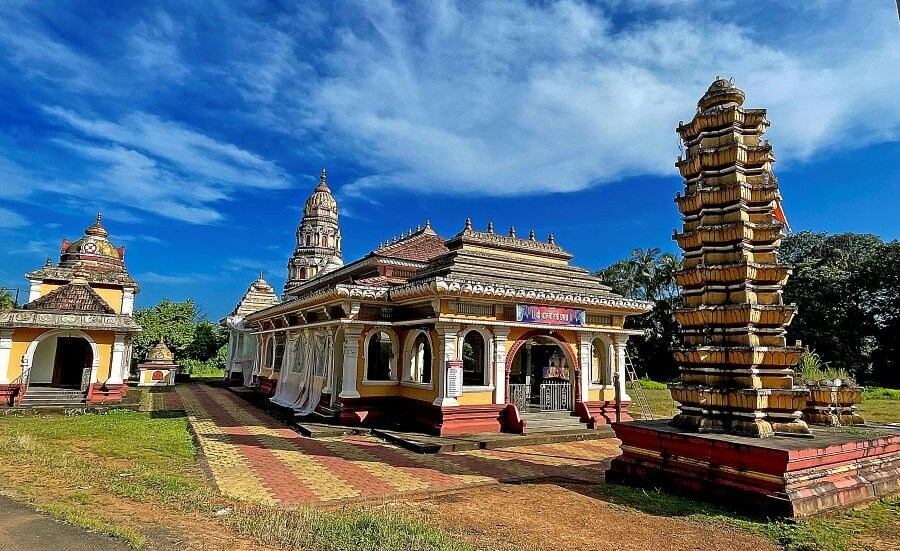
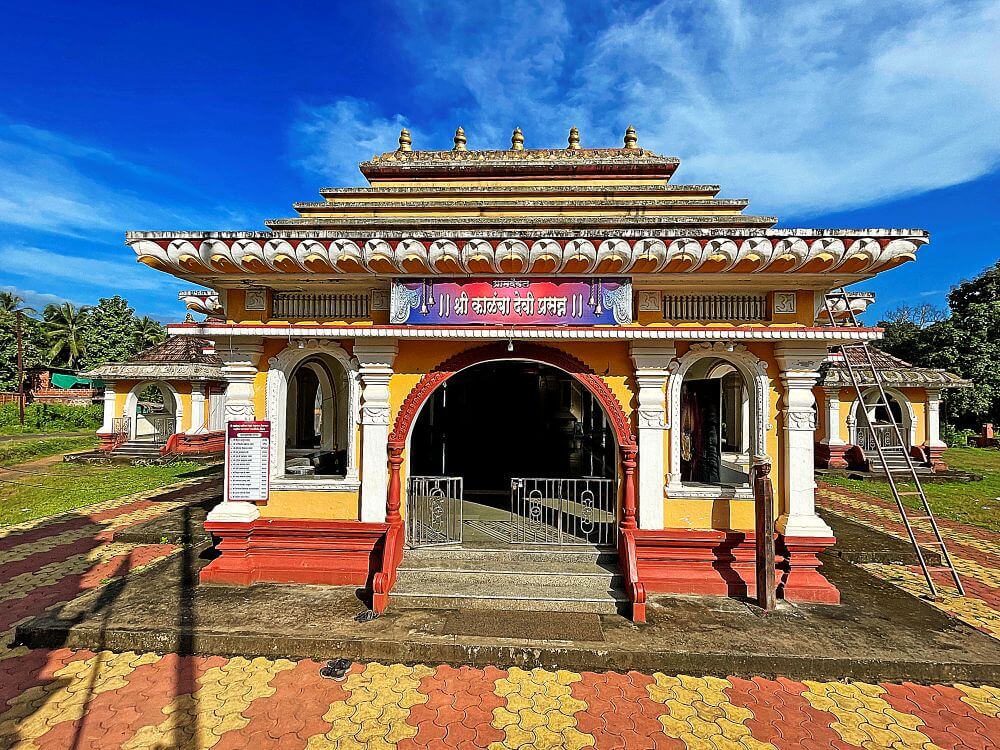
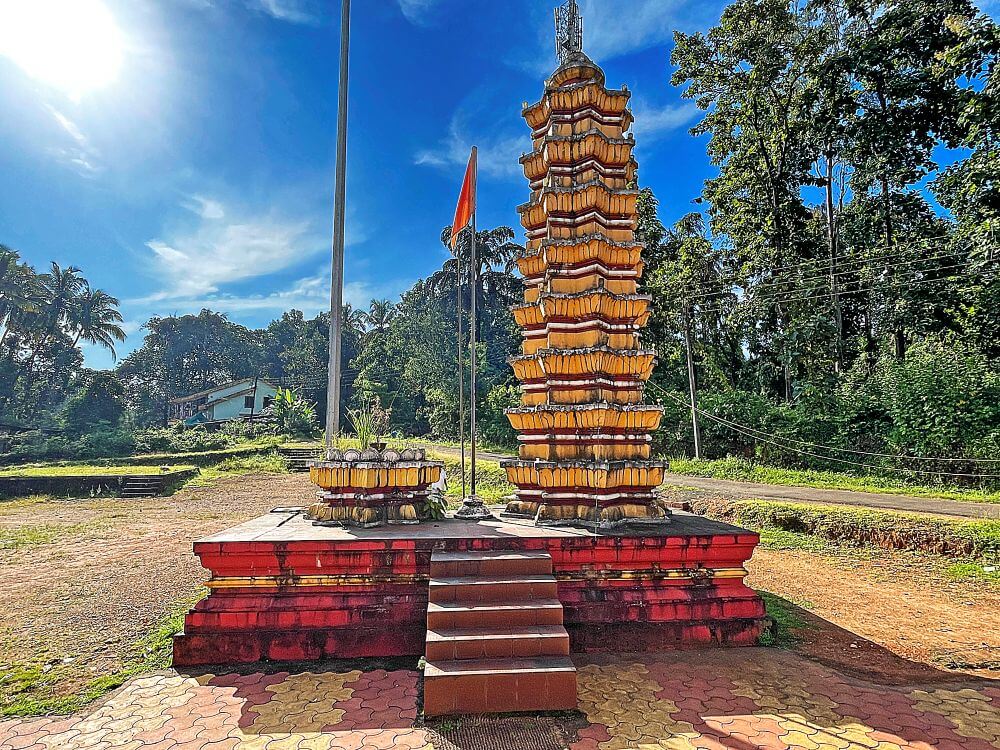
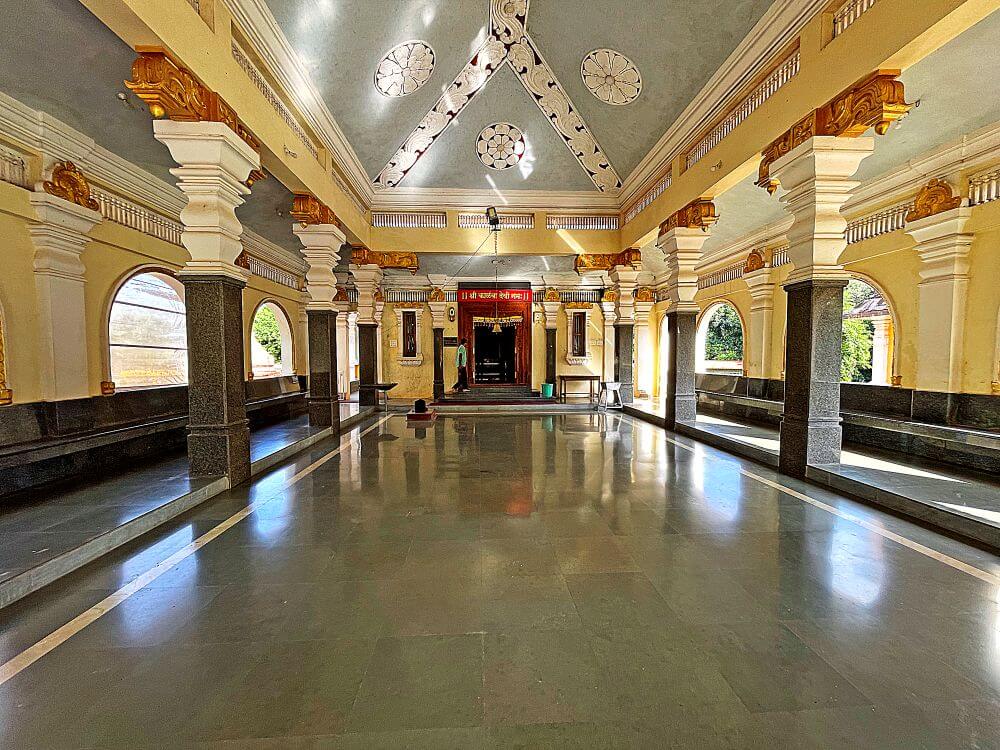
The Kalambadevi temple at Digas is grand and of modern construction. In front of the temple, on a large platform, stands an eight-tiered lamp pillar (Deepmal) topped with an Amalaka. Beside the lamp pillar on the platform is a Tulsi Vrindavan. The temple structure consists of a Mukh-mandap (entrance hall), Sabha-mandap (assembly hall), Antaral (vestibule), and Garbhagriha (sanctum sanctorum). The Mukh-mandap and Sabha-mandap here are semi-open in nature. Instead of outer walls, there are benches (Kakshasanas) for devotees to sit. The Mukh-mandap has a pyramid-like shikhara topped with five small finials (Kalash). The tiled Sabha-mandap also has seven finials. There are several pillars in the center of the Mukh-mandap and Sabha-mandap. At the top of these pillars are sturdy, intricately carved beams. These beams are painted gold, making them stand out even more. According to Konkani architectural style, the central rectangular part of the Sabha-mandap is a few inches lower than the surrounding floor. Near the entrance of the Antaral, on a small platform slightly raised from the ground, are the local deities, their footprints (Padukas), and a Nandi made of black stone. One enters the Antaral by climbing five steps from the front of the Sabha-mandap. The entrance to the Antaral is made of wood and features characteristic floral carvings. A Ganesha idol is carved into the wood on the lintel of this entrance. This Antaral is enclosed and designed with a circumambulation path (Pradakshina marg) around the Garbhagriha. In the Antaral, on one side, are the Tarangkathis (processional poles) of five deities.
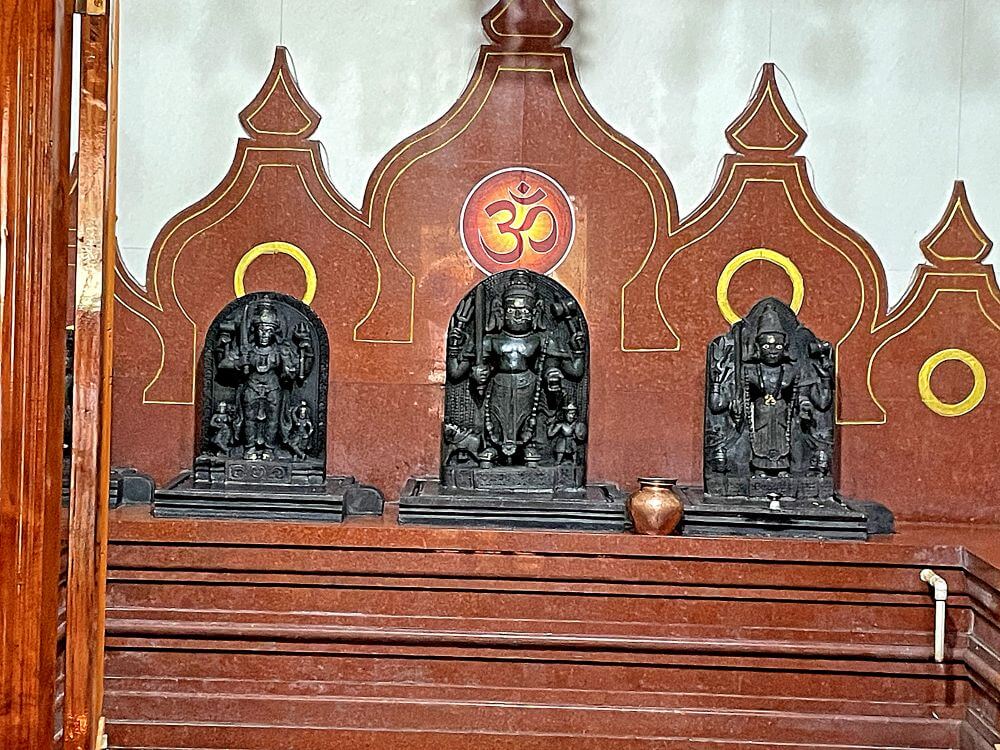
Like the Antaral, the door frame of the Garbhagriha is also wooden and intricately carved. An ‘Om’ is carved on the lintel of this door frame. In the Garbhagriha, on a high marble pedestal, stands the black stone idol of Kalambadevi along with other family deities. Kalambadevi is considered the sister of the deity Ravalnath. Above the Antaral is a dome-shaped shikhara, which features an Amalaka and a finial. The main shikhara of the temple is over the Garbhagriha. This shikhara has several niches (Devakoshthakas) and is topped with a large Amalaka and a beautiful brass finial.
It is a tradition to celebrate the Dussehra festival in this temple every year on the ninth day of Navratri. On this day, rituals include the worship of the deities and the ‘Rujavan’ ceremony, where five types of grains are sprouted and offered to the Goddess. During this time, a procession of the Tarangkathis, known as the ‘Devanchi Vari’, is taken out. Similarly, the wedding of the deities is performed here, known as ‘Shivalagna’. This grand ceremony takes place outside the temple. During the wedding, an antarpat (cloth) is held between the Tarangkathis, and Mangalashtakas (wedding hymns) are chanted. Akshata (sacred rice) is showered upon the deities. After the wedding, ‘gold’ (Shami leaves) is symbolically looted amidst the sound of drums. There is a Shami (Apta) tree in the temple premises. The villagers enthusiastically collect the Shami leaves and exchange them with each other while embracing. Following this, the deities from the temple are taken in a procession to visit the Lingeshwar temple. Villagers attend this Vijayadashami celebration, held on Ashwin Shuddha Navami, in large numbers.
Similarly, the annual fair (Jatra) is an important festival here, held on the thirteenth day of the dark fortnight of Margashirsha. On this day, the Goddess is offered an ‘Oti’ (a ritual offering), and the deities are worshipped. In the evening, a Dashavatar play is performed. During this fair, stalls selling various goods and food items are set up in the area. The entire premises, including the temple, are decorated with electric lights. Many people from the village who have moved away for work or business return in large numbers to attend this festival.
This sacred temple stands as a testament to deep spiritual devotion, ancient architectural grandeur, and rich local cultural traditions.
The sanctum sanctorum houses the divine idol consecrated according to ancient Vedic traditions, surrounded by serene courtyards and traditional temple architecture.
Navratri, Maha Shivratri, Annual Temple Jatra & Deepotsav
Compare and book flights, secure top-rated local hotels near the temple, hire reliable guides, and rent cars instantly.
Extend your pilgrimage by visiting other highly sacred temples located nearby.


Add ₹999 more to unlock FREE SHIPPING!
Your sacred cart is currently empty.
Shop Photo FramesFill in your delivery details below to place your order.
Add comment