
Add ₹999 more to unlock FREE SHIPPING!
Your sacred cart is currently empty.
Shop Photo FramesIn Hindu Dharma, there are many methods of worshipping the Supreme Lord. Although the Supreme Lord is one, He manifests in many forms. In the Hindu culture, which perceives the Divine in all living and non-living beings, each deity is believed to possess unique characteristics and powers. That is why different deities are worshipped for different purposes. Ganesha is known as the deity of wisdom, Lakshmi as the bestower of wealth and prosperity, and Hanuman as the destroyer of obstacles. Apart from this, in many places, Hanuman is also worshipped for the attainment of wealth. One such famous temple is in the village of Arvi in the Dhule taluka. This Hanuman is known as ‘Rokade Hanuman’. Devotees believe that merely by having the darshan of this Hanuman, one attains wealth.
The Rokade Hanuman Temple dates back approximately three hundred years. In recent times, this temple underwent renovation. The legend of this temple is that a merchant in the village had become severely addicted to gambling. Due to his obsession with gambling, his focus on his business diminished, and he began to suffer losses. Gradually, his financial condition became dire. One day, in a state of distress, he came to this temple for the darshan of Maruti Raya and prayed that Maruti Raya would bring prosperity to his business.
He offered prayers. From that day onwards, his business began to flourish. Not only that, but the merchant also recovered the wealth he had lost in gambling. Since then, this deity came to be known as Rokdoba Maruti, the Maruti who bestows wealth (rokad). Every day, hundreds of devotees visit this Maruti to seek the blessing of prosperity.
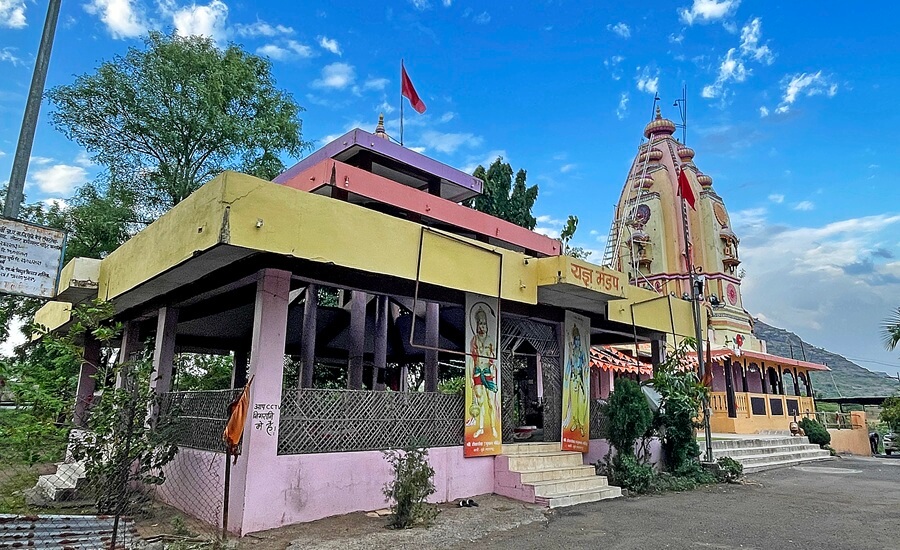
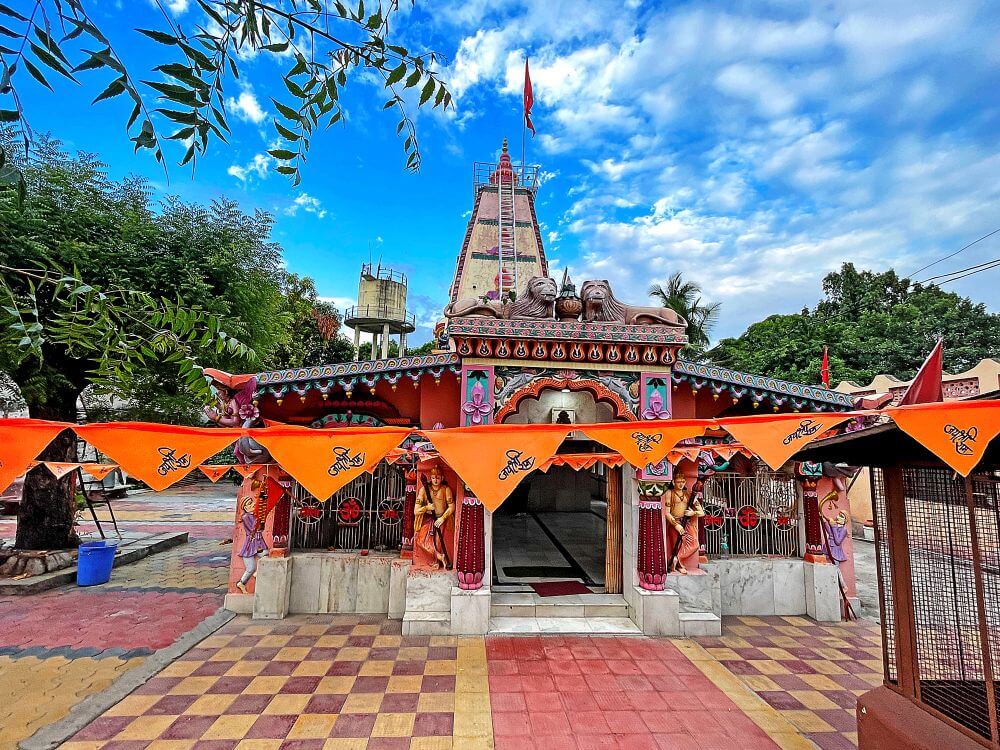
The temple is enclosed by a sturdy boundary wall adjacent to the main road. The entrance consists of two square pillars supporting a horizontal beam. From here, inside One enters the temple courtyard. On both sides of the entrance to the Rokade Hanuman Temple, at the base, there are two circular pillars featuring replicas of lotus flowers and vertical fluted carvings above. Both these pillars are connected to each other by an arched gateway. On the cornice above this arch, there is an auspicious Kalash in the center, with sculptures of lions on both its sides. On both sides of the entrance, there are two-armed gatekeepers holding staffs. At the center of the lintel, there is an idol of Lord Ganapati.
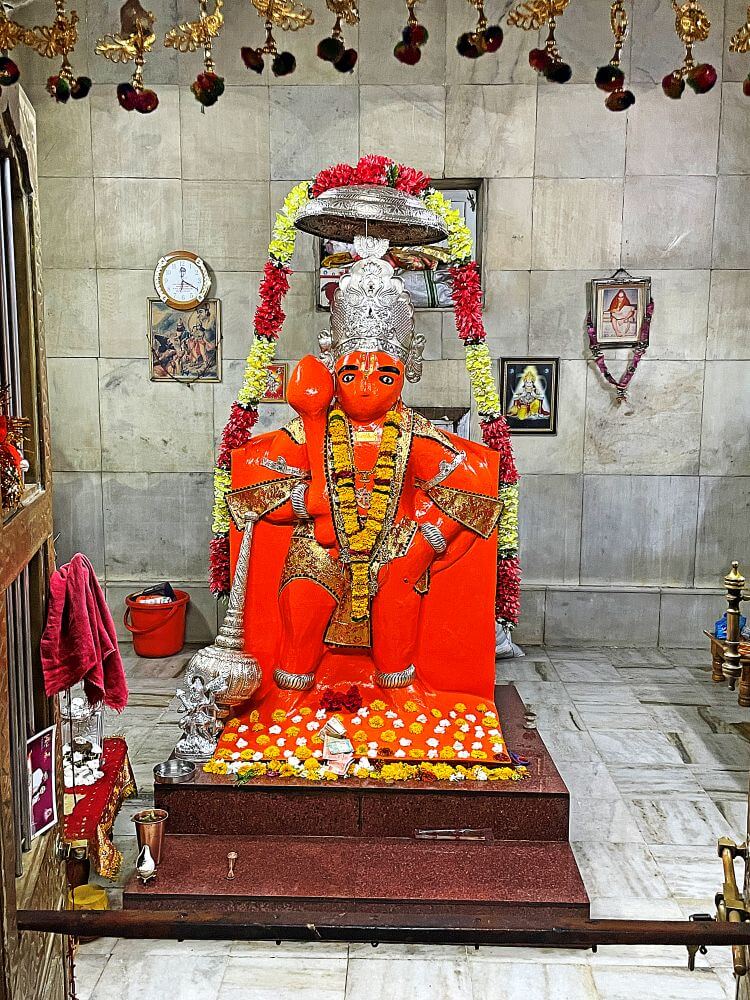
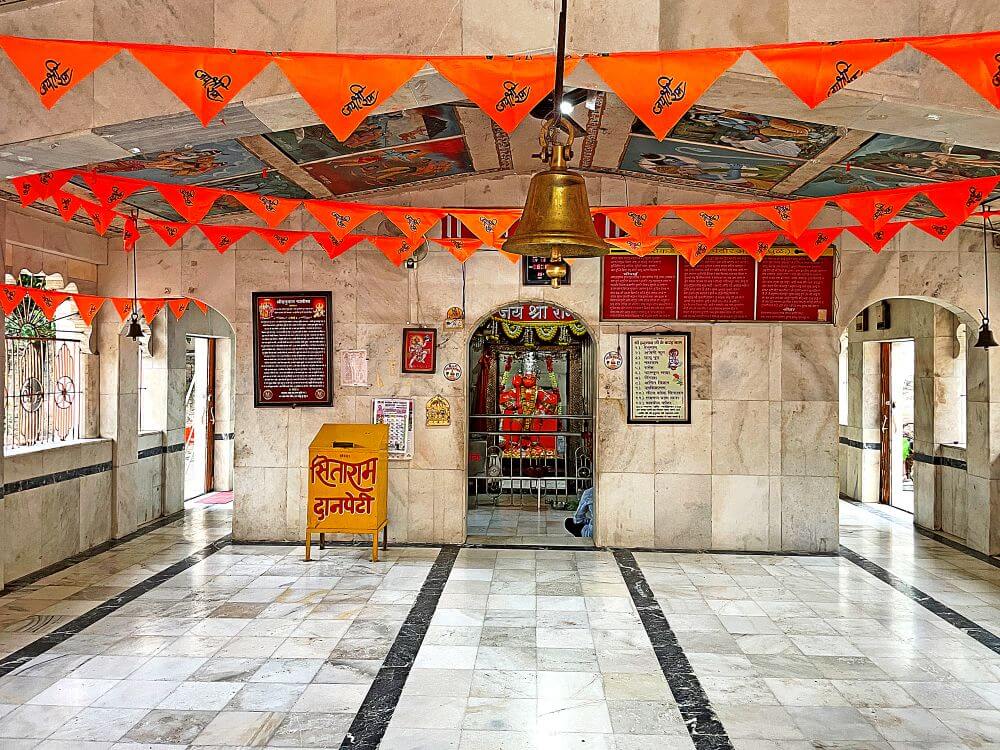
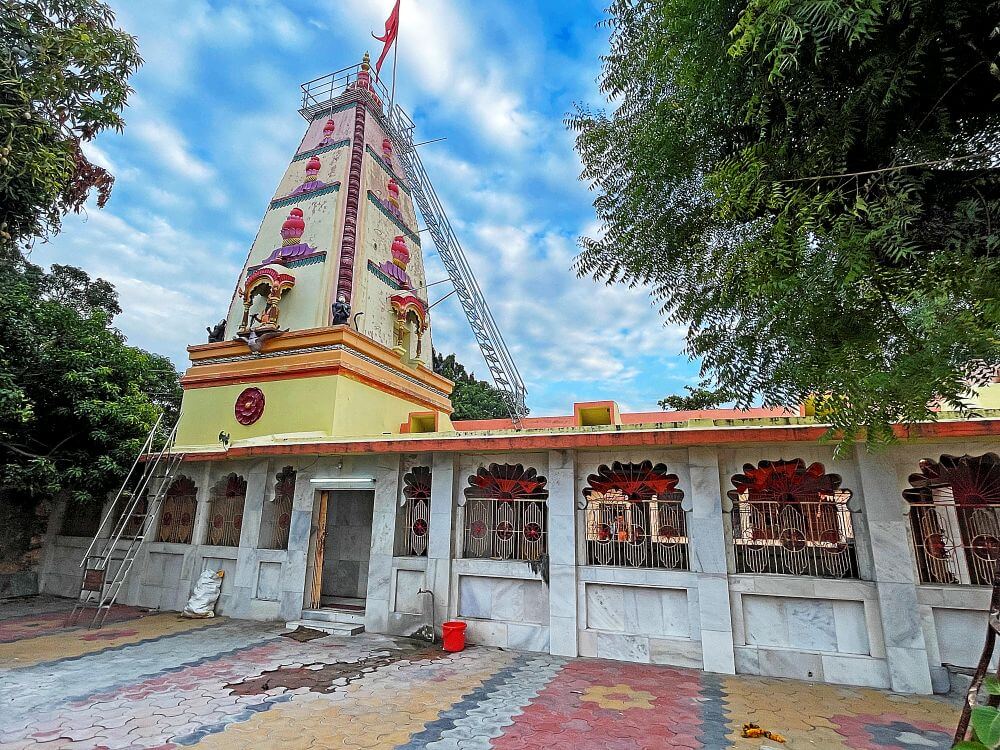
The temple structure consists of a Sabhamandapa (assembly hall), Antarala (vestibule), and Garbhagriha (sanctum sanctorum). The enclosed Sabhamandapa features numerous windows to ensure proper ventilation. Ahead lies the entrance to the Antarala. In the center of the Antarala is the Garbhagriha, surrounded by a Pradakshina Patha (circumambulatory path). On both sides of the Pradakshina Patha within the Antarala, there are doors to exit the temple. Inside the Garbhagriha, upon a Vajrapitha (diamond pedestal), stands the vermilion-anointed idol of Lord Hanuman in a heroic posture. The deity holds a mace in the right hand, while the left hand rests on the waist. A silver crown adorns the head of the deity, with a canopy above. is. Apart from this, there is a large silver mace to the right of the idol. Paintings depicting various episodes from the Ramayana are painted on the ceiling of this temple. Above the sanctum sanctorum, there is a square-shaped spire that tapers upwards, featuring niches for deities on all four sides. On the lower side of the spire, there are monkey sculptures at all four corners. At the top of the spire, there is an amalaka, followed by a kalasha and a flag.
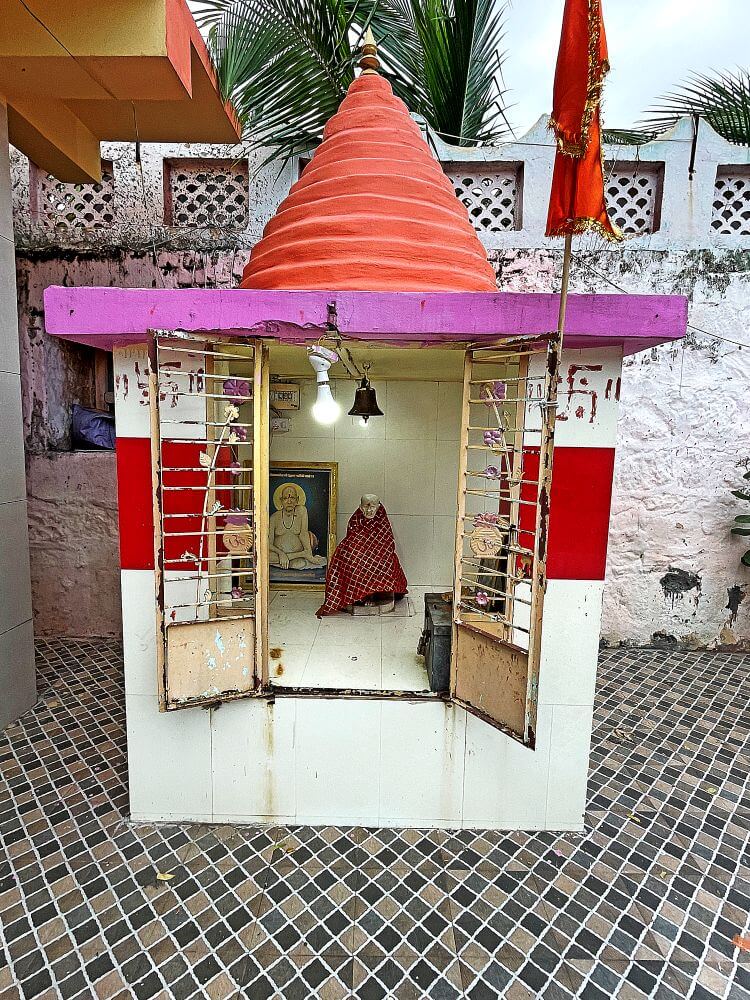
Apart from the main temple, there is a temple of Jwala Mata in the courtyard. On the Vajra-pitha in this temple, there is a four-armed marble idol of Jwala Mata seated on a lion. Next to this temple, there is a Sai Baba temple and some vermilion-smeared stones. In the Yajna Mandap located in the courtyard, there are nine sacrificial pits of different shapes. To allow smoke to escape from the Yajna Mandap, there is a roof divided into two parts, upper and lower, supported by sixteen circular pillars. During festival periods, there is a dining facility available here to organize Mahaprasad for the devotees.
Adjacent to the fortification of the main temple is the temple of Shri Rama. In its sanctum sanctorum, on a diamond-studded pedestal, stand the marble idols of Shri Rama, Lakshmana, and Sita, adorned with fine garments and ornaments. The deities wear silver crowns on their heads, with a halo behind them. To the right of these idols is the idol of Maruti. On the roof of the temple, in the square-shaped spire, there are two niches on each of the four sides, with an amalaka at the top, surmounted by a pinnacle.
Annual festivals such as Hanuman Janmotsav, Ram Navami, Dussehra, and Diwali are celebrated at the temple. During all these festivals, thousands of devotees visit for darshan and to fulfill their vows. As this is Rokad Denara Maruti (the deity who grants wealth), vows related to financial matters are frequently made to the Lord. There is a large number of devotees who visit every Saturday, Tuesday, and for daily darshan. Devotees can have darshan of Rokade Hanuman daily from 8 in the morning until 9 at night.
This sacred temple stands as a testament to deep spiritual devotion, ancient architectural grandeur, and rich local cultural traditions.
The sanctum sanctorum houses the divine idol consecrated according to ancient Vedic traditions, surrounded by serene courtyards and traditional temple architecture.
Navratri, Maha Shivratri, Annual Temple Jatra & Deepotsav
Compare and book flights, secure top-rated local hotels near the temple, hire reliable guides, and rent cars instantly.
Extend your pilgrimage by visiting other highly sacred temples located nearby.


Add ₹999 more to unlock FREE SHIPPING!
Your sacred cart is currently empty.
Shop Photo FramesFill in your delivery details below to place your order.
Add comment