
Add ₹999 more to unlock FREE SHIPPING!
Your sacred cart is currently empty.
Shop Photo FramesIt is the belief of the Sikh community that a Gurudwara is the house of God. The building that houses the ‘Sri Guru Granth Sahib’, the holy scripture of the Sikhs, in its prayer hall is called a Gurudwara. The Guru Granth Sahib is revered just as a human Guru would be. The five Takhts of the Sikhs—Akal Takht (Amritsar), Takht Sri Harimandir Sahib (Patna Sahib), Takht Sri Keshavgarh Sahib (Anandpur), Takht Sri Damdama Sahib (Talwandi), and Takht Sachkhand Sri Hazur Sahib (Nanded)—are considered the most important pilgrimage sites. Apart from these, there are many famous Gurudwaras across the world. The Guru Nanak Sahibji Gurudwara in Dhule is considered one of these significant pilgrimage sites.
Guru Nanak was the founder and the first Guru of the Sikh religion. According to information from the first volume of the book ‘A History of the Sikhs’ by the renowned editor Khushwant Singh, he was born on April 15, 1469, at Talwandi Rai Bhoi (present-day Nankana Sahib). His father’s name was Mehta Kalyan Das Bedi, and his mother’s name was Tripta. At the age of seven, he was sent to a Pandit for primary education. Two years later, he studied Persian and Arabic under a Muslim Mullah. He had a deep inclination toward spirituality. He was married at the age of twelve, but he had no interest in worldly life. He would spend his time with fakirs and religious teachers.
Over time, he moved from Talwandi to Sultanpur. He began working as an accountant for Nawab Daulat Khan Lodi. During this period, his spiritual inclination grew. One morning, while bathing in the river, he had his first divine revelation. According to his biography, the ‘Janamsakhi’, God appeared before him and said, “You are Me . Through you, My glory will spread. Go among the people and teach them how to worship.” During this time, he remained invisible for three days. People thought he had drowned in the river, but he returned on the fourth day. He proclaimed, “There is no Hindu, there is no Musalman.” After that, he renounced everything. He was thirteen years old at the time. Leaving his home, he embarked on pilgrimages. It is said that he also visited Mecca, Medina, and Baghdad.
Throughout his life, he preached the principle of ‘Ik Onkar’, meaning God is One. He rejected the existence of saguna deities as well as demonic powers. He also rejected the concept of the incarnation of God. Guru Nanak taught that the entire universe is the creation of God and that He is self-existent, omnipresent, and unique. The Sikh religion, founded by Guru Nanak, rejected the caste system and idol worship. He preached a religion that emphasized the service of humanity, tolerance, brotherhood, and a focus on righteous living. After completing his four journeys, Guru Nanak came to Kartarpur Sahib. He spent the final 18 years of his life there. It was here, on the banks of the river Ravi, that he gave the message: ‘Naam Japo, Kirat Karo, Vand Chhako’—meaning meditate on the name of the Lord (Simran), work honestly, and share what you have with others. He attained Nirvana in the early hours of September 22, 1539.
There are a total of ten Sikh Gurus, including Guru Nanak. The last of them in human form, Guru Gobind Singh (1666 to 1708), had a close connection with Maharashtra. Guru Gobind Singh spent his final days in Nanded. It was here that he passed away on October 7, 1708. Before that, he ended the tradition of living Gurus and installed the Guru Granth Sahib as the eternal Guru (Guru Ta Gaddi). The Guru Granth Sahib, which contains 1430 pages and 5,894 words, includes the teachings and prayers of Guru Nanak and other Gurus. It also includes the compositions of Saint Namdev, as well as Kabir, Ravidas, and Baba Farid.
There are many holy Gurudwaras across Maharashtra, reflecting the deep connection the Sikh religion has with the state. The Guru Nanak Sahibji Gurudwara at Mohadi is one of them. In 1965, Sant Sadhu Singh built this Gurudwara and managed it throughout his life. After him, Baba Niranjan Singh carried forward his work.
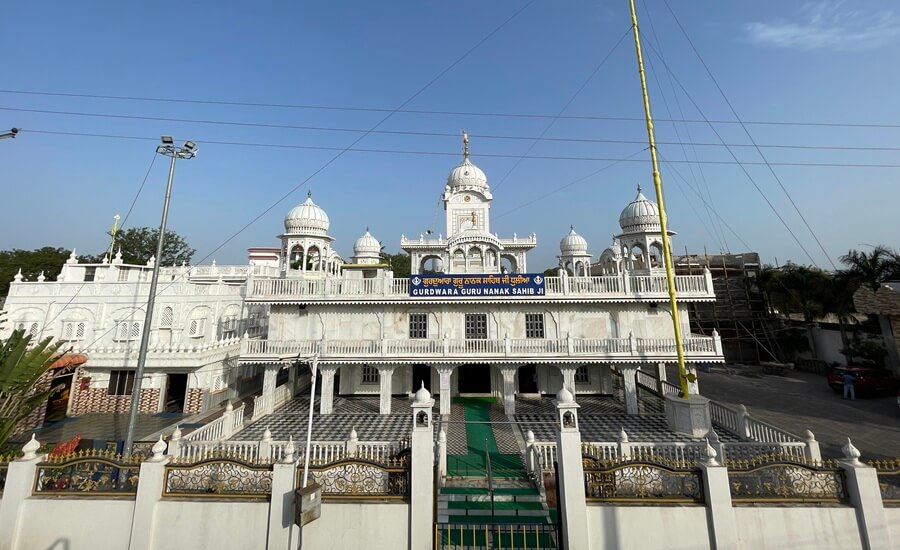
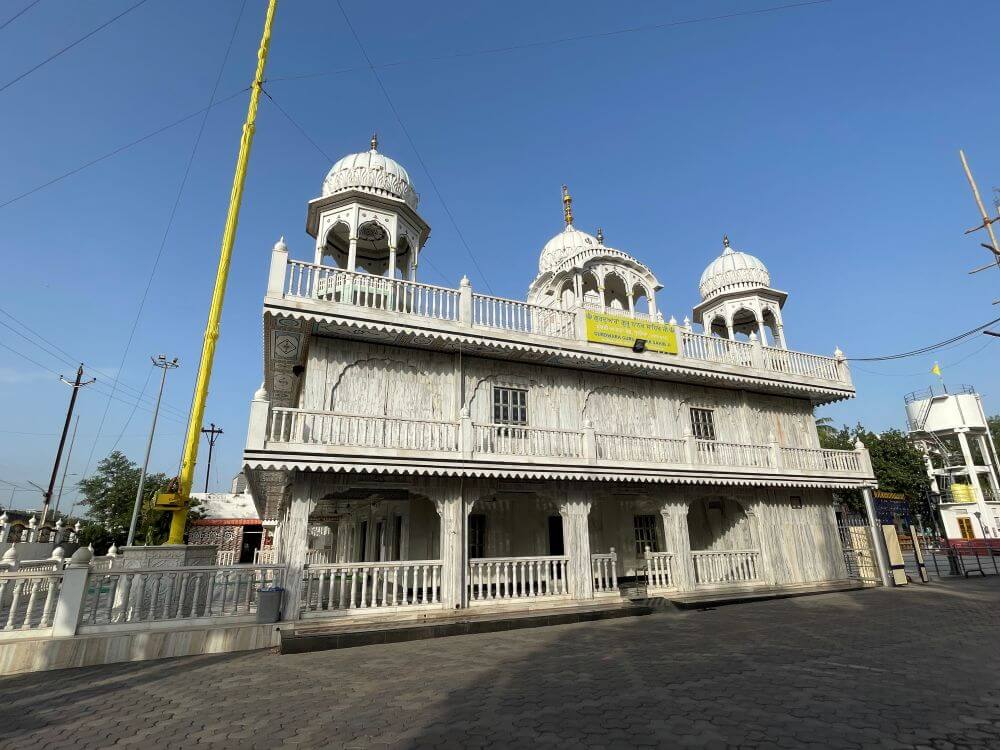
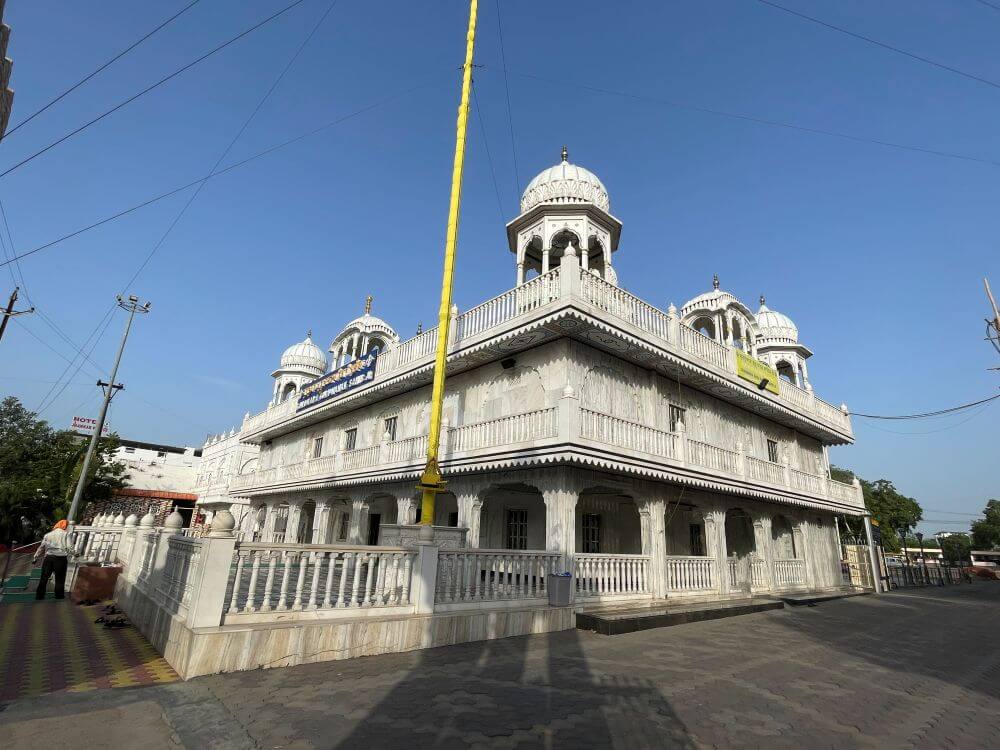
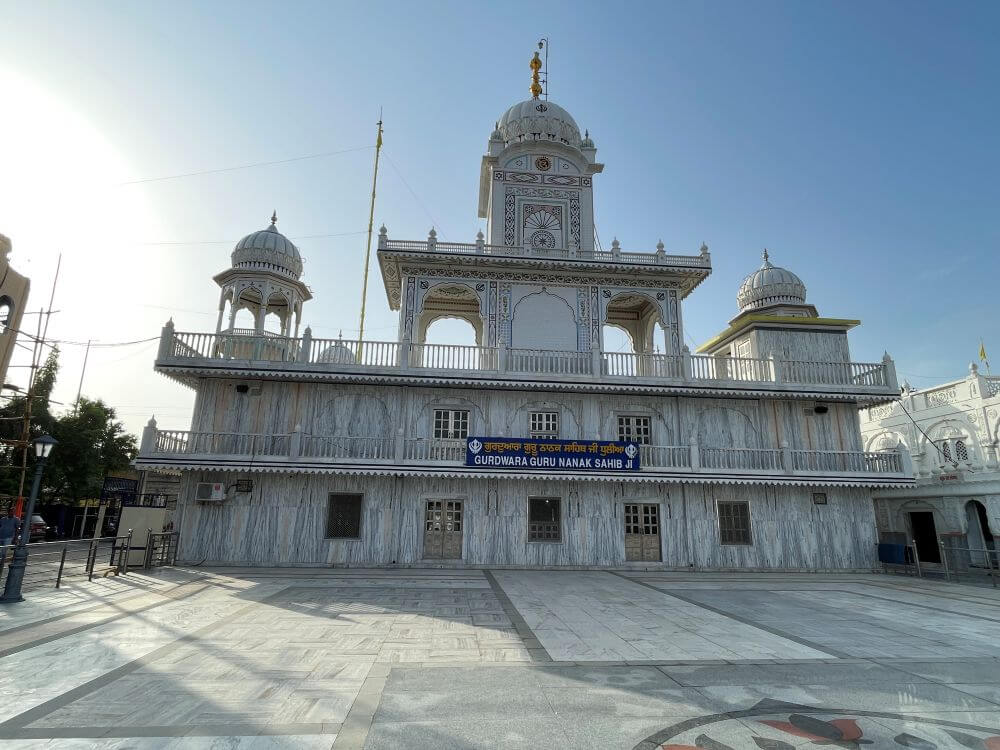
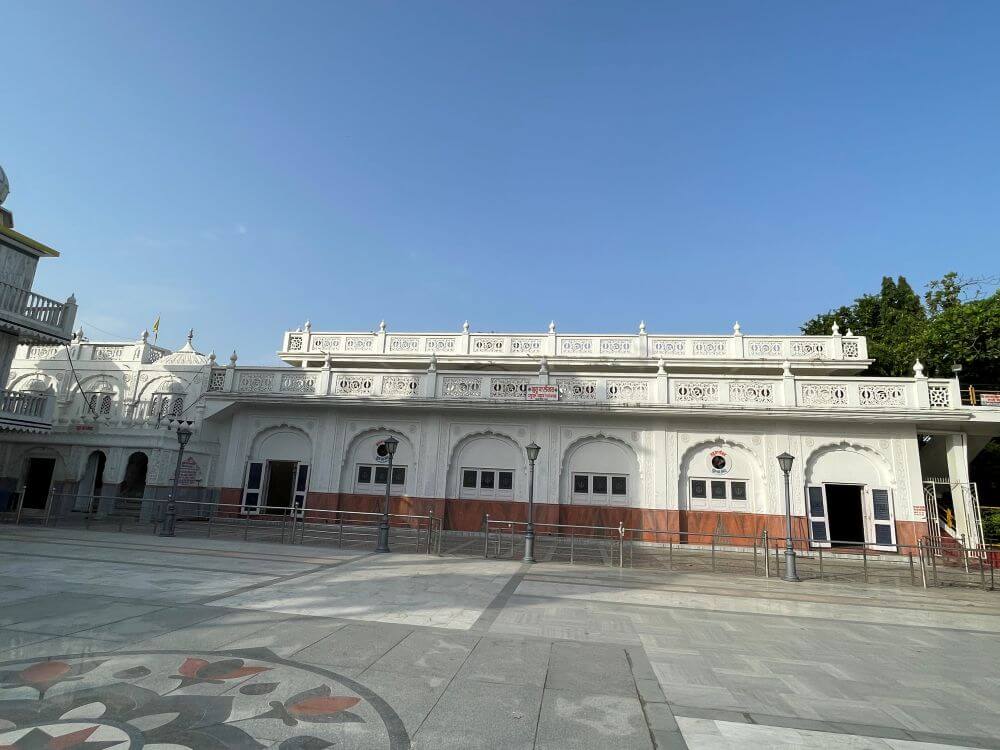
Like all Gurudwaras, this one also has a sturdy perimeter wall. At regular intervals along this wall, there are amalakas on pillars that are about two feet higher than the wall. On both sides of the entrance, there are square pillars topped with chhatris (meghdambari). One enters the courtyard through this gateway. Beyond this lies the Darbar Sahib. The prayer hall of the Gurudwara is called the Darbar Sahib. The construction of this prayer hall beautifully blends ancient and modern architectural styles. The hall has an outer veranda with many ornate pillars. On the brackets of these pillars, there are beams and a balcony above. The balcony on the upper floor also features ornate pillars.
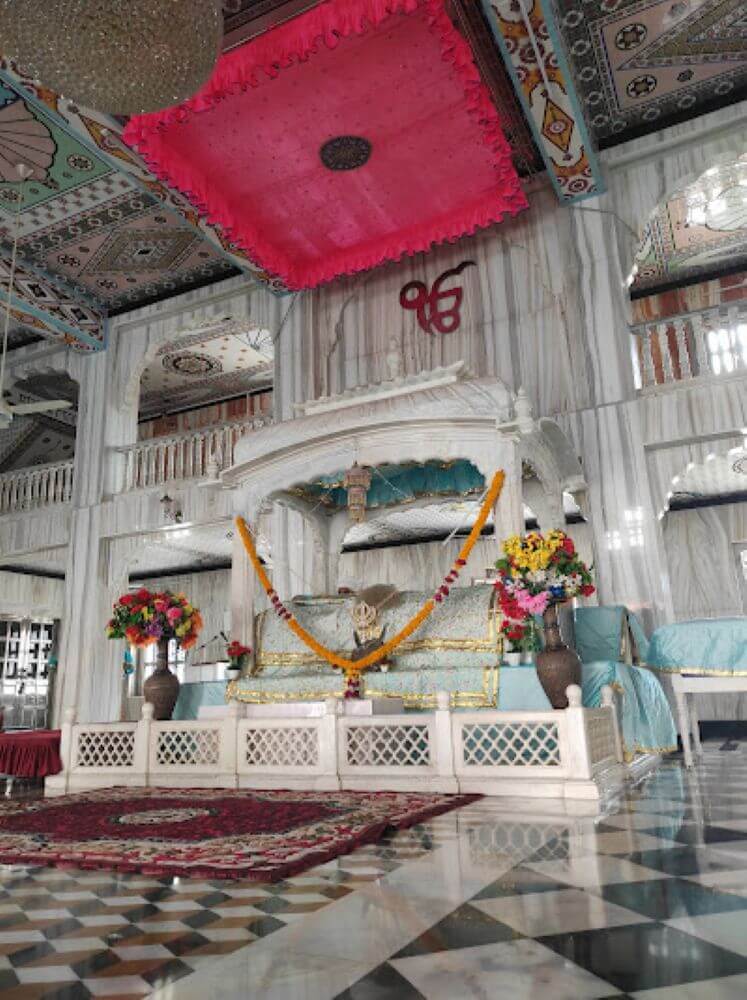
The prayer hall has three entrances on the front side. The door frames, lintels, and arches are decorated with floral motifs. Although people of all religions are allowed to enter the prayer hall, it is mandatory to cover one’s head; therefore, one must cover their head with the head-cloths provided outside before entering. The premises here are beautiful, clean, and serene. The prayer hall features ornate pillars on all four sides. All these pillars are connected to each other by arched designs. The ceiling is adorned with floral patterns, and there is a glass chandelier in the center. This enclosed hall has ventilators to allow for air and light. The entire hall is decorated with intricate work. In the center of the prayer hall, there is an ornate platform made of marble. The platform is topped with a shikhara and a kalash. On the platform, decorated with fine cloth, the Guru Granth Sahib is placed. The bedding on this platform is called Manji Sahib.
On both sides of the platform, there are chauris and chammars (ceremonial whisks). Around the platform, there are lattice railings carved from marble. Directly above the platform, a large glass chandelier and a canopy of fine cloth are hung from the ceiling. At specific times every day, a Granthi (scripture reader) performs a musical recitation of the scripture. Musicians and singers perform the various hymns from the scripture. Devotees of all faiths bow before the holy scripture and offer their prayers.
The Darbar Sahib, or prayer hall, features numerous spires on its roof. The hexagonal spires consist of six pillars connected by arched gateways, topped with a round dome and a kalash (finial). In the center of the roof stands a two-story spire. Below this spire, in the rectangular section, there are four pillars at the corners, supporting a square base, which is topped by a dome and a kalash. Beside the prayer hall is a three-story building. The ground floor of this building houses the Langar, which includes the kitchen and dining hall. Here, Mahaprasad is served to devotees throughout the day. The second and third floors of the building serve as Yatri Niwas (pilgrim accommodation) for devotees.
Kartik Purnima, the birth anniversary of Guru Nanak Dev Ji, is celebrated here with great fervor. A Nagar Kirtan is held, where the Guru Granth Sahib is placed in a palanquin and taken in a procession through the town. A public Langar is organized on this day, where all are served without any discrimination. Baisakhi, the Sikh New Year, is celebrated here as a harvest festival. Prakash Utsav is celebrated to mark the birth anniversary of the tenth Sikh Guru, Guru Gobind Singh Ji.
Additionally, festivals like Diwali and Makar Sankranti are also celebrated. During all these festivals, thousands of Sikh devotees and people of other faiths visit the Gurdwara to seek blessings from the Guru Granth Sahib and offer prayers. The Granthi (scripture reader) recites from the holy book. The Gurdwara organizes Bhajans, Kirtans, music, and Langar.
This sacred temple stands as a testament to deep spiritual devotion, ancient architectural grandeur, and rich local cultural traditions.
The sanctum sanctorum houses the divine idol consecrated according to ancient Vedic traditions, surrounded by serene courtyards and traditional temple architecture.
Navratri, Maha Shivratri, Annual Temple Jatra & Deepotsav
Compare and book flights, secure top-rated local hotels near the temple, hire reliable guides, and rent cars instantly.
Extend your pilgrimage by visiting other highly sacred temples located nearby.


Add ₹999 more to unlock FREE SHIPPING!
Your sacred cart is currently empty.
Shop Photo FramesFill in your delivery details below to place your order.
Add comment