
Add ₹999 more to unlock FREE SHIPPING!
Your sacred cart is currently empty.
Shop Photo FramesThe Tirumala Tirupati Devasthanam in Andhra Pradesh is considered the richest temple in the world after Vatican City in Rome. Every year, millions of devotees from across the globe visit this temple. Situated on the Tirumala hills, this temple is at least one thousand five hundred years old. Along with the Chola and Pallava kings, the Maratha commander Raghuji Bhonsle also contributed to the construction and maintenance of this temple. There are many famous temples of this deity across the country. In that same tradition, the Balaji temple at Shirpur is a place of faith for thousands of devotees in the region.
In the scholarly work ‘Shri Vitthal: Ek Mahasamanvay’, the great researcher Ra. Chin. Dhere has noted that Vitthal of Pandharpur and Venkatesh of Tirupati are deities of the same nature. Both are unrelated to the Puranic incarnations or forms of Vishnu, yet they have attained the status of Vishnu. Vitthal is considered to be Balakrishna, while Venkatesh is known by the name Balaji. Vitthala’s wife, under the pretext of Radha, sat sulking in Dindiravana, whereas Venkatesha’s wife, angered by her husband’s endurance of the insult inflicted by Bhrigu, first stayed separately in Karavira and later in Tiruchanur. The name of Venkatesha’s wife is Padmavati, while the name of Vitthala’s beloved is Padma. Like Vitthala, Venkatesha is also weaponless and silent, resting his left hand on his waist while bestowing blessings upon devotees with his right hand. Such devotees of Balaji are found in large numbers in Maharashtra, just as they are in Andhra.
This temple in Shirpur is approximately one hundred and fifty years old. The story of the construction of this temple is that, in the past, a stream flowed through the middle of Shirpur city, dividing it into two parts: the lower village and the upper village. At that time, there was a Balaji temple in the lower village. During the temple’s chariot festival, the chariot would travel through both villages. Chatur Sheth from the lower village and Ganpat Sheth from the upper village would both perform worship of the Balaji chariot, after which the chariot procession would commence. Once, because Ganpat Sheth was late to arrive for the worship, in his absence The chariot festival was initiated. This wounded the ego of Ganpat Sheth, and he built a Balaji temple in his own village (Varche Gaon) and started an independent chariot festival.
One year, both chariots came face to face in a narrow lane of the upper village, and as neither side was willing to move their chariot back, a major dispute arose. The Tehsildar and police officers spent three consecutive days attempting to mediate a settlement. Finally, on the third day, Ganpat Sheth agreed to move his chariot back. Following this, a solution was reached whereby both chariot processions would be held on different days. Consequently, the chariot procession of the lower village takes place on the day after Dussehra, and the chariot procession of the upper village takes place on the second day after Dussehra. Since then, the tradition of having the chariot of the upper village worshipped by the hands of the judge continues to this day.
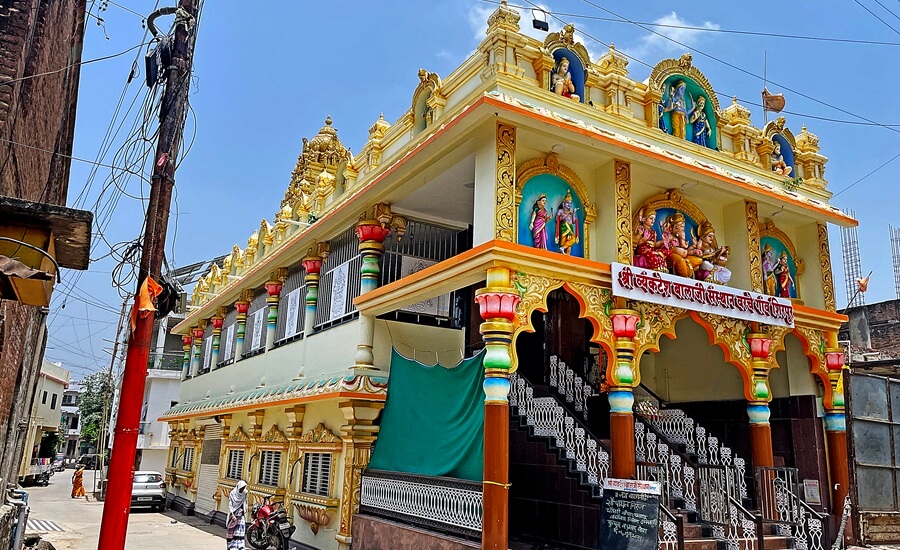
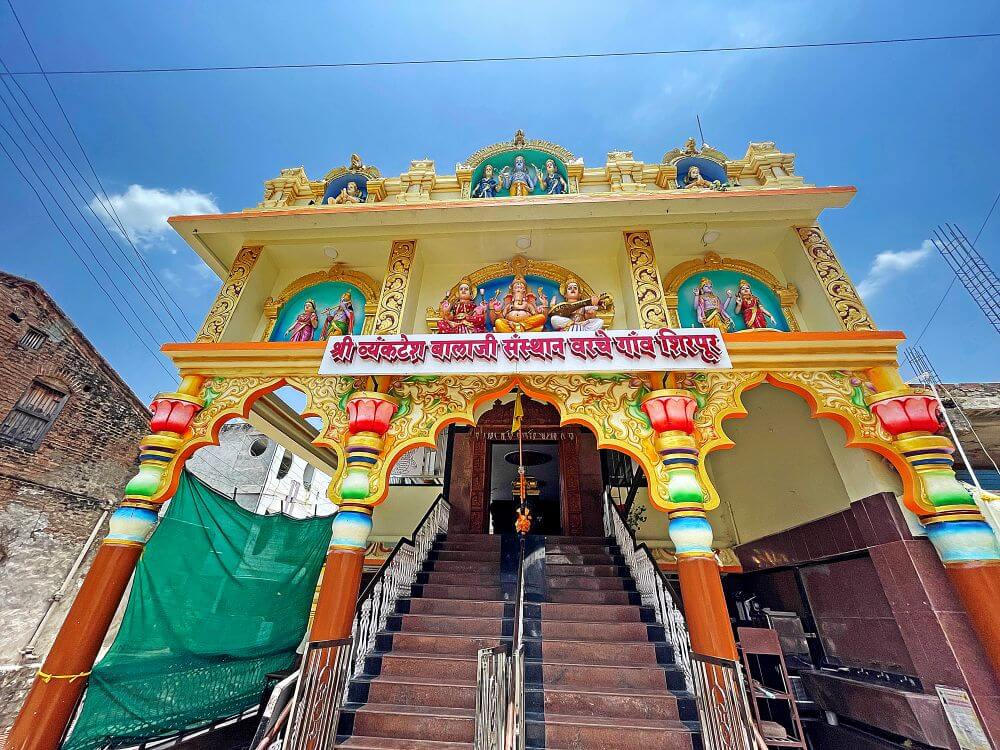
This temple is situated in a densely populated area in the heart of the city. There are 15 steps to reach the main entrance hall (Mukhamandapa) of the temple, which stands about ten feet above the road level. There are safety railings on both sides of these steps. The temple structure consists of a main entrance hall, a two-story assembly hall (Sabhamandapa), and a sanctum sanctorum (Garbhagriha). The front side of the main entrance hall has four circular, intricately carved pillars. There are three niches (Devakoshthakas) on the facade of the second floor. Among these, the central niche houses the idol of Ganapati, while the idols of Lakshmi and Saraswati are placed on the left and right sides, respectively. The niche on the left side contains the idols of Radha-Krishna, and the niche on the right side contains the idols of Vishnu-Lakshmi. All the idols are backed by intricately carved stone slabs.
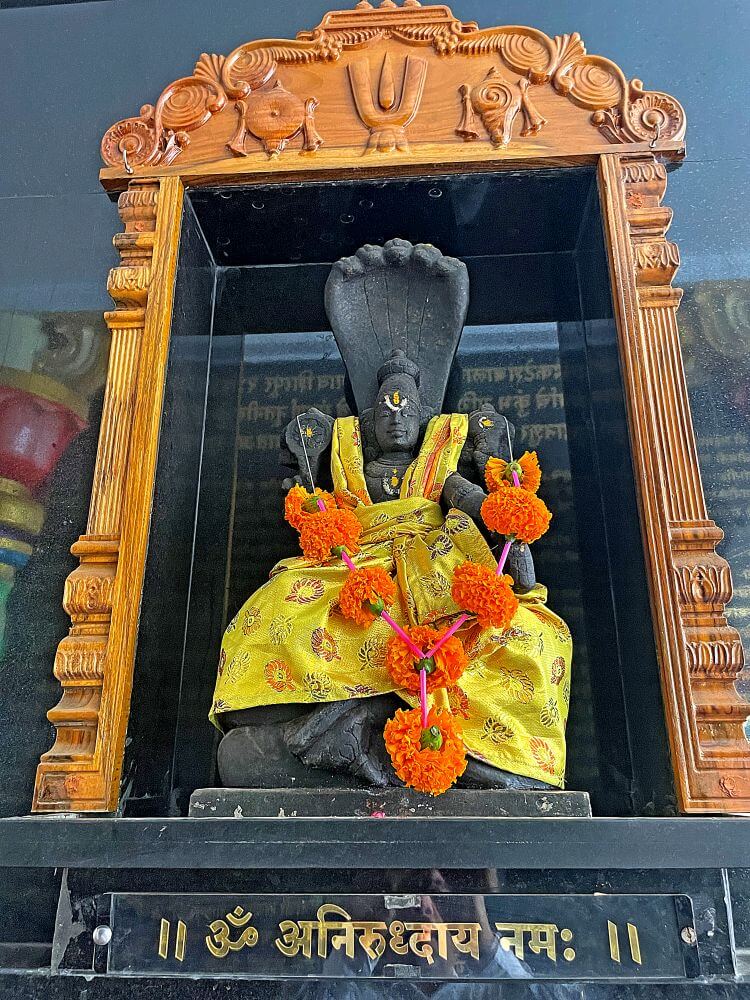
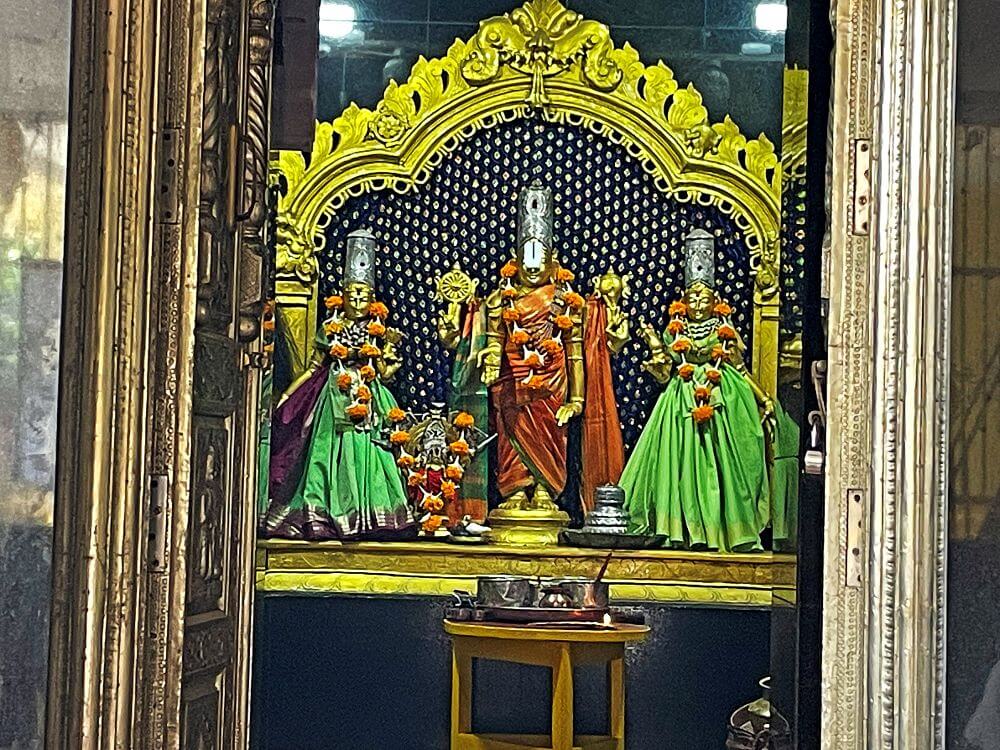
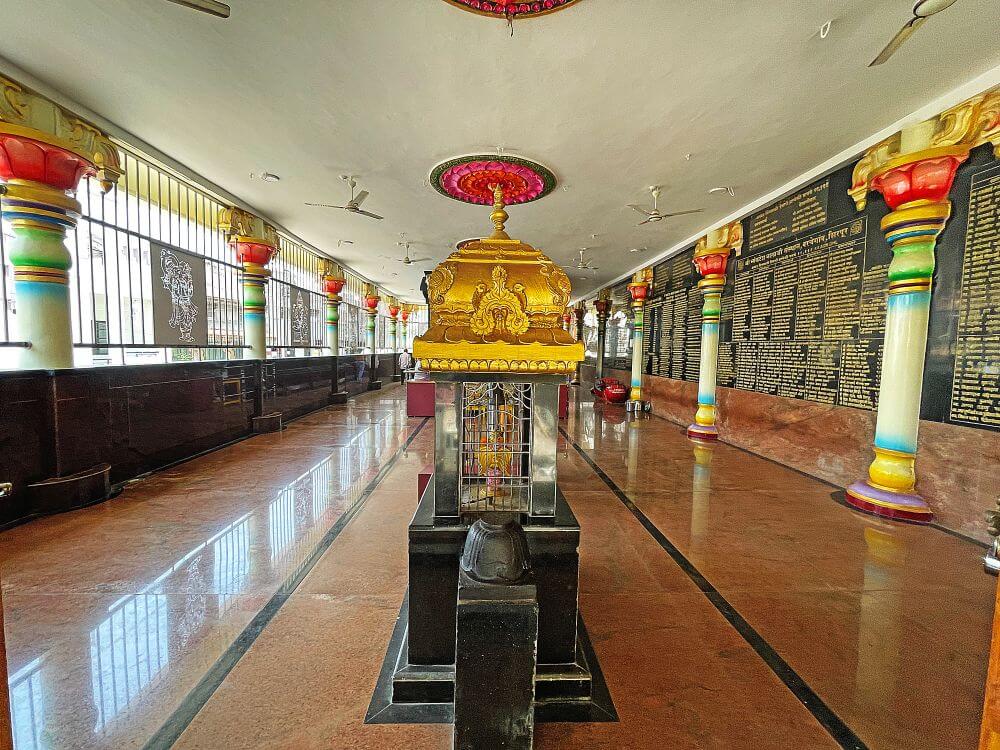
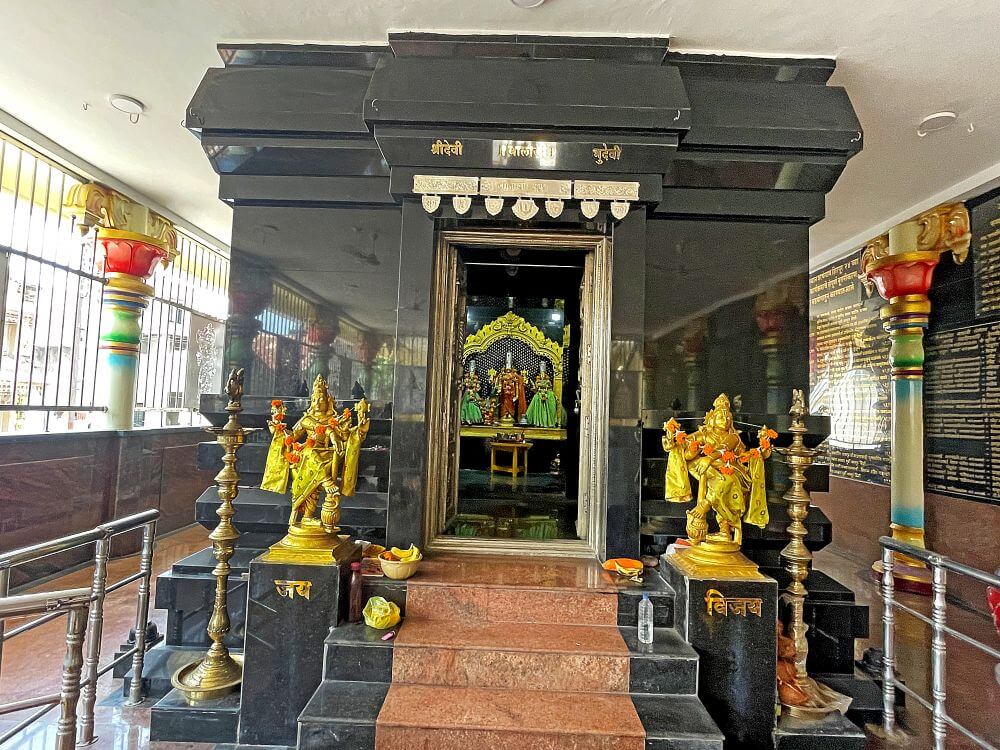
On the wooden door frames of the entrance to the assembly hall, there are vertical carvings, and the face of Lord Balaji is sculpted on the lintel. Inside the entrance, in the assembly hall, there is an ornate canopy with a golden ceiling supported by four pillars. There is an idol of Garuda, the vehicle of Lord Vishnu. In front of the sanctum sanctorum, there is a stainless steel safety railing. From here, devotees must take the darshan of Balaji within the sanctum. On the platforms on both sides of the sanctum’s entrance, there are brass sculptures of four-armed attendant gatekeepers. Inside the sanctum, on a diamond-studded pedestal, are the idols of Sridevi, Venkatesha, and Bhudevi, along with the Utsavamurti (processional idols) beside them. Outside the sanctum, there is a Sandhara-style circumambulation path. Along this path, there are niches in the walls of the sanctum containing idols of various deities.
There is a safety railing on all four sides of the temple roof. Within it, there are idols of various deities in the niches located on all four sides. In the safety railing, there are three niches on the side facing the entrance. Among them, the middle niche contains idols of Balaji, Padmavati, and Lakshmi, while the niches on the right and left sides contain idols of Garuda and Hanuman. The southern-style shikhara on the roof of the sanctum sanctorum features Kuta and Shala architectural carvings. Of the shikhara At the summit is the stupika, upon which rest the kalasha and the dhwajapataka.
From the first day of the bright fortnight of Ashwin until Dussehra, the Brahmotsav of Balaji is celebrated here for ten consecutive days. During this time, special worship of the deity and various religious programs are organized in the temple. On the twelfth day of the bright fortnight of Ashwin, the processional idols of the deity are mounted on a chariot and taken out for a procession through the town. Thousands of devotees gather to participate in this chariot festival. The procession begins amidst the sound of drums and cymbals, with the showering of vermilion powder. In this, the cultural and social organizations of the town present various tableaux. The town procession lasts for more than twenty-four hours, after which the deities are re-installed in the temple.
The five-day Vasantotsav of the Lord, from Chaitra Padwa to Vasant Panchami, is celebrated through the recitation of Vishnu Sahasranama, Shri Sukta, and various other scriptures, along with special worship. Additionally, special festivals are celebrated during the months of Margashirsha, Shravan, and Adhik Maas. The temple witnesses a significant influx of devotees on days such as Ekadashi, Pradosh, Saturdays, Thursdays, Purnima, and Amavasya.
This sacred temple stands as a testament to deep spiritual devotion, ancient architectural grandeur, and rich local cultural traditions.
The sanctum sanctorum houses the divine idol consecrated according to ancient Vedic traditions, surrounded by serene courtyards and traditional temple architecture.
Navratri, Maha Shivratri, Annual Temple Jatra & Deepotsav
Compare and book flights, secure top-rated local hotels near the temple, hire reliable guides, and rent cars instantly.
Extend your pilgrimage by visiting other highly sacred temples located nearby.


Add ₹999 more to unlock FREE SHIPPING!
Your sacred cart is currently empty.
Shop Photo FramesFill in your delivery details below to place your order.
Add comment