
Add ₹999 more to unlock FREE SHIPPING!
Your sacred cart is currently empty.
Shop Photo FramesMany pieces of evidence have emerged from research indicating the ancient tradition of deity worship in Bharat. From the study of ancient scriptures, inscriptions, and oral traditions, it is understood that communities carried their revered deities with them when they migrated. In a similar vein, the ancient and renowned temple of Ashapuri Mata, who came from Rajasthan to Dhule district in Maharashtra, is located at Patan in Sindkheda taluka. Devotees firmly believe that Ashapuri Mata, the Kuldevi of approximately 256 clans, is a जागृत (awakened) deity who grants wishes and removes the troubles of her devotees simply through remembrance.
According to the first volume of the ‘Bharatiya Sanskritikosh,’ edited by Pandit Mahadevshastri Joshi, Ashapuri is a revered deity in Gujarat and Rajasthan. She is the Kuladevata (family deity) for many devotees there, especially for the Panwar community in Rajasthan and the Dudi community among the Jat Sikhs. Ashapuri Devi is also worshipped in the form of Shakambhari Devi. Devotees offer vows to this Goddess for the blessing of children. Significant shrines of Ashapuri Devi are located in Sambhar in Jaipur district, Nadol in Pali district, both in Rajasthan, and at ‘Mata no Madh’ in Kutch district, Gujarat. It is observed that Ashapuri Devi has been established in many central locations with the intention that the family deity’s shrine should not be too far away. As Dhule district borders Gujarat, Ashapuri Devi is a revered deity for many people in this region as well.
The legend of the Devi temple in Patan tells us that in ancient times, a Brahmin gentleman, a most devout worshipper of Ashapuri Devi from Sindkheda, would undertake a pilgrimage every year to Rajasthan for the darshan of Ashapuri Devi. As he grew older, this journey became too arduous for him. Therefore, he earnestly prayed to the Devi, requesting her to accompany him to the town of Sindkheda. The Devi graciously accepted his prayer. She agreed, but with the condition, ‘I will follow you, but you must not look back. If you do, I will become a murti and remain fixed at that very spot.’ The Brahmin accepted this condition. He began walking towards his village. Journeying day by day, when he reached Patan village near Sindkheda city, his faith wavered. He looked back to see if the Devi was truly accompanying him. At that very moment, the Devi became a murti and became fixed there. It was then that the villagers built a temple for the Devi at this spot.
It is said that this sacred shrine of Mother Ashapuri, nestled on the banks of the Burai River, dates back approximately seven hundred years. However, according to the records in the Dhule District Gazetteer, this temple was consecrated in Samvat 1884 (1828 CE). Ashapuri Devi is the revered Kuldevata (family deity) of the Rawal royal lineage of Rajasthan. The Gazetteer mentions that a royal personage from this family graciously donated nine acres of land to the temple here. The temple’s construction was also undertaken by a Rawal king. It is said that this was done.
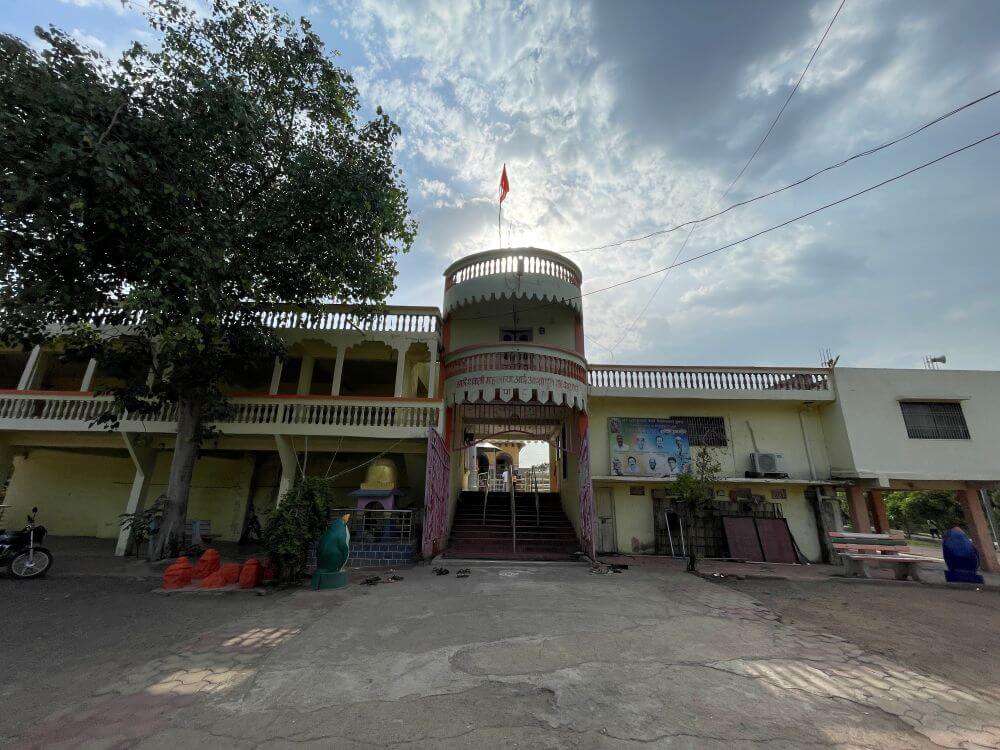
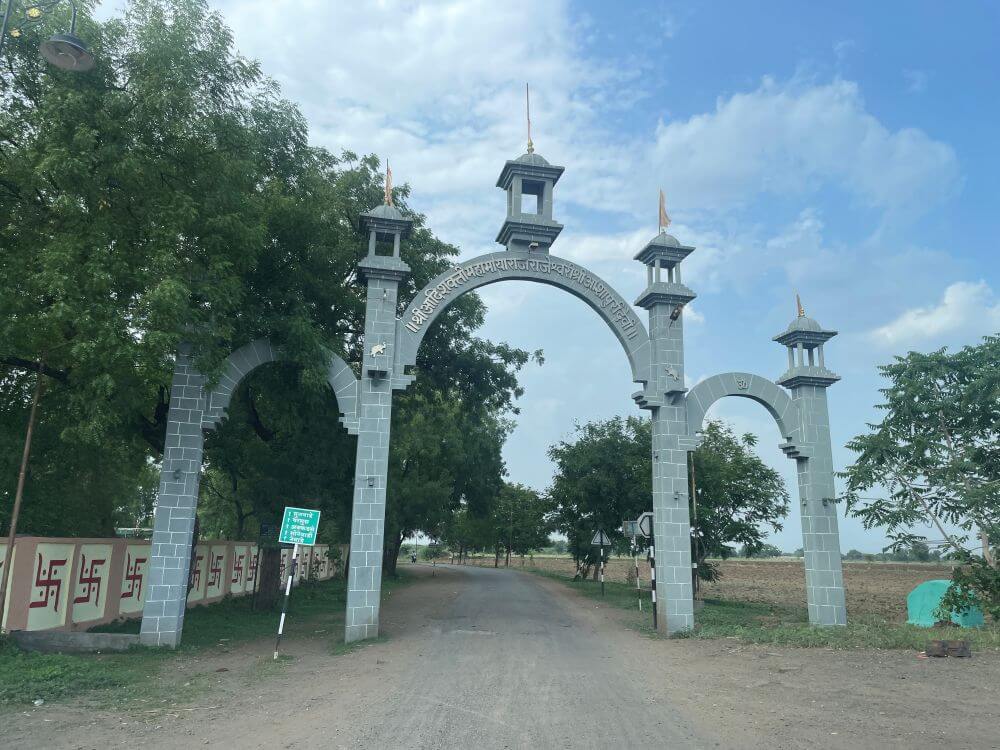
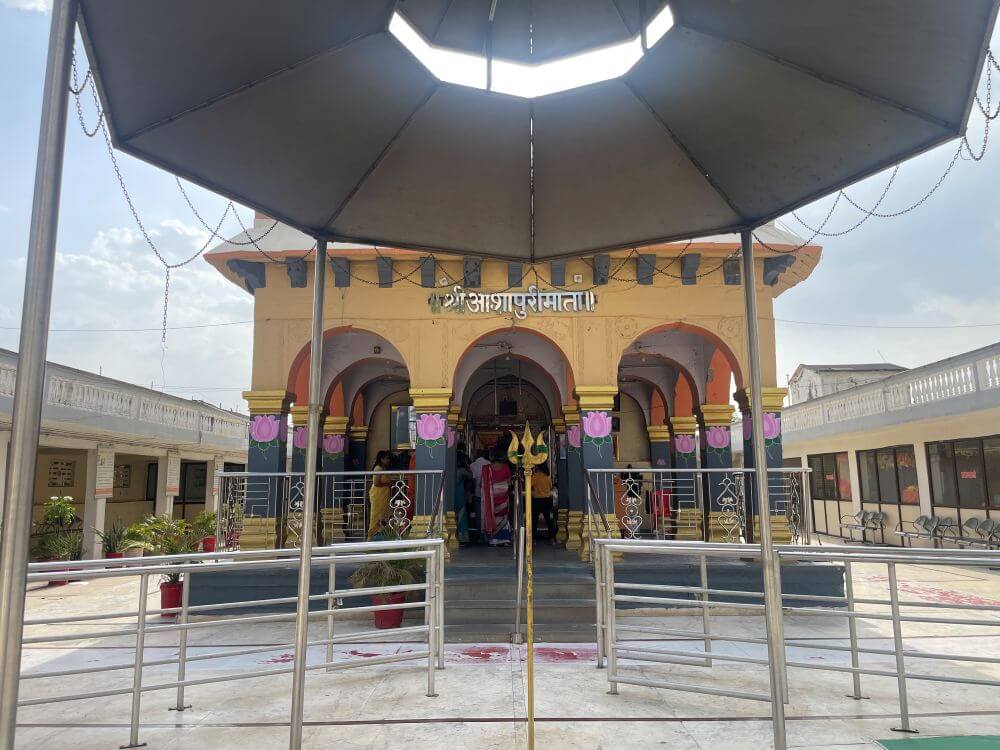
At the entrance to Patan village stands a grand welcome archway. This archway features a total of five meghadambaris (canopies): one on each pillar and one centrally placed on the crescent moon in the middle. A short distance further, the two-storied entrance gate of the temple comes into view. Inside the entrance gate, on both sides, are guard rooms, and on the second floor is the nagarkhana (drum house). Adjacent to this entrance gate is the temple’s compound wall. Further on, surrounding the temple, is a two-storied dharmashala (pilgrim’s rest house) building. From the entrance within this building, there are 12 steps leading up to the elevated temple. To the left of the entrance, within an intricately carved stone meghadambari, resides an ancient Shiva lingam. In the courtyard, on a platform, stands an ancient and distinctive deepmala (lamp tower). There is a pathway to enter the deepmala from above the platform. From there, a circular staircase leads to the very top of the deepmala. Next to this deepmala, on a platform, are a brass lion and a tortoise on the ground. Further on, beneath an octagonal roof, is the yagnakunda (sacrificial fire pit), and beside it, a twelve-foot There is a Trishul of great height.
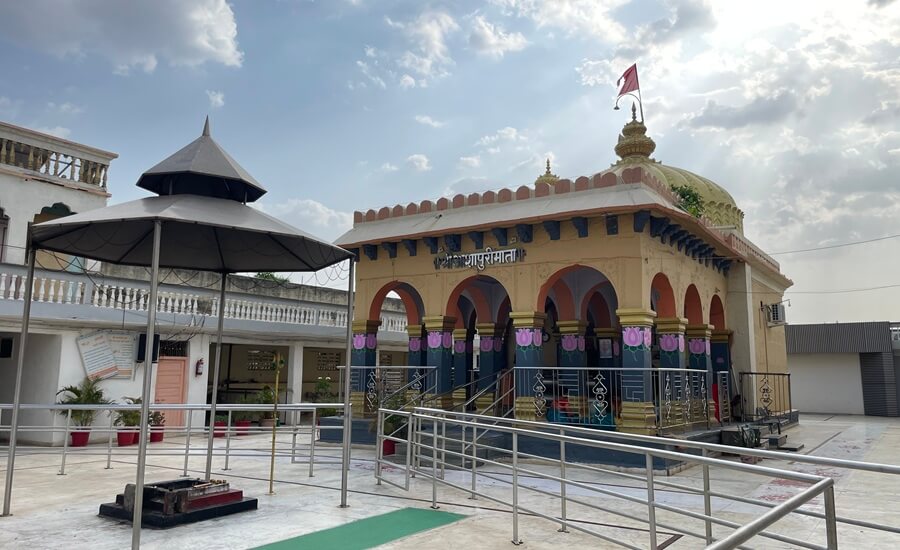
The temple is structured with a assembly hall (sabhamandapa) and a sanctum sanctorum (garbhagriha). As the temple stands on a raised platform (jagati), one enters the assembly hall by ascending a few steps. This open-plan assembly hall features four rows, each with four square pillars. Each pillar rests on a base adorned with horizontal mouldings. The capitals of the pillars are intricately carved. All the pillars are interconnected by crescent-shaped arches, creating nine domes in the ceiling. Further ahead is the ornate entrance to the sanctum sanctorum. Both door jambs are embellished with floral designs, and the lintel (lalatabimba) features Gajalakshmi. In the upper corners above the entrance, there are lion sculptures carved on the hands. An inscription is present above the entrance.
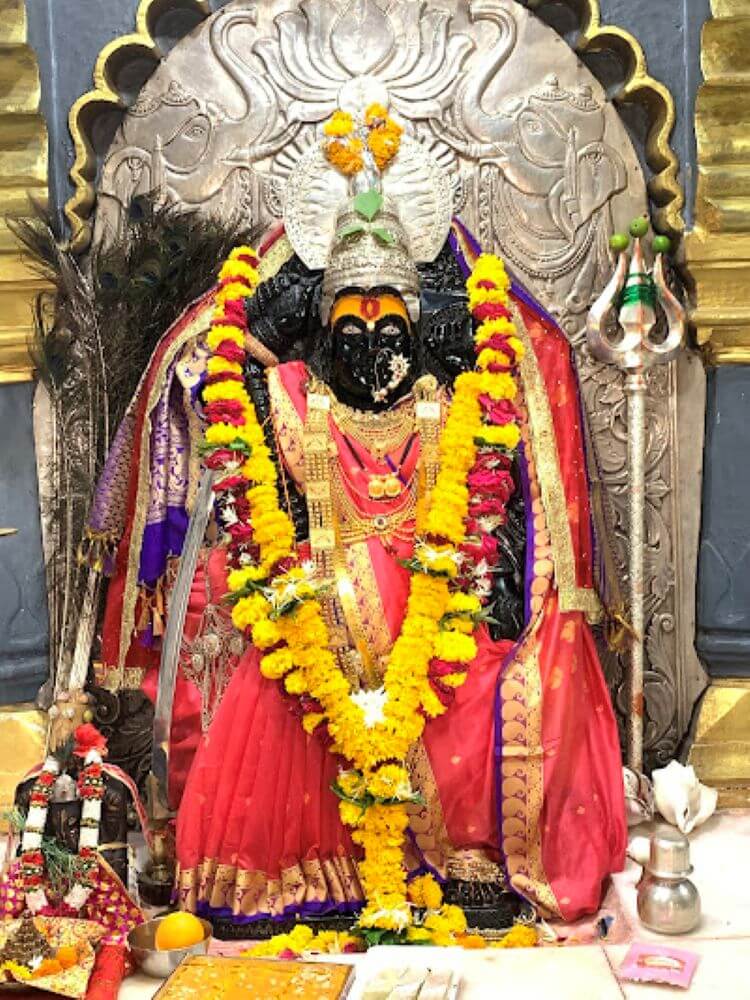
Within the enclosed sanctum sanctorum, upon the Vajra Peetha, and enshrined in a makhar adorned with four ornate octagonal pillars, resides the four-armed black stone idol of the Devi. In one of Her hands, the Devi holds a sword; in the second, a trident; in the third, a laddu; and Her fourth hand is in the Abhaya Mudra, bestowing fearlessness. A silver crown graces the Devi’s head, and Her divine form is adorned with golden ornaments. On the silver prabhavali behind the idol, on both sides, are Gajraj (royal elephants), with a lotus flower design between them.
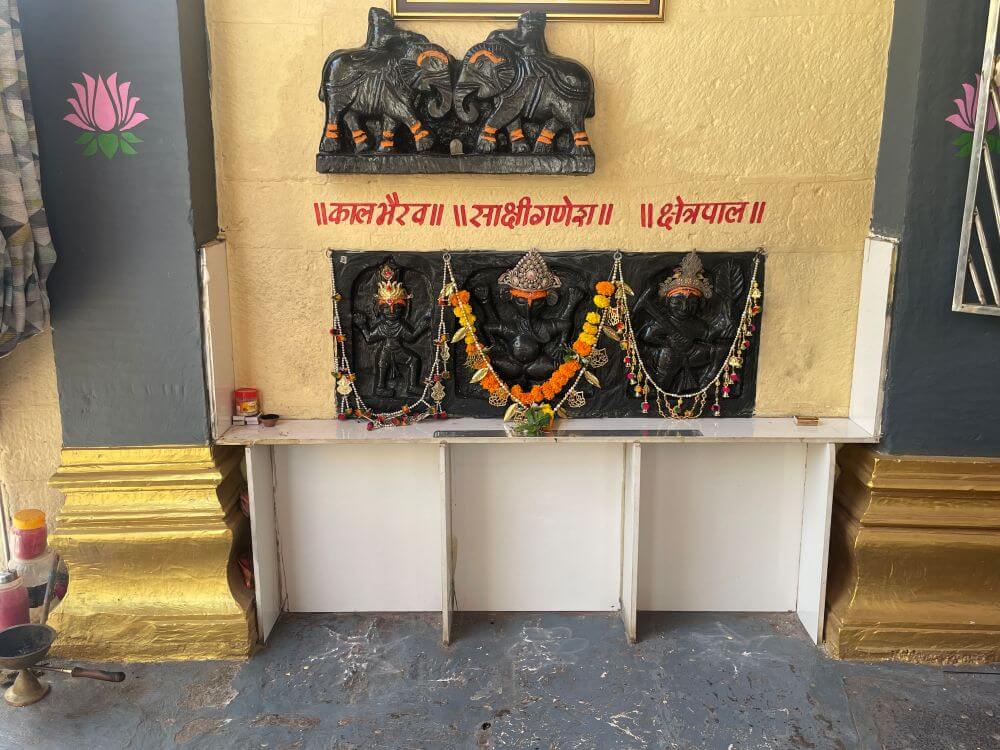
On the outer side of the temple, towards the roof, there are hands (corbels) on all four sides, supporting a balcony. The roof is adorned with a ‘bashingi’ parapet on all sides. Above the sanctum sanctorum (garbhagriha) roof, there is a dome-shaped shikhara (spire). The shikhara features a lotus petal design at its base and a vertical fluted design above. At the apex of the shikhara, there are two amalakas placed one above the other, crowned by kalashas. Within the temple complex, there are shrines dedicated to local deities, some ancient sculptures, as well as buildings like a community hall (mangal karyalaya) and a cultural center (sanskrutik bhavan).
In our temple, the main annual festivals of Chaitra Shuddha Chaturdashi, Shakambhari Pournima, Shakambhari Navratri, Chaitra Navratri, Sharadiya Navratri, and Paush Pournima are celebrated with immense devotion and enthusiasm. During all these auspicious festivals, the Devi is honored with a Mahabhishek, followed by profound worship. Throughout the day, various devotional programs such as Bhajan, Kirtan, Pravachan, Jagran, and Gondhal are organized. Mahaprasad is lovingly arranged for all the devotees. On the monthly Pournima, Amavasya, Ashtami, Tuesday, and Friday, the temple is thronged with devotees who come to perform their Kulachar (family traditions and rituals).
This sacred temple stands as a testament to deep spiritual devotion, ancient architectural grandeur, and rich local cultural traditions.
The sanctum sanctorum houses the divine idol consecrated according to ancient Vedic traditions, surrounded by serene courtyards and traditional temple architecture.
Navratri, Maha Shivratri, Annual Temple Jatra & Deepotsav
Compare and book flights, secure top-rated local hotels near the temple, hire reliable guides, and rent cars instantly.
Extend your pilgrimage by visiting other highly sacred temples located nearby.


Add ₹999 more to unlock FREE SHIPPING!
Your sacred cart is currently empty.
Shop Photo FramesFill in your delivery details below to place your order.
Add comment