
Add ₹999 more to unlock FREE SHIPPING!
Your sacred cart is currently empty.
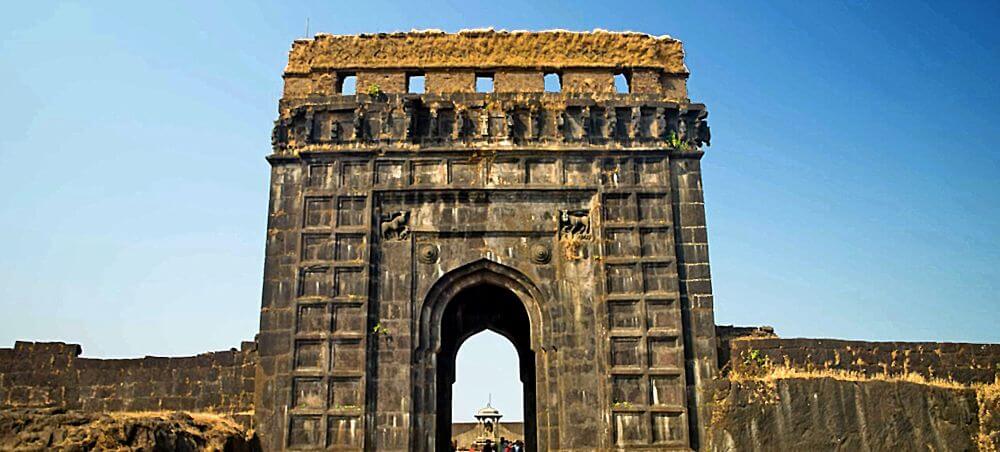
Shop Photo FramesDescribed by epithets such as impregnable, inaccessible, formidable, and invincible, Raigad Fort stands as the capital of the Shiv Swarajya. Regarding this ‘pilgrimage site’ of Maharashtra, the Sabhasad Bakhar states: “When the King himself went to see it, the fort was found to be very strong… Daulatabad is indeed a strong fort on this earth, but it is somewhat lacking in height. Seeing this fort ten times higher than Daulatabad, he was satisfied and said, ‘This very fort should be made the seat of the throne.'” One of the places for the daily worship of King Shivaji on this capital fort is the palace of Jagdishwar or Wadeshwar.
Raigad is a very ancient fort. It was known by names such as Tanas, Rasivata, and the hill of Nandadeepa. Rairi was another one of its names. In 1656, Chhatrapati Shivaji Maharaj captured this fort of Rairi along with Javali. At that time, he himself named this fort Raigad. Around 1671-72, King Shivaji chose this fort for his permanent residence. Under the orders of the Chhatrapati, Abaji Sondev, the Subhedar of Kalyan, had buildings constructed on this fort before 1673, making it well-equipped. Subsequently, on the occasion of the coronation in 1674, the temple known today as the Jagdishwar Palace was erected. Originally, this is a temple of Wadeshwar. It was built in the Hemadpanti style. On the occasion of the coronation, it was renovated and given the form of a palace.
The work on the Jagdishwar Palace was carried out by Hiroji Indulkar, the chief of construction for the Swarajya. Some historical evidence of this is available on Raigad itself in the form of an inscription. On the step of the main entrance to the premises of the Jagdishwar Temple, it is written, “Hiroji Italkar, ever ready in service.” This carved inscription is in Devanagari, although the ‘E’ is in the Modi script, and there is confusion regarding whether it is ‘T’ or ‘D’. Therefore, the ‘Italkar’ there is also read as ‘Indulkar’. To the right of this same door, on the wall, there is another large, eight-line inscription. It is a verse written in Sanskrit, in the Devanagari script, and in the Shardulavikridita meter. It is as follows:
‘Shri Ganapataye Namah
Prāsādo Jagadīśvarasya jagatām ānanda-do ‘nujñayā
Śrīmac-chatrapateḥ Śivasya nṛpateḥ siṃhāsane tiṣṭhataḥ |
Śāke ṣaṇ-nava-bāṇa-bhūmi-gaṇanā-dānanda-saṃvatsare
Jyotī-rāja-muhūrta-kīrti-mahite śukle sa-sāṃrpe tithau || 1 ||
Vāpī-kūpa-taḍāga-jirucirair harmyair vane vīthike
Stambhaiḥ kumbhi-gṛhair narendra-sadanair abhraṃlihair mihite |
Śrīmad-rāyagirau girām aviṣaye hīrājina nirmite
Yāvac-candra-divākarau vilasatas tāvat samujṛmbhate || 2 ||’
This means that on the Jyeshtha Shukla Trayodashi of the Shaka year 1596, the Ananda Samvatsara, at the auspicious time determined by the royal astrologer, this palace of Jagdishwar, which gives joy to the world, was built by Hiroji at the behest of Chhatrapati Shivnripati, who was seated on the throne. It was built on the magnificent Raigad, which is adorned with many tanks, wells, ponds, beautiful forests, elephant stables, royal palaces, pillars, etc., and is beyond description. May it flourish as long as the moon and sun exist in the sky.
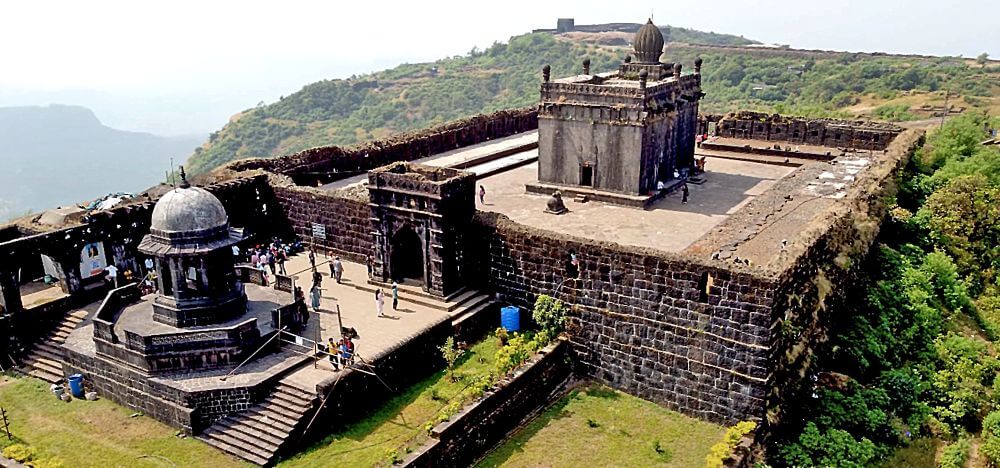
The Jagdishwar Temple is located approximately one kilometer ahead after crossing the buildings shown as the marketplace on the fort. There is a thick stone perimeter wall around the temple. Inside, the entire area is paved with stone. The main entrance to this temple is towards the east. This entrance is very elegant. It is a small replica of the Nagarkhana of Raigad (or, according to some scholars, the building of the pre-Shivaji era victory pillar). There is carving on this door. The symbol of a lotus is visible on both sides. The western door is somewhat smaller. Nowadays, the temple courtyard is entered from here. An image of Ganesha is carved on the lintel of this entrance. Through this door, one enters the premises from the back of the temple.
In front of the temple, there is a large stone statue of Nandi. This statue, an excellent example of sculptural beauty, is in a ruined state today. In the vicinity of this statue, Ranjit Desai, in his novel ‘Shriman Yogi’, has narrated the story of the first meeting between Shivaji Maharaj and the poet Bhushan during the coronation ceremony. Everyone tells the same story as history. However, the poet Bhushan, that is, the poet Bhushan Ratnakar Tripathi from Trivikrampur in Kanpur district, had arrived at the court of King Shivaji towards the end of 1667. The Jagdishwar temple is built entirely of stone on a high plinth. It is rectangular and grand in size. This temple occupies an area of fourteen thousand square feet. The influence of the contemporary Bijapuri or Muslim architectural style is clearly visible on this temple. The temple has a dome at the summit and six turrets or minarets on all four sides. Two minarets are also carved in relief above the frame of the temple entrance. An image of Ganesha is carved on the lintel of this frame.
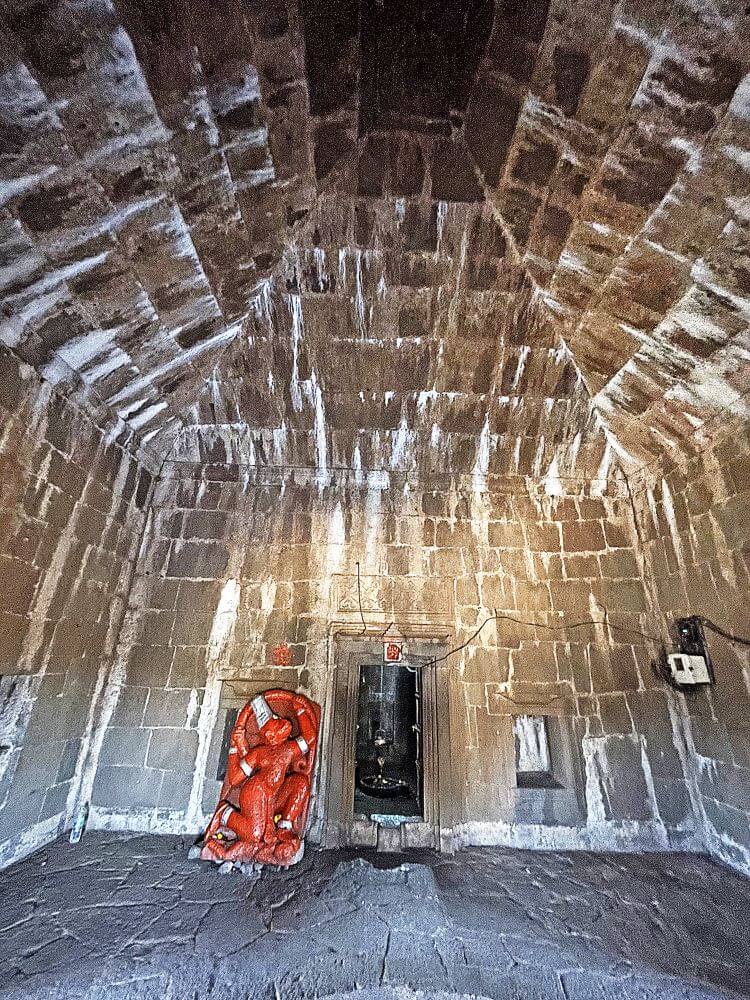
In the assembly hall of the temple, there is a large round stone platform. It is said that there used to be a tortoise here. The assembly hall has a total of three doors: one towards the east, and one each on the south and north sides. There is a Kirtimukh on the step of the sanctum sanctorum door. A similar Kirtimukh is also found on the eastern door. There are two Yaksha faces on the upper side of the sanctum door. In the center of the sanctum is the Linga of Jagdishwar. It is said that the Linga here is not the original one but was installed later. When Chhatrapati Shivaji was on Raigad, he used to come to this temple for darshan regularly. There are records of him going in a procession to have darshan of Jagdishwar both before and after the coronation.
Shiv Samadhi Site
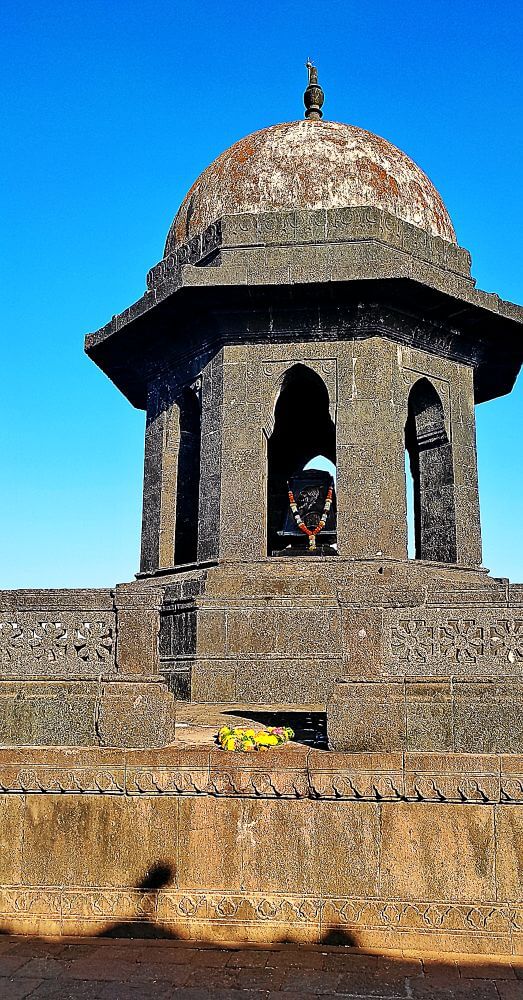
Right in front of the Jagdishwar Temple is the Samadhi site of Chhatrapati Shivaji Maharaj, the holy pilgrimage site of all of Maharashtra. On 22 March 1680, Chhatrapati Shivaji began to feel the affliction of fever. His health deteriorated day by day, and finally, on Saturday, 3 April 1680, on the day of Chaitra Shukla Purnima of the Shrinripashalivahan Shaka 1602, Raudra Samvatsara, at 12 o’clock in the afternoon, Chhatrapati Shivaji attained Mahaparinirvana. His sacred mortal remains were cremated in front of the Jagdishwar Palace. The funeral rites were performed by Yuvraj Rajaram Maharaj, who offered the sacred fire to the Maharaja’s remains. The post-funeral rites were performed by Sabaji Bhosale Shingnapurkar, with Rajaram Maharaj seated nearby. It was at this very place that Chhatrapati Sambhaji Maharaj built the Samadhi of Chhatrapati Shivaji. This Samadhi was an octagonal platform.
Over time, this Samadhi fell into disrepair. In the research book ‘Raigadchi Jeevangatha’, Shan. Vi. Avalaskar, using the Peshwa Daftar and other documents… Information regarding the various expenses incurred on the fort is recorded; however, there is no mention of the Samadhi. After the British took control of the fort, the British officer Colonel Prother visited the fort on the afternoon of 10 May 1818. At that time, he observed that the Samadhi was in a dilapidated state. In 1880, Mahatma Jyotiba Phule visited Raigad, located the Samadhi site, and cleaned it. In 1885, the Governor of Mumbai, Sir Richard Temple, visited the fort. Upon seeing the ruined state of the Samadhi, he wrote a letter to the Collector of Kolaba, providing instructions for its repair. In 1885, Govind Abaji Joshi of Vasai visited Raigad, observed the condition of the Samadhi, and wrote a book that drew the attention of many. The title of this book was ‘Description of Raigad Fort – A Brief Career of Chhatrapati Shivaji Maharaj and Prayers for the Restoration of the Maharaj’s Samadhi’. Later, due to the persistent efforts of leaders like Mahatma Jyotiba Phule and Lokmanya Tilak, the work of restoring the Samadhi began, and festivals were initiated on the fort. In 1925, the Samadhi was restored. On 3 April 1926, Tatyasaheb Kelkar, Raja Laxmanrao Bhosle, and others visited the fort and performed the Vedic worship of the Samadhi. On that day, a bust of Shivchhatrapati, crafted by the sculptor Phadke, was installed on the throne stone. Additionally, a bronze plaque made by the sculptor Karmarkar was placed there. Subsequently, in 1935, the Samadhi was restored once again.
The shape of this Samadhi is octagonal, like the Royal Seal (Rajmudra) of Shivchhatrapati. Stone paving has been laid in an octagonal shape a few inches above the ground, and in the center, a high, stone-masonry octagonal platform has been erected. This platform has a lattice-style railing. Atop this, in the center, stands a high canopy (Meghdambari), and inside it, a relief sculpture of Shivaji Maharaj has been installed. Devotees of Shiva constantly visit this site to pay their respects. On the day of Shiv Punyatithi, thousands of people gather here to offer tribute to Shivchhatrapati.
Shirkai Devi Temple
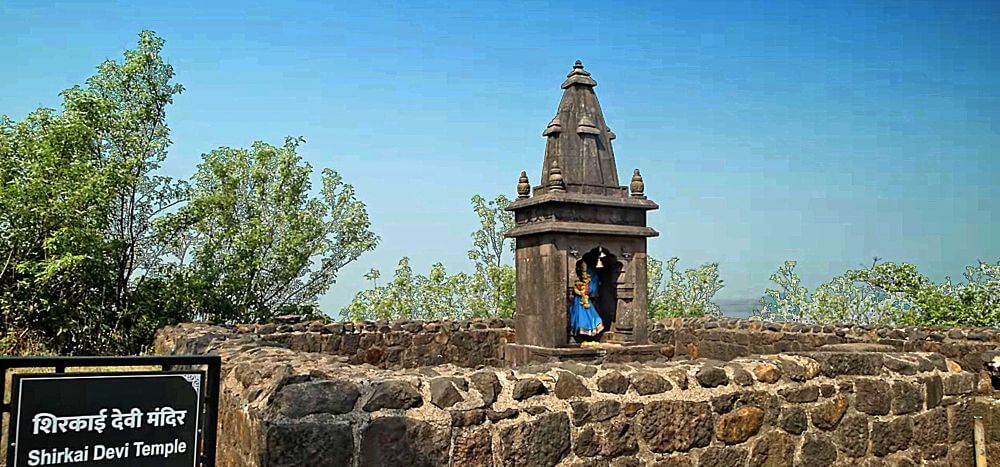
At a short distance from the Jagdishwar Temple is a small, ancient temple of Shirkai Devi. Shirkai is none other than Mahishasurmardini. Notably, this temple lacks a main hall (Sabhamandap) and an inner sanctum (Garbhagriha). In place of the inner sanctum, there is only a stone altar. Within it, an exquisitely carved monolithic idol of Shirkai Devi is enshrined. This Goddess is the family deity (Kuldevata) of the Shirke clan. There are many historical references to this temple dating back to the pre-Shivaji era. During the Shiv era, this deity gained prominence as the guardian deity of the fort (Gad-devata). It was a tradition to perform the ritual worship and ‘Gondhal’ of Shirkai Devi at the beginning of any program here, a practice that continues to this day.
After crossing the main gate (Mahadarwaja) of Raigad Fort and entering the citadel (Balekilla), one first encounters the Hatti Lake. From there, there is a small path leading to the Gangasagar Lake. This temple is located along this path. In the 11th-12th century, Raigad was under the control of the Shirke family. In front of the temple is the Holi ground (Holi cha Maal). The platform on the left is known as the ‘Gharata’ (nest/shrine) of Shirkai Devi. Behind this shrine, amidst a cluster of fig trees, lies the temple of Shirkai Devi. It is likely that they established the seat of their family deity here at that time.
In the book ‘Description of Raigad Fort’ published by Govind Babaji Joshi of Vasai in 1885, there is a mention that there was a ‘Devalacha Gharata’ (temple shrine) of Shirkai Devi there at that time. On page 37 of this book, it is stated that ‘To the east of Gangasagar, there is a temple shrine quite far away. It contains no idol, but the eight-armed Mahishasurmardini idol is seen installed elsewhere nearby. This temple is called the temple of Shirkabai.’ According to fort researcher P. K. Ghanekar, lightning struck the original temple of Shirkai Devi, causing it to collapse. Later, in 1935, the contractor Tatyasaheb Sule, who was working on the restoration of Shivaji Maharaj’s Samadhi, built the current small temple of Shirkai Devi.
Many historical references regarding this deity are available. After the Vedic coronation of Chhatrapati Shivaji Maharaj, some untoward incidents occurred. Consequently, Nishchalpuri Gosavi performed a Tantric coronation of Shivray. Among the reasons recorded by Nishchalpuri for those untoward incidents was the fact that Shirkai Devi had not been worshipped. Before any auspicious occasion or setting out on an expedition, the blessings of Shirkai were sought. In the year 1772, when the Raigad Potnis, Vitthal Yashwant, stopped providing accounts to the Peshwas, and when it appeared that the Raigad Havaldar, Yashwant More, was about to join the Siddi, Shrimant Madhavrao Peshwa sent his commander, Apaji Hari, to take control of Raigad. In 1773, he captured the fort through battle and strategy. Thereafter, he visited the main deity of the fort, Shirkai. At that time, he placed an offering of two rupees before the Goddess. There is also a mention of him performing a Navchandi Homa here, and a fixed income was allocated for the expenses of Shirkai. A vow of jewelry was made to Shirkai for the victory of Raigad. Records in the Peshwa Daftar indicate that after the decree was presented from Pune, jewelry was prepared and sent to the Goddess. Subsequently, Hansaji Khaira, who was appointed as the Havaldar of Raigad, performed the Goddess’s festival by sacrificing a goat to Shirkai. Furthermore, unpublished documents in the Peshwa Daftar (Bundle No. 8) mention that two masks were sent from Mahad to Raigad on 8 October 1775, and in the research work ‘Raigadchi Jeevangatha’, Shan. Vi. Avalaskar has stated that these were likely the masks of Shirkai.
After the ‘Ghat’ was raised during Navratri, a ‘Gondhal’ used to be performed before Shirkai Devi. This stopped in 1786. Following this, disturbances began on the fort. Then, the ‘Gondhal’ was restarted. It is noted in the research work that it was a custom to hold the Shirkai festival whenever any kind of disturbance occurred on the fort, and lists of expenses incurred for those festivals are available. A saree and blouse were provided to Shirkai from the government treasury, and a goat was sacrificed every year on Dussehra. In the year 1787, heavy rains fell on Raigad, causing the reservoir above the main gate to burst at night, and a torrent of water began flowing over the gate. It became impossible to open the gate to provide a path for the water. There is a record stating that a vow of sacrificing a goat to Shirkai was made at that time. This highlights the importance that Shirkai Devi held during the Shiv era and the Peshwa period.
This sacred temple stands as a testament to deep spiritual devotion, ancient architectural grandeur, and rich local cultural traditions.
The sanctum sanctorum houses the divine idol consecrated according to ancient Vedic traditions, surrounded by serene courtyards and traditional temple architecture.
Navratri, Maha Shivratri, Annual Temple Jatra & Deepotsav
Compare and book flights, secure top-rated local hotels near the temple, hire reliable guides, and rent cars instantly.
Extend your pilgrimage by visiting other highly sacred temples located nearby.


Add ₹999 more to unlock FREE SHIPPING!
Your sacred cart is currently empty.
Shop Photo FramesFill in your delivery details below to place your order.
Add comment