
Add ₹999 more to unlock FREE SHIPPING!
Your sacred cart is currently empty.
Shop Photo FramesIn the twelfth century, many sects emerged that rejected social inequalities, divisions, and ritualism. The ‘Nagesh Sect’, propagated by Nagnath or Nagesh Maharaj, is one of them. There are many temples associated with the Nagesh Sect in Maharashtra and Karnataka. In Maharashtra, places like Manur, Degav, Mohol, Vadval, Mardi, Kendur, Pabal, Kanhurmesai, Nimgaon, as well as Narand, are considered more significant as places sanctified by the holy touch of Nagesh Maharaj. Devotees have a firm faith that Nagesh Maharaj’s divine presence is experienced even today at the Nagnath Temple in Narand.
A legend regarding Nagnath Maharaj states that he first appeared on the banks of Lake Manasarovar to a Bharadwaj-gotra Brahmin named Hegras, who lived in Mohol (Chandramauli) in Solapur district. Since many serpents used to play on his body, he became renowned by the names Nagnath or Nagesh. Later, he accompanied Hegras to Mohol. Disturbed by the harassment of mischievous elements in the village, he went to a forest along with Hegras and other devotees. While sitting under a withered banyan tree there, he asked his disciple to pour water on the tree. As soon as the water was poured, the banyan tree sprouted fresh leaves. Consequently, he came to be known as Vadvalasiddha Nagnath. Nagnath Maharaj was a Siddha Purusha who lived in the twelfth century. Maharashtra and Karnataka were the fields of his active ministry.
This path established by Nagnath Maharaj places great importance on yoga practice and is devoted to Lord Shiva. Rejecting rituals, severe asceticism, and renunciation, this tradition propounded a spiritual philosophy that inspires devotion in ordinary people. Embracing the teachings of tolerance and generosity inherent in the Hindu religion, this sect has always affectionately embraced Hindu and Muslim faiths, as well as various other traditions. It is said that once in Mohol, Nagesh appeared to Hegras in the guise of a Fakir. Similarly, in Delhi, he appeared to Sheikh Nasruddin in the form of a prophet. Nasruddin and Alamkhan were devotees of Nagesh. Even today, during the festival in Mohol, there is a custom of putting fingers in one’s ears near the mosque as a symbol of Hindu-Muslim unity. Additionally, this sect is influenced by the Warkari tradition. Agyansiddha is considered the foundational preceptor of this sect. Philosophical texts such as ‘Sankantharani’, ‘Varadanagesh’, ‘Swaroopnirman’, and ‘JeeVabrahmabhedalakshan’ are attributed to him.
The story regarding the shrine of Nagnath at Narande is that Hegras’s daughter had three sons, of whom Agyansiddha was one. From his childhood, he lived at Vadval and served Nagnath. Later, Nagnath gave him a divine vision and sent him to the village of Narande to propagate the sect. He lived in a grove outside the village. Once, longing for the vision of his Guru, he called out to Nagnath in all four directions. At that moment, a responding voice of affirmation echoed from all four directions, and finally, the divine voice emanated from Agyansiddha’s own body. Realizing that he had become one with Nagnath, Agyansiddha took Sanjeevan Samadhi at this very spot. As a testimony to this event, there are five Shiva Lingas here—four in the cardinal directions and one in the center. The Linga in the central Nagnath Temple is said to be self-manifested (Swayambhu). The local priests state that this temple was built in the year CE 1391.
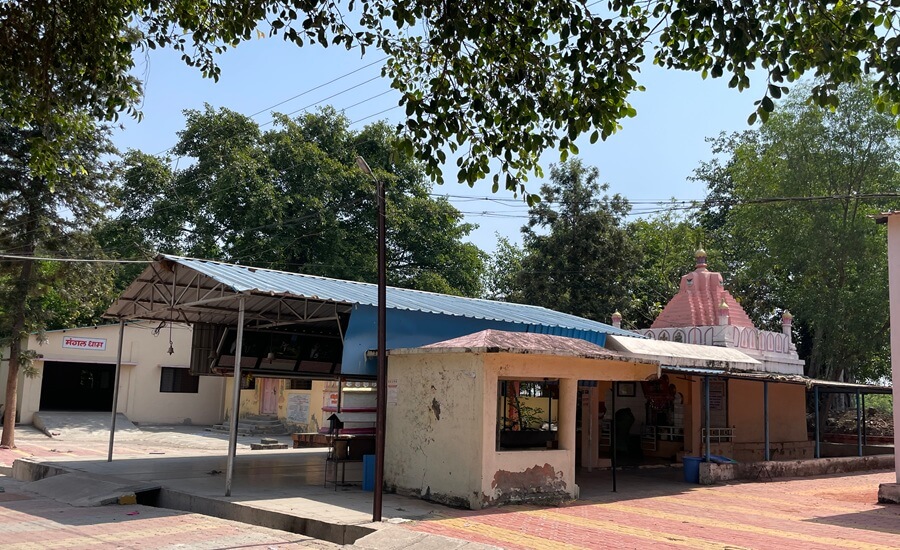
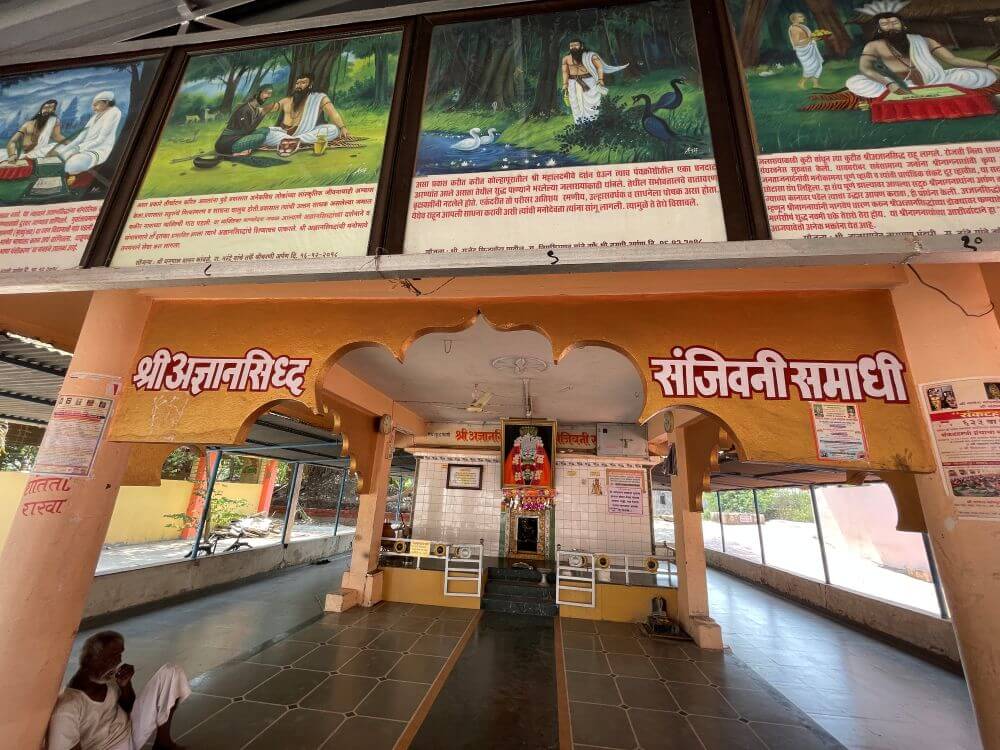
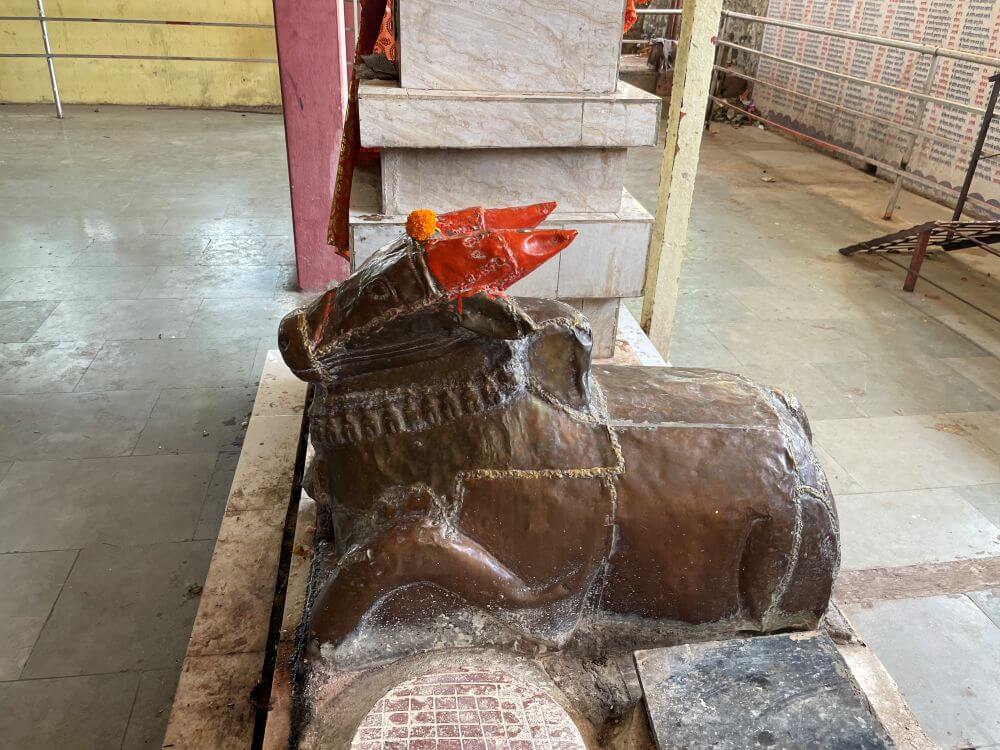
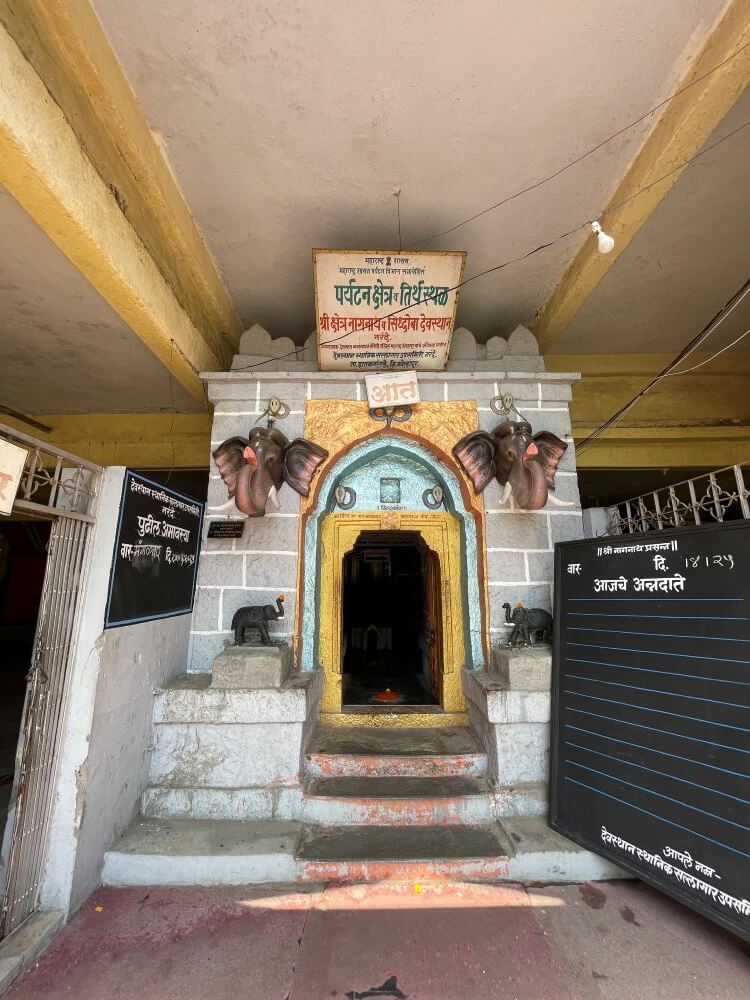
Approaching the temple, one first encounters a welcoming arch (Swagat Kaman). The pathway leading from here to the temple is paved with interlocking blocks. In front of the temple stands a lamp tower (Deepmal). Ahead is the Nagnath Temple housing the self-manifested Shiva Linga. Comprising a pillared hall (Sabhamandap), an intermediate vestibule (Antaral), and the sanctum sanctorum (Garbhagriha), the entrance to the Sabhamandap has three steps. On both sides of the entrance, the facade walls feature elephant sculptures (Gajraj Shilps). The door frames are adorned with vertical edge carvings, and the lintel centerpiece (Lalatbimba) features an image of Lord Ganesha. There are divine niches on both sides of the entrance inside the Sabhamandap. Directly in front of the entrance on the floor is a tortoise sculpture, followed by a black stone idol of Nandi seated on a Vajrapitha. There is a tradition here of offering oil and mustard seeds to Nandi. The Sabhamandap features circular pillars supporting a ceiling resting on beams. The Sabhamandap is enclosed in structure, equipped with windows for light and ventilation. Paintings depicting the life story of Agyansiddha Maharaj are mounted on the walls of the Sabhamandap. Goddess Annapurna and Goddess Ambabai have independent sanctums here.
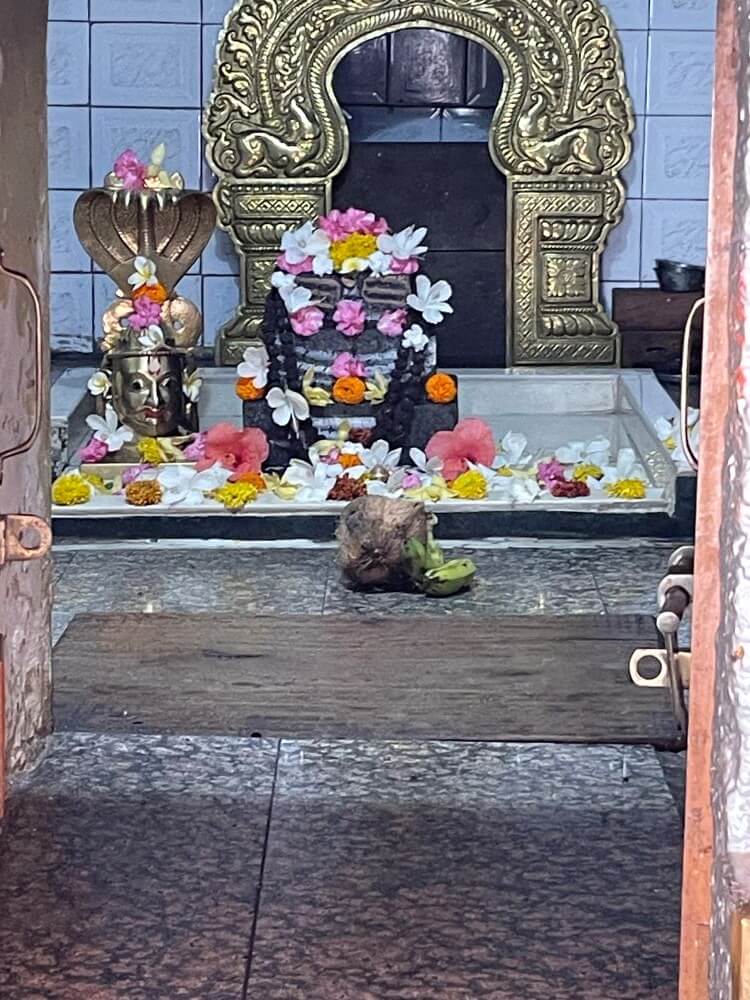
Further ahead, since the Antaral is elevated higher than the Sabhamandap, its entrance has three steps. The Antaral is of ancient architecture. It houses the divine resting cot (Shayanmanch) of the deity. Divine images are placed in the niches on the left and right sides of the Antaral. Beyond this lies the entrance to the Garbhagriha. The Garbhagriha is elevated higher than the Antaral. The door frames feature vertical edge carvings, and the lintel centerpiece has an image of Lord Ganesha. Inside the Garbhagriha are the self-manifested Shiva Linga and a silver mask (Mukhawata). Adorning the mask is a turban (Pheta) and a silver serpent holding a canopy over it. Along the back wall inside the Garbhagriha, serpent sculptures are placed within a stone arched alcove (Makhar) on a Vajrapitha. Atop the roof of the temple is a square tapering stepped pyramid-like tower (Shikhar). Serpent sculptures are carved on all four sides of the Shikhar. At the apex is the Amalaka, surmounted by the pinnacle (Kalas).
Directly in front of the Nagnath Temple is the Samadhi Temple of Agyansiddha Maharaj. This temple is similarly structured with a Sabhamandap, Antaral, and Garbhagriha. In the Sabhamandap, four circular pillars situated at the four corners are interconnected by arched brackets. Ahead is the entrance to the Garbhagriha, which houses the Samadhi of Agyansiddha Swami. The Swami is adorned here with a silver mask, alongside royal garments and ornaments. There is a circumambulation path (Pradakshina Marg) around the exterior of the Garbhagriha. Atop the roof of this Garbhagriha rises a tall, tapering Shikhar.
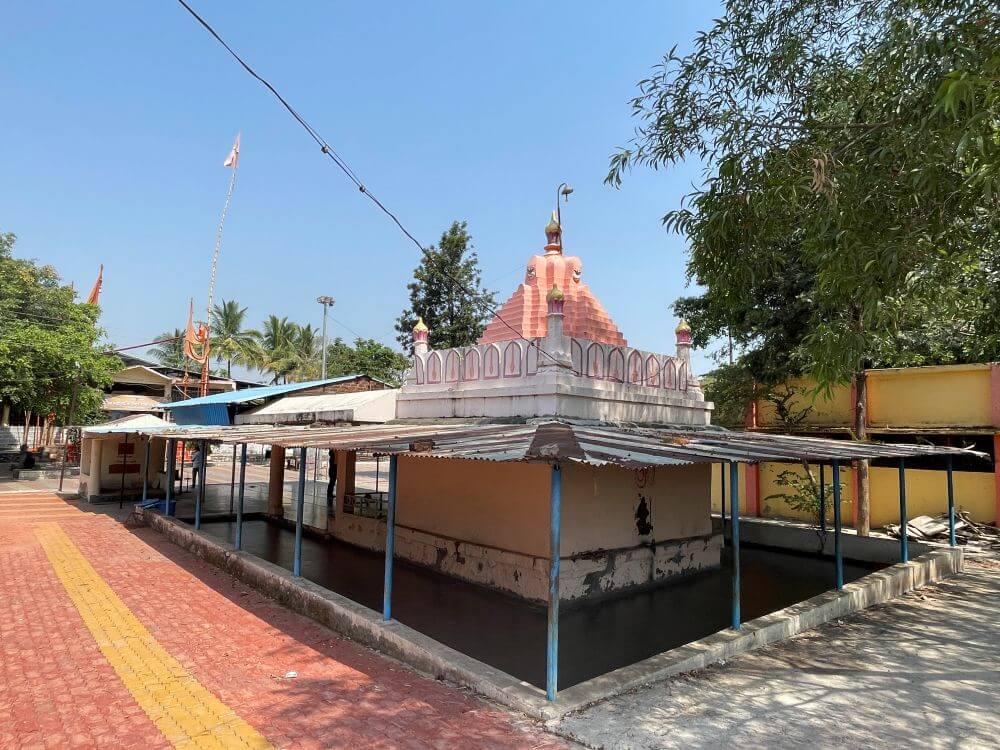
Local devotees refer to these two temples—the Nagnath Temple and the Agyansiddha Samadhi Temple—as the Nagoba-Shidoba Temple. Surrounding the main Nagnath Temple in the four cardinal directions are four smaller Shiva temples. The door frames of all four of these temples feature vertical edge carvings, and their lintel centerpieces bear images of Lord Ganesha. These temples enshrine Shiva Lingas. Devotees stack miniature stone cairns (Lagorya) in front of these temples to pray for blessings of a happy and prosperous family life.
There is also a tradition of worshiping the anthill located in the courtyard here. The pond within the temple premises is referred to as Pratikaashi or Bhagirathi Tirtha. The legend associated with this pond is that once Agyansiddha wished to go to Kashi. Even without the permission of Nagesh Maharaj, he insisted on going to Kashi. Thereupon, Nagesh Maharaj gave Agyansiddha a sword and told him to have it take a holy bath in Kashi. Upon returning, Agyansiddha told his guru that while taking the Kashi bath, the sword had sunk into the Ganga. Then, upon the guru’s command to dive into the pond here and retrieve the sword, Agyansiddha dived into the pond and retrieved it. At that moment, the utterance, “He who does not get to experience Kashi, should come to Narande,” emerged from the lips of Agyansiddha Maharaj.
Within the temple courtyard, there are buildings such as a Bhaktaniwas (devotee accommodation), Annachhatra (free food service), and a hall for cultural events. Mahaprasad is distributed daily in the temple from morning eleven to afternoon two o’clock. Nagpanchami is the main annual festival celebrated with great enthusiasm at the temple. The ten-day annual fair festival from Magh Panchami to Magh Navami is celebrated with deep devotion. On the first day, the palanquin of the village deity comes from the village to the Ban, that is, the Nagnath Temple. The palanquin stays here overnight, and on the second day, Nagnath, Agyansiddha, and the village deity are seated in the same palanquin and take a circumambulation of the village (Grampradakshina). On the third and fourth days, the holy ceremonial bath (Maha-abhishek) and grand worship (Mahapuja) of the deities are performed. On the fifth day, the celebration is held. During all festivals, many devotees from states such as Maharashtra, Andhra Pradesh, and Karnataka come for the darshan of the deity. Every Thursday, the palanquin procession of the deity is taken out in the temple.
Maha-aarti is organized on every Monday, Thursday, Purnima (full moon), and Amavasya (new moon). Nitya abhishek and puja are performed in the temple at five in the morning and five in the evening.
This sacred temple stands as a testament to deep spiritual devotion, ancient architectural grandeur, and rich local cultural traditions.
The sanctum sanctorum houses the divine idol consecrated according to ancient Vedic traditions, surrounded by serene courtyards and traditional temple architecture.
Navratri, Maha Shivratri, Annual Temple Jatra & Deepotsav
Compare and book flights, secure top-rated local hotels near the temple, hire reliable guides, and rent cars instantly.
Extend your pilgrimage by visiting other highly sacred temples located nearby.


Add ₹999 more to unlock FREE SHIPPING!
Your sacred cart is currently empty.
Shop Photo FramesFill in your delivery details below to place your order.
Add comment