
Add ₹999 more to unlock FREE SHIPPING!
Your sacred cart is currently empty.
Shop Photo FramesThe Choundeshwari Devi Temple is a beloved shrine in the town of Ashta, blessed with many unique customs and traditions, and bearing the architectural heritage of the Peshwa era. The Bhavai festival at the Choundeshwari Temple, located in this town sanctified by the holy touch of Shree Rama’s feet, is renowned. It is said that at one time, the practice of human sacrifice existed here. However, at present, not even a coconut is offered in this temple. The Shakta tradition of Bhavai, however, has been regularly observed here for several centuries. This Bhavai festival in Ashta is extremely famous.
According to the seventh chapter of the ‘Devi Mahatmya’ in the ‘Markandeya Purana’, the demons Shumbha and Nishumbha conquered the kingdom of the three worlds from Lord Indra. At that time, the gods appealed to the Adishakti Bhagavati. As they were praying to Bhagavati, Devi Parvati arrived there. From her body-sheath, Devi Ambika manifested. Chanda and Munda were servants of Shumbha and Nishumbha. They saw Ambika and described her beautiful form to Shumbha. Shumbha sent a message to Ambika asking her to become his wife. Ambika rejected him. Then, to capture her and bring her, Shumbha and Nishumbha sent Chanda and Munda. At that moment, Kali, who emerged from Ambika’s body, slew Chanda and Munda. Because Devi Kali slew Chanda and Munda, Devi Bhagavati named her Chamunda.
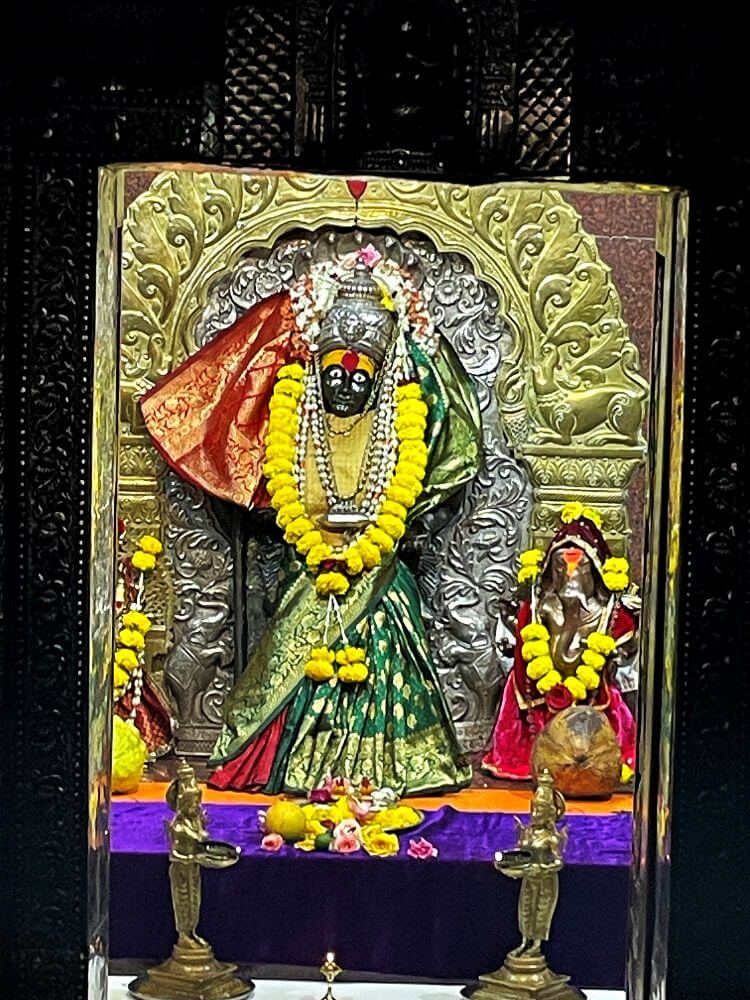
The name Choundeshwari for the Devi here is a corrupted form of Chamunda or Chamundeshwari. Many temples known by the name Choundeshwari are found not only in Maharashtra but also in other states. The idols in such temples are often in fierce forms, related to Kali Mata or Ranchandi. The original four-armed, weapon-wielding idol in the temple at Ashta is also related to Chamundeshwari. However, her appearance and adornment are done in the manner of Ambabai of Kolhapur. This Chamundeshwari temple of Ashta is also known as the Ambabai temple. There is also a mythological tale that this Chamunda slew Mahishasura. This Mahishasuramardini Chamunda is the family deity of the Mysore royal family in Karnataka. It is also said that the Choundeshwari Devi here originally hails from Badami in Karnataka. The Devi’s aarti mentions, ‘Ashtegrami rahivas, pari tu Badamiswamini’ (Residing in Ashta village, yet you are the mistress of Badami). The memories of her original abode are still preserved in this temple through the Shakta Bhavai festival of Badami.
There is a legend about how this Bhavai festival came here. While on a campaign in Karnataka, the Thorat Sarkar of Walwa found a box during the looting of Badami. When it was opened, one mask suddenly flew away. Then another mask, similar to the one remaining in the box, was made. While examining it, three copper plates were discovered in the box. From the information on them, the tradition of the Bhavai play was understood. The twelve Balutedars of Ashta decided to start the Bhavai festival here. The Thorat Sarkar supported them. It is said that since then, the tradition of this Bhavai festival began in Ashta. In all the Bhavai festival plays, the twelve Balutedars, who are still the honored participants, take part as they did then.
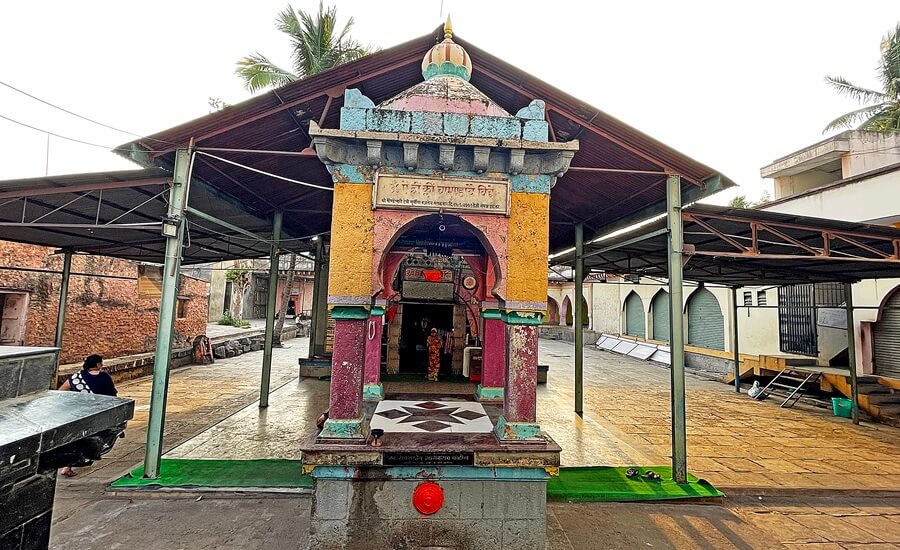
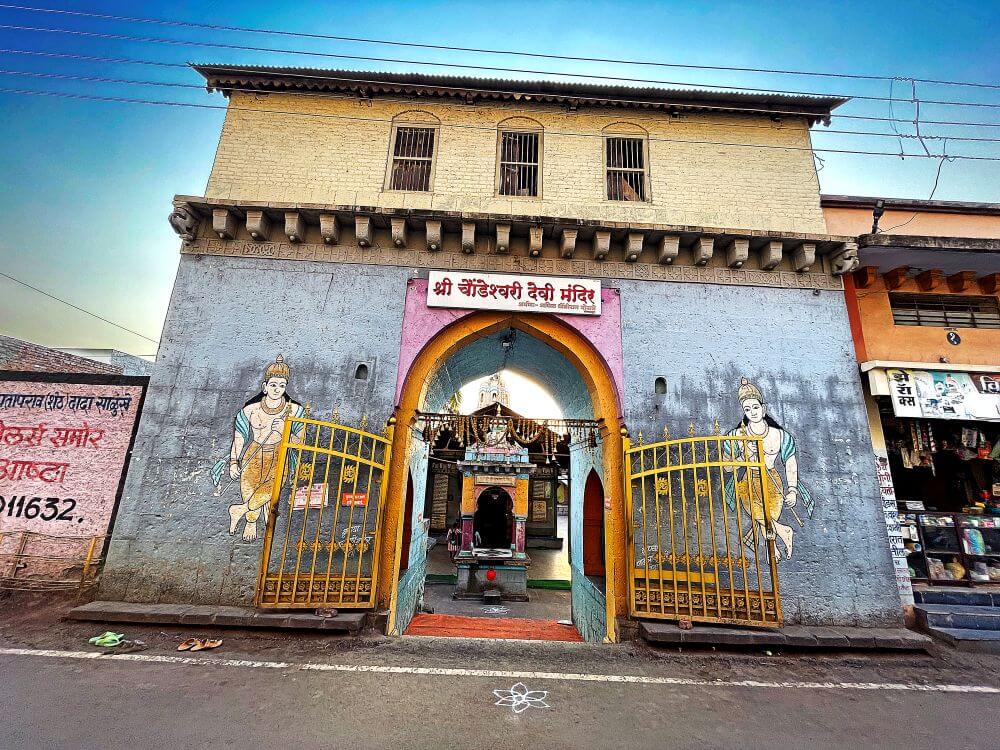
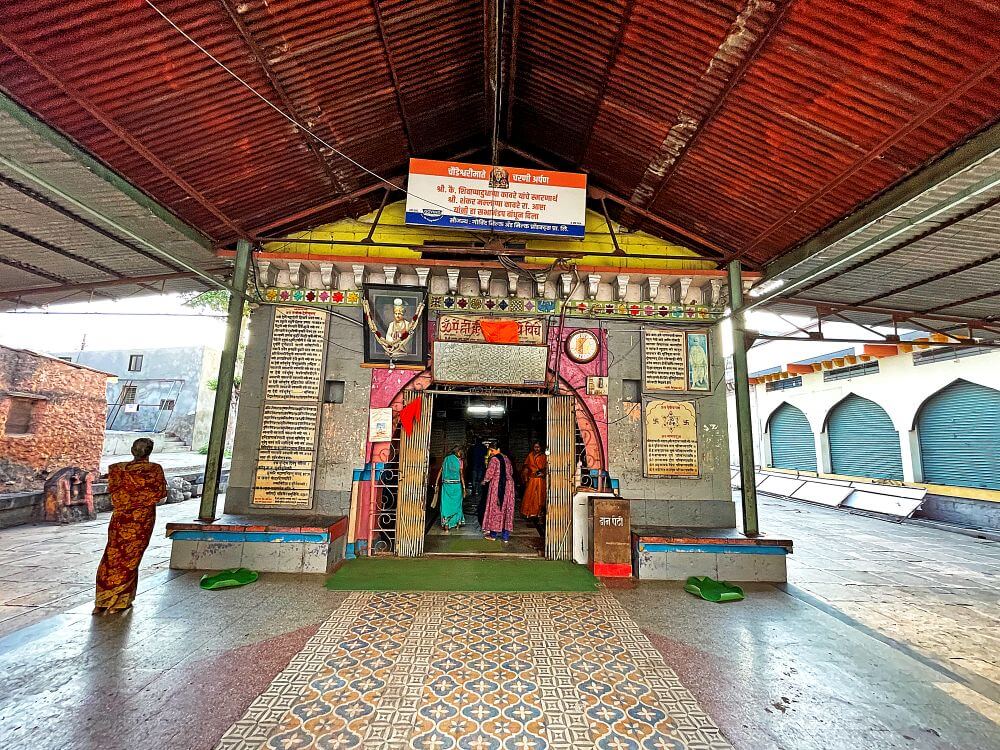
The Devi’s temple here is of Hemadpanti construction. Adjacent to the large entrance, which includes a Nagarkhana (drum house), is a compound wall. Upon entering through that grand entrance, one sees rest areas for guards. Within the temple complex, on one side of the compound wall, there are also small arched niches. These now appear to be arranged for management committee offices and shops. The other side is open. Upon entering, to the left, one sees a small, black stone temple with a spire. It contains a distinctive black stone idol of Ganaraya. Behind the idol is a beautiful metal prabhaval (halo). Kirtimukha is carved on it. Nearby is also a small dome-shaped Shiva temple. To the right is a Tulsi Vrindavan and a Deepmala (lamp tower). At the base of the Deepmala, on all four sides, are carved tiger sculptures. In most places, the custom is to carve elephants at the base of the Deepmala. This Deepmala therefore seems unique.
In front of the temple is a small, dome-shaped Nandi mandap. Earlier, there was a Nandi and a Shiva lingam here. Currently, there is nothing in this mandap. During festivals, it is used as a palanquin mandap. Leaning against this mandap, towards the temple, are two ancient idols smeared with sindoor. Beside them are also two lion sculptures carved in black stone. The space from the Nandi mandap to the main temple is covered with tin sheets. Here, on the left, many stone relics are seen, including Sati stones.
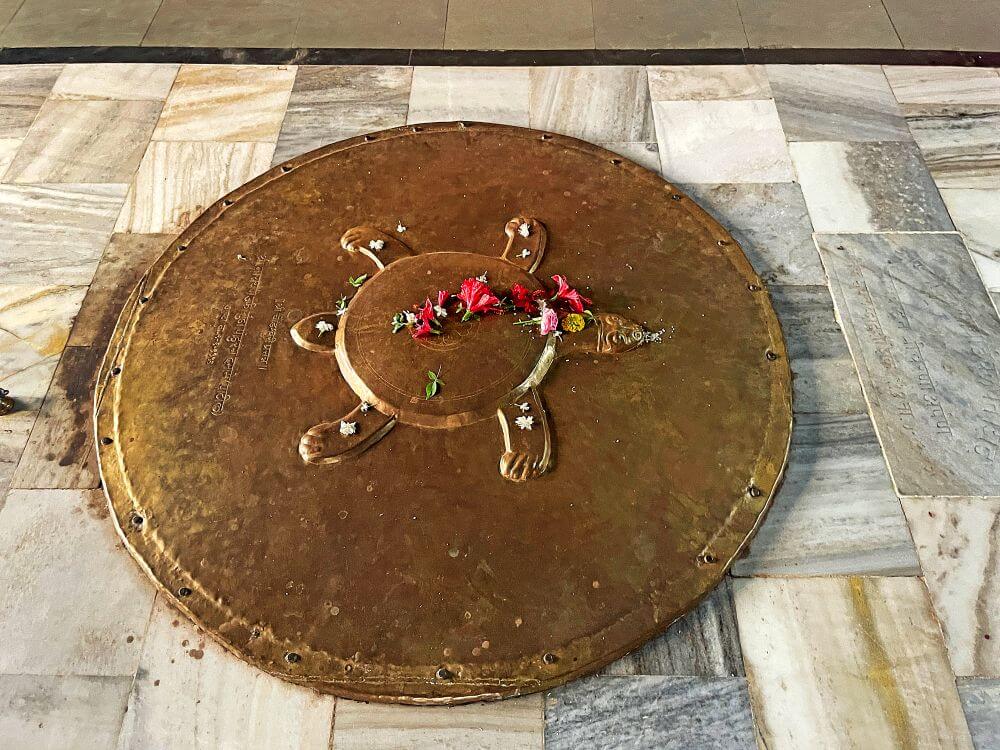
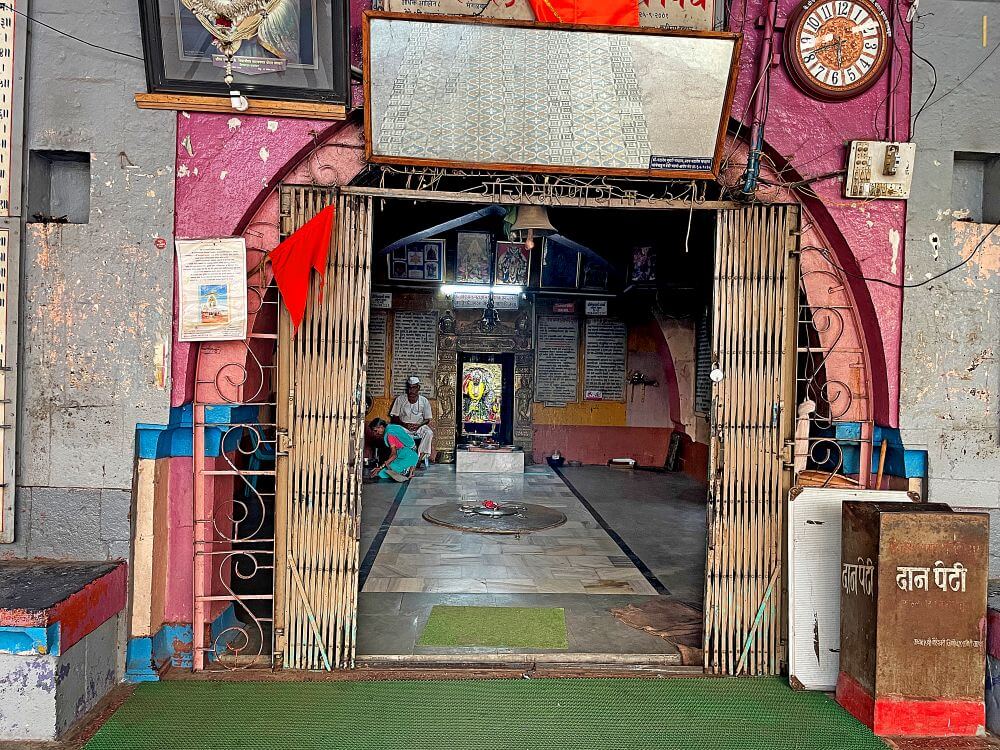
The main stone temple bears many marks of antiquity. Upon entering, there is a Gudhamandap, which is an enclosed assembly hall. Further ahead are the Antarala (vestibule) and the Garbhagriha (sanctum sanctorum). On the four corners of the shikhara (spire) above the Garbhagriha are miniature shikharas. On the octagonal shikhara in the middle two stages are Devakoshthakas (niches for deities). These contain idols of Hanuman, Vishnu, Rama, and other deities. Above are the Amalaka and the Shikhara. The stone ceiling of the assembly hall has a stepped, dome-shaped design. Directly below it is a large, sixty to seventy-year-old brass tortoise. There are no pillars in the assembly hall.
The metal four-fold doorframes of the main Garbhagriha have extremely intricate carvings. On the Mandaraka (lintel) is a lotus flower. Inside the Garbhagriha is a four-armed idol of the Devi with a beautiful prabhaval behind her. In the Devi’s four hands are a trident, a sword, a human skull, and a drinking cup. To the left of the Devi is a metal idol of Ganapati. During festivals, a mask is placed on the Devi. Her adornment varies according to each festival. The main festival of this temple, Bhavai, begins on the Dashami of the Jyeshtha month and continues until Ashadha Purnima. The Devi’s yatra (pilgrimage/fair) continues for twenty-one days. One legend of the Bhavai festival here is that a battle took place between the Devi and the demons Chanda and Munda in the dense forest of this area. In it, the Devi destroyed them. To commemorate this event, the Bhavai play is performed here every year.
In this festival, mock battles are played with demon characters. At the beginning of the festival, war drums are played in the temple. Then an honored participant, carrying a lamp on his head, roams the village searching for the demon. But on that day, the demon is not found. On the second day, forty honored participants pledge to find and destroy the demon. This is called the Kankan Vidhi. Later, one of the honored participants disguises himself as a demon and roams around. Various methods such as Aalu-Malu, Ghodi, Pise, and Thal Uthavane are employed to search for this demon who roams in illusory forms. At night, five individuals, adorned as young maidens, go from house to house in search of the demon. The honour-bearers from the five families of Damame, Gurav, Atugade, Hirgude, and Korbi take on these roles. These five maidens, who visit every home, are worshipped. Following this, the rituals of Lot and Lahu are performed. On the day of Amavasya, one person wears a demon’s mask; this individual is called Aragadi. Two others don masks of deities. Then, the one wearing the demon’s mask is apprehended and brought before the deity’s mask. The honour of capturing and bringing the demon belongs to the Sarade family here.
Once the demon is located, the battle between the Devi and the demon commences. This play takes place at the Ambabai Mandir, Ganapati Mandir, Gandhi Chowk, Maruti Mandir, and one other location in the city. The boundaries for the Devi and the demon are predetermined. The battle begins amidst the resounding war drums and shouts of ‘Harhar’. The battle consists of ‘dhāve’ or ‘runs’. The masks of the Devi and the demon, accompanied by chhatra (umbrellas), chāmara (whisks), and chaure (fly-whisks), begin to run. As the Devi’s mask retreats, Aragaḍī, the demon, advances. The Devi, playfully engaging the demon in this manner, brings him into her territory and then suddenly attacks him. At this moment, Aragaḍī attempts to flee back into his own territory. The Devi pursues him again. Five such ‘dhāve’ occur at five different locations. Finally, near the Maruti Mandir, Aragaḍī, the demon, surrenders. He lies down horizontally. Then, the Devi’s masks, chanting ‘Harhar’, step over him. The demon is vanquished. At this time, the joy of the Devi’s victory is celebrated; this is called Pakhare. After this, one person, impersonating the demon’s mother, wanders about lamenting. This is a procession, known as Khatale. That night, the demon’s wife performs Sati, meaning a large pyre is made. The next day, all these honour-bearers wear sarees and celebrate with great joy. Until Ekadashi, these honour-bearers, dressed as women, dance in the village. Certain words used for all these rituals, such as Diva, Kankanvidhi, Alumulu, Ghodi, Pise, Thal Uthavane, Joganya, Lot, Lahu, Mukhavate, Pakhare, Bajale-Khatale, Chor Sati, Chitkya Mitkya, highlight the uniqueness of this festival. Thousands of people from across the state come to this festival.
After the festival concludes, all these masks are locked away in a box. It is a custom here that these masks, which are only brought out during the festival, are not to be seen at other times. Similar to Badami, during the festival celebrated here in the month of Pausha, sixty types of vegetables are offered to the Devi as naivedya. Land has been dedicated in the Devi’s name for her expenses. It is said that this grant dates back to the year one thousand seven hundred and sixty-three.
This sacred temple stands as a testament to deep spiritual devotion, ancient architectural grandeur, and rich local cultural traditions.
The sanctum sanctorum houses the divine idol consecrated according to ancient Vedic traditions, surrounded by serene courtyards and traditional temple architecture.
Navratri, Maha Shivratri, Annual Temple Jatra & Deepotsav
Compare and book flights, secure top-rated local hotels near the temple, hire reliable guides, and rent cars instantly.
Extend your pilgrimage by visiting other highly sacred temples located nearby.


Add ₹999 more to unlock FREE SHIPPING!
Your sacred cart is currently empty.
Shop Photo FramesFill in your delivery details below to place your order.
Add comment