
Add ₹999 more to unlock FREE SHIPPING!
Your sacred cart is currently empty.
Shop Photo FramesRivers flowing through different regions carry the essence of their respective soils with them. At the confluence, the minerals from the soils of various regions merge, enhancing the medicinal properties of the water. For this reason, river confluences have been considered sacred places since ancient times. Famous temples like Kashi and Prayag stand at such confluences. One such Sangameshwar temple has stood for thousands of years at the confluence of the Krishna and Warna rivers. A unique feature of this temple is that the deity’s palanquin procession is taken out as many as 62 times in a single year.
The legend of this temple states that after Lord Mahadev was insulted at the yajna performed by Daksha Raja, Sati jumped into the sacrificial fire and gave up her life. Following this, an enraged Mahadev came to this place and stayed for some time. Since his anger subsided here, all the gods established a Shiva Linga at this spot. According to another legend, Sage Mrikunda, who lived in Miraj, had a son named Markandeya. It was prophesied that he would be highly scholarly but short-lived. When Markandeya learned of this, he sought refuge at Sangameshwar. He began rigorous penance here. As the time of his death approached, he sat embracing the Shiva Linga here. Consequently, Yama had to turn back. Pleased by his devotion, Mahadev granted him a life span of fourteen kalpas. It is said that for this reason, a stone image of Sage Markandeya is placed in front of this temple.
Observing the carved stone construction of the temple in the Hemadpanti architectural style confirms its antiquity. It is said that this temple dates back to the time of the Shilahara King Bhoja II, while some experts believe it belongs to the Chalukya period. It is believed that while Lord Shriram was heading towards Lanka in search of Sita, he established a sandy Shiva Linga at this sacred place. The priests here state that the imprints of Lord Rama’s hands are visible on this Shiva Linga. Due to this legend, the period of this temple is directly linked to the Ramayana era.
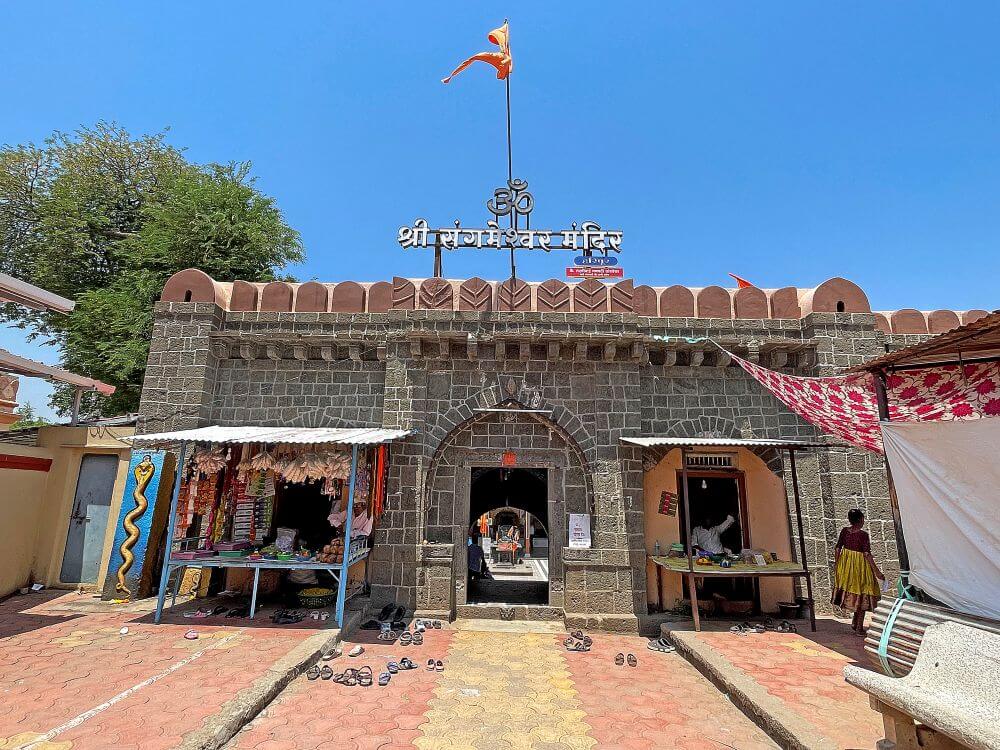
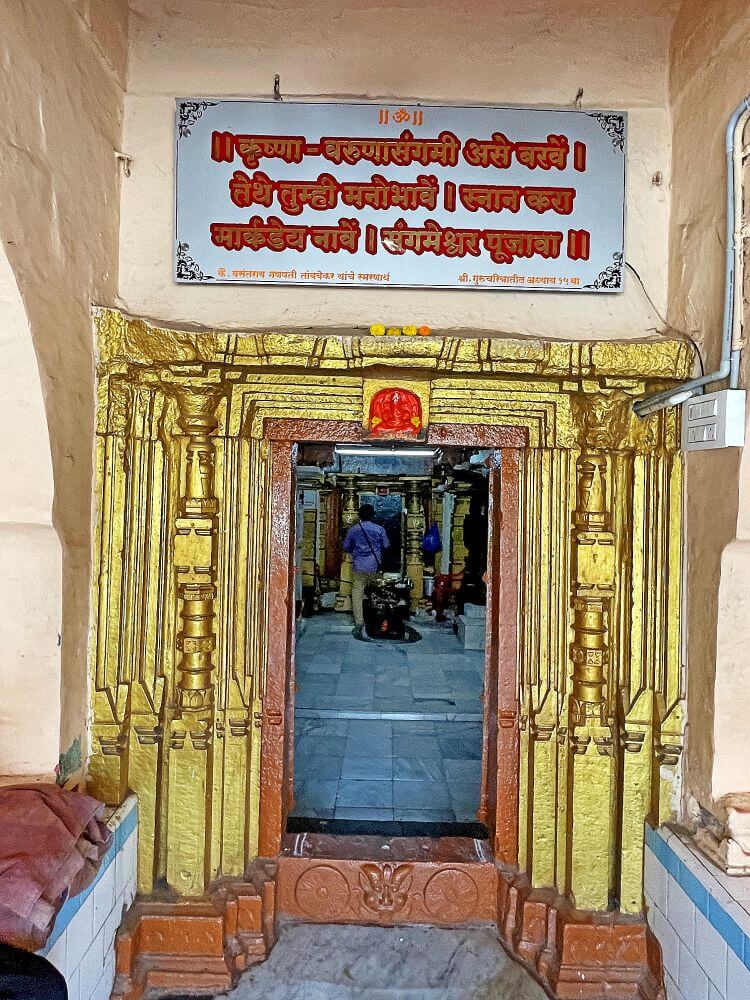
While approaching the temple, one finds welcome arches with pillars on both sides of the road at the village entrance, adorned with crescent moons. Further ahead is the temple parking area, followed by a walled courtyard. There is a lamp tower (Deepmal) near the entrance of this courtyard. Beyond this, in the second fortification of the temple, is a fortress-like stone entrance gate. The entrance features a crescent-shaped arch and vertical linear carvings on the door frames. There is an image of Lord Ganesha on the lintel. One must descend nine steps from this entrance to reach the second courtyard of the temple. There are lamp niches on both sides of the staircase in the entrance, and a brass bell hangs from the ceiling.
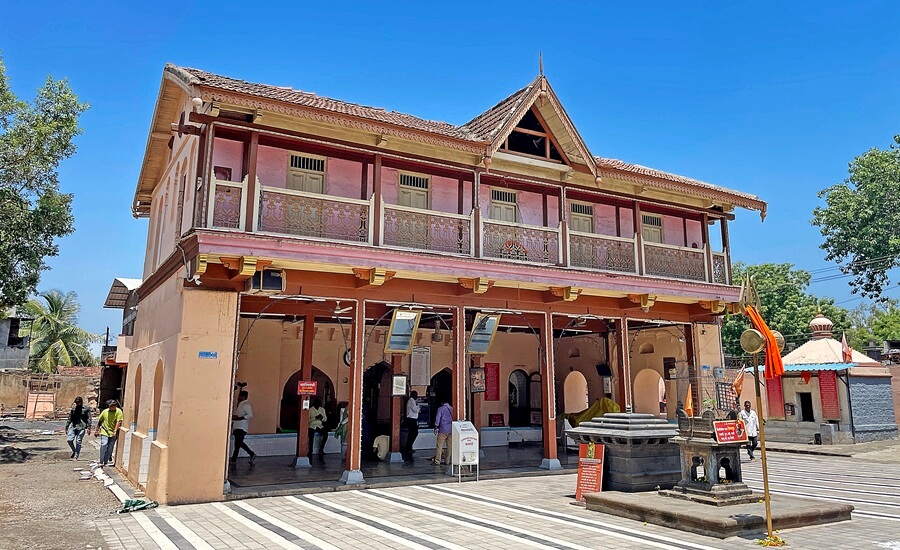
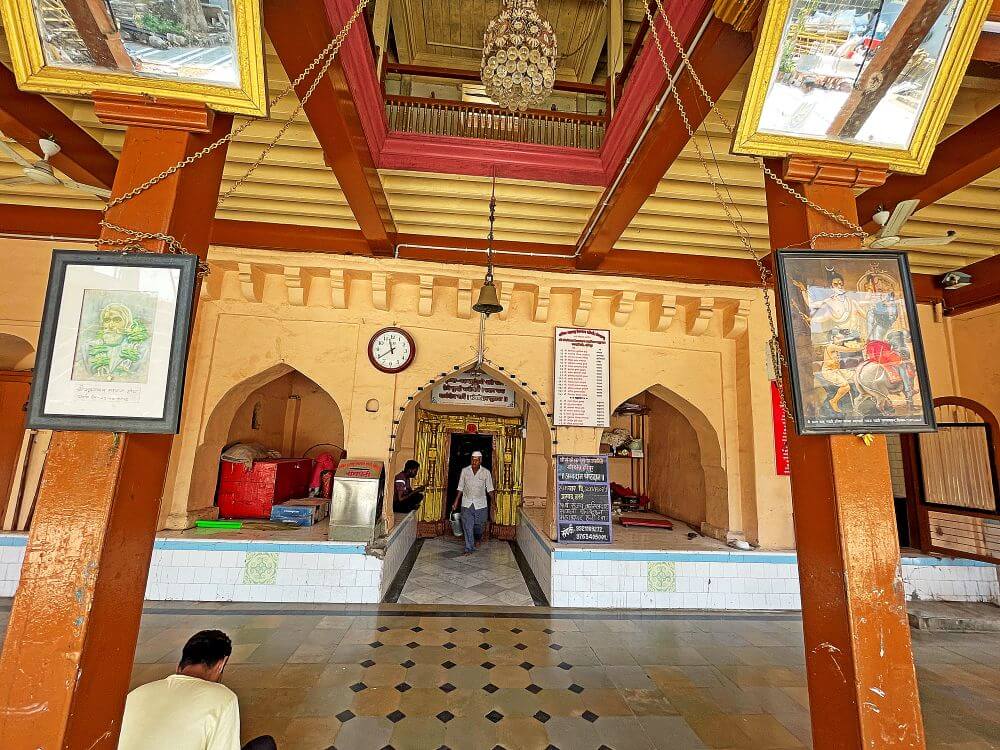
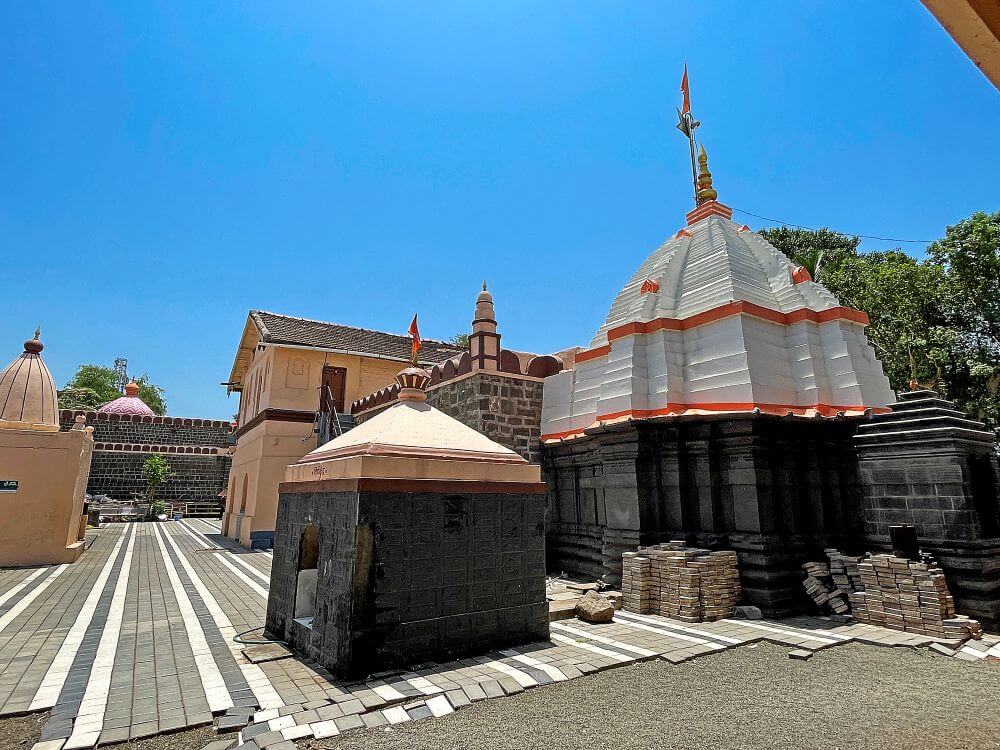
In this paved courtyard, there is a platform with a Tulsi Vrindavan built of carved stone. Beside it stands a trident about five feet tall, adorned with a damaru. Next to the Tulsi Vrindavan is the temple of Markandeshwar, which houses a black stone idol of Markandeshwar. Further ahead is the two-storied wooden assembly hall (Sabhamandap). The front side of the assembly hall is open. There are two entrances each on the right and left sides. The assembly hall contains a large drum (nagara) played during the aarti. Nearby are lamp niches, followed by traditional lamps (divtya) and torches (kakade). The ash container (bhasmapatra) is also kept on one side here. This assembly hall houses a brass tortoise and Nandi.
The front wall of the antarala (vestibule) has two chambers and two niches on both sides. The door frames of the antarala feature vertical linear carvings and an image of Lord Ganesha on the lintel. Inside the antarala, between four ornate circular pillars, is a black stone idol of Nandi placed on a vajra-pedestal. On the left side of the antarala, in two wall niches, are the Saptamatrika panel and a Ganesha idol. In the right niche is an idol of Goddess Parvati. Beside these niches is the processional idol of Lord Sangameshwar.
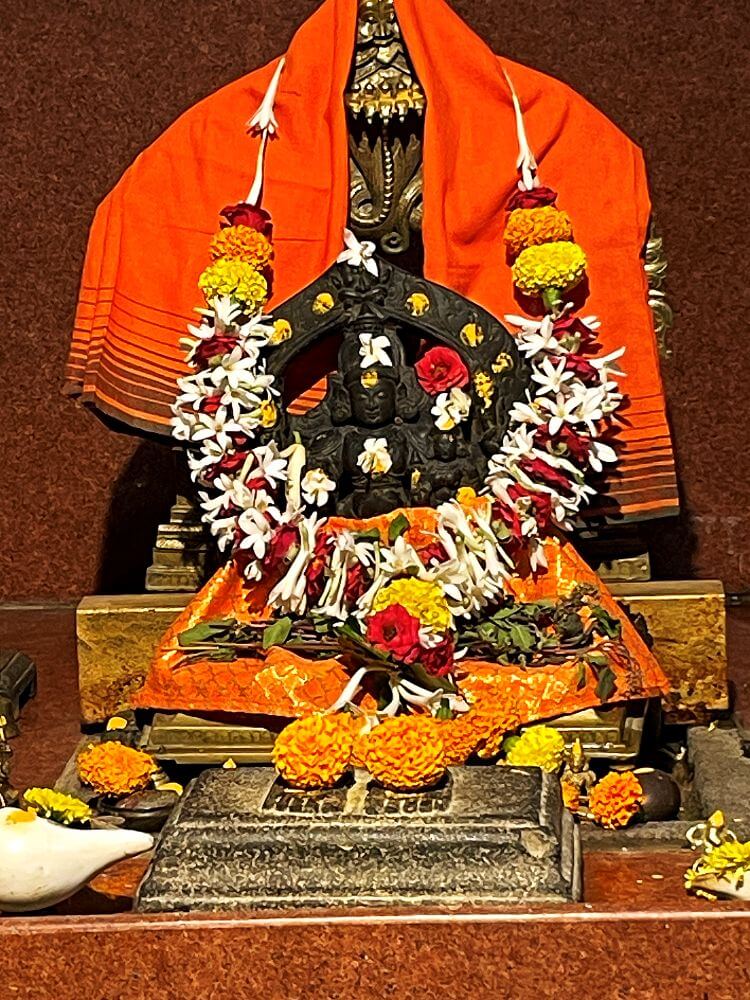
In front of the sanctum sanctorum entrance are four ornate pillars. The threshold features a crescent stone (ardhachandrashila) and floral carvings on both sides. Inside the sanctum is the Shiva Linga, with a silver serpent holding a canopy over it. An abhishek vessel, which drips water, hangs from the ceiling. It is said that the imprints of Lord Rama’s hands are still visible on this Linga today. The Linga and its base (Shalunka) are separate. There is a one-inch crevice in it, through which it is said that the water from the river confluence flows.
On the roof of the antarala is a square high spire, topped with an amalaka and a finial (kalash). On the roof of the sanctum is a square dome-shaped spire, topped with a square stone, a finial, a trident, and a damaru. In the courtyard, there is a Dattatreya temple, which houses a marble idol of Lord Dattatreya. There is a legend that Dattatreya came to this place to seek the darshan of Mahadev. Behind the main temple is the Bhairavnath temple, which houses a four-armed idol of the deity holding a damaru, trident, nectar vessel, and displaying the abhaya mudra. Additionally, there are temples of Vitthal-Rukhumai, Maruti, Shanidev, and Shri Vishnu in this area.
Maha Shivaratri is the main annual festival celebrated in the temple with great enthusiasm. On this day, Panchamrut Abhishek is performed at four in the morning, followed by an aarti at five, and continuous abhishek until eleven in the morning. During this time, 50 pots of water are offered to the deity. This is followed by Shodashopachara Puja. A special puja is performed at noon, after which the deity is bathed with sugarcane juice. Apart from this, the Gudi Padwa festival is also celebrated in the temple. During festivals, the deity’s palanquin procession is taken out. On these occasions, hundreds of kilograms of khichdi prasad are prepared for the devotees. Thousands of devotees visit the temple during festivals for darshan and to fulfill their vows.
This sacred temple stands as a testament to deep spiritual devotion, ancient architectural grandeur, and rich local cultural traditions.
The sanctum sanctorum houses the divine idol consecrated according to ancient Vedic traditions, surrounded by serene courtyards and traditional temple architecture.
Navratri, Maha Shivratri, Annual Temple Jatra & Deepotsav
Compare and book flights, secure top-rated local hotels near the temple, hire reliable guides, and rent cars instantly.
Extend your pilgrimage by visiting other highly sacred temples located nearby.


Add ₹999 more to unlock FREE SHIPPING!
Your sacred cart is currently empty.
Shop Photo FramesFill in your delivery details below to place your order.
Add comment