
Add ₹999 more to unlock FREE SHIPPING!
Your sacred cart is currently empty.
Shop Photo FramesSangli, blessed with a great historical and cultural heritage, remains renowned today for various reasons. Known as the largest turmeric market in Asia and home to the largest cooperative sugar factory in the Asian continent, Sangli is also recognized as the city of wrestlers. It was here in 1843 that the first performance of ‘Sita Swayamvar’ by the pioneer Marathi playwright Vishnudas Bhave took place. Similarly, Sangli also possesses a significant religious legacy. The ancient Ganpati Panchayatan temple here is famous. Regarding this temple, it is said, “Sangli’s Ganpati is made of gold… and he loves a grand, ornate shawl.”
Although the worship of Ganesha in Maharashtra has been practiced since the Satavahana era, it gained greater significance during the Peshwa period. Many Ganesha temples were established here during that time. Lord Ganesha was the presiding deity (Aradhya Daivat) of the Patwardhan sardars of the Peshwas. Harbhat Balambhat Patwardhan, the founder of this dynasty, had worshipped Ganesha at Ganpatipule for twelve years. His descendants preserved that same legacy of Ganesha worship. The Patwardhans established Ganesha temples in the jagirs they received during the Peshwa era and later within their own princely states. The Talavatal Ganpati temple (the Ganesha temple by the lake) built by Shrimant Gangadharrao Govind Patwardhan in Miraj is famous. The magnificent Ganesha Panchayatan temple in Sangli was built by Chintamanrao Appasaheb Patwardhan, the founder of that princely state.
According to the English book ‘The Sangli State’, published in 1917 by Rao Bahadur D. B. Parasnis, Govind Hari, the son of Haribhat, received jagirs in Mangalwedha, Kurundwad, and Miraj during the reign of Shrimant Nanasaheb Peshwa (1740–1761 AD). Chintamanrao Appasaheb Patwardhan was the great-great-grandson of Govind Hari. He received the robes of the Sardari of Miraj at the age of nine. As he was a minor, he managed the administration through his uncle, Gangadharpant. Later, due to internal family strife, Chintamanrao and Gangadharpant could not get along, and in January 1800, their properties were partitioned. Following this, Chintamanrao chose the small village of Sangli, situated on the banks of the Krishna River, as his capital.
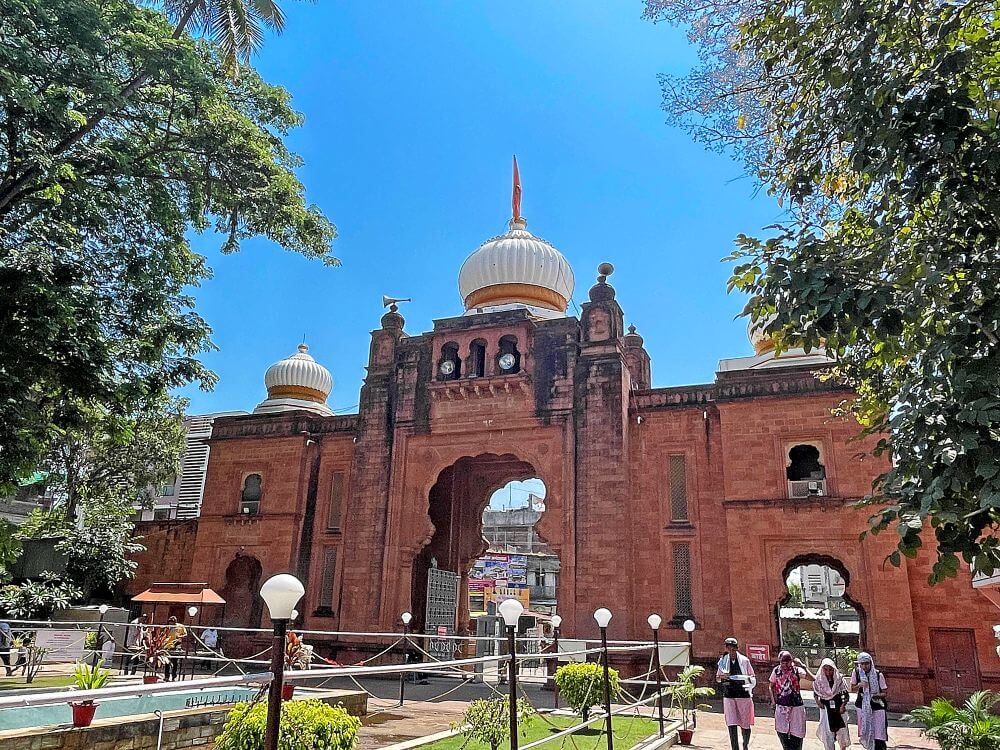
From 1807, he began the planning of the peths (neighborhoods) in Sangli and initiated the settlement. Just three years later, in 1811, he commenced the construction of the Ganesh Panchayatan temple. Fortunately, detailed documents regarding the construction of this temple are still available to historians today. According to these, Chintamanrao Patwardhan had initially selected a spacious site on the hill of Swanand Bhavan for this temple. However, due to a shortage of water there, the construction of the temple remained incomplete. Subsequently, he chose the scenic area along the banks of the Krishna River. The installation of the idols in the temple took place on Chaitra Shuddha Dashami in 1845, while the Kalasharohan ceremony of the temple was held in 1847. Even after this, additions were made to the temple structure from time to time. Chintamanrao Appasaheb Patwardhan’s He passed away in 1851. After him, his son Dhundiraj became the ruler of the Sangli State. During his tenure (1851 to 1901), the balcony (sajja) of the main temple structure was built, along with the construction of three-tiered pavilions (sopya) for four deities. In the third phase, during the time of Chintamanrao Appasaheb Patwardhan (II), the construction of the Ganapati Sabhamandap (assembly hall) began on 12 March 1944. The work continued for nine years and cost four lakh rupees. This Sabhamandap was inaugurated in 1953 by the then Vice President and great scholar of Hindu philosophy, Dr. Sarvepalli Radhakrishnan. Following this, in 1954, a grand Mahadwar (main entrance gate) was built here at a cost of nine lakh rupees.
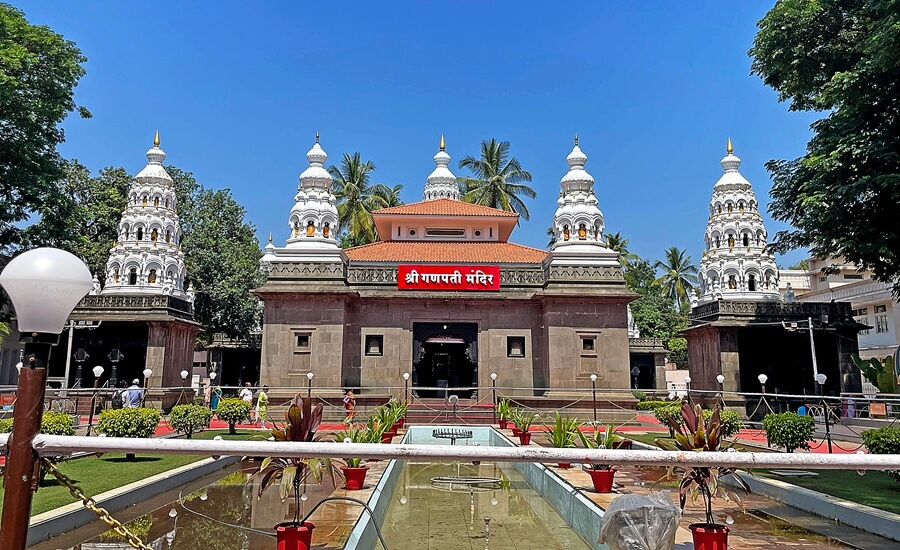
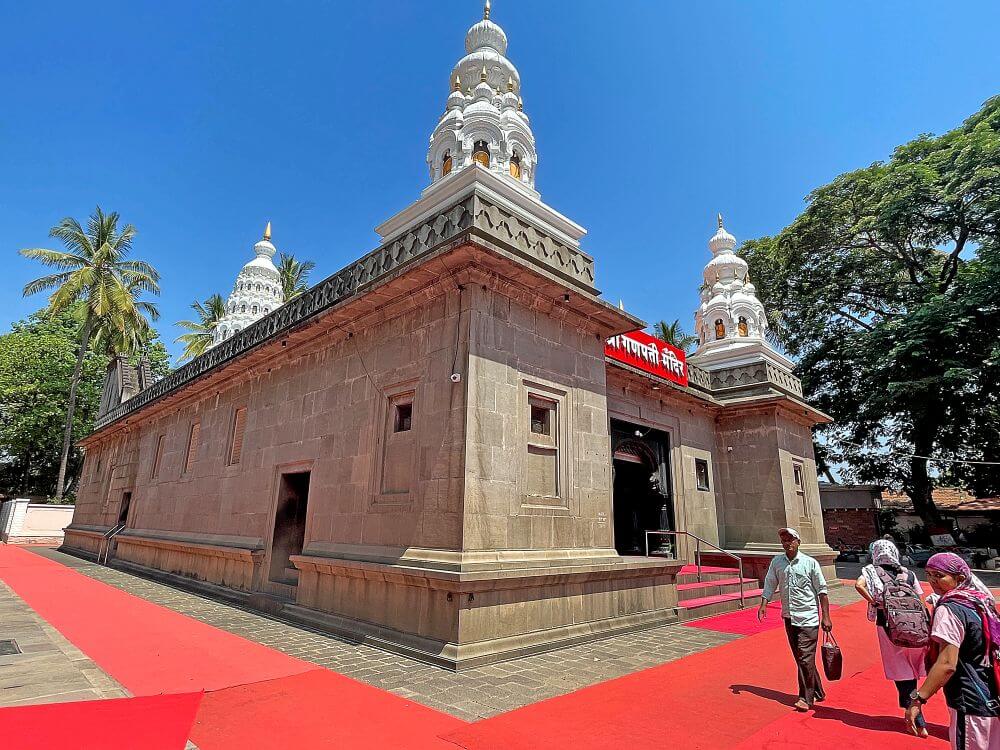
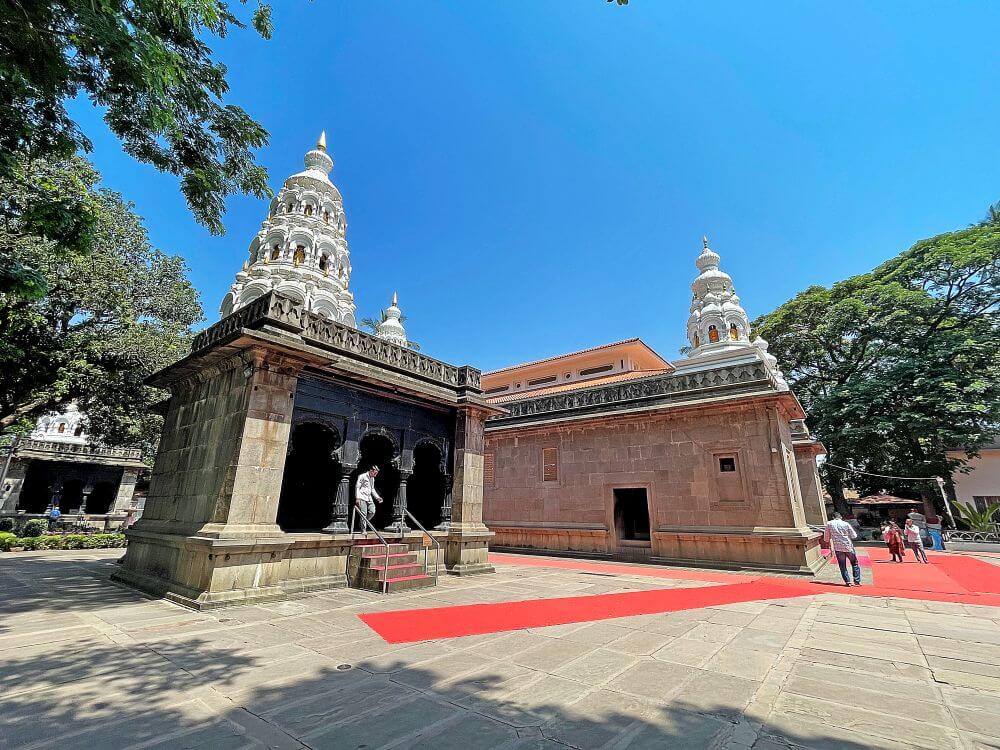
In front of this two-story Mahadwara (main entrance), built from red-pink stone brought from Gokak, are many shops selling worship materials. The structure of the Mahadwara consists of a main entrance in the center and sub-entrances on both sides. All three entrances feature arched gateways, with guard rooms on both sides inside. On the floor above the main entrance is the Nagarkhana, and between four ornate pillars are three There is a balcony featuring an arched facade. Above the entrance roof, there are three dome-shaped spires, each crowned with an amalaka and a kalasha. Upon entering through the main gate, one steps into the temple courtyard. The fountain and beautiful garden here enhance the temple’s aesthetic appeal. A short distance ahead from the courtyard stands the temple of Lord Ganesha, constructed from black stone. Since it is situated at a higher elevation than the courtyard, one must ascend three steps to reach the assembly hall (sabhamandapa). There are platforms on both the left and right sides of the steps. On both sides of the entrance, there are lamp niches (deepakoshtakas) built into the facade walls.
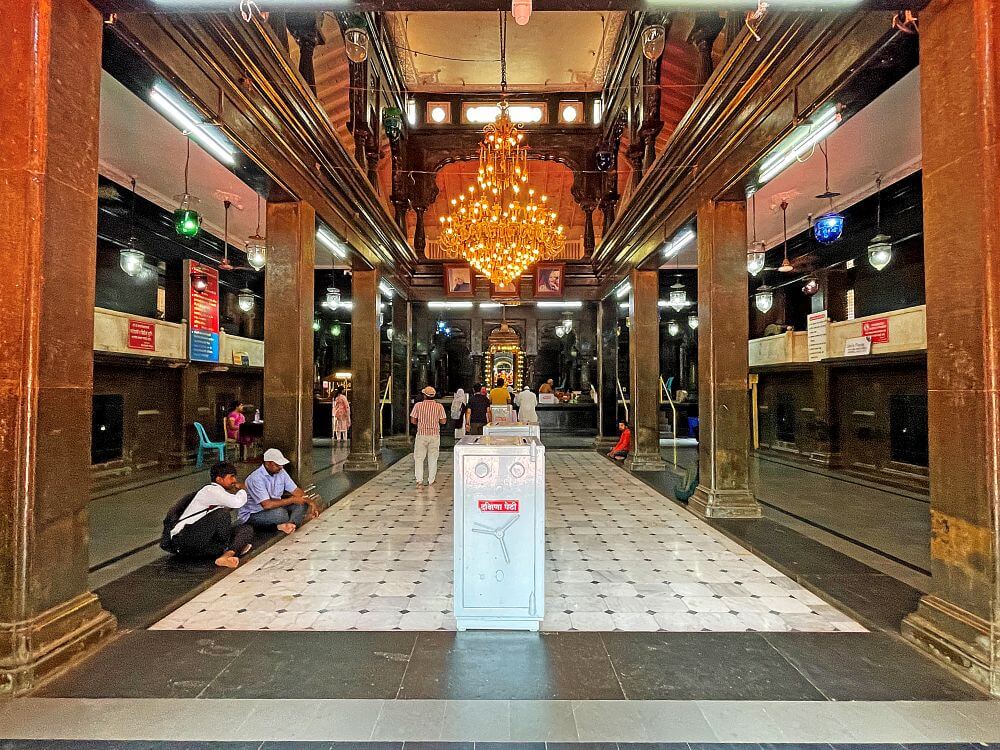
In the enclosed assembly hall (sabhamandapa), near the entrance on both sides, there are two ornate pillars each, with carved brackets and cusped arches above them. The two-story assembly hall features two rows of five wooden pillars each, supporting the balcony of the upper floor. On the upper floor, the balconies on both sides have five ornate pillars and cusped arches between them. During festivals, the women of the royal family would stand in these balconies to witness the splendor of the programs. There are two exit doors on the left and right sides near the entrance of the Antarala (vestibule) of the Sabha Mandapa (main assembly hall). A large chandelier and a brass bell are hung from the ceiling of the Sabha Mandapa.
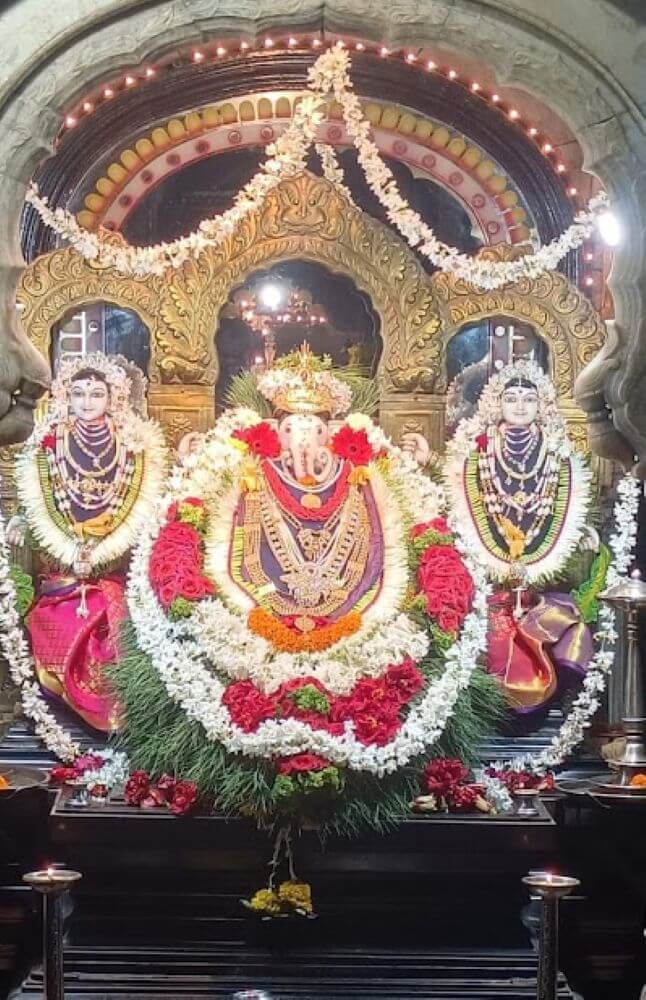
In the sanctum, the Utsav Murti (processional idol) of Ganesha is placed in an intricately carved wooden shrine. Ahead lies the ornate entrance of the Garbhagriha (sanctum sanctorum). The door frames are adorned with floral and leaf motifs, and the Lalatabimba (lintel) features a sculpture of Ganesha. Inside the Garbhagriha, the four-armed idol of Ganesha with a left-turning trunk is seated on a Vajrapitha within a marble shrine. Of the two upper arms, the right hand holds a pasha (noose) and ankusha (goad), while the left hand holds a danta (tusk). The lower right hand is in the Abhaya Mudra (gesture of fearlessness), and the left hand holds a modak. On both sides of the Ganesha idol stand the figures of Riddhi and Siddhi, holding chauris (whisks) and baskets of flowers. The Ganesha idol is adorned with fine garments and ornaments. The golden prabhavali (halo) behind the idol features exquisite craftsmanship. This idol, along with the idols of the Panchayatan deities here, was carved from marble brought from Mahabaleshwar. In the documents of the Sansthan, According to the records, all theological guidance for those idols was sought from the Vedashastrasampanna Pandit Chintaman Dixit Apte of Pune. The task of crafting these idols was entrusted to Mukunda Patharwat and Jiwanna Deshingkar.
The temple’s Sabha Mandapa (assembly hall) features a tiled roof divided into two sections, an upper and a lower level. On both sides of the entrance, the roof is adorned with two-tiered shikhara (spires). Each first tier of the shikhara contains eight devakoshtakas (niches) housing idols of various deities. The upper tier features lotus petal motifs, topped with an amalaka and a kalasha. Above the Garbhagriha (sanctum sanctorum) rises the main shikhara, which tapers as it reaches toward the sky in five tiers. This cone-shaped shikhara stands at a height of 80 feet. Four of its tiers contain niches with various idols, while the fifth tier features two stacked amalakas, topped by a kalasha and a dhwajapataka (flag).
On all four sides of the temple are four smaller temples dedicated to Chintamaneshwar, Chintamaneshwari, Lakshmi Narayan, and Surya Narayan. In documents from the era of Chintamanrao Appasaheb Patwardhan, the deity Chintamaneshwar is referred to as ‘Shri Samb’, and the goddess Chintamaneshwari as ‘Shri Devi’. This clarifies that these deities were named after them following their passing. The Sabha Mandapa of this temple has five steps. Inside, there are four ornate pillars connected by arched gateways. The doorframe of the Garbhagriha is decorated with floral and leaf motifs, with an idol of Lord Ganesha on the lalalata-bimba (lintel). All four temples, which feature four-tiered shikharas on their roofs, share a similar architectural design. All the temples are constructed from red carved stone. In the open courtyard, the wall-less Navagraha temple houses the black stone idols of the nine planets, each placed on an independent vajrapitha.
In the courtyard, there is a sculpture of Gajraj (the royal elephant) and a statue of Shrimant Appasaheb Patwardhan on a pedestal. The Maghi Ganesh Jayanti and the Parthiva Ganeshotsav in the month of Bhadrapada are the main annual festivals celebrated here with great enthusiasm. During the Parthiva Ganeshotsav, programs such as bhajans, kirtans, music, and pravachans (discourses) are organized in the temple for all five days. On the fifth day, the immersion procession of the Sansthan’s Parthiva Ganesha is taken out on a chariot, accompanied by elephants, camels, horses, bhaldars (spearmen), and chopdars (mace-bearers) to the banks of the Krishna River. During this time, devotees shower the chariot with pedhas (sweets). The temple sees a large influx of devotees on Sankashti and Vinayaki Chaturthi.
This sacred temple stands as a testament to deep spiritual devotion, ancient architectural grandeur, and rich local cultural traditions.
The sanctum sanctorum houses the divine idol consecrated according to ancient Vedic traditions, surrounded by serene courtyards and traditional temple architecture.
Navratri, Maha Shivratri, Annual Temple Jatra & Deepotsav
Compare and book flights, secure top-rated local hotels near the temple, hire reliable guides, and rent cars instantly.
Extend your pilgrimage by visiting other highly sacred temples located nearby.


Add ₹999 more to unlock FREE SHIPPING!
Your sacred cart is currently empty.
Shop Photo FramesFill in your delivery details below to place your order.
Add comment