
Add ₹999 more to unlock FREE SHIPPING!
Your sacred cart is currently empty.
Shop Photo FramesAnandmurti is revered as the youngest among the ‘Adhikari Purushas’ (enlightened masters) of the Samartha Panhayatana, who conclusively demonstrated that spiritual practice (sadhana) can be undertaken without renouncing the householder’s life (grihasthashram). The names of these enlightened masters in the Panhayatana are Ramdas Swami Chaphalakar, Ranganath Swami Nigadikar, Jayaram Swami Vadgaonkar, Keshavswami Bhagannagar, and Anandmurti Brahmnalkar. It is said that whenever Anandmurti stood before his Guru’s samadhi (tomb/shrine) for kirtan (devotional singing), the samadhi would sway. Anandmurti’s Math (monastery) and Samadhi are located in Brahmnal, in Tasgaon Taluka. Devotees believe that visiting this place grants a profound spiritual experience (adhyatmik anubhuti).
According to the sacred text ‘Shri Anandcharitamrut’, Anandmurti’s original name was Anant Balambhat Brahmnalkar. His ancestral village was Bhadasgaon, situated on a riverbank 40 kilometers from Kolhapur. His ancestors, having received the ‘Joshipan’ (hereditary priestly rights) of eighteen villages, had settled in the village of Agal. It was in this very place, in the 16th century, that Anantbhat was born into the family of Balambhat Brahmnalkar. His father was a devout Vedic scholar. From a young age, Anantbhat developed a deep fondness for satsang (spiritual company), bhajan (devotional songs), and kirtan. By the age of seventeen, he had memorized the ‘Dashagranth’ (ten sacred texts). He had become proficient in the philosophies of Sankhya and Yoga. He was also an excellent astrologer (jyotishi). Consequently, he unknowingly developed a sense of pride in his vast knowledge.
He served as the family priest (purohit) for Appajipant Deshpande of Dhalgaon in Miraj Taluka. For his priestly duties (joshi vrutti), he would travel throughout the entire region. Once, upon returning from an out-of-town trip, he learned that Appajipant had received spiritual instruction (upadesh) from a Swami. Enraged, Anantbhat exclaimed, “How could he take another Guru when we are his Kulaguru (hereditary family preceptors)?” and went to Deshpande’s house to demand an explanation. Raghunath Swami, from whom Appajipant had received the Guru Mantra, was present there. The moment the agitated Anantbhat met Raghunath Swami, it was as if a soul (Jeeva) met the Divine (Shiva). His pride instantly melted away, and he humbly surrendered at the feet of the Guru (Gurucharani leen).
Shri Anandmurti has beautifully described how his Sadguru (true Guru) bestowed divine grace (Gurukrupa) upon him. In his words, he states:
“The pauper was transformed into a divine being. Anandmurti was made the very embodiment of bliss.”
“Oh Self-effulgent Consciousness-Bliss, dense with joy, the perfected embodiment of one’s own bliss.”
However, Anant Bhatji’s father was displeased that his Vedic son had received spiritual initiation (Guruupadesh). In his anger, he cast his son and daughter-in-law out of the house. Anant Bhatji left his home with his wife and two-month-old child. He went to his Guru, Raghunath Swami’s residence. They settled in the village of Vasagade, located 12 kilometers from Sangli. The Swami, with the help of the villagers, cared for them. Living there, Anantbhat became completely absorbed in the service of his Guru (Guru Sevet magna).
Once, to test his disciple, Raghunath Swami left the village of Vasagade. Anantbhatji tirelessly searched for his suddenly disappeared Guru for three continuous years. Finally, he met his Guru in Sankeshwar, Karnataka. The Swami was overjoyed that his disciple had found him. He expressed his happiness upon seeing his disciple by naming him ‘Anandmurti’ (embodiment of bliss). This name subsequently became famous everywhere. Through his actions and guidance, he imparted the joy of spirituality (adhyatma) to his disciples. He showed many the path of life. Through the grace of his Guru (Gurukrupa), he understood that spiritual practice (sadhana) is possible even without renouncing the householder’s life (grihasthashram). He also composed many divine poetic works (prasadik padyarachana). Anandmurti, who resided in Brahmnal for his spiritual practice, attained Mahanirvan (final liberation) in 1666.
Anandmurti worshipped Shri Rama throughout his life. He played a significant role in enlightening the common people. The boundless love between this Guru and disciple persisted even after death. After Anandmurti’s Mahanirvan, his samadhi was erected right in front of his Guru’s samadhi. Even today, devotees believe that the samadhis of both the Guru and the disciple sway during special kirtan performances.
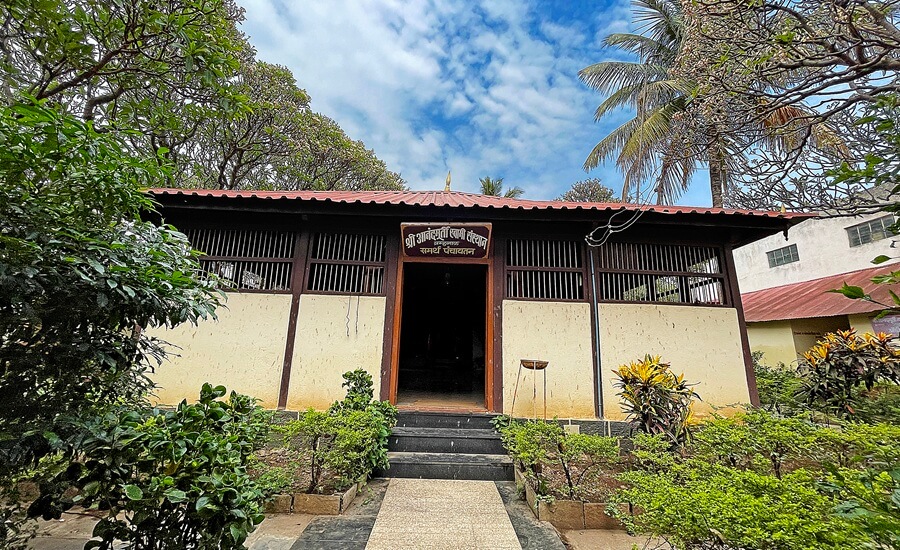
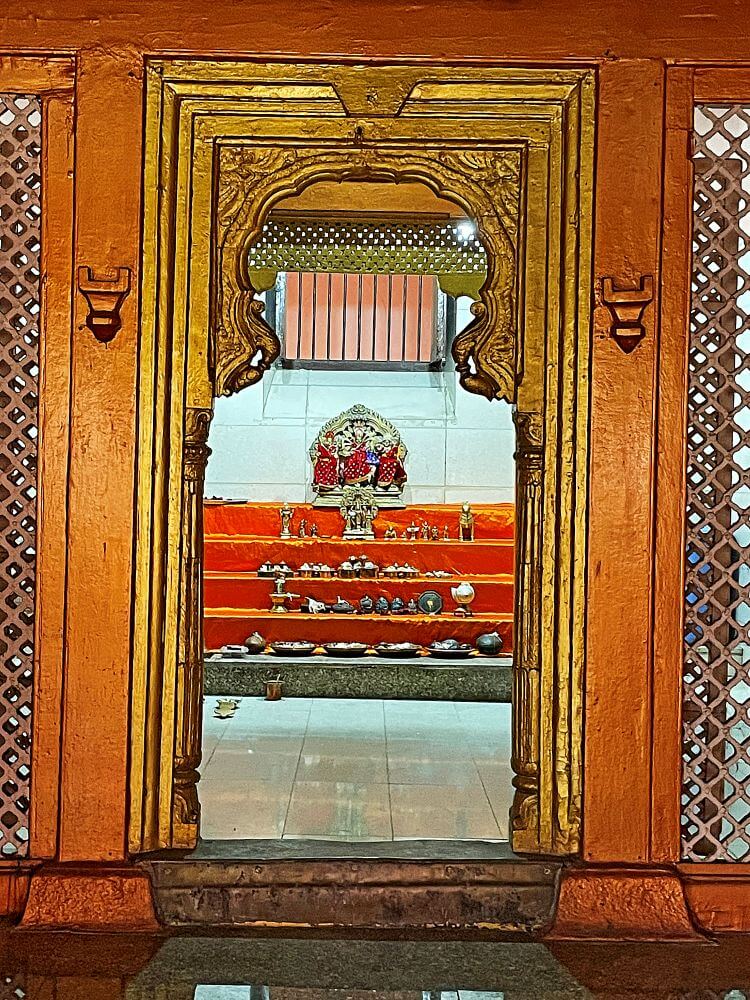
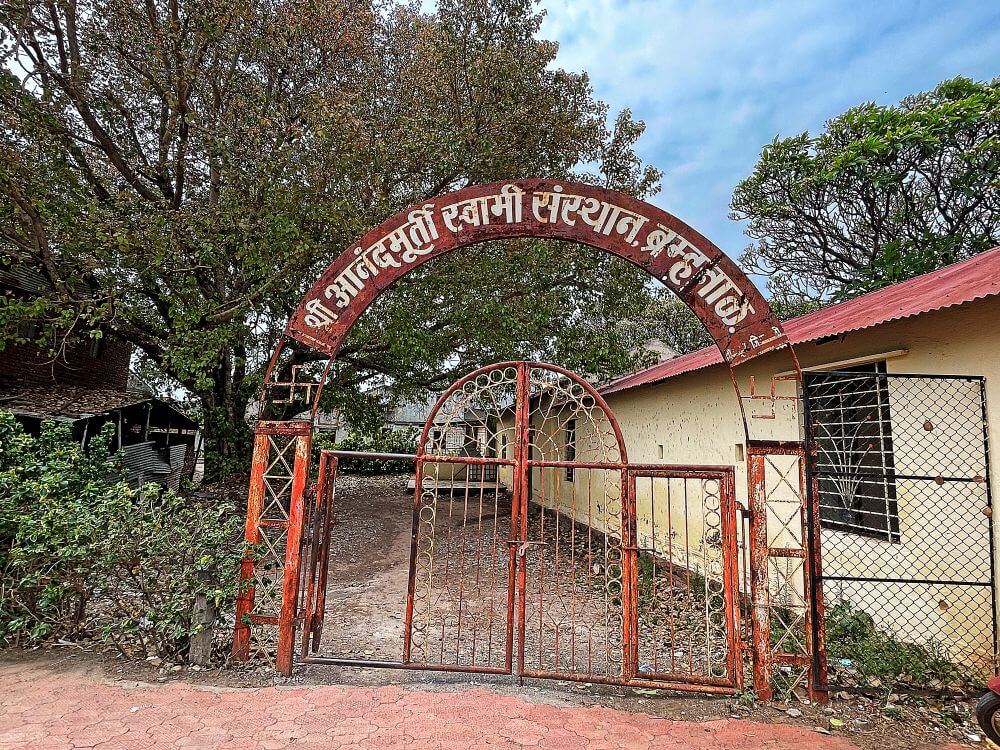
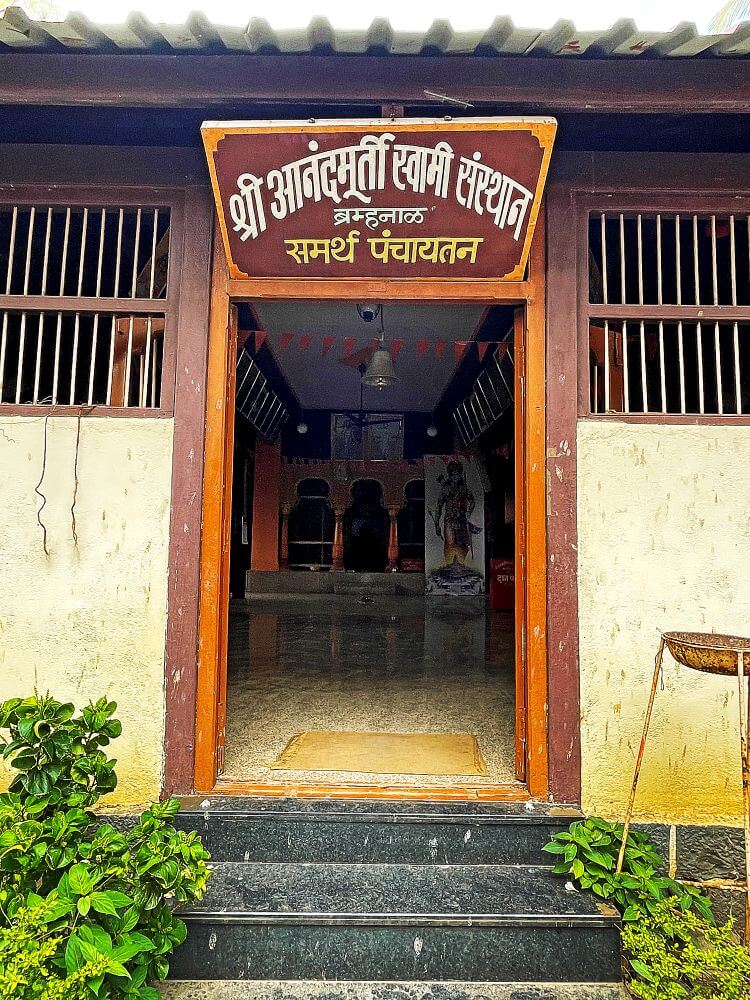
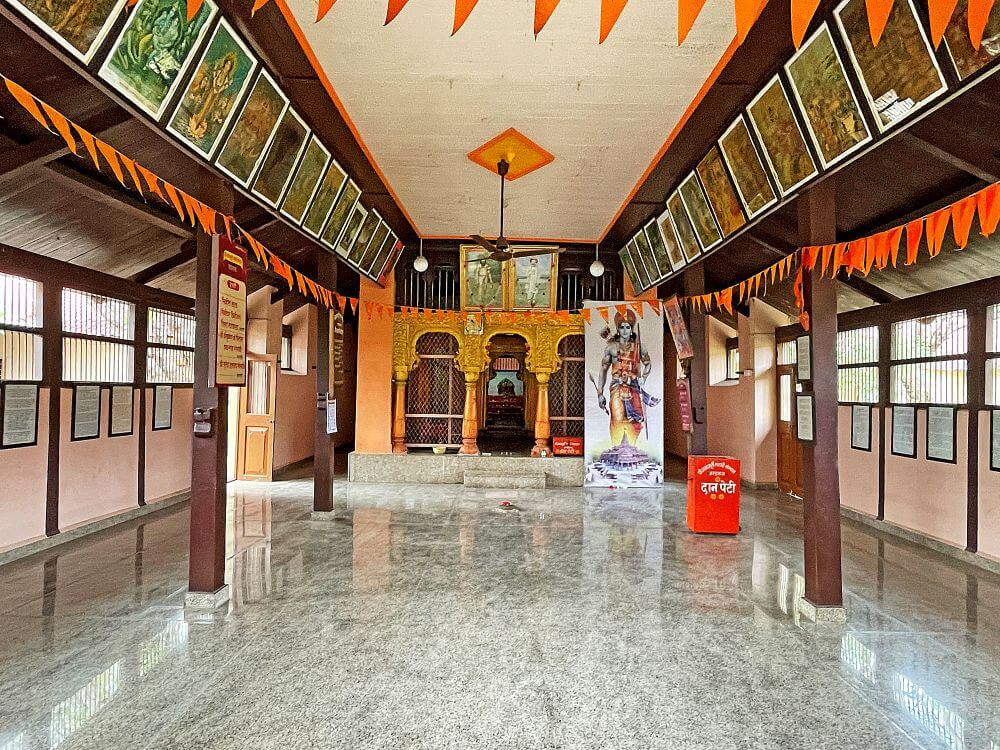
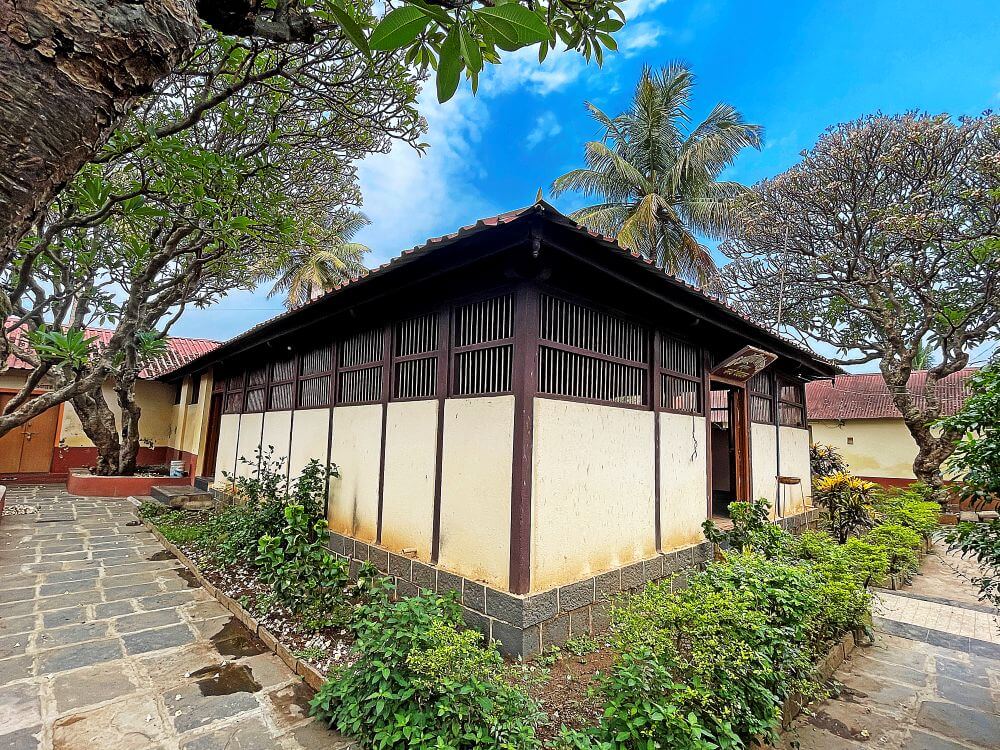
Anandmurti Swami’s Math (monastery) is located in the central part of Brahmnal village. Entry into the temple courtyard (prangan) is through the gateway in the compound wall (avarbhinti) surrounding the temple. The garden within the courtyard features large Chafa (Plumeria) trees. The construction of this Math, which has a four-sided tin roof, extensively uses wood. The structure of the Math comprises an Antaral (antechamber) and Garbhagriha (sanctum sanctorum), excluding the Sabhamandap (assembly hall) and Pradakshinapath (circumambulatory path). Entry into the Sabhamandap is through the main entrance of the Math, which stands on a raised platform (jagati). This enclosed Sabhamandap features wooden pillars. On the upper part of these pillars, in a balcony-like space, are placed images of various deities. Additionally, the walls of the Sabhamandap display numerous informative images depicting the life and work of Anandmurti and his Guru, Raghunath Swami. The Antaral is slightly elevated compared to the Sabhamandap. Four pillars near the entrance are connected by arched gateways (mahirpi kamani). The upper parts of these pillars feature distinctive carvings (naxikam). The Garbhagriha houses many idols of deities worshipped by Anandmurti, along with his sacred footwear (padukas). Here, the Ramnavami Utsav is celebrated from Chaitra Shuddha Pratipada to Dashami. Raghunath Swami’s Punyatithi (death anniversary) is observed from Bhadrapad Shuddha Ekadashi to Chaturthi, and Anandmurti’s Punyatithi on Kartik Shukla Chaturdashi. Besides these, a grand festival is also held here on Mahashivratri.
Approximately one kilometer from the Math, on the banks of the Krishna River, are the samadhis of Anandmurti and Raghunath Swami. The samadhis of Anandmurti’s wife and son are also located in this vicinity. The area features large ‘ovarya’ (riverfront steps/galleries). The Ramnavami festival is celebrated here with great enthusiasm. Devotees can visit the Math for darshan (sacred viewing) daily from 8 AM to 12 PM and from 5 PM to 8 PM. Aarti (ritual of waving lamps) is performed here at 7:30 PM.
This sacred temple stands as a testament to deep spiritual devotion, ancient architectural grandeur, and rich local cultural traditions.
The sanctum sanctorum houses the divine idol consecrated according to ancient Vedic traditions, surrounded by serene courtyards and traditional temple architecture.
Navratri, Maha Shivratri, Annual Temple Jatra & Deepotsav
Compare and book flights, secure top-rated local hotels near the temple, hire reliable guides, and rent cars instantly.
Extend your pilgrimage by visiting other highly sacred temples located nearby.


Add ₹999 more to unlock FREE SHIPPING!
Your sacred cart is currently empty.
Shop Photo FramesFill in your delivery details below to place your order.
Add comment