
Add ₹999 more to unlock FREE SHIPPING!
Your sacred cart is currently empty.
Shop Photo FramesKharsundi, Taluka Atpadi, District Sangli
Following the rise of the Nath tradition, the word ‘Nath’ began to be added before the names of many deities. As the propagation and outreach of the Nath tradition grew, the eighty-four Siddhanaths began to be worshipped in the shrines and temples of common people. Since the Nath tradition is fundamentally Shaivite, Siddhanath was considered an incarnation of Lord Shiva and began to be worshipped in the form of Shiva. An ancient and famous temple of one such Siddhanath is located in the village of Kharsundi in Atpadi taluka. Devotees firmly believe that the deity Siddhanath is extremely powerful and always rushes to answer the calls of his devotees.
This temple, built in the Hemadpanti architectural style, is said to be approximately one thousand years old. According to mythological accounts, the primary seat of this deity is at Sonari in the Paranda taluka of Osmanabad district. Pleased by the devotion of a shepherd named Bhoja from the Mandesh region, this Lord Siddhanath arrived in Mhaswad during the tenth century and, over time, manifested at Kharsundi. The legend regarding this states that a devotee of Siddhanath named Nayappa (Nayaba) Gawali lived in the village of Chincholi, near Kharsundi. He would regularly travel to Mhaswad every Saturday to worship Siddhanath with curd and milk. He owned a ‘Kunwar’ cow named Kapila. Whenever Nayappa would depart for Siddhanath, she would low mournfully and wait for his return.
Later, due to old age, it became difficult for Nayappa to travel to Mhaswad. However, his heart remained at the feet of Siddhanath. One night, Siddhanath appeared to Nayappa in a dream and said, “There is no need for you to come to Mhaswad anymore. I myself will come to you. In the pasture where you graze your cattle, I will manifest at the spot where streams of milk flow from the udder of your beloved cow.” Following this divine vision, one day, Nayappa’s Kapila cow, which was a virgin—meaning she had never… A cow that had not yet calved began to let down her milk in one particular spot. Instead of milk, streams of colostrum flowed from her udders. Layers upon layers of this colostrum accumulated, eventually taking the shape of two Shiva Lingas. He narrated this incident to the villagers. Upon hearing this, the villagers verified the event. Once they were convinced, they all resolved to build a temple where those Shiva Lingas had appeared. This is the very temple of Siddhanath. Since then, this place became known as Kharvas Pindi. Over time, the name became corrupted, and the village came to be known as Kharsundi.
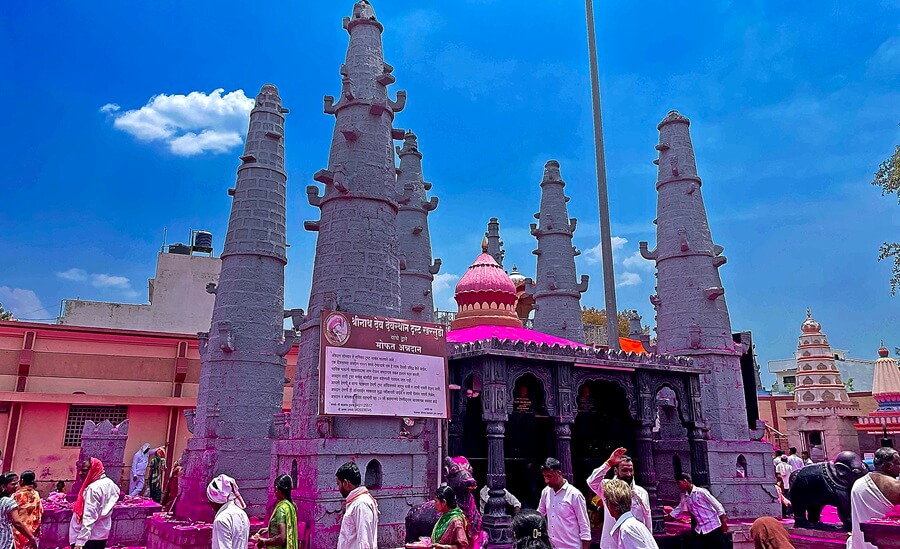
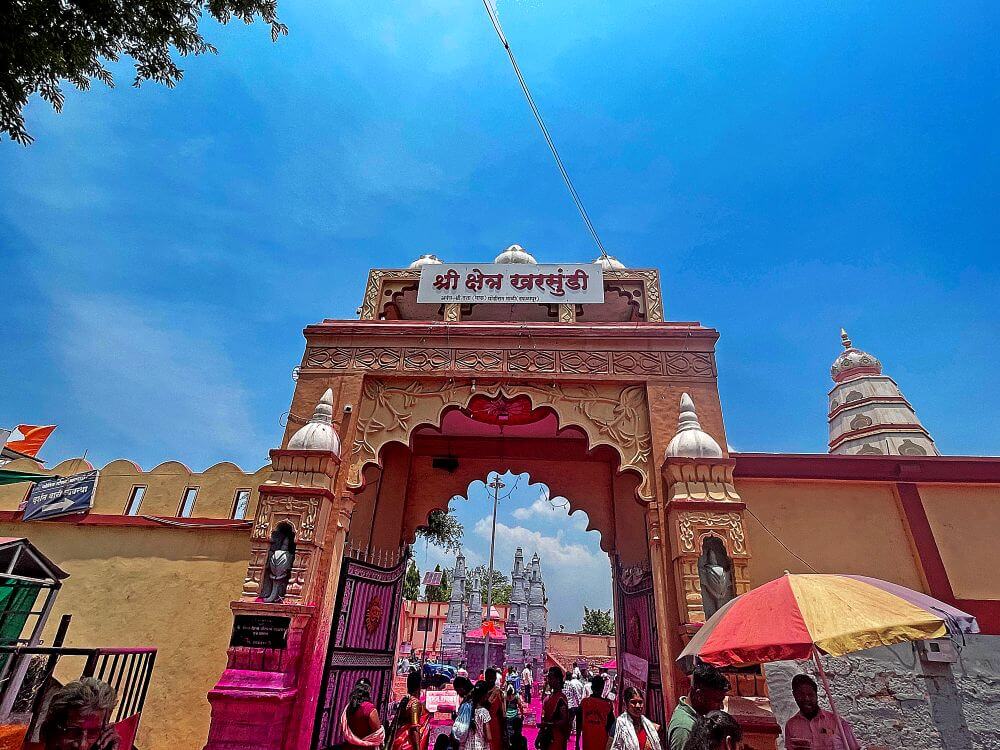
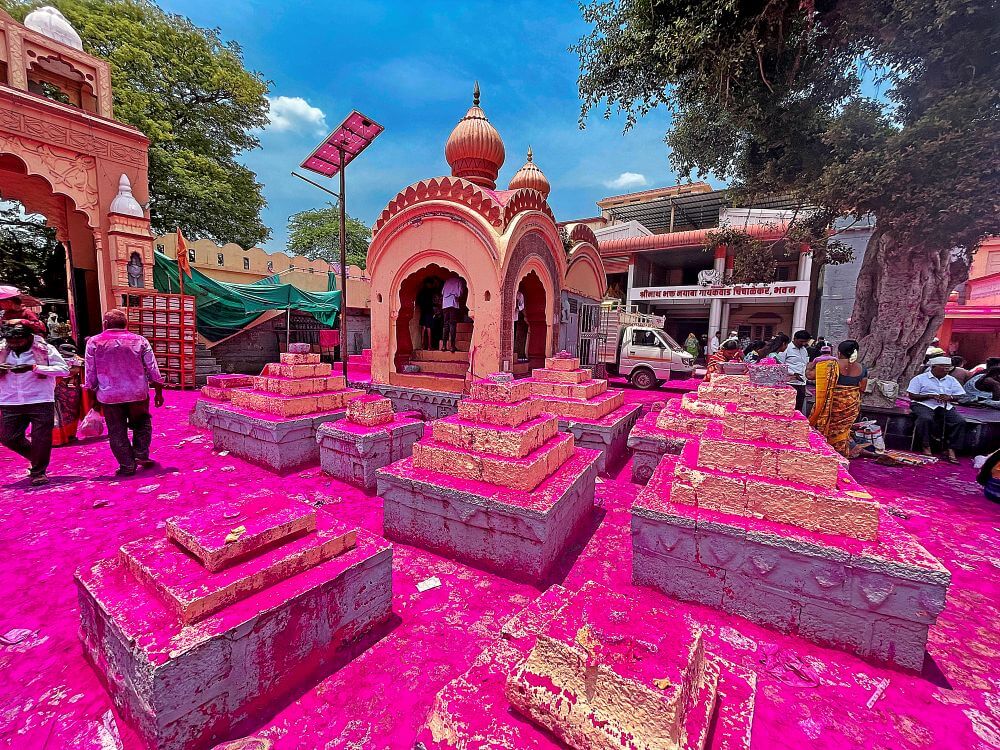
The Siddhanath Temple has a double fortification. The first fortification features a two-storied entrance gate. This entire entrance is adorned with intricate carvings. There is another entrance on the right side within the temple’s fortification. Adjacent to this entrance, on the inside, there is one platform on the right and three platforms on the left. On these stand five-tiered ornate stone lamp towers. The lamp towers are square at the base. The first tier features elephant sculptures and lamp niches. The second tier is hexagonal, while the tier above it They are circular. On the side of the platform, there are some elephant sculptures and a Tulsi Vrindavan. There is a drum in the room near the entrance. Further ahead, in the courtyard paved with paver blocks, there is a Maruti temple on a platform in the center.
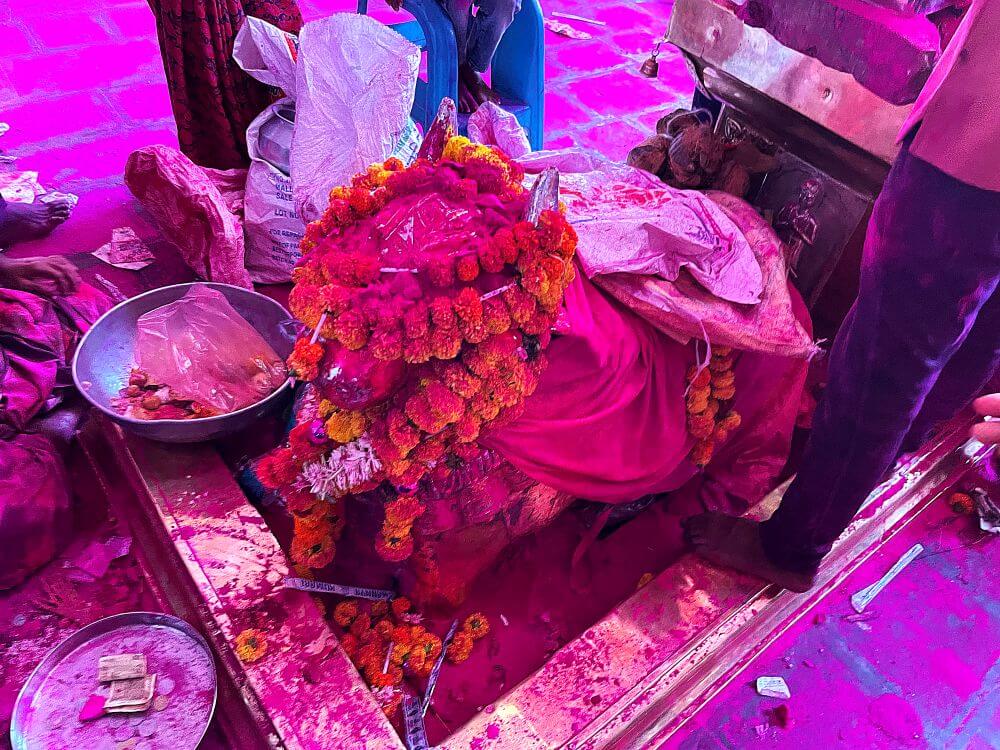
Ahead lies the second fortification of the temple. It features a two-storied entrance gate with a drum house. On both sides of the entrance, there are staff-bearing gatekeepers, and an idol of Lord Ganesha is placed at the lintel. There are guard rooms on both sides inside the entrance. The second floor of the entrance has twelve ornate pillars connected by arched curves, topped with a roof. In the room on the left side, there is an idol of the ‘Kapila’ cow belonging to Nayappa Gawali, a devotee of Siddhanath.
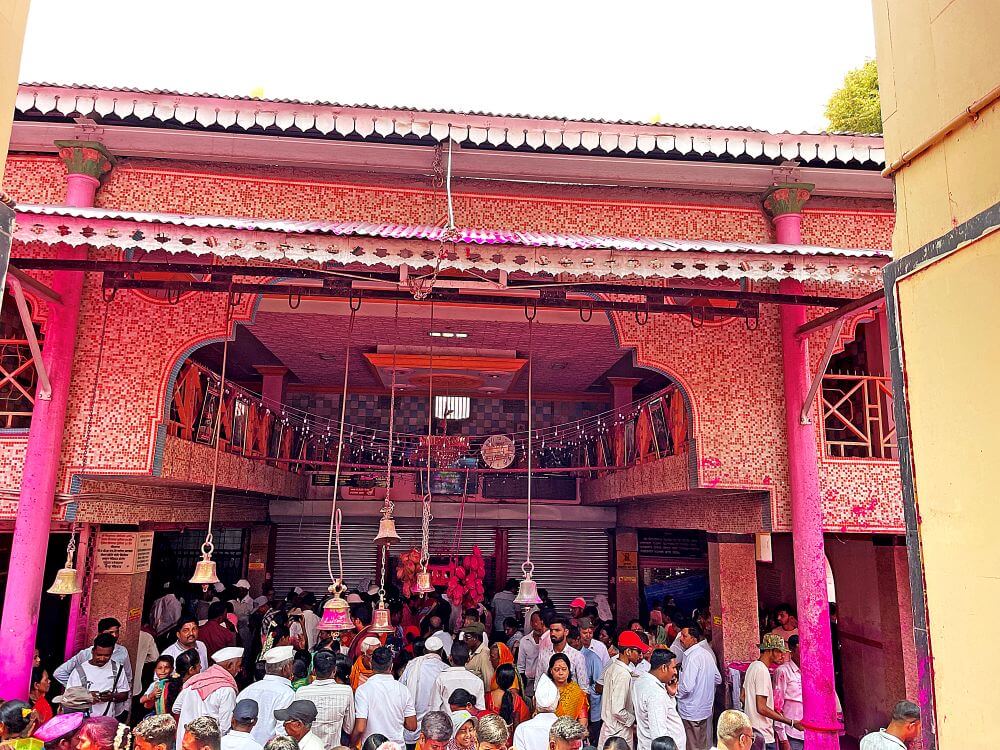
Beyond this point lies the newly constructed two-story, enclosed assembly hall of the temple. Its entrance features an ornate silver arched gateway. The upper-story balcony rests upon six wooden pillars within the assembly hall. The balcony is equipped with a safety railing. Further ahead is the ancient stone structure This is the entrance to the original main hall of the temple. The facade wall and the entrance of this hall are covered with silver plating. The door frames are adorned with floral and leaf carvings, and an image of Lord Ganesha is placed on the lintel. Above the lintel, the archway features a design of five spires.
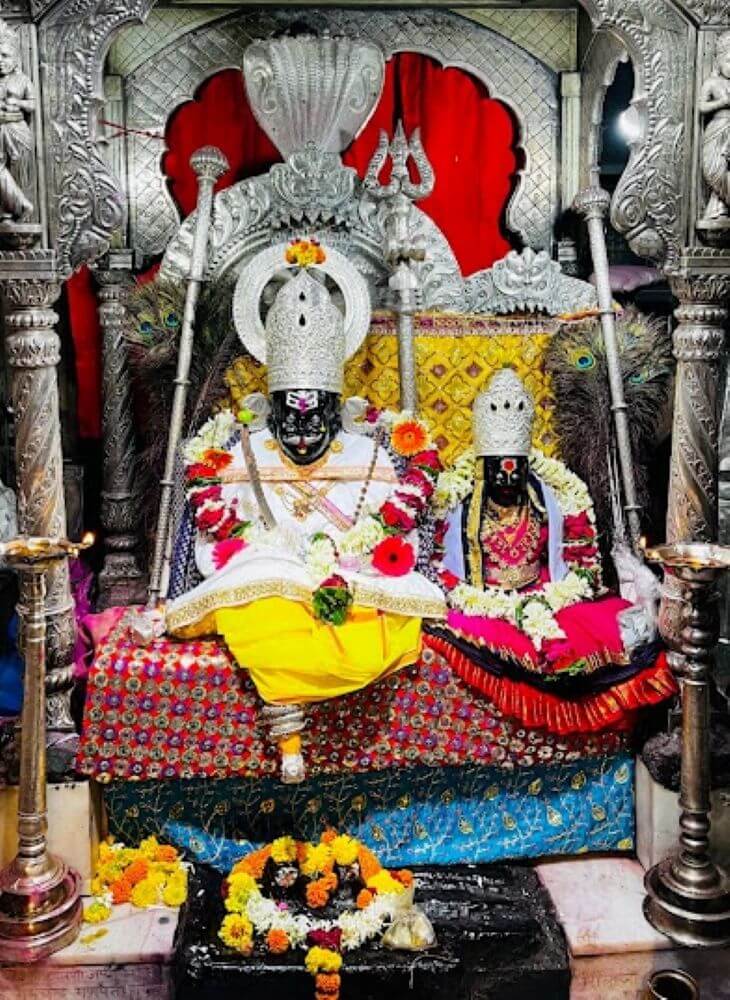
In the assembly hall, there are four rows of five ornate pillars each. The ornate carved pillars in the outer rows are embedded within the walls. These pillars are also covered with silver plating. At the top of the pillars are the capitals and brackets. Beams rest upon the brackets, and the ceiling rests upon the beams. A brass bell is hung from the ceiling. The floor of the assembly hall is paved, and in its center, on a raised platform, stands the idol of Nandi. The ornate entrance to the sanctum sanctorum of the temple is also covered with silver plating. On the door frames of this entrance, there are floral carvings, and on both sides above, there are elephant sculptures. On the lintel is the idol of Lord Ganesha. In the sanctum sanctorum, upon a diamond-studded pedestal, within a silver shrine, are the deities Siddhanath and Yogeshwari Devi. There is a self-manifested stone idol, and in front of it is a Shiva Linga. The shrine is adorned with intricate carvings. On its facade, there are celestial damsels (Sursundaris) on both sides. From Monday to Saturday, the idols are decorated with different ornaments and floral arrangements. Behind the idols, there is a Kirtimukha in the center of a silver halo. A five-hooded serpent holds a canopy over the head of Siddhanath.
There is a parapet on all four sides of the temple roof. Above the roof of the sanctum sanctorum, there is a small dome-shaped spire in the front and a tall, square-shaped spire behind it. On all four sides of the spire, there are niches containing idols of various deities. Above these niches, there are three amalakas arranged in ascending order, topped by a kalasha. The original stone structure of the spire is covered with marble tiles. The tapering spire features a step-like design. At the apex, there is an amalaka adorned with lotus flower carvings, surmounted by a kalasha and a flag. This golden kalasha on the spire was offered by devotees from Nelkaranji, consecrated at the hands of the Shankaracharya of the Karveer Peeth. This Kalasha was consecrated in the year 1979.
On the outer walls of the temple, various animal and human figures are carved. On the two square pillars beside the Gomukh, there are sculptures of the Ashta Bhairavas. In the temple courtyard, there is a Ganesha idol museum housed in a chamber, which contains various small-sized idols of Lord Ganesha. Further ahead is the temple of Malai Devi, the consort of Siddhanath, and their son Agneya. Nearby are the temples of Lakshmi-Narayan, Yamai Devi, Radha-Krishna, Chhota Maruti, Durga Devi, Sati Mata, Dattatreya, and others, along with some Samadhis. In the Navagraha temple located in the courtyard, the idols of the nine planets are placed on a central platform. Rituals such as Navagraha Jananashanti are performed here. There is a basement beneath this temple. In this area, there are also some stone sculptures in a dilapidated state.
Festivals such as Chaitra Padwa, Ram Navami, Akshaya Tritiya, Dussehra, and Navratri are celebrated with great enthusiasm at the temple. On Chaitra Padwa, the temple hosts the reading of the Panchang and the ‘Bhaknuk’, an astrological prediction regarding the year’s weather and crop conditions. On Chaitra Shukla Navami, which is Ram Navami, turmeric and oil are applied to the deity. The wedding ceremony of Siddhanath and Yogeshwari commences on Chaitra Vadya Ashtami. The wedding concludes on Chaitra Vadya Dwadashi, followed by a grand procession of the deity, which includes the temple’s iron Sasan-kathis (ceremonial poles). During this time, the deity’s palanquin is carried in a circumambulation of all the surrounding villages. The birth anniversary of Siddhanath is celebrated here from Kartik Vadya Pratipada to Navami. Thousands of devotees visit to seek the blessings of the deity during all these annual festivals. The number of devotees visiting the temple for daily darshan is also significant. Devotees believe that if one makes a vow while climbing onto the roof of this temple, that wish is fulfilled.
The sanctum sanctorum houses the divine idol consecrated according to ancient Vedic traditions, surrounded by serene courtyards and traditional temple architecture.
Navratri, Maha Shivratri, Annual Temple Jatra & Deepotsav
Compare and book flights, secure top-rated local hotels near the temple, hire reliable guides, and rent cars instantly.
Extend your pilgrimage by visiting other highly sacred temples located nearby.


Add ₹999 more to unlock FREE SHIPPING!
Your sacred cart is currently empty.
Shop Photo FramesFill in your delivery details below to place your order.
Add comment