
Add ₹999 more to unlock FREE SHIPPING!
Your sacred cart is currently empty.
Shop Photo FramesAncient temples are often associated with Paurāṇic tales or legends, which find their roots in references to places or names within ancient scriptures. However, it is the legends passed down through oral tradition that appear to be more widely prevalent among the common folk. In our land, numerous legends are found to be associated with Shiva temples. According to scholars, these legends hold significance not only religiously but also culturally. Such a renowned temple, rich in both legend and historical context, is located in the Bhivghāṭ area of Nelkarañjī village in Āṭpāḍī Taluka. The temple’s linear construction, from base to pinnacle, in the Hemāḍpaṅtī architectural style, is truly distinctive.
It is said that an inscription found here by the Pantapratinidhīs of Auṅdh indicated that this temple was built by the Kalachurī kings in the twelfth century, and they subsequently took it to Auṅdh. The Kalachurī dynasty emerged around five hundred and fifty CE, after the Vākāṭakas. Their progenitor was Kṛṣṇarāja (reign – approximately five hundred and fifty to five hundred and seventy-five CE). His dominion extended over Central India, Gujarāt, Koṅkaṇ, Vidarbha, and also over Western Mahārāṣṭra. The kings of the Kalachurī dynasty were devotees of Lord Shiva. The inscription found here begins with a verse in Saṃskṛta, followed by text in twelfth-century Kannaḍa. This inscription praises Mahādeva. It also mentions that the Kalachurī king Sūryadeva donated lands in Nelkarañjī village to this temple. The inscription further states that Sūryadeva was residing in Maṅgaḷaveḍhā during that period.
According to oral tradition, the Shiva Liṅgam here was established by Bhīma, one of the Pāṇḍuputras, and thus the Deity is known by the name Bhīmāshaṅkar. Maharṣi Vyāsa’s ‘Mahābhārata’ in its Ādiparva narrates the story of the slaying of the Hiḍiṃba demon. Accordingly, after safely escaping from the Lākṣāgṛha in Vāraṇāvata, the Pāṇḍavas were journeying through the janapadas of Matsya, Trigarta, Pañchāla, and Kīchaka towards Ekachakrā Nagari. It was then, in the dense forest along the way, that Bhīma slew the demon Hiḍiṃba. According to the sthāna māhātmya (glory of the place) of the Bhīmāshaṅkar Temple, this event occurred in the Bhivghāṭ area. It is also said that Ghaṭotkacha, the son of Bhīma and Hiḍiṃbā, was born here.
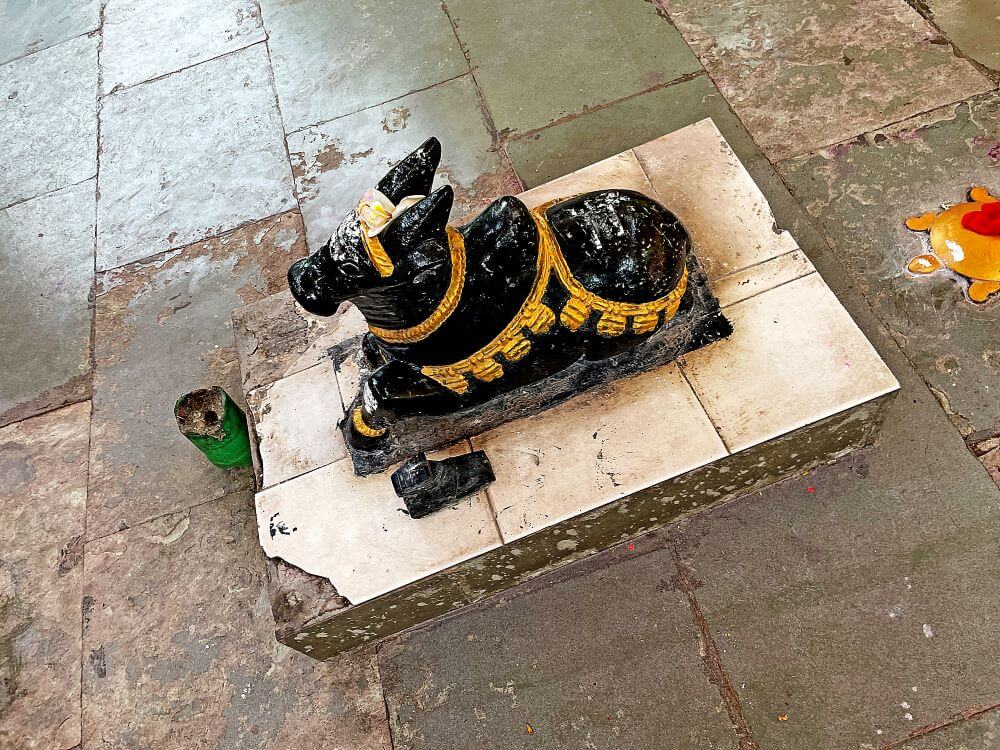
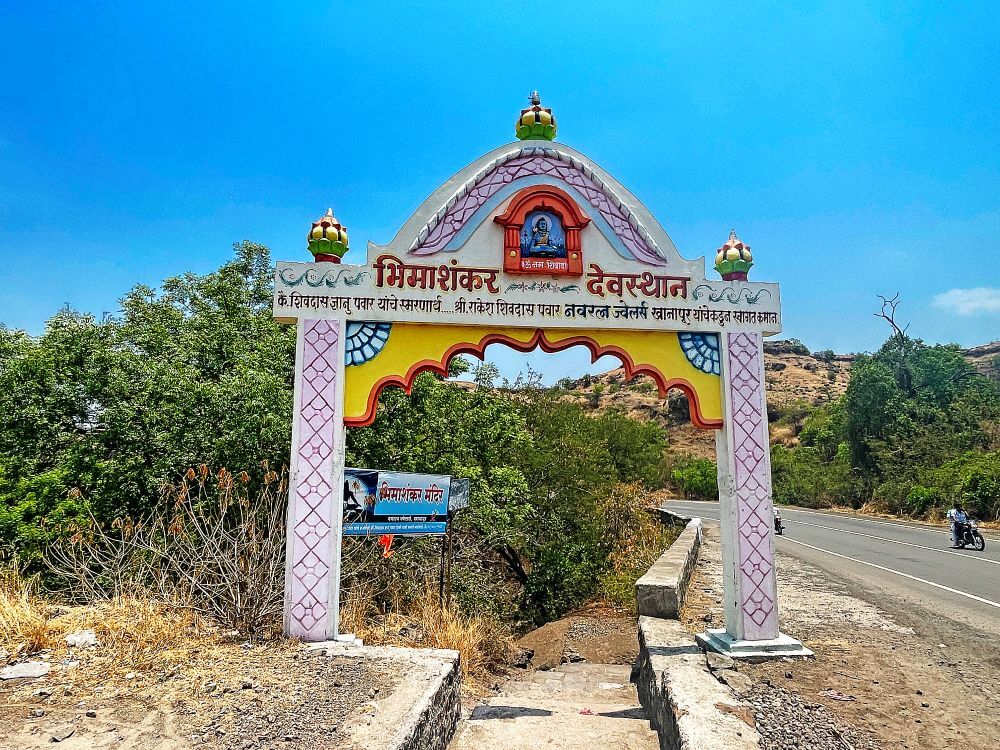
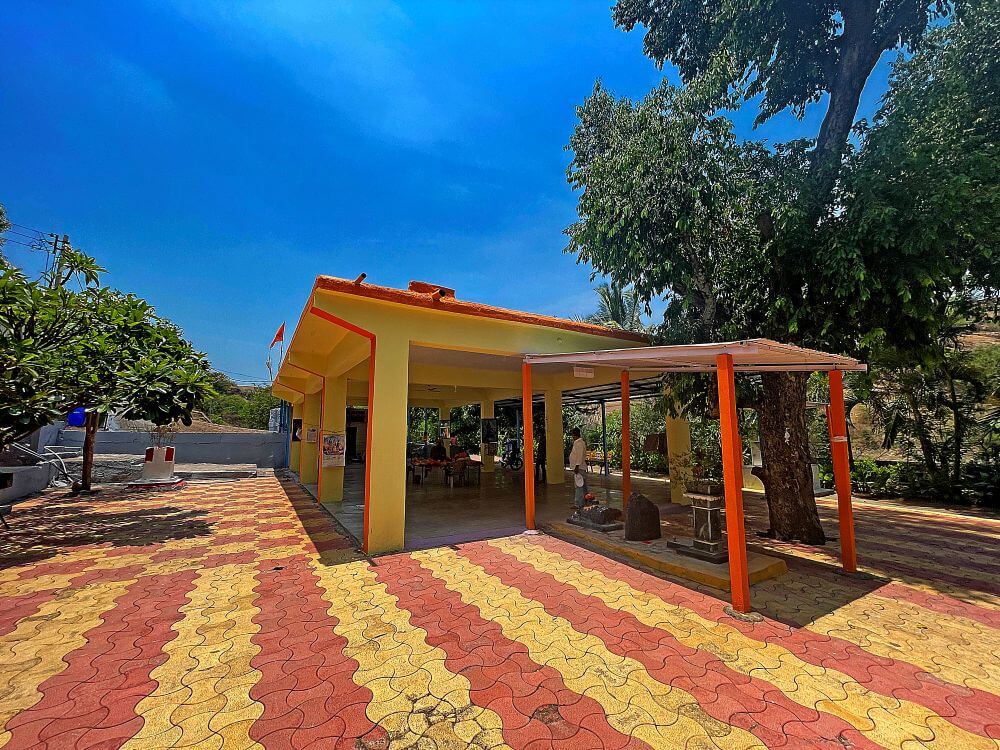
In Bhivghāṭ, on the Karāḍ-Āṭpāḍī road, there is a welcome arch for the temple on the stepped path leading down from the roadside. On both sides of the arch are two square pillars, with āmalakas on both sides of the horizontal beam above them, topped by kalaśas. In the center, within a devakoṣṭhaka adorned with a bāshiṅga (forehead ornament), is a relief sculpture of Mahādeva. From here, one must descend approximately fifty steps to reach the temple. These steps are constructed of dressed stone. Both sides of the stepped path are covered with dense foliage. The temple courtyard, enclosed by a stone compound wall, is paved with paver blocks. Within the courtyard, near the rampart, seating arrangements are provided for devotees. In the open maṇḍapa within the courtyard, on a raised platform, there is a black stone idol of Naṅdī and a Nāgayugala (pair of serpents) sculpture on the slab behind it. Behind the Nāgaśilā (serpent stone) is a Tulasī Vṛndāvana.
The temple’s structure comprises a newly built maṇḍapa, followed by an ancient enclosed sabhāmaṇḍapa, an antarāḷa, and a garbhagṛha. The temple’s maṇḍapa has two rows of four square pillars each. Beams rest on the pillars, and the roof on the beams. In front of the entrance to the sabhāmaṇḍapa, on the ground, is a brass tortoise, and on the platform beyond it, an idol of Naṅdī. On the lalāṭabimba (lintel) above the entrance to the enclosed sabhāmaṇḍapa is an idol of Gaṇeśa. The sabhāmaṇḍapa has four rows of four intricately carved pillars each. The upper part of the square pillar base is shaped in various geometric forms: square, hexagon, octagon, and circle. At the top of the pillars are kaṇīs (corbels) and hastas (brackets). On the right wall of the sabhāmaṇḍapa is an ancient sculpture of Sheṣashāyī Viṣṇu. In this, a five-hooded serpent holds a canopy over Viṣṇu’s head, and one of Viṣṇu’s feet rests on the lap of Lakṣmī, who is seated near his feet. Brahmādeva is depicted within a lotus flower emerging from Viṣṇu’s navel.
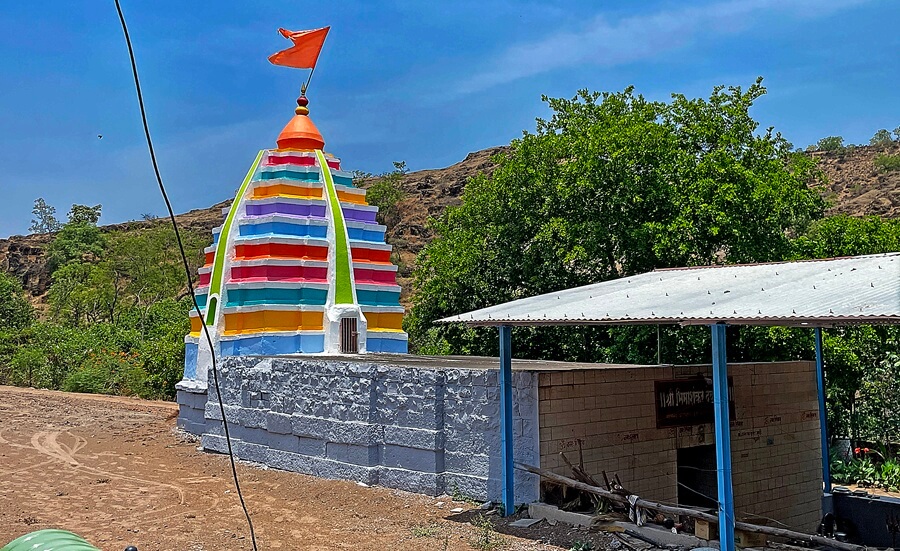
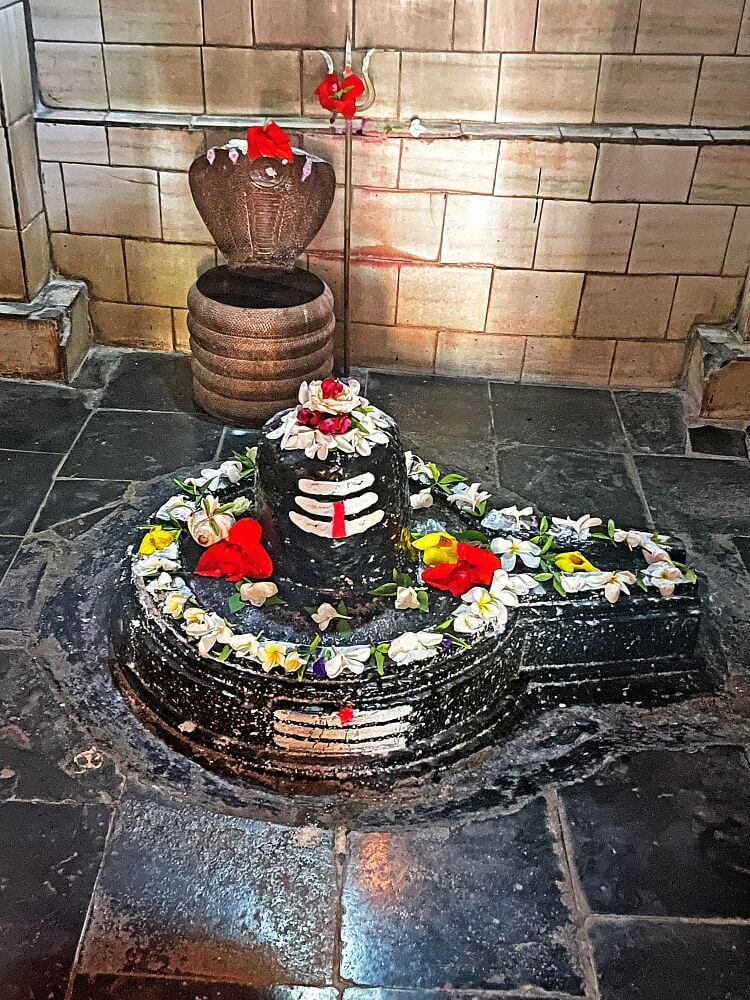
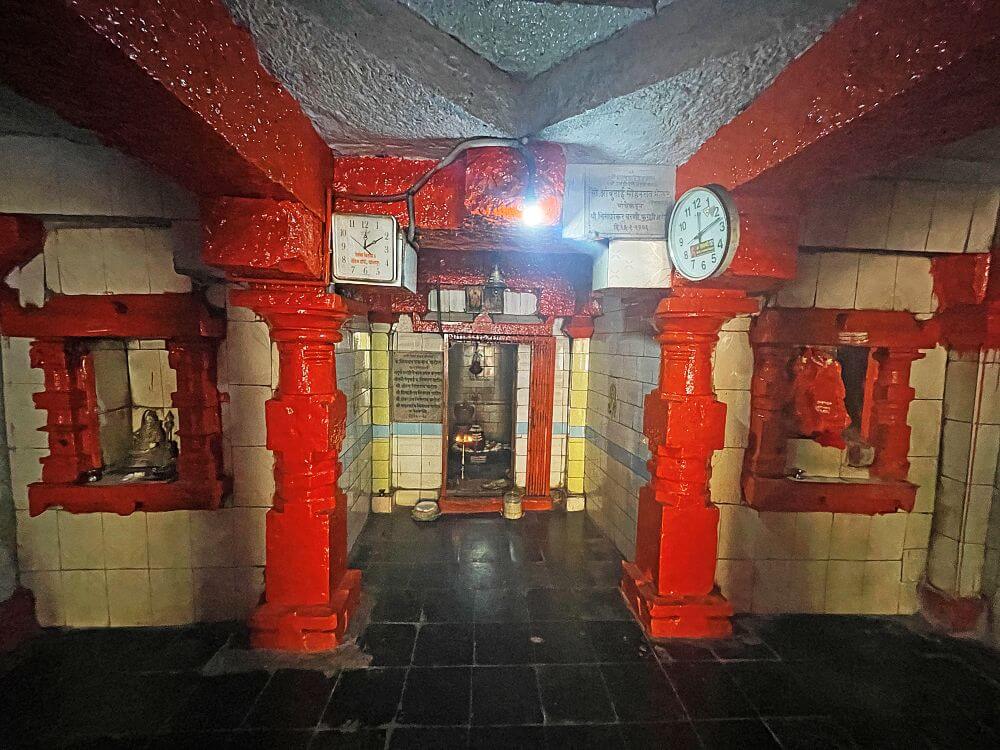
In the sabhāmaṇḍapa, near the antarāḷa, there are two devakoṣṭhakas on the left and right sides. Further ahead is a narrow antarāḷa, and beyond that, the entrance to the garbhagṛha. In the center of the garbhagṛha is a Shiva Liṅgam, with a five-hooded brass serpent holding a canopy over it. On the back wall is a painting of Lakṣmī. The ceiling features a hexagonal dome with circular carvings and a chandelier in the center. The roof of the garbhagṛha has an eleven-tiered square shikhara. Within the shikhara, devakoṣṭhakas are present on all four walls. The upper tier has a circular tapering dome, with an āmalaka on top, crowned by a kalaśa and a dhvajapatākā (flag). The garbhagṛha has a monolithic structure from the ground to the kalaśa. From the entrance on the platform outside the garbhagṛha, one can access a secret chamber within the temple’s shikhara.
Within the temple courtyard is a bhaktanivāsa (devotee accommodation). In front of the temple is a small temple dedicated to Mārutī. This temple has three steps. Inside is an ancient black stone idol of Mārutī. Below the circular shikhara on the roof, there is a replica of a lotus flower, and on the tapering upper part, there is a vertical ridge pattern. At the top are an āmalaka and a kalaśa. In the courtyard, on a marble platform, there are marble shrines with marble idols of Gaṇapati and Dattātreya. Behind the temple is a pond. Mahāshivarātri is the main annual festival celebrated with great enthusiasm at the Bhīmāshaṅkar Temple. On this day, the day begins with Laghurudra and Mahābhiṣeka in the early morning. Throughout the day, programs such as bhajan, kīrtan, music, and jāgaraṇa are organized. During this time, thousands of devotees from across the state come for darshan of the Deity and to fulfill their vows. Every Monday during Shrāvaṇa, there is a large gathering of devotees here. At that time, this area takes on the appearance of a fair.
This sacred temple stands as a testament to deep spiritual devotion, ancient architectural grandeur, and rich local cultural traditions.
The sanctum sanctorum houses the divine idol consecrated according to ancient Vedic traditions, surrounded by serene courtyards and traditional temple architecture.
Navratri, Maha Shivratri, Annual Temple Jatra & Deepotsav
Compare and book flights, secure top-rated local hotels near the temple, hire reliable guides, and rent cars instantly.
Extend your pilgrimage by visiting other highly sacred temples located nearby.


Add ₹999 more to unlock FREE SHIPPING!
Your sacred cart is currently empty.
Shop Photo FramesFill in your delivery details below to place your order.
Add comment